Last I heard (it's been about a year since I looked into numbers), Power/PPC chips appeared to be outselling x86 chips by a substantial margin with the caveat that it's hard to come by numbers from the "smaller" x86 vendors (like Via) that might very well be selling larger numbers than expected of the low end alternatives but at much lower prices and margins and so fly under the radar.
x86 is likely something like the 4th or 5th largest chip architecture by volume shipped today. Last estimate I've seen was in the 360 million range per year, maybe as high as 400 million.
That's after ARM, likely to ship 3 billion this year, MIPS and PPC probably in the 500+ million range each unless there's been massive unexpected changes over the last year.
X86 gets all the attention because it's on desktops and in laptops and because Intel is disproportionally important because their revenue is several times that of any other CPU manufacturer because nobody else ships nearly as many high end chips (e.g this puts Intel at 7 times Qualcomm, at second place, in revenue from CPU/MPU's last year: http://www.xbitlabs.com/news/cpu/display/20130521205843_Inte... )
And for the surprise contender, it is unclear where the 6502 architecture falls: It ships in "hundreds of millions" a year according to Western Design Centre). Note that this might very well largely be in the form of licenses for embedding the cores in custom ASICs or in FPGAs, so whether you'd want to count that is another matter (as an example, some Amiga's had keyboards with an embedded 6502 core + PROM and a tiny amount of RAM). It's possible that some of the other extremely low end 8-bit CPU cores that are still being used as micro-controllers might also ship volumes like that.
I've seen no indication that Sparc is anywhere in the running
I work in automotive software, and PowerPC CPUs (albeit from Freescale and STMicroelectronics, not IBM) are more popular than ever. It's a very common choice for powertrain ECUs.
Power Architecture is used in spacecrafts as well:
The [PowerPC] 603e processors also power all 66 satellites in the Iridium satellite phone fleet. The satellites each contain seven Motorola/Freescale PowerPC 603e processors running at roughly 200 MHz each.[1]
There is a radiation hardened version called "RHPPC" based on PowerPC 603e made by Honeywell & Freescale. RHPPC is equivalent to the commercial PowerPC 603e processor with the minor exceptions of the phase locked loop (PLL) and the processor version register (PVR). [2]
The F-22 uses PowerPC processors in the upgraded Common Integrated Processor(CIP) avionics, partly for compatibility with the F-35 Integrated Core Processor (ICP) avionics.
F/A-18s also use PowerPC processors in the Advanced Mission Computer (AMC) avionics.
General Motors was a big user of Motorola 68k variants. Workstations and personal computers that used the 680x0 series switched to the Power series, maybe the developers just find them easier to migrate to.
The ISA is not better than others in any real way, but IBM put a lot of early work into RAS features for their server chipsets, and this sort of leaked into the automotive and aviation world.
If you want to run 3 cpus lockstep, verifying each other's results, the PPC world already has the infrastructure. This and other similar things make it an easy choice for some applications.
All three of the PS3/XBox360/Wii generation consoles used POWER-derived chips: very different chips, of course, but POWER all the same. The Wii U uses a POWER chip too.
POWER stalled in the performance/watt category around the time of the Power Mac G5: unfortunate, since this was around the time that performance/watt was starting to be considered a real thing. That hurt the architecture's standing terribly. But it's still around.
Intel opened a CPU design facility down the street from Motorola's PowerPC operation and bought away key parts of the team in '98-'99 setting Motorola back enough that they could no longer be ahead in the horse race. (For years, PPC had beaten Intel in some categories when the new PPC architectures came out, then Intel would pull ahead until the next generation. Apple always found something good to put on a Keynote slide. After the brain drain that wasn't going to happen.)
My take is that it's all about the execution of creating a chip. x86 for example is a much worse ISA, but there is some research (no source on this assertion) that says at the end of the day it doesn't matter too much since the machinecode is just translated into some internal RISC code.
So, it isn't that PowerPC is doomed from a technical standpoint. Instead it's all about money, business cycle stuff. Less sales means less R&D. Less R&D means you fall behind of the competition. IBM doesn't really have the heavy hitters they used to in the chip business (Relative to Intel/ARM/TSMC). If you want the newest flashiest tech, you can't really use their fab - that sort of stuff.
Every chip technology node is getting more expensive for foundries, which means the chip market will likely naturally converge to a small number of players.
I think it's truer to say that PowerPC stalled in performance per watt. The high end Power7/Power8 chips are massively powerful but that comes with Power and Cooling requirements that aren't going to work in a laptop.
Kindof true. I'd forgotten how much of a Mhz bump the P6 was -- It came out 12 months after the first intel Mac Pro (and ran at 4.7Ghz at the high end).
The P5 was a contemporary of the G5 (although the G5 was really a P4). But it wasn't quite the beast the P6 was.
And the G5 (the PPC 970 in IBM's nomenclature) was an "ultra-light" POWER4 — the POWER5 was ~30% quicker than the G5. POWER never really fell behind at the high end — there was just no real focus on anything except the high-end.
Some of us had m88k systems (not bad actually) and 88open helped that architecture take over the world. It even merits two whole sentences at wikipedia! http://en.wikipedia.org/wiki/88open
Motorola thought it was going to take over the world. Our company made a desktop environment for Unix so all the vendors would send us their equipment to port to. At one point I counted over 20 different versions of Unix and associated hardware. We even had a Sony Workstation.
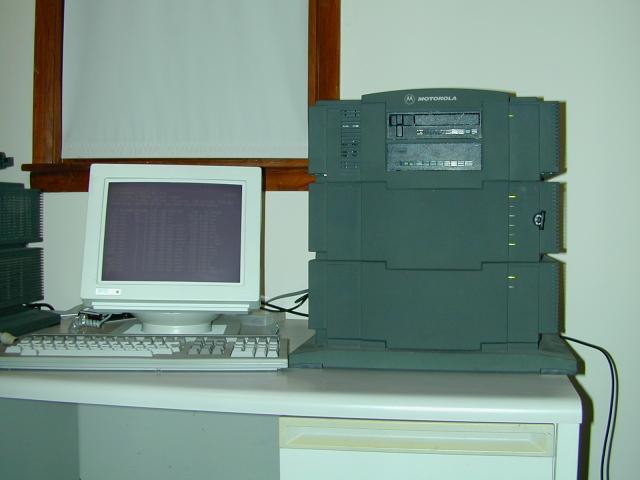
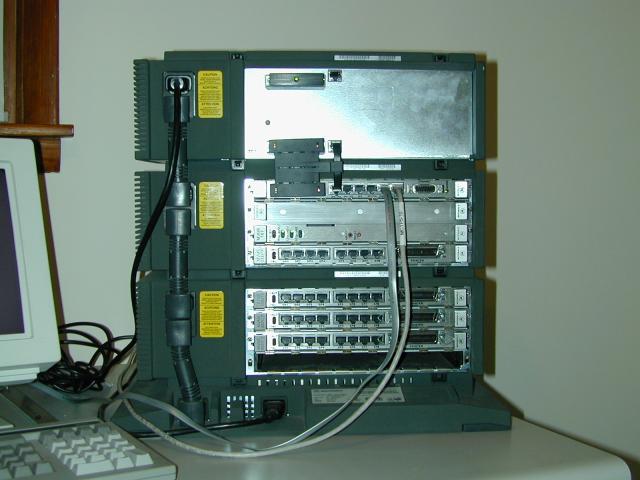
The M88K system had big vertically stackable blocks with ribbon cable connectors at the back between the units for power and data. [1] [2] One unit consisted of a tape drive and a floppy drive. The floppy drive was actually SCSI and very fast (over 100kb/s when most floppy drives top out at 25kb/s). I can't imagine how much that drive must have cost.
The system arrived in a massive box and for some bizarre reason they stuffed the empty space with O'Reilly books. There were lots of "read me first" and "read me first" for the read me firsts. I ignored all of them.
About a year later the machine failed. It turned out there was a filter by one of the fans and one of the readme firsts told you to clean it once a month. Eventually the system had overheated and shut down.
We also had a Data General system that used the m88k. They called it the Aviion which was annoying to read and type. The DG folk we dealt with were by far the nicest out of all the vendors. Both the DG system and the Motorola system ran lightly modified SVR4. It was basically Unix of the time, and worked just fine.
The Motorola system ended up acting as the office server for various things because of its high spec. Hold onto your chair - it was blazingly fast at 40MHz, and had a whopping 64MB of memory. At one point we spent a thousand pounds to get a 1GB hard drive and used it as a Usenet server.
It is the execution that counts. The world could use a third mass architecture. Especially one that is not too tightly IP locked. The whole web 0.1, 1.0,2.0 came from the fact that PC clones were everywhere.
> The whole web 0.1, 1.0,2.0 came from the fact that PC clones were everywhere
I was there and it didn't! TBL did development on Next. There were some text mode browsers that worked on Unix only. The popular graphical browser was Mosaic[1] which started out as Unix/X windows only. It was run on Sun, HP, IBM, SGI etc workstations (32 bit).
At that time popular Windows was still 16 bit. It didn't even include TCP/IP with various third party stacks (for a price) and later a Microsoft stack for Windows 3.11 for Workgroups. Some brave people did start porting Mosaic but it was hard because a completely different GUI API and semantics was needed, as well as dealing with the cramped machines compared to the 32 bit workstations. It was late 1994 before these ports became somewhat usable.
Netscape was formed around then, and the big difference was they made their code portable to multiple guis from the very beginning (a lot easier than retrofitting it). By 1995 every platform had to have TCP/IP and a web browser to be relevant. The web spread because no one was in charge, and everything had to work everywhere on a wide variety of screen sizes, operating systems and user environments.
ie it was the diversity of systems out there that was the cause, not that you could buy the PC architecture from different companies.
It really depends on whether your counting number of chips or dollars in sales. POWER chips sell at a premium inside high end enterprise systems, while MIPS is embedded in lots of places like handheld consoles and routers for more chips sold but for less money.
The high end POWER chips from IBM makes up a miniscule fraction of the overall Power/PPC market in terms of units. PPC sells in comparable unit numbers to MIPS, but mostly from architecture licensees like Freescale.
Cheap IBM PC clones make possible having a lot more computing devices in every home, which allowed the dot com boom in the late 90's.
The clones were possible because IBM due to various business, legal and other stuff could not stamp them down. So we got to the point where computing penetration was fast and high enough for the whole net thing to make sense.
I just hope people realize that the Internet was the most compelling and most popular way to "get online" even before there were significant numbers of PC clones on the Internet.
Specifically, although it was technically possible to give a Windows machine a direct TCP/IP connection to the Internet, if you were using a PC clone to access the internet before July 1993, you were probably using the PC clone to run a terminal-emulation program (e.g., Kermit) to log in to a Unix shell account.
(I chose July 1993 as the date by the way because that was the month in which the New Yorker ran the cartoon, "On the Internet, nobody knows you're a dog," which was the first reference to the Internet in a mainstream publication that seemed to arouse the interest or the curiosity of large numbers of readers.)
Actually, the most popular way for ordinary (non-academic) users to get online was through services such as CompuServe, AOL and Prodigy. The web thing and Windows really took off after the widely-publicized launch of Windows 95, which came shortly after the widely-publicized Netscape IPO.
Besides the fact that PowerPC is still very common in embedded systems (and provided the CPU in all three of the last generation of game consoles), POWER != PowerPC. IBM Watson was a POWER7 system, as are a bunch of the top 500 supercomputers and many many large business big iron servers running AIX.
It's completely dominant in the console market. That is going to change with the new generation though but if you go buy a console today, you're buying and IBM PowerPC.
That's PowerPC-based chips, not actual off-the-shelf PowerPC CPUs. Big difference.
Also, the main thing with the PS3 was the Cell architecture which was going to appear in every type of device from TVs to mainframes and make the rest of the processor industry obsolete.
ARM chips outsell x86 chips by at least a factor of two, and I'm pretty sure more than that. For each Intel desktop/laptop there are twenty ARM chips in microwaves, cars and airplanes.
In the beginning it had a lot to do with toolchain support, these days I think it's a combination of force of habit and the fact that you can fry an egg on an x86 floating point unit.
From what I know of the space, ARM is not used very much at all in cars or aviation. These are both areas where PowerPC dominates. I'd guess most modern cars have at least a dozen PowerPC chips.
And both ARM and PowerPC outsel x86 by a hell of a lot more than a factor of 2. It's at least a factor of 10, and that's almost certainly low too. x86, in terms of units sold, is an extremely small market.
Not so much in cars and airplanes, but somewhat ironically, a typical x86 pc has many more ARM cores than it has x86 cores. My hard drive has 3 arm cores, my ssd has 2, my sound chip has one, my network chip has one...
x86 is likely something like the 4th or 5th largest chip architecture by volume shipped today. Last estimate I've seen was in the 360 million range per year, maybe as high as 400 million.
That's after ARM, likely to ship 3 billion this year, MIPS and PPC probably in the 500+ million range each unless there's been massive unexpected changes over the last year.
X86 gets all the attention because it's on desktops and in laptops and because Intel is disproportionally important because their revenue is several times that of any other CPU manufacturer because nobody else ships nearly as many high end chips (e.g this puts Intel at 7 times Qualcomm, at second place, in revenue from CPU/MPU's last year: http://www.xbitlabs.com/news/cpu/display/20130521205843_Inte... )
And for the surprise contender, it is unclear where the 6502 architecture falls: It ships in "hundreds of millions" a year according to Western Design Centre). Note that this might very well largely be in the form of licenses for embedding the cores in custom ASICs or in FPGAs, so whether you'd want to count that is another matter (as an example, some Amiga's had keyboards with an embedded 6502 core + PROM and a tiny amount of RAM). It's possible that some of the other extremely low end 8-bit CPU cores that are still being used as micro-controllers might also ship volumes like that.
I've seen no indication that Sparc is anywhere in the running