Some of us had m88k systems (not bad actually) and 88open helped that architecture take over the world. It even merits two whole sentences at wikipedia! http://en.wikipedia.org/wiki/88open
Motorola thought it was going to take over the world. Our company made a desktop environment for Unix so all the vendors would send us their equipment to port to. At one point I counted over 20 different versions of Unix and associated hardware. We even had a Sony Workstation.
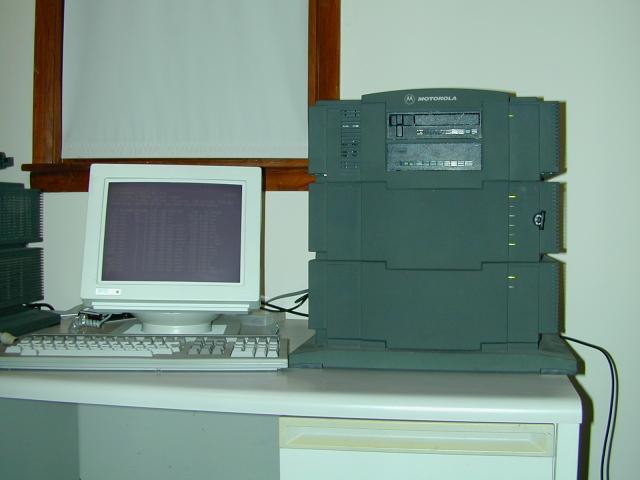
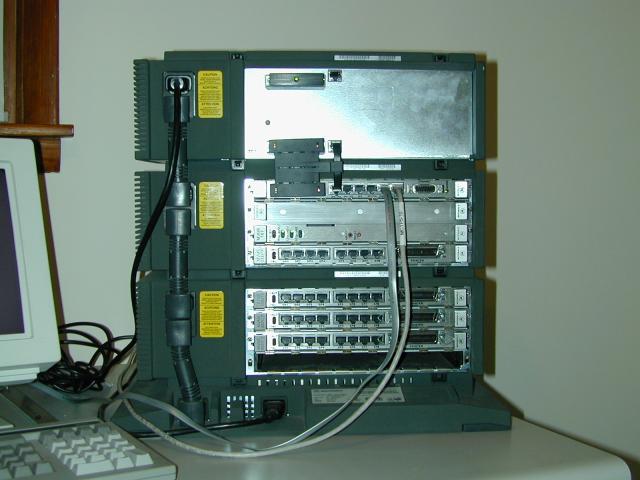
The M88K system had big vertically stackable blocks with ribbon cable connectors at the back between the units for power and data. [1] [2] One unit consisted of a tape drive and a floppy drive. The floppy drive was actually SCSI and very fast (over 100kb/s when most floppy drives top out at 25kb/s). I can't imagine how much that drive must have cost.
The system arrived in a massive box and for some bizarre reason they stuffed the empty space with O'Reilly books. There were lots of "read me first" and "read me first" for the read me firsts. I ignored all of them.
About a year later the machine failed. It turned out there was a filter by one of the fans and one of the readme firsts told you to clean it once a month. Eventually the system had overheated and shut down.
We also had a Data General system that used the m88k. They called it the Aviion which was annoying to read and type. The DG folk we dealt with were by far the nicest out of all the vendors. Both the DG system and the Motorola system ran lightly modified SVR4. It was basically Unix of the time, and worked just fine.
The Motorola system ended up acting as the office server for various things because of its high spec. Hold onto your chair - it was blazingly fast at 40MHz, and had a whopping 64MB of memory. At one point we spent a thousand pounds to get a 1GB hard drive and used it as a Usenet server.
It is the execution that counts. The world could use a third mass architecture. Especially one that is not too tightly IP locked. The whole web 0.1, 1.0,2.0 came from the fact that PC clones were everywhere.
> The whole web 0.1, 1.0,2.0 came from the fact that PC clones were everywhere
I was there and it didn't! TBL did development on Next. There were some text mode browsers that worked on Unix only. The popular graphical browser was Mosaic[1] which started out as Unix/X windows only. It was run on Sun, HP, IBM, SGI etc workstations (32 bit).
At that time popular Windows was still 16 bit. It didn't even include TCP/IP with various third party stacks (for a price) and later a Microsoft stack for Windows 3.11 for Workgroups. Some brave people did start porting Mosaic but it was hard because a completely different GUI API and semantics was needed, as well as dealing with the cramped machines compared to the 32 bit workstations. It was late 1994 before these ports became somewhat usable.
Netscape was formed around then, and the big difference was they made their code portable to multiple guis from the very beginning (a lot easier than retrofitting it). By 1995 every platform had to have TCP/IP and a web browser to be relevant. The web spread because no one was in charge, and everything had to work everywhere on a wide variety of screen sizes, operating systems and user environments.
ie it was the diversity of systems out there that was the cause, not that you could buy the PC architecture from different companies.
It really depends on whether your counting number of chips or dollars in sales. POWER chips sell at a premium inside high end enterprise systems, while MIPS is embedded in lots of places like handheld consoles and routers for more chips sold but for less money.
The high end POWER chips from IBM makes up a miniscule fraction of the overall Power/PPC market in terms of units. PPC sells in comparable unit numbers to MIPS, but mostly from architecture licensees like Freescale.
Cheap IBM PC clones make possible having a lot more computing devices in every home, which allowed the dot com boom in the late 90's.
The clones were possible because IBM due to various business, legal and other stuff could not stamp them down. So we got to the point where computing penetration was fast and high enough for the whole net thing to make sense.
I just hope people realize that the Internet was the most compelling and most popular way to "get online" even before there were significant numbers of PC clones on the Internet.
Specifically, although it was technically possible to give a Windows machine a direct TCP/IP connection to the Internet, if you were using a PC clone to access the internet before July 1993, you were probably using the PC clone to run a terminal-emulation program (e.g., Kermit) to log in to a Unix shell account.
(I chose July 1993 as the date by the way because that was the month in which the New Yorker ran the cartoon, "On the Internet, nobody knows you're a dog," which was the first reference to the Internet in a mainstream publication that seemed to arouse the interest or the curiosity of large numbers of readers.)
Actually, the most popular way for ordinary (non-academic) users to get online was through services such as CompuServe, AOL and Prodigy. The web thing and Windows really took off after the widely-publicized launch of Windows 95, which came shortly after the widely-publicized Netscape IPO.
The Internet had more non-academic users in July 1993 than CompuServe, AOL or Prodigy. Most of those non-academic users connected "through work" (either at work or by dialing in to a pool of modems maintained by their employer).
If you remove people who connected through work from the definition of ordinary users, then AOL or Compuserve might have had more ordinary users than the Internet, but not vastly more. There were at least a dozen ISPs offering shell-account-style access to the internet in July 1993, Netcom, Best, Panix and The World being big US-based ones.