Hacker News new | ask | show | jobs
by chirau 17 days ago
That would be quite a play. Stripe, PayPal, Venmo, Braintree, Xoom all under one umbrella. The Herfindahl-Hirschman Index (HHI) for online card-not-present (CNP) checkout on that is going to be absurdly high and this will take a lot of convincing to beat antitrust. They will probably have to unwind Venmo and Braintree.
7 comments

The Herfindahl-Hirschman Index is a measure of the concentration of a market based on the market-share of the firms participating in it. Very much like the Simpson's index that tells you the probability of two organisms in a place being of the same type when randomly drawn.

It's just \sum_i^n h_{i}^2 sum of squares of market-share.

Enjoyed that. Thanks for the discovery.

Why does the `i` after `h_` need a curly but not after `\sum_`?

A pity that HN can't render TeX or MathJax or whatever.

It doesn't. The rule for TeX is that single-character tokens don't need braces. I assume this is just an artefact of their particular muscle memory.

You can test it here, if you like: https://www.mathjax.org/#demo

HHI and Simpsons are neat new finds.

There's also this other variant of the Simpson's Index: https://www.thesimpsonsindex.com/

Payment processor margins are already very high, especially considering they are basically low-tech utilities.

If the US had functioning antitrust laws it would be looking at their margins and be considering whether to break up some of the existing players, not considering when allow even more mergers.

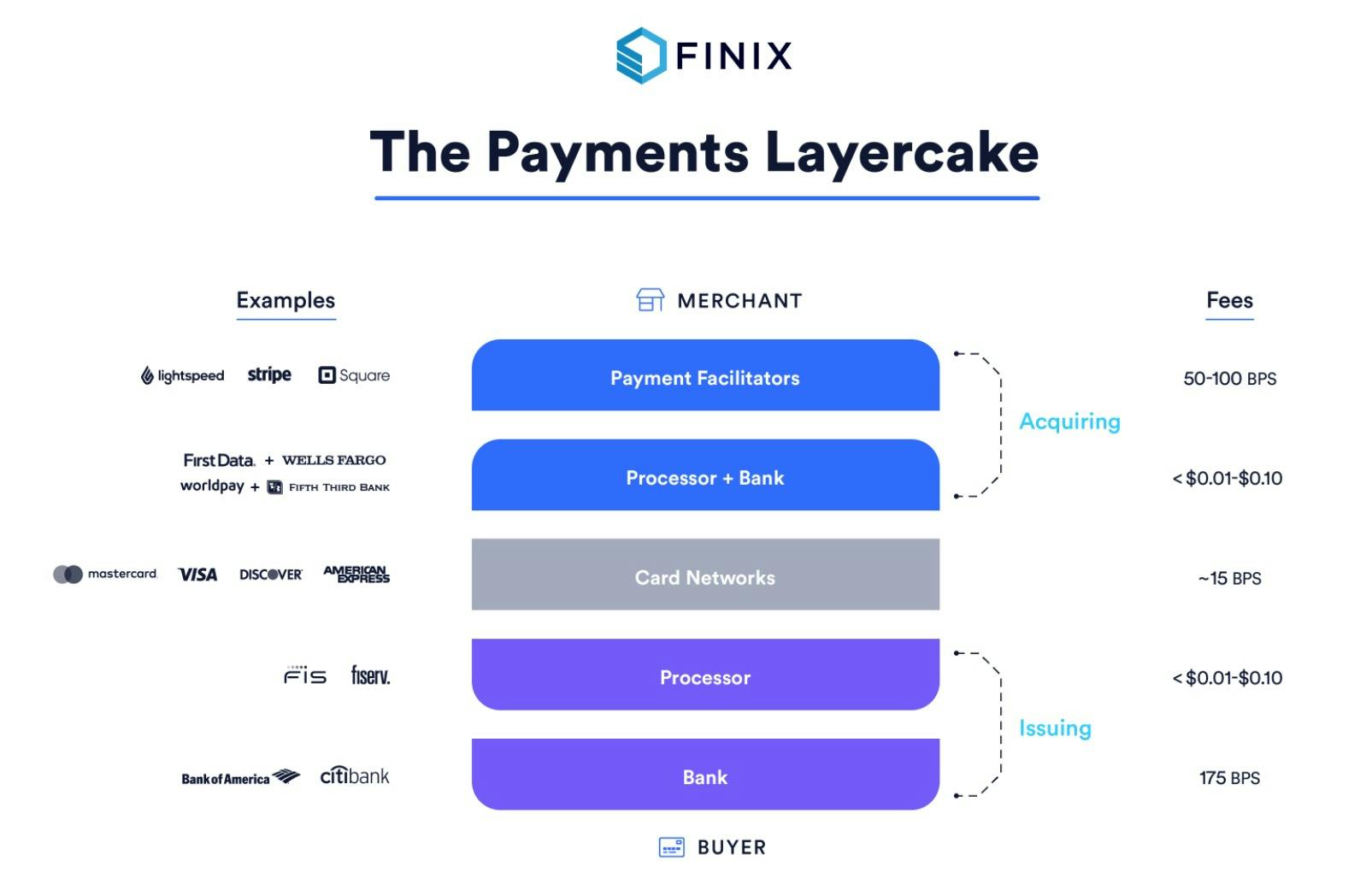
If it's a card-not-present transaction, Visa or MasterCard is making the bulk of the commission and forcing the vendor to take on the risk of a transaction without a PIN or password.

At least the others offer the hope that maybe some customers will pay directly from a Stripe/PayPal account, without the high commission and high risk of a Visa/MasterCard network transaction.

> Visa or MasterCard is making the bulk of the commission

They are not. Payment facilitators (like Stripe) are.

https://images.prismic.io/sacra/30d7bd58-8149-461e-a3c2-8a4a...

>If it's a card-not-present transaction, Visa or MasterCard is making the bulk of the commission and forcing the vendor to take on the risk of a transaction without a PIN or password.

3DS2 is the solution to that problem.

3-D Secure has been a fiasco IMO.

I can recall when we first tried 3DS in the US and it went over like a lead balloon. Let's jump out of the middle of checkout and go to a page which looks like they're trying to phish your bank account to continue, and by the way, you can just skip it. So customers did, and then merchants followed, except in countries that effectively required it because they cared about fraud.

One of the major selling points of 3DS2 was basically "we can guesstimate fraud with magic black-box logic behind the scenes so most of the time the customer is not disrupted."

But it's still lipstick on a pig because there are plenty of outs where you don't strictly need 3DS even in "countries that required it", and it's still window dressing around the idea that we're giving merchants an unscoped credential and hoping desperately it doesn't get misused or stolen elsewhere.

When we finally decide we don't want to get lapped by India and Brazil in payment tech anymore, I hope the camel-designed-by-committee it spawns is a push-only paradigm. If I want to buy something, let Newegg render a HTML microformat that browsers can detect and turn into a big clicky link to my bank's website/app with a pre-configured outbound transaction. Just as easy for the customer as a stored card, with less risk of abuse/compromise.

> 3-D Secure has been a fiasco IMO.

> I can recall when we first tried 3DS in the US

Exactly, it has been a fiasco in the US, but it's working quite well in Europe.

> When we finally decide we don't want to get lapped by India and Brazil in payment tech

They are indeed ahead, but they still work based on some kind of user authentication that's not a plaintext credit card number. That's the same disruption as 3DS, except normalized and a better executed.

> Let's jump out of the middle of checkout and go to a page which looks like they're trying to phish your bank account to continue, and by the way, you can just skip it.

Any idea why they implemented it like that?

In the UK you either get a text from your bank with transaction details and a code to approve it. Or the better ones you just open their app and tap approve.

> Any idea why they implemented it like that?

3D-Secure long predates apps, including in the UK. I had to work on a Government Gateway integration for local council payments in the mid 2000s that included 3D-Secure. I still see it today, although it normally now results in a ping to an app approval.

It's also stupid because most people already have a bank app as 2FA so they could just make approve payments there. And this functionality exists or at least existed but I can count the number of times I have seen it on one hand. Instead my bank went back to randomly denying transactions based on questionable heuristics.
In my experience that's how 3DS actually works though, you have 8 minutes to approve the transaction in your bank app and your bank app usually has it's own security to actually access it to accept the transaction
that's how it works in my country, though there are no denies, almost 90% of transactions over 20-30$ will require I go into my bank app and confirm it.

rarely a big transaction will go through without 2FA but I've never had a transaction declined outright without first asking me to 2FA from the bank app

> Let's jump out of the middle of checkout and go to a page which looks like they're trying to phish your bank account to continue

Except that your bank has just sent you an SMS OTP with the details of the transaction, or has sent you a push notification via their app for you to confirm that it's you.

Nowhere do we enter credentials of any sort on the 3DS2 interstitial page.

Not true. Visa and Mastercard don't make the bulk of the commission. When a merchant pays a standard 2.9% + $0.30 fee on a credit card transaction the issuing bank gets roughly 1.5-2.5% for interchange, which is the bulk. The processor or acquirer gets anywhere from 0.2-0.5% and the card network gets only about 0.1-0.15.

Also, PayPal does not lower a vendor's commission. If they pay with a PayPal cash balance, PayPal still charges the merchant a premium flat rate (often 3.49%) and simply pockets the entire spread. They don't pass the savings down. And consumer's don't have a Stripe account to pay from, Stripe is probably aiming for PayPal wallets via this move.

Upvote because AFAIK this is true. Not sure why your comment was downvoted to dead just a few minutes ago.
Convince who? There is no such thing as antitrust anymore in the USA, it’s merely the size of the bribe required to let the merger go through now
States have the ability to sue to block mergers as well as the federal government. See the recent 11 state lawsuit seeking to block the WarnerMount merger.
Just a couple of months ago, someone was still suing[1] to block Alaska Air/Hawaiian. This is a merger that already entirely went through. I would predict equal likelihood of some state lawsuit derailing a merger like this.

[1] https://viewfromthewing.com/passengers-demand-court-undo-ala...

There's a pretty clear difference between a lawsuit by 8 individuals, vs one filed by attorneys general representing a combined ~100m people.
Nevertheless, I have very little faith in states somehow blocking big mergers. Can you cite an example where this has happened? We've had basically every airline, several supermarket chains, and every major media company go through 1-2 rounds of megamergers. Which, specifically, have been successfully blocked by states?
In 2017, Valero tried to acquire some energy infrastructure owned by Plains All American. The FTC cleared it but California's AG filed to block the deal, which was ultimately abandoned before the trial could begin.

https://www.hklaw.com/en/insights/publications/2017/10/futur...

Washington state was key to blocking Kroger-Albertsons.
Considering that California is one of the states and it’s Warner Brothers and Paramount, both entertainment companies based in California, the bark has a lot of bite.
Which is funny because regardless of whether or not those states succeed in blocking the merger, those legacy video entertainment businesses will become irrelevant whether they are one business or two, due to the fierce competition from TikTok/Instagram/Reddit/Youtube/Whatsapp/computers/anything on the internet in general.

It's probably the most inconsequential merger, from a consumer standpoint.

Anything can be a monopoly or not, depending on how you define the market.
But not anything is worth litigating. The kids with a lemonade stand on the corner in my neighborhood have a monopoly on that corner.

Video media sellers are dime a dozen these days, and the barrier to entry for selling video media is basically none. Warner brothers and paramount are nowhere near the only business to buy and watch media, and it affects almost no buyers negatively if they merge.

Sure they have ability, they are just not doing it often enough
If it isn’t red states the current admin won’t care at all. If it’s mostly or entirely blue states, they’ll just default to siding with the merger out of spite.
You think they'd only have to go through antitrust in the US? These are global payment processors, and the EU loves getting involved in this kind of thing. And no they can't just ignore it if they want to keep the majority of their customers.
How is Spirit airlines doing with your witty remark?
Maybe their bribe wasn’t big enough?
Quite true. Or honestly, it's really barely about direct financial bribery anymore[1] - all the recent ones have just hinged on incredibly naïve (and easily manipulable) readings of how a merger might affect culture war / red vs blue partisanship.

For instance, CNN really doesn't matter, and was a tiny part of WB/Discovery, but of course Trump cares deeply about (hating) CNN, so all that was needed to win over Trump and guarantee his approval was for the acquirer to whisper to him that they'd do a housecleaning there. This lifehack would work for acquiring any company that happens to control any media property that hasn't established itself as a Trump cheerleader.

Note: I'm not even a Democrat today, but the pure and petty corruption on display definitely sickens me.

[1] though, back when it was, the bribes were astoundingly high ROI due to how cheap they were!

Do you have any evidence that you can just bribe your way past antitrust regulations (which are enforced by hundreds or maybe even thousands of attorneys across the political spectrum) or is this just how you feel because you don't like who is in the White House right now?
Not anti-trust, but you can apparently bribe the FCC to get a merger through. This just came out today.

https://www.propublica.org/article/paramount-mergers-fcc-ken...

> Do you have any evidence that you can just bribe your way past antitrust regulations

Well... we certainly know that preemptive appeasement is a thing [1]. IMHO, this is equivalent to a bribe - a favor, just not in monetary form.

[1] https://www.theguardian.com/media/2025/sep/26/kimmel-controv...

I was curious so to get a very rough ballpark figure. So I went to the Wikipedia List of largest mergers and acquisitions article (https://en.wikipedia.org/wiki/List_of_largest_mergers_and_ac...)

Added up all the free market enterprise section completed deals where the purchaser was indicated as US based

Obama era:

2009: 6,

2010: 1,

2011: 4,

2012: 1,

2013: 4,

2014: 5,

2015: 7,

2016: 6

Trump term 1:

2017: 4,

2018: 8,

2019: 13,

2020: 7

Biden term:

2021: 4,

2022: 4,

2023: 7,

2024: 4

Trump term 2 so far:

2025: 11*,

2026: 9*

Obama average: 4.25 / year

Biden average: 4.75 / year

Trump term 1 average: 8 / year

*Most of the last two years are indicated as still pending, so not sure if they will go through or not.

Not exactly the most scientific data gathering or study. But it does suggest that large mergers and acquisitions have generally been made more frequently under Trump.

"More business happens under comparatively pro-business Administration" is certainly a revelation.

I don't mean to be snarky but "I counted things on Wikipedia" is not exactly slam dunk proof when the GP was all but saying Trump is selling antitrust immunity on the open market.

It was still non-zero amount of evidence and that’s exactly what was being asked for.
Evidence of a process being used is not evidence of bribes in a process.

A thing happens in every administration regime where once it becomes clear that X is acceptable (e.g. renewables projects, LBOs, nuclear, oil drilling, etc), there will be a lot of submissions to do X without any bribes at all.

It’s honestly a howler to imply that this isn’t a deeply corrupt regime that’s openly doing crimes. The burden of proof is frankly on the argument to the contrary at this point.

The president is making a genuine, serious attempt to install his personal attorney to the office of Attorney General and he has a good chance of succeeding. This country is cooked.

Do you have data from 2000 to 2004? Not only covering an earlier Republican administration it also captures the last tech bubble.
I would say “don’t like who is in the White House” is really underselling the situation.

The high level of financial corruption of the current administration is very well documented.

Let’s not forget that the president is a convicted felon, and his felonies were all financial crimes.

Seeing as payment processing is already a highly regulated industry, I hope that the anti-trust issue is simply ignored, as a consumer. I don't really want to maintain six different payment processor accounts, or have thoughts about which payment processor I prefer. I just want there to be one that everyone uses and that doesn't get in the way. Some countries have a single government-controlled online payment processor, and that seems to work. The ideal American way might be to have a single technically-private-sector highly-regulated one.
In the US that would just mean you'd get to enjoy absurdly high fees.
With all these new banking methods, also "Hero" more recently, I really don't know where this new "Numerical Euro" stuff from the ECB is going
Gosh, with such efficiency of operations consumers will win because pricing of their services will be more efficient! Todays Feds will try selling that story.