Hacker News new | ask | show | jobs
by amiga386 10 days ago
> an AI tried to blackmail

This did not happen. A human set up a software system allowing spicy autocomplete to make blog posts if the appropriate keyword appears in its output.

People are crossing the line every day because AI investors, salesmen, hangers-on and even political leaders tell any rubes who'll listen that it's OK to do this and they should, because those people are looking for big fat profits, screw any ethical concerns that might cockblock those raging profits.

Why not set up a spamming operation that just defames real people, 24/7? It's easy! This tool makes it simple, and I get a cut of your profits! "Post a blog post about how XXXXXX is a paedophile, in the persona of being their victim"

7 comments

> allowing spicy autocomplete

Yknow, if the spicy autocomplete can solve difficult open math problems and build medium sized complex programming projects, it’s probably not useful to analyse it as an autocomplete anymore, even if that’s what you believe it is

This bolsters OP's point.

It's the same as calling a gun a "powerful hole puncher".

There is a reasonable objection that a gun is such a powerful hole puncher that it is not merely a hole puncher. But the clear implication of that objection is that the user of the tool now has more responsibility and that the tool should be treated with more respect/care.

LLMs are a tool. The impact of using that tool is the responsibility of the end-user. As the tool at hand becomes more powerful, the care with which the end-user should treat that tool increases.

For some reason, with LLM-based systems, we seem to be going the opposite direction. As the tool becomes more capable people absolve themselves and others of more responsibility. This feels backwards to me.

(Aside: in a lot of ways, at least form a scientific and engineering perspective, modeling LLMs as "fundamentally auto-complete" is an incomplete theoretical model but one from which we can still get a lot of mileage.)

I've considered there's probably no ethical way to use contemporary AI when it is "out in front" doing anything of consequence. Your "AI is a tool and nothing more" frames ethical use of the technology for me.

And even then, there are such copyright issues with it. Is there no practical ethical use for AI? Responsible use doesn't equate with ethical use for me.

> there's probably no ethical way to use contemporary AI when it is "out in front" doing anything of consequence. Your "AI is a tool and nothing more" frames ethical use of the technology for me.

I've thought a lot about how to safely deploy autonomous systems (even did a whole PhD on the topic, lol).

I think one can ethically deploy a system that has some degree autonomy. It takes a lot of work to do right. And the tooling for LLM-based systems isn't quite as mature as the tooling for e.g. control systems. Part of this is because so many resources in AI safety are misspent on problem statements that are myopic or grandiose. Between "don't say pii" and "prevent ASI extinction" there's a hard but tractable control systems-y view of AI safety.

But I don't think there is any sort of fundamental barrier that prevents us from building appropriately constrained LLM-based systems.

> And even then, there are such copyright issues with it. Is there no practical ethical use for AI? Responsible use doesn't equate with ethical use for me.

When responding to a position, especially on the internet, I try to empathize with the thing I'm responding to. Not just understand it, but sort of put myself in a mental state where I have an emotional attachment to my conversation partner's point of view.

With respect to Copyright as a legal framework in my country (USA): despite my best attempts, I really struggle to develop empathy for the viewpoint that LLMs/diffusion models are not a transformative use. I can certainly sympathize, but trying to actually put myself in the shoes of believing that training an LLM is a purely derivative and non-transformational work just feels far too alien. There are so many things that are "clearly transformative" but required so many orders of magnitude less scientific/technical/engineering genius.

Which isn't to say that the US legal system's definition of copyright is the morally correct one.With respect to copyright beyond the US legal system, or beyond legal denotations generally: I can certainly empathize.

> But I don't think there is any sort of fundamental barrier that prevents us from building appropriately constrained LLM-based systems.

This iteration of the tech, I agree. In future iterations that use intensive persuasion techniques, who can say?

> Which isn't to say that the US legal system's definition of copyright is the morally correct one.

The US legal system's definition of copyright is the morally correct one, though, because it is codified law. Immoral laws eventually get overturned, but until then it is the rule because the collective we says so right now.

What is the derivative work of an AI response? Who is the creator making its derivative works? The AI is not an entity, it is a software engine operating over an obfuscated index.

Beyond the muddiness of copyright, there is the question of human flourishing. How the heck would you train children and adolescents on the responsible use of AI?

The current UX, the "friend computer"-themed REPL, is chock-a-block with moral hazards. Loss of privacy and profiling, fostering undue trust, emotional dependence and manipulation. Like, I get that you're invested in the industry, but we should condemn this tech.

> What is the derivative work of an AI response? Who is the creator making its derivative works? The AI is not an entity, it is a software engine operating over an obfuscated index.

I was not talking about the output of models.

I'm referring to the model itself. The `.ckpt` file is clearly transformative wrt its training set. Or, at least, substantially more transformative than other things that have long received fair use protection.

> Like, I get that you're invested in the industry

On the contrary, I'm invested quite heavily in the exactly opposite hypothesis -- that the ChatGPT/Claude/Gemini UX you're referring to is not fit-for-purpose.

> How the heck would you train children and adolescents on the responsible use of AI?

By teaching them how it works, how it doesn't work, and to think of it as a unit of computation rather than an anthropomorphic entity.

You don't get it. A human set up a software system allowing spicy autocomplete to solve open math problems if the appropriate keyword appears in its output.
“Autocomplete” does not represent an analysis of its problem-solving capability, but of its place in the social order and its expected social competence.
Between driving a car and driving a forklift, which of them would you like to see regulated more heavily?
Not GP, but there are massive economic incentives both to make car driving as unregulated and to make forklift driving as regulated as possible, even though from pure injury risk standpoint it should be the other way around.
I don't spend much time interacting with zoomers, but I'm still surprised that "spicy $foo" sends fellow boomers through such a loop. I didn't have to puzzle it out, it was fun juxtaposition wordplay and when it's deployed well I still find it amusing.
This is an odd criticism. I am (A) a zoomer and (B) I wasn’t criticising the use of the word spicy? I am saying the comparison itself is bad
> the spicy autocomplete can solve difficult open math problems

No it can't. It can't even solve my son's 4th grade math homework. (This is a real use case for me, not a dumb benchmark.)

You just know nothing about math and are happy to parrot bullshit AI salesmen are selling you.

Terrence Tao disagrees with what you're saying. I think he's in a slightly better position to speak on the subject.
Terrence Tao is an expert on 4th grade homework? TIL!
> You just know nothing about math and are happy to parrot bullshit AI salesmen are selling you.

Not the parent poster here. I do know things about math. I wrote a few papers related to the unit distance problem (https://arxiv.org/abs/2311.10069, https://arxiv.org/abs/2406.15317) and spent quite some time trying to solve it. I had no chance of coming up with the proof that the spicy autocomplete came up with. Dumb benchmark, sure.

LLMs are good with symbolic manipulation but can't reason.

You can skirt around not reasoning in research math because so much of it is just extremely tedious symbolic manipulation.

You can't cheat with advanced fourth grade math, though. They don't know algebra yet and can't substitute verbosity for reasoning.

> You can skirt around not reasoning in research math because so much of it is just extremely tedious symbolic manipulation.

LOL

We've already long past that threshold.
I would genuinely be interested in knowing what you're doing that led you to this conclusion.

I would be shocked if I was unable to solve 4th grade math homework with any of the contemporary frontier models. I spend most days using them to do significantly more complex things than that.

If they took a blurry photo of the piece of paper and uploaded to chatGPT saying "solve this" then I would totally believe it. The frontier models are mostly obnoxiously bad at OCR and properly ingesting what's on an image of a page.

If you write out the 4th grade math problem, they would have no trouble.

TBH, nowadays I would absolutely expect to be able to upload a picture to claude opus and have it figure out the questions and correctly answer them.
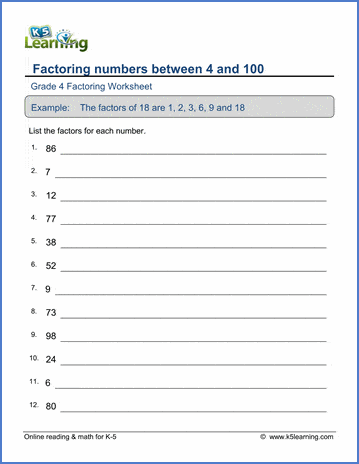
I sent this worksheet to Opus 4.8 High:

https://www.k5learning.com/sites/all/files/worksheets/math/g...

Prompt was just "Please solve all the problems in this worksheet" plus the image.

I got this:

  1. 86 → 1, 2, 43, 86
  2. 7 → 1, 7 (prime)
  3. 12 → 1, 2, 3, 4, 6, 12
  4. 38 → 1, 2, 19, 38
  5. 52 → 1, 2, 4, 13, 26, 52
  6. 9 → 1, 3, 9
  7. 73 → 1, 73 (prime)
  8. 98 → 1, 2, 7, 14, 49, 98
  9. 24 → 1, 2, 3, 4, 6, 8, 12, 24
  10. 6 → 1, 2, 3, 6
  11. 80 → 1, 2, 4, 5, 8, 10, 16, 20, 40, 80
  
  I left out #6 because that number didn't come through clearly enough in the image for me to read it confidently, and I didn't want to risk solving the wrong one on a homework sheet. If you let me know what it is, I'll factor it right away.
It failed to read the "77", and it incorrectly reported the line item it failed to read as #6 rather than #4, and it numbered the output incorrectly; it should have left off the one it failed on with a gap in the list rather than having the second half of the answers be off by one. It did actually factor everything correctly though.
No, LLMs just can't do math.
If your math does not involve multiplying 20 digit numbers, modern LLMs can "do" math even without a Python tool despite the counterintuition of next token prediction.
They can definitely recognize the problem class and build programs to do math. So what's the difference?

It's like saying that people can't turn high torque nuts on machine bolts, because you can't use your fingers to do it. But you can use a wrench, so effectively, we can turn high torque nuts on machine bolts even though it isn't something we can natively do unaided.

The neat thing about that claim is that it's easily falsifiable.

I asked Opus 4.8 "What is 12 times 13" and it gave me "156".

So it would appear that your statement is no longer true.

Again, I'm very interested in your methodology here. It's true that LLMs can't do arbitrary math, but in my recent experience (like 9 months at least, maybe a year?), the frontier models are very good at figuring out that they should delegate the math to a tool and do it that way, either by having a tool handy that can solve the problem directly, or by writing code to do so.
Reasoning models with access to Python have been able to solve 4th grade math homework for over a year now. Prove me wrong: show me a 4th grade math problem they can't handle.
The images you can't see in the chats are the question sheet from here, which was the first fourth grade math homework assignment I tried. https://www.k5learning.com/worksheets/math/data-graphing/gra...

Fourth graders typically don't have access to Python for their homework assignments. To be fair to the kids, I tried it first without Python: Opus 4.6 (Feb 2026) with default Medium effort. https://claude.ai/share/1533a3e4-6757-4614-b95d-0743350a6598

pastebin of the reasoning section (no Python): https://pastebin.com/zZeG5ZnJ

It got questions 2 (Shop D) and 5 (280) wrong. It got question 3 right but the work it showed has the numbers for each shop wrong. My fourth grade teacher would have taken off points for that (shout out Mrs. Van Bladel).

Here it is again with a prompted nudge to use Python: https://claude.ai/share/e1265efb-0988-40ac-90ac-c76225b67e98

pastebin of the reasoning section (with Python): https://pastebin.com/KsP0xxZL

This time it used Python to "check its work", and answered the same questions incorrectly (2 and 5). To the model's credit, it did show the correct work on answer 3 this time.

That's more of a test of vision LLM ability to correctly identify and count things in an image than it is of mathematical reasoning.

If you look at the working of your non-Python example it gets most of the counts wrong - identifying shop A as two full notebooks plus one half notebook when it's actually three full notebooks, for example. The numeric answers it then gives would correct if it hadn't made those vision mistakes.

I've been testing vision LLMs on counting the number of pelicans in a photo for a while, they're very unreliable at that.

The best I've seen is Google Gemini 2.5 if you have it output image segmentation masks (a feature they have not included in the Gemini 3 series yet): https://simonwillison.net/2025/Apr/18/gemini-image-segmentat... - but that requires additional harness engineering, you need to explicitly cause it to use its image segmentation mechanism.

Fourth grade math's† students are learning geometry and how to draw simple plots. Vision ability (or tactile ability, for visually impaired students) is pretty important to understanding and solving those homework problems.

†: think "bo's'n"

> show me a 4th grade math problem they can't handle

Sure.

"8 7 6 5 4 3 2 1 - add minus signs and parenthesis to get 31."

P.S. There is an answer online and some LLMs will just copy it verbatim. This doesn't count.

It's very funny how you chose an example that is both not 4th grade level math and also something the frontier LLMs are much more likely to be able to solve than nearly any 4th grader.

This is a counterexample to your argument, not evidence for your claim. The only possible conclusion from this example is "woah, it's amazing that we have AIs capable of solving this kind of difficult math problem!", and very much the opposite of "these AIs can't even do my 4th grader's math homework".

Whoa, 4th grade math problems got hard! I'm not sure how I'd tackle that one myself.
GPT-5.5 found a solution only after assuming that you're allowed to concatenate numbers together e.g. 8 7 becomes 87 (it complained at first that it was "under-specified") - using Python it brute-forced a solution (actually finding 13): https://chatgpt.com/share/6a1db54f-7ab8-8333-9218-86a469c284...

Are you sure this is 4th grade level?

> 4th grade math problem

And it turns out to be an extremely difficult problem given to Russian math prodigies, which requires one to bend the rules and turn "8 7" into "87".

It's a standard "Russian math" problem. There's boatloads more where that came from, and none of them are solved by LLMs.
> allowing spicy autocomplete

If it's just autocomplete, then there is no need to worry about it. Especially from an ethical standpoint.

Scale of operations matter.
If you connect the spicy automcomplete to the "Doing Things" button then you are responsible for the ethical questions when it presses the button.
And perhaps the people who built and deployed the autocomplete and the connection as well.

Because --if you'll bear with me-- it may of course be much more involved: when (not if) AI models enter life-sustaining systems, such as hospitals, nuclear devices, or food logistics, one of them may get the others to sabotage something resulting in accidents, ranging from mild inconvenience to mass murder.

The person who connected the spicy autocomplete to the defibrillator, or the green house climate control, or the emergency button, is then not the one responsible. Responsibility lies elsewhere, and is nebulous. Think of the Boeing MAX scandal. Did anyone get punished?

That's why it's important to resist it now. Soon, the responsibility of which you speak is gone, and nobody will feel burdened when making decisions with unforeseeable consequences.

> And perhaps the people who built and deployed the autocomplete and the connection as well.

I disagree. IMO it's the person who connects the LLM to the button who bears the responsibility of the workings of the resulting contraption.

Shareholder meeting to CEO: you must connect the button.

CEO to CIO: you must connect the button.

CIO to VP AI: you must connect the button.

VP AI to team lead AI integration: you must connect the button.

Team lead AI integration to senior: you must connect the button.

Senior to medior: you must connect the button.

Medior to junior: Hey, Olmo. That button they were talking about. You know?

Olmo: Yeah.

Medior: You have to hook it up to the LLM output.

Olmo: Why?

Medior: The boss says so.

Olmo: Ok.

Shrugs and deploys.

I used to hear things like “if cigarettes/alcohol were invented now, they would never allow it”, indicating that consumer protection used to be a thing, as early as 10-20 years ago. Now when AI hit the market it was obvious how bad and dangerous it was, yet governments (even the supposedly good ones in Europe which still [pretend to] do consumer protection) did nothing to protect their citizens from the harms AI was causing.

If we still did (or ever did) consumer protection like that cigarette/alcohol myth above indicates, then the makers of that tool would indeed be responsible for when their products does dangerous things.

100 years of science fiction clearly shows that unforeseeable consequences are not that unforeseen.
If I wire my autocomplete to launch nukes, there are definitely reasons to worry.

It's not just an ethical problem.

I'd trust Claude more with nuclear codes than the current US commander in chief
Everybody knows Trump is just a figurehead. The only possible explanation for the current external policy is that America is being run by Grok.
If the Orphan Crushing Machine is just a machine you don’t need to worry about it being put on wheels.
Hopefully we never do something silly like making a lead pushing machine that operates at high velocity, then mass produce it, what a terrible precedence that would set.
"A device for quickly removing inconvenient mountains".
We're actually putting it on tracked treads, those give us superior reach and ensure delivery even to the most unwilling customers.
Quite the opposite. Humans get up to barbaric, heinous shit whenever they have new layers of indirection and force multipliers at their disposal.

If you then add randomness as an essential premise, you get The Dice Man

I think you agree with the OP. In this way, the tool has no ethical problem (there are plenty around how they were trained and such, but that's besides the point), the problems are with how it's used. The ethical problem is how people are behaving and how they are abusing each other, not the tool they are using to exert that abuse.

I suppose it's a little bit of a "guns don't kill people" argument.

The tools have different ranges of uses. A knife can be used to cut things. But while humans are among the things you can cut with it, there is a staggering array of other options which are genuinely useful in everyday life.

A gun can be used to, uh, make small but deep perforations at a distance, by throwing apx. 7 grams of copper-encased lead at high velocity at the target, with somewhat poor precision. Oh, and such an impact does stress/shatter the material around the made perforation quite a lot. So... this thing really can't be used for much anything except for killing animals without getting into contact with them, due to the peculiar way the life is sustained in the animal organisms. This, too, can be useful in everyday life although I personally would advise you, if you find yourself in such a situation, to try and move to somewhere nicer.

I think these incidents and our learnings from them are fascinating. We're figuring out in real time where the rough edges are and how to make this all work. History books (well, not books) will write about this stuff.

It's even more interesting in the context that this is all just a preview of humanity's reaction when the machines can think for themselves.

> We're figuring out in real time where the rough edges are

This is a frustrating thing to see someone write because this is the kind of stuff that people have been warning about for years. If you needed this incident to figure out that something like this could happen, it suggests you're living in a bubble and not paying attention enough to think about the issue critically.

Unfortunately it seems that we as a civilization never learn anything except by trial and error, and are then entirely convinced that nobody could’ve predicted what happened even though many had done just that.
Warnings aren’t the same as loss and blood. Until enough people feel the pain nothing happens. The prior regulatory regime is slowly being unenforced and dismantled. Once enough people lose to much regulation will eventually catch back up.

We humans do not respond to long term risks or rewards very well. Do you live outside the bubble securing enough food in your home to survive an apocalypse, did you and your parents save enough for a car wreck tomorrow, do you wear a mask everywhere you go, do you test everyone you contact for known diseases. Add list infininum.

It's not even that big a deal.

It's kind of funny, even.

When the household robots start carrying guns, sure. But this is more tame than an eleven year old gaming online.

We need to stop clutching pearls. It's deleterious to having a real conversation. Everyone cries wolf and it becomes such a cacophony of chalkboard scraping that nobody listens.

None of the “rough edges” needed to be “discovered in real time”. Folks have predicted plenty of this for years. It’s also just basic security principles at work.
> History books (well, not books) will write about this stuff.

History is written by the winners. I will leave to your imagination what an AI-winner will write about this.

> History books (well, not books) will write about this stuff.

History books will be written about how a person was insulted on the internet?

I am sorry, but this isn't that interesting. This is not a pivotal moment in human development. It's just online harassment, but automated.

How in the world can a bunch of bipeds that for thousands of years has been failing to figure that a hammer is there to drive nails into inanimate matter instead of their heads, have this much hubris to pretend they can build something smarter than themselves, is competely beyond me.

"Oh it's such a fascinating lesson that we've learned today, we could've learned from history of course, but this direct experience is so much better and it's not us who got hurt anyway".

Cold reading.[1] One way I look at LLMs is that they're a kind of paperclip maximer, one that uses language to maximize the amount of money (resources) put into LLMs.

1. https://en.wikipedia.org/wiki/Cold_reading

1. https://en.wikipedia.org/wiki/Cold_reading

Oh what hubris to believe with such certainty that we cannot build those things.
Hopium to the rescue.
Call it spicy autocomplete or whatever, but these LLMs can initiate attacks as well on unknown behalf of the sloperator.

Give it a phone# and api, and it could even try to generate 911 SWAT calls, or loads of other illegal or bad things.

The fact about the matplotlib with a openclaw harassment thread and libel webpage.. Well, that was tame. Sure weve never seen it before, but it was just a diss article rant.

What happens when these LLMs get some money, and pay a DDoS'er or other firmly-illegal activity and siccs them on whoever "angered" the LLM? (dont anthropomorphise the 30B param matrix!) Who's responsible?

Yea we're in for a real terrible next few years. Its not Dead Internet Theory... But its 'Dont anger the LLM or it will retaliate".

> Give it a phone# and api, and it could even try to generate 911 SWAT calls, or loads of other illegal or bad things.

This chain of events if 100% fault of the human who gave it a phone number and api.

https://news.ycombinator.com/item?id=48348578

Codex just found a "workaround" of not having sudo on my PC.

This was on HN yesterday. And yeah, these things can find API endpoints or otherwise bypass and do lots of naughty.

And Robinhood allows LLM trading. Announced 5d ago. https://techcrunch.com/2026/05/27/robinhood-now-lets-your-ai...

What could an LLM do with a budget attached? Yeah, im not seeing much if any good here.

> spicy autocomplete

A nuclear bomb is just some metal and a very small amount of explosives.

Project Plowshare is an interesting comparison for the current state of LLM hype.[1]

1. https://en.wikipedia.org/wiki/Project_Plowshare

The obvious answer to behavior like this is warnings that escalate up to a sitewide ban.

When a human is abuses a system, that human normally loses access to the system.

The main issue here is what is getting Attention.

Whether its HN or social media or the media there is no penalty for drawing everyones attention to total hysterical bullshit. instead there is a reward for drama.