Hacker News new | ask | show | jobs
by toast0 858 days ago
> After a million dollars or so in salary, the absolute amount that a person is paid has no real impact on their life. They can't eat more meals in a day or wear more shoes. What matters to the manager is the relative amount.

Sure, nobody needs more than a million dollars in annual compensation (in 2024 dollars), but relative amount gets you to your never need to work again number faster or slower. You might still work after you don't need to, but it's nice to not need to. And of course, there's economic milestones to be had like flying first class, flying charted, leasing a jet, owning a jet. Those certainly have an impact on your life, depending on how much you travel; and you might travel more if you didn't have to wait at the airport for a flight.

7 comments

I think this over-estimates the amount required to live a luxurious life in perpetuity.

Consider the case of someone wishing to live a luxury lifestyle in the trendy lower east side neighborhood of manhattan. We'll use a 1300 sqft 3 bedroom condo as a baseline.

https://www.redfin.com/NY/New-York/455-FDR-Dr-10002/unit-B30...

This condo will cost 8k/month with a 20% downpayment at todays interest rates, leaving our hypothetical million dollar a year salary person with 52k/month post-tax. Assuming they live a rather luxurious lifestyle of ~16k per month, they will still have a savings rate of 60%. Leading to a retirement in 12 years with a portfolio of 7.8 MM.

If the person makes 10x this value or 10MM per year... Then they can retire in 1 year. At 100 MM, they can retire in ~2 months.

You can play with the numbers a bit, our hypothetical 1MM/year individual would be living in the "average" 3-bedroom apartment for the Lower East Side. Perhaps the 10MM/year individual would choose the most expensive unit which is only ~4x more expensive, and increase their spending to 90000 per month - equivalent to a new model X per month.

They still retire in 3.8 years.

https://www.redfin.com/NY/New-York/105-Norfolk-St-10002/unit...

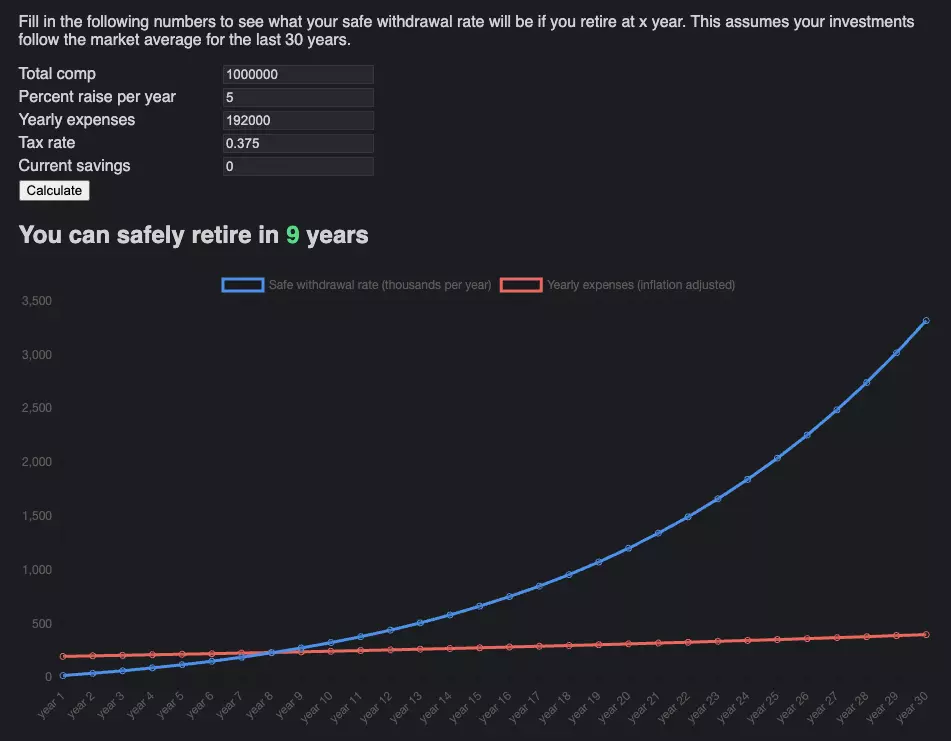
If anyone wants an extremely simplified "when can I retire given x expenses and y income" calculator, I threw together one here: https://html.non.io/simple-retirement-calculator/

Screenshot with op's scenario: https://image.non.io/7865a80e-d1e7-4437-b983-9101ed023024.we... (assumes a 4% safe withdrawal rate, I suspect op is using 3%).

Thanks! It looks like I can safely retire in `null` years! I'll put the champagne on ice.
It looks to be inflation adjusted, so null means never since your safe withdrawal rate will always be less than expenses.
Yep, I got that - hence the "thanks!" :|
This one is immensely more powerful and should be used if you want anything more than a "neat, that's a nice ballpark to have" estimate like what you'd get from mine.
> 1,830 monthly HOA fee
Good catch - missed that!
Thanks for this, it's simple and extremely helpful.
Further, this assumes that a person's primary financial goals are based on personal consumption, when a person might much more highly value their ability to contribute to their community and finance projects that improve the quality of life of those around them, or maybe they have a particular goal for society in general that they want to pursue, like funding a research project. Many wealthy people don't focus on personal consumption at all, even living frugally, but care about the wider impact of their money.
A 1300 sqft apt isn't exactly lux with a family of 4. Plus public schools aren't great in most of the city and private will cost you 50k per kid, post tax. Then you have to ask what you're doing during the summer. Camp will cost you easily another 20-50k per kid. And your naive math of tax leaves out a lot city and state tax.

There are a lot of expenses. The fire stuff you read about people retiring after a few million is often heavily biased towards young single people where you can move to Thailand and live well but falls apart with a family.

People don't retire and live in the city after making a million a year for a few years. Maybe they're all stupid, but chances are they aren't and you're severely understimating how much things cost and how much you're taxed.

If you're making a million a year you'll want nice things for your family, that includes space for your kids to enjoy their childhood, vacations together, good food, transportation, and other things, otherwise what the hell is the point of working hard?

In Manhattan, it's pretty lux :) If you expand your radius to Brooklyn and the other burrows you can get a modern renovated brownstone with 4k sqft for similar pricing and a 20 minute commute to wherever you need to go in Manhattan. Adding in 100k per year doesn't change the math too much Our hypothetical individual would retire in 13 years. However it's worth highlighting that the costs for this hypothetical individual will fall by ~30% following the kids graduation from college.

Now, in theory - there is nothing which stops one from scaling housing costs arbitrarily high. If Musk desired, he could buy the New Yorker hotel and turn it into his house.

Camp cost 20-50k per kid.

Is that lobster camp? What are kids doing in a 50k camp? I am regular European and 50k is like an annual salary. Kids go to camps though but they are more like 700 a week. Let’s call it a grand. For 50k you can get a helicopter pilot license not a summer camp

Likely this is a summer at sleep away camp. Although tbh I've usually seen something closer to ~10k for a summer away. Presumably you could pay more for spending a summer in an immersive camp experience or do multiple high end camps spread over the summer.
The private chefs and specialized tutors for niche subjects add up (I wish I was joking, not that I ever sent any of my kids to one).
I went to the Johns Hopkins one way back in the day. It's more like a lite-college experience for 8 weeks (but much more supervised ofc).

Still, I think it cost in the realm of 3k, not 50k. Honestly, not bad for a 2 month stay at a college campus in California.

Yeah, I’ve been debating the utility on that one. From observation, my daughter does better with a group of strong peers. While she’s still young (3) nothing motivates her to do something like seeing another kid do it.
Found the millionaire ;)

Agreed, nowhere near close to those numbers but kids, school, vacations, life, things just add up quickly.

what really needs to be said is that conspicuous consumption is expensive and generating a "Elon" affect where you simply can't do anything dumb for an infinite number of reasons is the trajectory of conspicuous consumption.
I work in finance and know a bunch of people who made more than 10 million a year for a while, and they all tell you exactly that: very quickly, you have way more than what you'll ever need, and having more money has zero impact on your personnal lifestyle.

They already have the house(s) they wanted, the cars they dreamt of, and the kids in the expensive schools. Plus being in finance, these people make more money with the money they already have.

Of course, there's always the dumbass who just bought his 20th ferrari, but that's just something else entirely.

Number of millions matters when donating to your favorite charity or political lobby, too.
I'm sure that's important to some people, but I'd be very surprised if that's why most millionaires are still going to work every day.
dunno. after you get enough to meet all needs forever, the question then becomes "what can I build?" and how to steer civilization into something you want -- dictate the shape of things to come.

way more motivating than trying to squeeze out an extra 30k per annum to get a slightly nicer condo

True.
This, I can't believe all these "money doesn't bring you happiness after a certain level" tropes keep ignoring saving and investing angle, just lazy. Or accumulating wealth for your kids.
On accumulating wealth for your kids: while there are definitely huge benefits to be had there for stability, freedom to pursue passions, and so on, I sort of doubt it actually leads to positive outcomes on average beyond a certain point. Giving them a financial safety net seems inarguably good, but giving them so much that they have no need to work could easily do more harm than good.
There is a counter fact - more money almost always means more motivated predators, and needing to modify lifestyle or behaviors to compensate.

It’s really scary how dangerous and destructive some people can be.

My personal pet peeve is how every retirement calculator bakes in an assumption like “you’ll NEED 75% of your current income as living expenses when you retire.”

Like your salary won’t change over your career. Like you’re just an impulse buyer. Like there’s anything but a distant correlation between these numbers.

I think there’s a conspiracy or a (USA) cultural aversion to not working.

Sadly I can see a lot of workers never truly getting pay raises as they go around jobs, not careers. The progression feels obvious if you have something highly technical, but many don't get to that point.

>I think there’s a conspiracy or a (USA) cultural aversion to not working.

maybe. "American Dream" hasn't died in many's minds.

>(USA) cultural aversion to not working

It's generally good for people to have activities. That said, if money were totally off the table, I'd probably have retired at least somewhat earlier.

flying first class, flying charted, leasing a jet, owning a jet

Perhaps counterintuitively, going from first class to charter/leased flights is a safety downgrade. Search for accident statistics on the NTSB site and you'll see that Part 135 flights (smaller aircraft, including business jets) have 3-4x the accident rates compared to Part 121 (large air carriers), arguably because Part 121 regulations are much more stringent. Here[1] is a very recent leased jet fatal accident, for example.

[1] https://www.usatoday.com/story/news/nation/2024/02/09/plane-...

You pay for flexibility in multiple ways.

Private helicopters are only slightly safer than solo parachute jumps.

It's really about flexibility. First class + airport lounges is pretty comfortable. But you're still on someone else's schedule.
Yeah, a million dollars a year is not anywhere close to where having more money doesn't impact you.

If that's $600K after taxes, and a year of college for a single child costs $80K at an excellent school, and you've got two or three kids, and housing in a major metropolitan area...

I mean you're definitely living very comfortably, but there are still lots of ways to spend money that have a big impact on your life, between your home and child care and your vacations and your comfort in traveling.

If the number is $25 million, then sure there isn't much more difference. Probably even $5 million. But $1 million still has plenty of room for very meaningful life improvement, that isn't anywhere near private jets. Not that you need, but that it's entirely normal to want.

From my personal experience in my circle of friends in my expensive west coast city, there are very impactful differences between the lower end of annual household income (400K) to the upper end (1.5M). While everyone lives fairly comfortably and doesn't have much financial stress, there are things the upper end can do that the lower end can't:

- Send the kids to private schools (more and more important as public schools start to cancel gifted programs, focus on non-core subjects, tolerate misbehavior and disruption from students that wouldn't be accepted to private school, etc.)

- Live closer to work, shortening commutes from 2 hrs round trip to 45 minutes, saving more than an hour of stressful commute per day.

- Every major purchase other than a house requires no budgeting or planning

- Optional early retirement at 45 vs 60 or later

- Have a vacation house, which enables building social capital through hosting friends, and never having to compete with others to book lodging during peak season

- Freedom to leave a job that is too stressful/time-consuming

> Have a vacation house, which enables building social capital through hosting friends

Psychopath

I used a very sterile, transactional description of it but there’s no denying that this is the case. Of course it’s not the only benefit, and it’s not what motivates the purchase in the first place.
It is unfortunately true. You cannot invite your social peers and pay for their lodging. It is only socially acceptable if you literally spend 3x as much for a rarely used guest room.
Not true. It's sad that you all quantify and gamify relationships.
Some people are just better about lying to themselves about it - the poor part of town literally depends on it.
You can argue about the numbers and there is definitely the flying private jets and basically not thinking about the cost of hotels and schools, etc. echelon. But, yeah, $1m/yr probably isn't that given it's not that much out of the range of a lot of salaried senior worker bees in tech, etc. Sure, that's great comp and you can save a lot but it's not "costs don't matter" level of things.
Consuming without working for it is immoral, flying privat jets and traveling more is bad for the environment. Those are not reasons in favor of higher salaries.
The idea here is that they did the work up front and then saved to accumulate wealth which they could spend later. Is that immoral to you?
Yes. If you work for 10 years and then just consume stuff for the rest of your life without lifting a finger, stuff for which other people work all day long to produce it while at the same time probably not enjoying a quality of life anywhere near yours, that is deeply unjust and I consider it immoral to desire such a life.
I would have paid double my taxes over my career if the US would spend it on elevating the poor. But asking me to not retire, to give away my savings to very few people? What, that’s not ethical.

What if I made a lot, but spend very little? Shouldn’t that weigh in, if your issue is consumption level?

What if in my early retirement, I go around lifting people up in non-monetary ways?

What if my job earned me a lot of money but was ultimately doing something I found socially harmful? I should continue working to the detriment of my mental health and against my principles?

We can elevate the poorest and decrease the amount of work the median/average person must do.

keyword references: degrowth, UBI

My point is very simple and we do not have to discuss all the edge cases. Working x hours and consuming stuff that took y hours to produce where y is much larger than x is unjust. All the rest are details.
I make widgets. I work 8 hours and make 8 widgets. In my spare time I make a machine to make widgets for me.

I've finished my machine, and it can make 16 widgets in 8 hours as long as I turn the crank. So I sit and turn the crank for 8 hours a day and make 16 widgets. Am I immoral yet? I just doubled my productivity for the same amount of work.

Now I pay someone to turn the crank for me. They work 8 hours and I give them 8 widgets, and I keep the other 8. They are doing the same 8 hours of work that I was doing, and I do nothing but make sure they keep turning the crank.

Am I immoral now? Why? I built the machine and I get 8 widgets a day out of it, the same amount I got when I was building them by hand. The crank turner also gets 8 widgets in 8 hours, the same amount I was producing by hand.

So the crank turner does less work for the same output, I do no work for the same output. But both of us have the same resources as my competitor who makes 8 widgets by hand.

Is it moral for the crank turner to exchange their 8 widgets for his? What about me?

Are you saying time has objective value?

If it took me 50 hours to whittle a doll from a piece of wood, I deserve 50 times the hourly salary of whomever buys my doll?

I think that's really stupid, just like the labor theory of value.

You are morally and intellectually superior.
How bizarre it is to have strongly prescriptive opinions about other people's time-value preference, and then to mistake those opinions for moral principles.
Ok, so capitalism isn't your thing. Fair enough.

I wonder where the limits are though. What if I save up and take a month off? Is that immoral? What about 6 months? A year? Or do I have to have some justification for it that you find acceptable (like having kids or mental health, etc?)

Or is it just immoral to not be constantly working while other people are working?

To a first approximation, you work for one hour, you get to consume stuff that requires one hour of work to produce. I don't care if you work your ass off for some time and then retire early or if you work very little or very much as long as your consume at most a proportional amount.
What about different working conditions? Is one hour in a coal mine the same as one hour as an actor?

What if a person has a debilitating illness that prevents them from working but is also expensive to take care of?

Nice, the labour theory of value and the lump of labour fallacy lumped into one
So, nobody is "allowed" to watch movies or play videogames then.
Let me guess your take on folks who never work, are able bodied/minded but live off the state.
You should not be able to do that, the system should discourage it. But I think one likely has to tolerate this to some extent because trying to completely eliminate it will probably negatively affect people that rightfully claim such benefits, for example having to constantly prove that they are eligible.
But what if I inherited it?
That is your idea, my idea here is that it is immoral to pay insane amounts of money to keep promoting inequality which in some cases, as flying jet planes, also involves having more power to dismantle the planet we all live in.
Why do you believe they didn't work for their salaries?
I did not say that they did not work for their salaries.
You did. Not directly, but you implied it.
Okay, I see how can read it like that. What I meant is that consuming after you stopped working for it is immoral, or alternatively earning so much that you can keep consuming but stop working.
By that logic, do you consider it immoral to spend lottery winnings?
Good question, but I would ad hoc say no. In the case of a lottery people willingly gamble with some money they earned. In case of management salaries they just take a share of the money for which all the thousands of workers on the factory floor worked.
They are reasons for higher salaries. You just disagree that they justify those salaries.
Yes, there are reasons for differing salaries and they have important functions. But at some point those justifications stop to make sense and it is really just about exploiting your position to grab as much as you can for yourself.
How is demanding your fair market value exploitation? Do we really need to take pity on companies grossing massive incomes while simultaneously not paying their fair share of taxes?
Has there ever been a union that pushed for lower compensation for it's members? A union advocating/negotiating for as much as it can for its members is exploiting its position in the same way.
No, trying to get a better compensation is not per se the issue. In a hypothetical company where the management takes home all the profits and the workers make minimum wage, moving to a more fair distribution of the profits involves less money for the management and more money for the workers.