Hacker News new | ask | show | jobs
by badcppdev 902 days ago
This is a very sad example of land movement and it's a tragedy that people have died in the aftermath and recovery effort.

But it's also an important reminder that our super accurate GPS measurements are not 100% reliable over time. The earth moves. Either in jumps like this or fairly constantly if it's somewhere like Australia [0]

0 -https://www.nytimes.com/2016/09/24/world/what-in-the-world/a...

4 comments

> our super accurate GPS measurements are not 100% reliable over time

The GPS measurements are 100% reliable. Think of it like getting GPS co-ordinates while on a boat - it's the boat that moves.

A point of interest on land doesn't stay at the same latitude/longitude/altitude because land is a tectonic plate "boat" floating on the mantle.

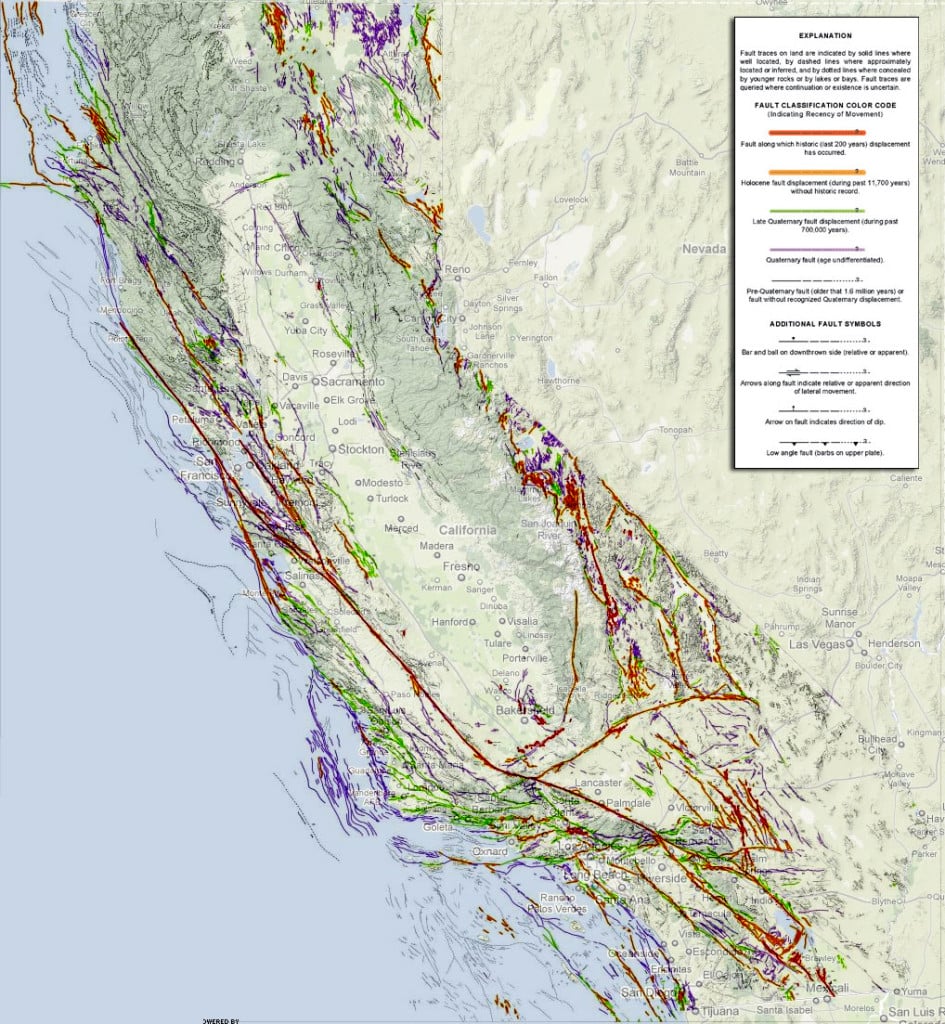
Close to the earthquake faultplane, land crumples and shears sideways and up/down. Plus secondary effects of the shaking: landslides, settlement, liquifaction.

Finally: I think it helps to remember that earthquakes are fault _planes_. Talk of epicentres and depths and faultlines often misleads our intuitions. For one of the Christchurch earthquakes my parents were about a kilometre away from the faultline (where the faultplane met the surface) and many kilometres away from the epicentre (which is just a synthetic average point), but the faultplane actually was relatively close to them somewhere underneath their home.

Also images of cracks in roads are often extremely misleading. They tend to be spectacular subsidence and are not the faultline. The actual faultline is usually not so photographic and less likely to have great photos early on. Media choses photos for their emotional appeal - not because they are a good approximation for the truth.

> The GPS measurements are 100% reliable. Think of it like getting GPS co-ordinates while on a boat - it's the boat that moves.

I'm not sure this is a good metaphor. When doing high-accuracy GNSS (GPS) survey work, a static reference station is typically used to help correct errors from the GPS measurements themselves.

If GPS was 100% consistent and reliable, differential correction wouldn't be a common and often-required technique:

https://www.e-education.psu.edu/natureofgeoinfo/c5_p23.html

While you’re correct that GNSS is not 100% accurate (like everything in the physical world, it comes with error bars), I think the point stands that the error is unrelated to the movement of continents.

Ultimately GNSS is just measuring your position relative to some celestial objects using the time it takes for signals to propagate space (and some other info: their ephemerides, and a shared-ish clock). The fact that land exists, and where it exists, are not relevant

Your error corrections might be thrown off when the base station moves, but that’s not an issue of GNSS that’s an issue of RTK

GNSS satellites talk to base stations on earth to get correction data using the measurements they obtain (including measurements obtained by tracking satellites from the ground). I believe this is what the poster above is reffering to.

RTK is a whole another beast and the meaning of an RTK base station is something else.

RTK is exactly what I was referring to.
I'm confused, how does moving 2.7 inches a year translate into 656 feet over 25 years? Was it moving tens or hundreds of times faster a few decades ago?
Basically, before 1994 the official Australia coordinate system was not optimized for GPS, which was not common when the system was developed, and so didn't exactly align with global coordinates. The 656 foot change was mostly about that, not about tectonic changes.

AGD is Australian Geodetic Datum of 1984 and GDA94 is Geocentric Datum Of Australia 1994.

> The AGD provided a reference system that best fit the shape of the earth in the Australian Region but its origin did not coincide with the centre of mass of the earth. National datums were commonly non-geocentric before satellite based navigation systems were established in the early 1970’s. The distance between the origin points of GDA94 and AGD is approximately 200 metres. When the coordinates of a point on the Earth’s surface are converted from AGD to GDA94 this translates to a coordinate difference of approximately the same amount. The difference varies slightly depending on where you are in Australia.

- https://www.icsm.gov.au/datum/australian-geodetic-datum-1966...

> Previously, a change of about 200 metres occurred in the year 2000 when Australia shifted from the Australian Geodetic Datum 1984 (AGD84) to the Australian Geocentric Datum 1994 (GDA94).

- https://www.dmp.wa.gov.au/News/Geocentric-Datum-of-Australia...

Nowadays you can use the Australian Terrestrial Reference Frame, which is time dependent and automatically adjusts to compensate for tectonic movement: https://www.icsm.gov.au/australian-terrestrial-reference-fra....

I assume that should be 6.56 feet or some similar miscalculation converting from metric to imperial measurements
Or Swedish feet (29.69 cm), perhaps an Amsterdam foot (28.3133 cm)?

Perhaps make it half and half (and undocumented) so that neighbours can embark on generational land feuds.

https://en.wikipedia.org/wiki/Swedish_units_of_measurement#O... https://en.wikipedia.org/wiki/Dutch_units_of_measurement#Voe...

> But it's also an important reminder that our super accurate GPS measurements are not 100% reliable over time. The earth moves.

This is IMO an odd statement. Land moves, and we can measure that movement extremely precisely. If software was more competent, we would record positions in four dimensions: space and time, relative to a well defined coordinate system. And we could map a position at one time to a position at another time, with excellent accuracy.

As far as I can tell, the only real limitations are a lack of standards and a lack of software support. I don’t think any common CAD or GIS system has any particular support. Heck, QGIS will happily complain that WGS84 isn’t good for high precision, and I can even tell whether this is a genuinely meaningful statement.

It’s not just a software problem, you also need to know how the earth is being deformed which is far more difficult than you might think.
Not necessarily. Place a grid of receivers in fixed locations and observe their reported position. That grid is then the transform you need between the map when they were placed and the current state of the globe.

A question would be how many you need, but these movements are on a large scale and receivers are dirt cheap.

A low resolution grid is cheap, but having enough censors for local accuracy is expensive because fault lines are so complicated:

https://strangesounds.org/wp-content/uploads/2014/09/earthqu...

What you really want is censers placed based on the underlying geology rather than a grid and then to combine that with a model of the geology.

Whether it is a grid or a selectively placed point cloud was not the point. Either way you end up with a mesh you can use for a relatively simple warp.

Granted, using it as input for a model might be more accurate, but also more complex. The simple warp might be enough to get within reasonable mapping tolerances though, while simultaneously revealing which areas are in most need of update.

The wider point was you assumed it was easy because you didn’t understand the underlying complexity. GIS is a surprisingly deep rabbit hole once you start digging into the specifics.

Apply corrections on the device and Google Maps may want to use a more accurate model which then requires undoing the first correction before applying the second etc.

*sensors
This is how things are done. You specify the datum, coordinates, and time. Geodetic datums are time-dependent transformation functions. Any software that is recording points at the particular time called “now” and not either recording the coordinates and time, or reprojecting them to a meaningful reference datum at its epoch (origin in time), is bad.
As far as I can tell, GIS software is bad, then. I spent longer than seemed at all reasonable trying to research this with QGIS, and I got nowhere. ArcGIS (which I don’t have) wasn’t obviously better.

Do you have an example of good software?

Sorry, no. This was my dad’s field, not mine, so I’ve just got a bunch of second-hand info and know that the software he worked on (two pieces, one for a company and one of his own) handled these sorts of things correctly. And I find it genuinely impossible to imagine that major GIS software would not handle this, because it’s so fundamental.

Your GIS software will have you set a base CRS, and then, presuming it’s not recording time on points, all coordinates will be relative to it at its epoch. That’s all you need, now if you want to see what it’s like now, you project it accordingly. Anything along the lines of recording new points based on actual measurements should obviously either record time and position, or just position after performing the reverse transformation. But there you’d tend to be getting beyond the domain of what the bulky GIS software is doing, and into the domain of specific-purpose mobile apps and such.

>reminder that our super accurate GPS measurements are not 100% reliable

Lockheed solved this with their super sensitive Magnetic Field 'GPS' device - which they claim if for having 'GPS' accuracy for aircraft and ships nearly 100% based on the localized magnetic signature of the earth - but we all know these are actually built for subterranian/submarine environs where space based GPS no cut it. Can't navigate Agartha without it.

https://www.gpsworld.com/quantum-magnetometer-senses-its-pla...

I do wonder how much major earthquakes affect the finer signature of the magnetic fields?

How is this solved?

The surface of the earth just shifted in a highly non-linear and non-uniform way. Places are not at the same coordinates or at the same distances from each other they were last week.

Read the link. The quantum magnetic locator doesnt use GPS satellites, so the "our GPS is not 100% accurate" is solved by the magnetic quantum thing... its just not available on _your_ smartphone.

Re-read my post, I believe that the real use of Lockheeds Quantum GPS is for subterranian and submarine navigation more than it is for aircraft - hoever, if we can map the magnetosphere of other planets, say, mars, then this could be a non-satellite-dependant GPS for any body in space where we know the magnetic signature based on probes... although said probes could also double as GPS satellites for the planet they are probing should we add such equipment, it would seem.

But the problem is not the accuracy, it's the temporal stability. GPS is accurate enough, but it's no good if the physical locations shift over time.

Most people need an up-to-date map, not just a location on a map.

Related - Farmers ‘crippled’ by satellite failure as GPS-guided tractors grind to a halt 181 points 8 months ago 150 comments https://news.ycombinator.com/item?id=35643705 -- https://www.smh.com.au/national/farmers-crippled-by-satellit...
GPS is only accurate up to 16 feet, and unless you are very close to an earthquake or other deformation source probably everything around you has moved by the same amount.

Most people only use GPS for local navigation.

GPS is much better than 16 feet these days.

Nobody asks google maps for instructions how to move 10 miles southwest. We ask it to provide a route to a specific latitude and longitude, that's global navigation and that, of course, doesn't work if the place you want to get to has gotten new coordinates overnight.

Could even use this as a revers GLOBAL ORBITING SYSTEM [GoS] - Whereby a single satellite|probe dispels a lander to a planet with the Quantum Magnetic Cannister, and that QMC signals its global location to the satellite launcher, and the satellit can extrap its location based on the absolute location of the ground guys... (might need more than one ground magnet-moles?)

How can this be measured? Can fluidx3d do martian magnetics? [0]

--

[0] https://github.com/ProjectPhysX/FluidX3D

---

EDIT: "Mars does not have a magnetosphere"

ELI5: "how do electronics work when there is zero magnetic field around them? A complete antimagnetic environ?"

I've never heard any mention about making any electrical device work on a planet (such as mars) in a complete magnetically dark location?

How is there gravity on mars if there is no magnetic field for a planet, and how can mass, the size of a planet not produce magnetism/gravity if its not made of iron-sh (the RED of the planet)

ELI5, please.