Hacker News new | ask | show | jobs
by amluto 902 days ago
> But it's also an important reminder that our super accurate GPS measurements are not 100% reliable over time. The earth moves.

This is IMO an odd statement. Land moves, and we can measure that movement extremely precisely. If software was more competent, we would record positions in four dimensions: space and time, relative to a well defined coordinate system. And we could map a position at one time to a position at another time, with excellent accuracy.

As far as I can tell, the only real limitations are a lack of standards and a lack of software support. I don’t think any common CAD or GIS system has any particular support. Heck, QGIS will happily complain that WGS84 isn’t good for high precision, and I can even tell whether this is a genuinely meaningful statement.

2 comments

It’s not just a software problem, you also need to know how the earth is being deformed which is far more difficult than you might think.
Not necessarily. Place a grid of receivers in fixed locations and observe their reported position. That grid is then the transform you need between the map when they were placed and the current state of the globe.

A question would be how many you need, but these movements are on a large scale and receivers are dirt cheap.

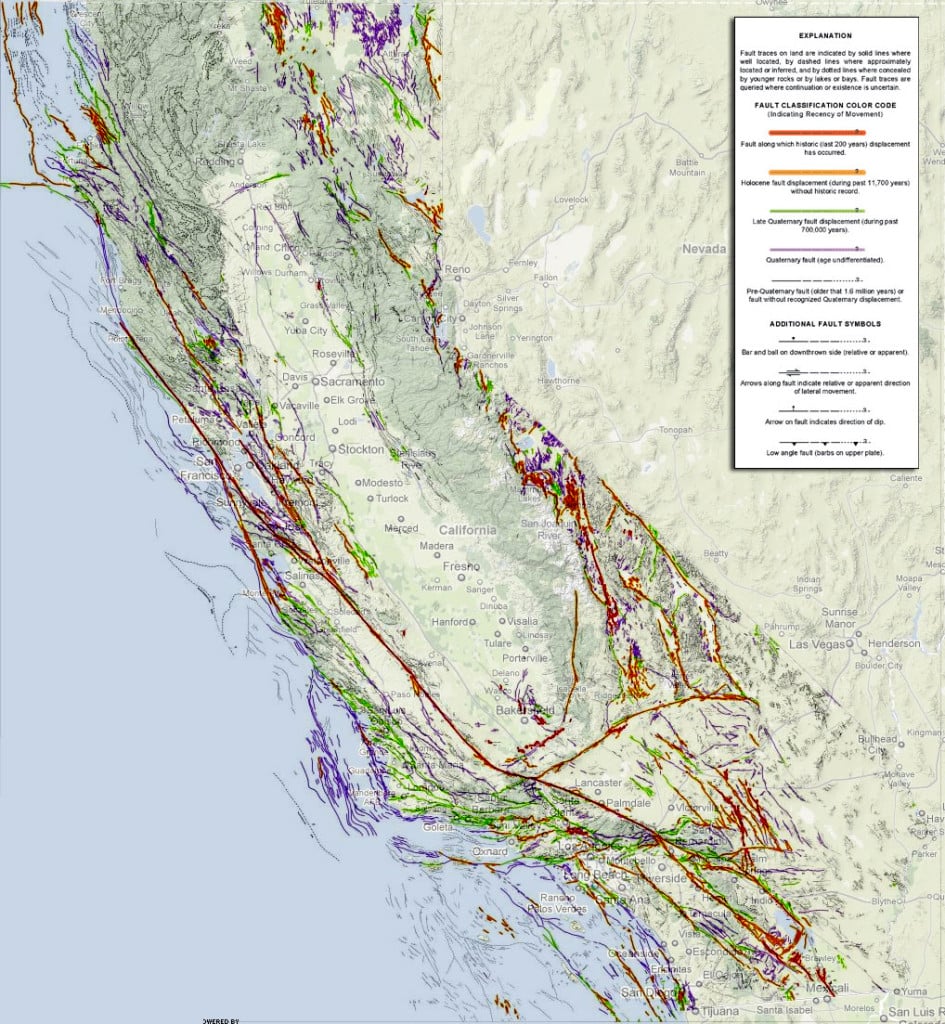
A low resolution grid is cheap, but having enough censors for local accuracy is expensive because fault lines are so complicated:

https://strangesounds.org/wp-content/uploads/2014/09/earthqu...

What you really want is censers placed based on the underlying geology rather than a grid and then to combine that with a model of the geology.

Whether it is a grid or a selectively placed point cloud was not the point. Either way you end up with a mesh you can use for a relatively simple warp.

Granted, using it as input for a model might be more accurate, but also more complex. The simple warp might be enough to get within reasonable mapping tolerances though, while simultaneously revealing which areas are in most need of update.

The wider point was you assumed it was easy because you didn’t understand the underlying complexity. GIS is a surprisingly deep rabbit hole once you start digging into the specifics.

Apply corrections on the device and Google Maps may want to use a more accurate model which then requires undoing the first correction before applying the second etc.

*sensors
This is how things are done. You specify the datum, coordinates, and time. Geodetic datums are time-dependent transformation functions. Any software that is recording points at the particular time called “now” and not either recording the coordinates and time, or reprojecting them to a meaningful reference datum at its epoch (origin in time), is bad.
As far as I can tell, GIS software is bad, then. I spent longer than seemed at all reasonable trying to research this with QGIS, and I got nowhere. ArcGIS (which I don’t have) wasn’t obviously better.

Do you have an example of good software?

Sorry, no. This was my dad’s field, not mine, so I’ve just got a bunch of second-hand info and know that the software he worked on (two pieces, one for a company and one of his own) handled these sorts of things correctly. And I find it genuinely impossible to imagine that major GIS software would not handle this, because it’s so fundamental.

Your GIS software will have you set a base CRS, and then, presuming it’s not recording time on points, all coordinates will be relative to it at its epoch. That’s all you need, now if you want to see what it’s like now, you project it accordingly. Anything along the lines of recording new points based on actual measurements should obviously either record time and position, or just position after performing the reverse transformation. But there you’d tend to be getting beyond the domain of what the bulky GIS software is doing, and into the domain of specific-purpose mobile apps and such.