The digital boards in hockey can get really annoying even when they're working as intended. Animating them should definitely be banned and I wouldn't mind seeing the digital ads disappear entirely.
I was shocked as a non-hockey fan to see an ad of a car driving along the wall during active play. My eyes instinctively moved to the ad away from the puck. It was gross.
As an NBA fan, I hate how ads keep getting crammed into every piece of equipment on the court, the jerseys, etc.
As not a fan of professional sports, every time I see a sports game on TV, I feel like the game itself is secondary. It absolutely feels like an advertising show with the unimportant addition of people playing something.
Which sports, specifically? I watch football and rugby and while both have a lot of advertising (in stadia and on jerseys) TV coverage is still very clearly focussed on the sport itself
Precisely.
I used to be an avid Arsenal fan, but now it seems that I would support "Emirates Fly Better". The fact that it's on every player's shirt one might say that "TV coverage is still very clearly focussed on the shirt itself".
I do enjoy admitting, their website https://www.arsenal.com/ is rather tastefully done (I turned off all extensions to have a good look), though. And 'Visit Rwanda' doesn't seem to such be a bad thing, though I couldn't find an Emirates flight to there.
Shirt sponsors aren't not a particularly new thing, though. But I guess in the past Arsenal in particular had sponsors with slightly less controversial owners - iirc JVC and SEGA/Dreamcast weren't directly involved in any slave labour controversies or human rights abuses like the UAE is :)
Over here in Europe that's now business as usual during soccer matches, and also biathlon, where a car follows the athletes on the billboard while they are skiing up a slope. However those are actual physical LED displays, not virtually inserted.
It's even worse when the hockey players' white uniforms confuse the video effect algorithm into thinking the uniforms are part of the board and the algorithm paints the uniform with part of the ad.
> "Like anything else, you're going to have your people that don't like it, that think it is difficult to watch. But over time, like everything else, people will get used to it, and we're not concerned at all whatsoever," Keith Wachtel, the NHL's chief business officer and executive vice president of global partnerships, told ESPN ahead of the season.
Wow. That statement is dripping with contempt for their viewers. It sucks that these huge sports leagues have little in the way of competition.
Marketing and advertising in general. Their spend billions to force their way into every aspect of people's lives, steal their attention, spy on their lives, sell their data, force malware onto their platforms, all so they can force people to think in a way they wouldn't ordinarily? It's truly dark, inhumane, mind control. Screw them. If I want your widget I'll come find it.
>It sucks that these huge sports leagues have little in the way of competition.
Of course they do: people could spend their time doing (or watching) something else. Watch a TV show or movie, read a book, listen to some music, practice playing an instrument, cook some food, write a software program, go on a walk; there's endless things to do with your time besides watching sports. If you don't like the ads and the contempt for viewers from the people running the sports leagues, then stop giving them your time and attention.
Google clearly has a very dominant market position, but the recent events with Facebook / Meta have made me reevaluate my stance on supposed tech monopolies. A few years ago, Meta and Google looked like they had an unassailable duopoly on digital advertising, and there were many calls to break up both companies. I completely supported this movement. However, looking at the situation now, Facebook's position is not nearly as strong. TikTok has made a huge impact on the consumption side, and Apple and Amazon have emerged as strong players in the digital ads business. Essentially, the market seems to be working as intended. As for Google specifically, the company recognizes that their main product is nothing more than the "homework website" for the new generation. People are getting more and more of their information from places like TikTok or Reddit. Even if you use Google, it's becoming increasingly a conduit to a handful of destinations. Google's position in the market place doesn't seem as dominant as it once was.
What's crazy to me is that the NBA is banning a specific shade of cream from one team, on the basis that it may interfere with court keying in some locations, when several possible solutions are proposed in the article.
But then the NHL is just like "hey, away jerseys are white and the ice is white and the boards are white and we really dgaf".
Similarly I seem to remember Boise State football games resulting in glitchy first-down marker lines on TV - the blue field and blue uniforms make blue screening a challenge I’m sure.
Similarly, seeing splashes of color on Eastern Michigan's gray field breaks my brain a little. It's like watching an old black and white film with only certain characters colorized.
I've been a hockey fan my entire life and now I can't watch any NHL games anymore. I made two attempts at watching my team's first game of the season. I didn't make it past the halfway point. I just can't focus, and the ads were giving me headaches to boot.
I went through a stage of mourning for the first couple weeks of the season. Now I'm just at a loss of what to do with my time...
Auto flagging ads is pretty good, but even don't bother, just using kodi as a front end with the plugin and skipping forward 3 minutes when an ad comes on does most of the job. (sometimes you do another 30 seconds or 1 minute and you get really good at it).
Start watching your program 10-20 minutes late and no ads.
Live sport is the only place I see tv ads at all nowadays - hence the crush and cram maybe?
Everything you do to avoid ads, from blocking your ears, to ripping out magazine pages, running myth or equivalent, pi hole and similar adblockers must be made explicitly completely legal on the grounds of self-defence and proper care of your family. Regardless of the legality it's kind of your ethical duty.
Hey, do you have a good way to communicate this to normies?
I haven't had any luck explaining to my wife that advertisements are basically a sort of cancerous meme designed to deliver misinformation and manipulate you into wasting your money on products that focus more on self-promotion than quality or value. I just sound like a jerk and she somehow takes it as a personal attack
I sometimes have trouble explaining this to others without coming off as a jerk as well.
I think the thing to do is to focus on yourself rather than the person you're talking to: instead of saying to someone that ads are "designed to manipulate you", say that they're "designed to manipulate, and I know that I'm not always strong enough to resist being swayed to want to buy something I don't actually want or need".
Frame it as ads making you, personally, feel manipulated. Don't try to proselytize and tell people that they're being manipulated, because no one likes to be told that they're gullible and weak. So focus on how ads affect you, not on how you believe they affect the person you're trying to convince. Because even if you're right about how it affects them -- and you probably are -- it doesn't feel good to be told that.
The really nasty side of advertising is the collateral damage of mental health issues, eg death by the torture of annorexia is just one. I find it's usually pretty easy to get some kind of agreement on that even if we agree we are not suceptible at the moment and how making the audience of the ads feel inadequate (so we spend money on something to feel better) is the point. Perfume advertised by perfet movie stars and models who are better and happier than you. It doesn't have to be a conspiracy, as a society we've thrown every ad strategy against the wall and selected for the ones that work and this one works so we use it, don't know or care it harms a vulnerable 12 year old. Ad exec doing lines off the boardroom table may not even be smart enough to abuse your children deliberately but _can_ copy this other thing that worked. "No fat women in coke ads." Needn't be a malicious agency or "obesity vendor" policy for it to actually be put into effect and be happening. (It could be policy too, who would trust them not to be vile?)
So that's the obvious end and you can see pretty easily how it exists all the way up the spectrum from the extremely serious effects through to the utterly "well thats 30 seconds I'm never getting back" level of trivial.
The advertising industry has no regard for you or your family's or your community's mental health. None. This is clear to me and you can form your own view. Given I believe that, we have to run defence. And you do, I do, everyone does. "Kids, that is fake, that isn't real." If you never had a discussion like that with younger humans, be they your kids, extended family, friends or randoms then, I kind of wonder why not? How much defence should we be playing against it all? As much as we can is my answer. It's wrong not to make some kind of effort.
Where are you drawing the line for the health and welfare of your family?
Depending on how the particular crowd, I sometimes describe it in D&D terms. I know that I took WIS as a dump stat, so why would I put myself in a position where I need to make a WIS saving throw against their CHA?
I've been a lot happier since completely removing mainstream news from my life, and everything I use has adblocking. I don't see any ads on my devices.
This is very hard and I wish I had a good answer, but all I can do is commiserate, really.
Most of the time when I try to float the idea that advertising is making someone sad so that they make purchases, that person tells me about the Great Products they discovered through instagram.
100% agree about the cancerous meme thing but you also need to be tactful, read the room, and let people have their fun. We'll all be dead soon anyway.
I was trying to figure out how to run the mythtv commercial flagging code w/o running an entire mythtv-backend. It doesn't look particularly straight-forward, if I recall correctly, because mythtv wants to store the cutlist in a database table.
We had expert systems in VCRs 20+ years ago that did that. They just sensed the black frames that occur during the fade-in/out between the commercials and the content.
It sounds interesting on a psychological/developmental level too, children are routinely taught to ignore certain thoughts, concepts or emotions. Looks like technology could offer increased level of granularity and control. Scary times.
Several TV models already incorporate that feature. If your device is supported, your remote should have a button conforming to the IEC 60417-5009 standard to activate it.
For those that didn't get the joke (like myself), the IEC 60417-5009 standard describes the power button icon shape, with a line partially within a broken circle.
I'm thinking of Carl Sagan's book _Contact_, in which one of the characters became a billionaire by developing "Adnix" (removed ads), "Preachnix" (removed televangelists) and "Jivenix" (removed politicians) technologies.
That's already happened ... just look at how many youtube channels have integrated a "and now let's briefly talk about my sponsors" segment in the middle.
That's why we have SponsorBlock: https://sponsor.ajay.app/
It even has an API that youtube-dlp uses to automatically trim out sponsored sections from downloaded videos!
It's definitely useful - especially for yt-dlp - but I eventually had to turn it off due to the clipping being a bit wayward[1]. Often got videos where it'd clip 15-20s before the sponsor and 30s after which leads to horrible glitchy cuts. Or sometimes it would only cut out the middle 2m of a sponsor segment leading to, again, horrible glitchy cuts but with sponsorship. etc.etc.
[1] This may be because I was downloading things reasonably quickly after they went up - waiting a day or two might have got better results?
>Video files cannot be cut at exact timestamps without re-encoding. yt-dlp does not re-encode the video by default, even when cutting is required. You can use --force-keyframes-at-cuts to force re-encoding; however, this process is slow - there is no way around this.
I'd probably rather just tell it to mark the sponsor segments as chapters and then skip them manually. I think it marks them by default.
Not to mention all the youtube videos that are just ads. My 11yo wanted to watch some saxophone videos to help him learn to play – next thing I know, he’s watching a saxophone unboxing video with a reviewer gushing over the saxophone he bought from Amazon.
And to be honest, I mind those a lot less. In fact, on old shows they're an interesting historical look into a society. To the point that they're included as bonus features.
Now all Youtube needs is to give the content creator the ability to disable the fast forward / skip 10 second buttons at specified portions of the video (in return for a fee of course).
At some point, they have to disclose they are an ad or the FTC can come after them. That's why Youtubers disclose it, and why Facebook goes through a ton of work to create a human, but not machine, readable "Advertisement" disclaimer.
We've had the ability for DVRs to automatically detect and skip ads for at least a decade now. Dish is the most prominent company that tried it, and immediately got sued by TV networks and had to remove the functionality.
My TiVo has a commercial skip button. It doesn’t work everywhere, but for a show that’s been in your queue for a few days it usually does. Apparently it uses AI to detect where others have fastfowarded or used the 30 second skip button and figures it out. It’s pretty nice for those times when I actually want to record something that has ads in it (which is rare).
The Mute button on the remote is surprisingly useful for this (but not if they overlay the regular programming, obviously). The sound is a big part of why we hate the ads.
You'd be amazed how un-annoying it is to watch commercials with the sound off. Sometimes you watch and wonder what it's actually an ad FOR.
One reason for this is that ads generally have a high dynamic compression applied to the audio to make them seem louder. It’s jarring because the content you’re watching has a more reasonable level of dynamic compression.
That's a good point, but I think I'd still find the audio annoying even at low volume. The images... now, those are sometimes interesting to watch, muted.
What I really hate about ads on YT (chromecast) especially is that they come with no warning. Just BAM, in your face.
They have added a countdown recently which makes it better because I can anticipate my experience sucking and turn off the sound.
Unless they're on the court, it wouldn't matter. It's not just the color, it's also the position of the players. The graphics are mapped to certain spots on the court, so this only happens if a player wearing the color stands where the graphic is.
Tangential at best, but there really should be limits to how bright (or white) a digital billboard can be. I’ve been temporarily blinded at night when, while trying to read an ad with a dark background, it switched over to a different ad.
Why settle for crumbs? There should be limits on how many billboards, digital or otherwise, are allowed to exist, and that limit can be "zero". Advertising is a blight.
That is truly awful. Enough to ensure I will never move to L.A. so long as it is in operation.
Any city government that allows an installation like that deserves to be dissolved. How have people not figured out how to destroy that monstrosity yet?
There is a strip club near me that is quite a ways off the interstate. They put up a sign so large you can see it from the interstate. For good measure they added in a lighthouse like light that revolves.
So glad I moved right before they started construction on this. This is on 24/7, and how that is remotely acceptable in a place people live I have no idea.
I don’t expect any laws to really change this any time soon, but the billboards in Times Square are about as egregious in this regard as it possibly could get.
I wouldn't say any of them are individually too bright (except maybe the big Nasdaq screen). I would say, however, that the density or collection of the boards makes for a really lit up scene. What disturbs me more is the frequent changes in color due to ads switching and lights going from on to off or one color to another. That fast and random changing can be annoying.
What makes you think I'm at all happy with the advertising here? As I said: advertising is a blight. In the meantime, I'm happy to exploit the false generosity of advertisers to denounce their practices on their own platforms. I'm unclear why you thought this was a counterargument?
You may say you’re unhappy with it, but your actions say you’ve been contributing heavily here for 11 years. You support something that you think is a blight because you don’t think this is a blight.
Just like every HN commenter who thinks they hate ads, the truth is they hate the ads they hate and (at best) pretend the other ads aren’t ads.
Also I really like ads and am quite stupid so that might explain why I thought my comment was a good one.
One can enjoy a single aspect of something without that implying total agreement.
I hate advertisement in nearly every aspect, I hate 'SV culture' in nearly every aspect -- but I can acknowledge that the collision of those two themes created a community that I enjoy, and has facilitated conversation that is generally on a more interesting level than the majority of communities out there on the internet that I could be spending time at otherwise.
>You support something that you think is a blight because you don’t think this is a blight.
I don't/can't/won't fall for the idea that 'HN=advertisement'; it's simply not true. HN has become something that is greater than the sum of its' parts, to ignore the other qualities that drive people to participate here would be disingenuous.
You appear to be quite confident in believing that this is the truth. I don't support HN, in fact I frequently denounce it (though I will say that dang is one of the better moderators I've seen). The reason to participate here despite that is because sacrificing power for the sake of principles is a losing strategy, despite what idealists would prefer to believe. You can't affect the world by running off and being a hermit in the woods; you must go to where the people are.
I'm probably the only person, but I feel like the tradeoff in value I get for advertising is reasonable. Would the world be a better place w/o ads? Maybe, but I don't see how you avoid a world where there are competing products and one tries to convince you somehow to use their product/service. It seems almost as natural as requiring payment for providing a service.
Billboards are unique in my opinion. They're public and cannot be avoided the same way television commercials, magazine ads, or website banners can.
If you drive down this street, or live near that intersection, you're advertised to and that's that.
Some places do ban billboards, and they look really nice to my eye. Whereas a magazine can decide to have or not have ads, and a video provider can choose to be ad-free or ad-supported, so too should the public be able to decide if billboards are allowed in their town or state.
You'd be surprised at how ineffectual a lot of advertising is.
Billboards should be just wiped out, there isn't any real utility from them, and for the most part they just make things very ugly.
Having giant ads in public spaces is ridiculous.
You really notice it when you go to a place with not much in the way of regulation and they are everywhere.
Around Paris they have giant neon signs on top of residential buildings, which is really odd because they have more awareness of that stuff, it feels very cyberpunk to me, as far as I know they don't even have that in most of the US even where giant road signs exist.
A small icon on the exit sign is fine for practicality.
Paradoxically, there are ways to make digital ads much more efficient but the system is a giant cluster of a mess. It's hard to fathom but many big companies just throw money out the window and hope that it sticks even with 'great reporting' it's a lot of fuzz, and nobody wants to own up to it - the exec at the company, the agency, the ad buyers, and the marketplace, they are in a weird kind of systemic collusion about it all kind of 'pretending'. Of course some entities are very effective about it as well but the amount of 'bad dollars' out there actually makes efficient spending hard.
There are also very bad issues of scale, and a lot of small businesses just can't compete, in an ideal world there would be a 'locality' effect priced in. The 'invisible hand' just doesn't work very well with most kinds of ads.
> Billboards should be just wiped out, there isn't any real utility from them, and for the most part they just make things very ugly.
When traveling interstates across the U.S. they’re valuable, because they let you know what you didn’t think to search for online to visit along the way.
(Plus obviously searching for places to visit while driving is dangerous, or merely seriously inconvenient if you have to frequently stop to conduct said searches.)
I’m a fan of old-fashioned billboards on the interstate in rural areas where local orchards/attractions/restaurants need to get the word out. I just don’t want digital billboards blinding me at night.
My moral belief is that being blasted with blinding amounts of light amounts to trespass and/or assault, and fully justifies a forceful response against the source of aggression (namely, the billboard). Obviously this is not going to be accepted as a legal argument, but if I'm not worried about the legal repercussions, I feel more than justified in taking matters into my own hands - for example, by cutting power to fixed billboards or by damaging vehicle-mounted billboards when sufficiently low-legal-risk.
There may or may not be groups of people doing this already and posting about it in certain venues...
Would be pretty dank and cyberpunk if someone built an onion-service ADsassination market, where you could put bounties on ugly public-space ads and a decentralized network of spraypaint-drone operators could deface those ads to earn crypto.
* That does sound cyberpunk techno-corporatist-lawless dystopian, but what I think would be infinitely more awesome is getting government regulations and human sentiment all aligned with not having ads in public spaces.
To be honest, that's what spray tags look like to me already, random, meaningless, unique. I've photographed hundreds of tags and have never seen two alike.
Now, hacking the ad screen with a virus that displays a unique artwork... that'd be cool.
Not live sports. At least the picture clarity and resolution has vastly improved, along with the sheer number of camera angles, but digital pollution of the screen space has proliferated and ads have not gone anywhere, and where they used to sometimes be fairly amusing, they're largely just depressing now since they're 75%+ for betting services, with PSAs warning you not to lose your family's life savings sprinkled in here and there. And you can't make a live event on-demand.
Throw a little hand wave to the starboard side, as I'm in the same boat as you. OTOH, I can spare a sympathetic thought for those into live, televised sports even if I don't enjoy the same entertainment.
I was watching something on Roku and it’s really jarring being interrupted with ads all the time after years of streaming. Ironically, most of the ads were for more Roku hardware!
I'd say the biggest problem with advertising is it increases perceived value and utility where none exists, and overtime makes people think certain products are cheaper, environmentally friendly or just benefitial
Lived abroad for a while in a country I didn’t speak the language in at first. Felt so much better when I didn’t get the normal “Ad” dose day to day just from casually watching TV. (Very anecdotal)
Also at first e.g. people having loud conversations in public or on the train and not having a clue what they are saying meant they were much less distracting.
I feel the same way but then when I'm promoting my own products I also feel like "my ads are useful to the audience I target". So I realize I'm a hypocrite when it comes to advertising. Maybe they aren't so bad?
Modern, post-XVI century, politics were born out of advertising. That's basically the advertiser's line, and they're right.
Gutenberg opened a huge can of worms. Day 1 bibles, day 2 pamphlets, and sooner than you know it, there's a whole internet popping cookies all over.
No, I don't like it much either, and maybe we should charge advertisers high fees for the privilege of messing with the collective mind, which is in none too good shape from all their ministrations. Perhaps that would dial it down.
The thing about sports that require advertising is that they don't need to exist in the way they do now. If I could ban advertising, and the consequence is that the highest level of sports is now a less-funded, more localized set of players, I think that would actually be a net improvement on society.
Obviously some people would disagree, but therein lies the problem; if one group of people wants to have professional sports and saturate society with ads, and the other group doesn't want to be saturated with ads, then society is saturated with ads. It's the same as the noisy neighbor problem; if one neighbor is noisy, and the other is quiet, life is perfect for the noisy neighbor and hell for the quiet neighbor.
I find it so odd that people can be intensely vocally supportive of a particular professional team from their home area, when it's just a bunch of sportsmen from all around mixed up to come below a salary cap, and has nothing to do with their geographic location at all.
I guess it's the same as brand worship, something else that doesn't resonate with me. I've bought good products from particular brands, but the brand doesn't in itself matter to me at all, only the particular product I'm interested in.
In this case, it's relatively easy to avoid the ads in question by not watching sports. You're not losing anything that you would otherwise get without ads: US sports wouldn't exist on the scale that they do without advertising.
I don't agree with that perspective. A lot of stuff on the internet wouldn't exist without advertising, just not using the internet is a poor solution. How about advocating for, or working on, solutions where the users are not the product. There are lots or successful examples, and they are growing.
I agree in general but am doubtful that it is a working model for the kinds of expensive elite sports that we're talking about here. If you want sports without ads it's possible, go to the park and watch a bunch of people play pickup basketball, it's just not going to be the same kind of production value.
From the article: "Teams can’t wear cream anymore because it interferes with the digital ads that are placed on the court in broadcast due to the uniforms being so close to the color of the wood that is keyed out in the process."
The NBA worked just fine when there weren't ads on jerseys, digital ads on courts, etc. This is nothing more than a ploy to enrich the owners and players who already make boatloads of money.
Half of revenue goes to the 30 guys who own the legal entities, and half goes to the 450 guys who actually play the sport. I don't think the salaries are the operative problem, although yes, if revenue were to decrease, those would have to decrease too.
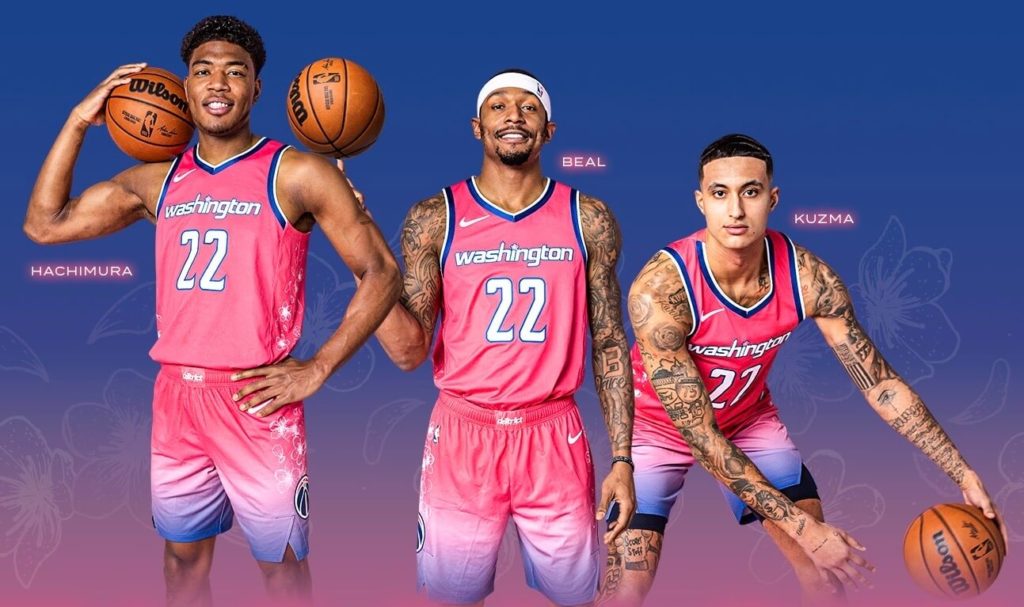
It's interesting that no professional sports team has decided to go full pink as one of their primary uni colors. It would be an amazing branding opportunity.
Fair enough as I see now, let that be a lesson to me to simply not comment on an article with little interest to me but happens rope me in for a few sentences with a particularly dopey lede.
The author must have gotten permission to repeat this even though it was a "private" Convo. This is just a way for the original source to avoid heat while still giving out the information.
> I have a good relationship with Godsey ... so I emailed him and asked if he could tell me the backstory, even if only off the record, just to satisfy my own curiosity.
> “I’m not sure I want to deal with the can of worms it will open, so I’ll tell you privately,” he wrote back.
And then the author published it. WTF? They won't have a good relationship now!
I don't understand why the author included the original reluctance, the entire part could have been replaced with "as I found out, it was for advertising. Here's the transcript of my zoom call..."
I think it's to make it clearer why Goodsey didn't just state it in his Tweet. He really was reluctant, but later decided (or got clearance) to tell it on the record.
No need to by sensational... Shortly after your quote the author wrote:
> After thinking about it for a bit, Godsey agreed to let me tell that story. Here’s a transcript of a Zoom conversation I had with him a few days ago, edited for length and clarity.
Okay, I was disgusted and quit reading right there, but I guess I should have given him a bit more of a chance. Maybe. Still a little bit disgusted, to be honest. Even if the reason was ultimately allowed to be communicated, these were still private words.