Hacker News new | ask | show | jobs
by RubyRidgeRandy 1398 days ago
All of these are well known carcinogens but it is crazy the lengths people will go to defend alcohol especially in this regard. Alcohol, in any amount, is a poison and is treated as so by the body. It breaks down into acetaldehyde and damages DNA.

I'm all for people making informed decisions on what they want to put into their bodies but informed is the operative word. There's a reason people don't associate drinking or being fat with cancer the way they do with cigarettes.

14 comments

I'm sorry to say that you are just plain wrong. Alcohol "in any amount" is not at all a poison, any more than formaldehyde (present in, for example, apples) is. At normal amounts (such as social drinking, and an occasional drink at home, or a regular glass of wine at dinner) it has never been strongly associated with increased cancer risk - in fact some studies show the the opposite. The reason alcohol shows up on this particular list is because alcohol abuse is a surefire way to get liver cancer, and if one is abusing alcohol they are often doing other things in their life that are unhealthy and may lead to other cancers. It is simply an easy flag to tease out of health data - more a signpost than anything else.
Here is a study suggesting the opposite to your claim:

   Light alcohol drinking and cancer: a meta-analysis


    Abstract

    Background: There is convincing evidence that alcohol consumption increases the risk of cancer of the colorectum, breast, larynx, liver, esophagus, oral cavity and pharynx. Most of the data derive from studies that focused on the effect of moderate/high alcohol intakes, while little is known about light alcohol drinking (up to 1 drink/day).

    Patients and methods: We evaluated the association between light drinking and cancer of the colorectum, breast, larynx, liver, esophagus, oral cavity and pharynx, through a meta-analytic approach. We searched epidemiological studies using PubMed, ISI Web of Science and EMBASE, published before December 2010.

    Results: We included 222 articles comprising ∼92 000 light drinkers and 60 000 non-drinkers with cancer. Light drinking was associated with the risk of oropharyngeal cancer [relative risk, RR = 1.17; 95% confidence interval (CI) 1.06-1.29], esophageal squamous cell carcinoma (SCC) (RR = 1.30; 95% CI 1.09-1.56) and female breast cancer (RR = 1.05; 95% CI 1.02-1.08). We estimated that ∼5000 deaths from oropharyngeal cancer, 24 000 from esophageal SCC and 5000 from breast cancer were attributable to light drinking in 2004 worldwide. No association was found for colorectum, liver and larynx tumors.

    Conclusions: Light drinking increases the risk of cancer of oral cavity and pharynx, esophagus and female breast.
[1] https://pubmed.ncbi.nlm.nih.gov/22910838/
The reply to this study from S-K Myung points out its flaws: https://www.annalsofoncology.org/article/S0923-7534(19)35822.... Further, as with all epidemiological studies on diet, there are plenty of studies showing the exact opposite (a protective effect of alcohol):

Alcohol lowers incidence of Non-Hodgkins Lymphoma: https://www.ncbi.nlm.nih.gov/pmc/articles/PMC4590626/#b32-ar...

Alcohol lowers incidence of melanoma: https://www.ncbi.nlm.nih.gov/pmc/articles/PMC4590626/#b3-arc...

Light drinking reduces leukemia incidence by 10%: https://www.ncbi.nlm.nih.gov/pmc/articles/PMC4590626/#b72-ar...

Lower risk of thyroid cancer: https://www.ncbi.nlm.nih.gov/pmc/articles/PMC4590626/#b20-ar...

Lower risk of renal cell carcinoma: https://www.ncbi.nlm.nih.gov/pmc/articles/PMC4590626/#b83-ar...

Lower risk of triple negative breast cancer in alcohol drinkers: https://www.ncbi.nlm.nih.gov/pmc/articles/PMC4590626/#b44-ar...

so ... alcohol is protective against diseases of old age?
So a significant amount, but most people would say that's an acceptable risk to continue their lifestyle. For comparison, living in an urban environment has a RR of 1.20 to 1.40 for lung cancer.

https://www.jstor.org/stable/3703988

That data is looking over a 1985-1990 / 1950-1990 time period. I wonder what the numbers are now with modern emissions improvements 30 years later, which are pretty big now!

And with electric car & electric heat pump transitions, how much better will it get on top of that going forward?

Also urban people tend to be wealthier, and also live longer.

Could it be that people who don't drink alcohol also largely don't smoke? Was that controlled for in this study?
I noted that it simply defines "light drinker" as <= 1 drink per day. It's not clear to me from reading the study how someone who drinks once every two or three days, or once a week, would be classified. The authors note some of the studies they incorporated in their results considered occasional drinking as "non-drinker" while others did not, so it seems that it was not consistent. However, it seems that in some cases the "non-drinker" category means people who completely abstain from alcohol.

Presumably you're right, they would be less likely to smoke, and I would imagine also possibly more health conscious in other ways. The authors mention that a different analysis of 15 studies of alcohol use among never-smokers was similar to their own findings, but also caution that tobacco could indeed be having an influence on their results (or even a possible synergistic effect with alcohol).

There is no safe level of alcohol, the dose dependent risk is clear in studies sibling to this comment and as flagged by WHO, but I drink it anyway well informed of the very real risk to my health.

Here's a top google result. https://www.webmd.com/heart-disease/news/20220125/no-amount-...

And a second https://www.sciencedaily.com/releases/2018/08/180824103018.h...

There's also no safe level of sun exposure. You can make lots of things sound absolutely terrifying if you're willing to abuse rhetoric.
I'm surprised by that. I would expect low enough exposure to cause abnormally low bone density and other calcium-related problems via "vitamin"[1] D deficiency.

[1] It's not really a vitamin, because we do produce it internally (as opposed to having to ingest it in diet).

On the contrary, alcohol consumption is associated with lower rates of many types of cancers, as noted in my other reply, and light/social drinking has never been associated with a reduction in overall mortality (what people actually care about).
If you can get out of bed and have a social drink,you're probably pretty healthy to begin with.

My understanding is that more modern research has unambiguously debunked the "light drinking" assertions.

But this is not something I'd expect you to be convinced of, because I don't have hard evidence on hand. We will have to leave it there, and I will go refresh my understanding some other time, if you will too :)

Nutrition Facts dot Org just published a youtube video on this subject today. The studies that associated light drinking with benefits were found to have systematic errors in more recent analysis, and after correcting for those errors researchers found that there is a linear relationship between drinking alcohol and increased cancer risk. That is, there is no drop in risks with light drinking. Any amount increases risks of cancer.

All the sources here:

https://www.youtube.com/watch?v=NEKHOvlMVIk

I doubt very much that alcohol consumption in any quantity can cause a lower rate of any cancer and I have not heard of any study providing any kind of evidence for this.

When some studies show a lower cancer rate correlated with moderate consumption of certain alcoholic beverages, e.g. wine or beer, it is much more likely that those studies show a beneficial effect of some other substances contained in those beverages.

In that case, it is likely that drinking the non-fermented precursors of those beverages might have the same effects, even in the absence of alcohol, e.g. drinking fresh grape juice instead of wine, or even better, eating red or black grapes instead of drinking juice.

Alcohol in small enough quantities may have negligible bad effects, because humans and their relatives are adapted to tolerate the ingestion of fermented fruits, but there is no reason to expect any good effects.

Slippery slope is a fallacy, but I think it's worth being aware of in the case of addictive substances and behaviors. I cringe when a health-care professional advocates for "light drinking," when the chances of it getting its hooks in anyone far outweighs whatever nebulous, tenuous health advantages it might provide. Alcohol consumption is certainly associated with alcoholism, and alcoholics certainly have lower life expectancy than non-alcoholics.
> Alcohol consumption is certainly associated with alcoholism

Breathing is, too, but the important question is what proportion of light drinkers become alcoholics. According the the first legitimate looking hit, 56% of people have had a drink in the last month, 5.6% of people have an "alcohol use disorder."

So, ignoring details, 90% of light drinkers are fine.

Heavy drinkers can have an outsized negative impacts: drunk driving, fights, wreckless stunts, abusive behavior, etc.

Heavy breathers not so much.

> alcohol consumption is associated with lower rates of many types of cancers

Associated or correlated? Which cancers?

I can remember a HN post not so long ago, linking a study, in which the result was alcohol in any amount being unhealthy. Now I don't know, if that includes carcinogenic, but you might want to look that up, before caps locking that "never". People associate all kinds of things with all kinds of other things. It seems highly unlikely, that "normal" (what is normal?) amounts have never been even associated with cancer risk.
This is just wrong. 0.5 liters of beer is already detrimental to health. Drinking a glass of wine daily does not have, on balance, a health benefit. Alcohol is not as bad as smoking, but it is a vice at any amount consumed. You do not need to defend an industry of billions for free.

I am writing this after having a couple of beers every evening for the past two weeks, and a wine tasting trip too.

I wear a fitness tracker every day, and it is extremely clear on which days I've consumed alcohol because my resting heart rate spikes by at least 5% the day afterwards. And I'm a one-beer drinker. It actually took tracking my entire food intake for about two months to figure out what was causing it.

Last time I mentioned this on HN, people here have claimed that the effect was psychosomatic.

I think people grossly underestimate the negative health effects of alcohol, and I doubt any amount of research will really change peoples minds.

Yes, I've noticed that I sleep longer and harder after having one glass of wine with dinner. It's a pretty solid correlation because I don't drink that often.
>You do not need to defend an industry of billions for free.

And you could do better by being a little less preachy and a bit more pedantic, anecdotes and opinions are not facts after all.

What specifically am I being preachy about?
You called alcohol a "vice". Definition of vice from Merriam-Webster is "moral depravity or corruption; wickedness; a moral fault or failing." You are specifically asserting that people who drink alcohol are bad people. How is that not being preachy?
I do apologize then, as this was not my intention when I chose to use this word. Instead, I meant to convey that alcohol is a net negative healthwise, not unlike smoking cigarettes or consuming large amounts of bad food.
There are many shades of meaning to "vice"; it broadly indicates a weakness of character, not necessarily to the extent of making someone a bad person. If you know that alcohol is bad for you (and the people around you) and should not be drunk, and yet you drink it anyway simply because it feels good, is this not a failure of self control?
>You called alcohol a "vice". Definition of vice from Merriam-Webster

the phrase "every man has his vice" is supposed to be interpreted as every man is corrupt and wicked?

>it is a vice at any amount consumed

Sounds like you're evaluating it through a moralistic/religious lens as opposed to unbiased scientific one. Vice is such a preachy way to frame it.

>You do not need to defend an industry of billions for free.

I don't buy from the giants. 90% of my consumption is locally produced beers from small businesses in my community.

There is no evidence to support any of your claims.
There is this - https://www.thelancet.com/journals/lancet/article/PIIS0140-6...

There's no evidence of the contrary from your side - drinking alcohol is like any abusing any other organic solvent, I can't imagine why anyone would presume it'd be any healthier.

Sorry but the study you linked doesn't support any of the specific claims from your initial post, and my other reply earlier in the thread lists plenty of evidence for a protective effect of alcohol consumption for certain cancers.
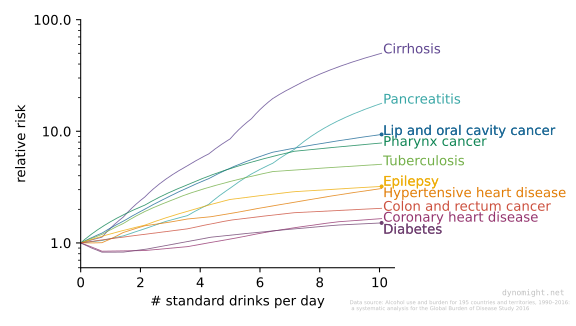
Alcohol even at a level of 1 drink a day is certainly associated with many types of cancer: https://dynomight.net/img/alcohol-trial/issues.svg

However, light to moderate drinking might reduce the risk of cardiovascular disease and diabetes and these might be enough to outweigh the extra risks from cancer. (This is still an active subject of research.)

> The reason alcohol shows up on this particular list is because alcohol abuse is a surefire way to get liver cancer,

It also very much causes esophageal cancer. I've known serious alcoholics who have died from both. It makes intuitive sense that constantly irritating your throat might cause cancer.

> alcohol abuse is a surefire way to get liver cancer

...and even then, in the vast majority of primary liver cancer cases, cirrhosis is already present, and typically precedes the cancer. So yes, it's very likely that the generally unhealthy lifestyle of the alcoholic is the primary contributor, here.

That doesn’t make much sense if the cirrhosis is also caused by the alcohol.
For acetaldehyde, you can take L-cysteine to combat its effects: https://en.wikipedia.org/wiki/Cysteine#Reducing_toxic_effect...
sunlight also damages DNA

i think most people know drinking isn’t good for you. people aren’t defending alcohol they’re defending the social value they receive from drinking; and it brings a lot. most people don’t drink that much anyway because it’s not great for you. alcohol usage is highly concentrated on alcoholics who drink like 90% of all alcohol produced

id say of these 3 the one people go to crazy lengths to avoid doing anything about is BMI. everyone knows it’s one of the biggest if they not biggest co-morbidities identified yet a good portion of the world has high BMI and does nothing about it

not only does a good portion of the world have high BMI and does nothing about it, we as a country have now gone so far as to say it's 'OK' to have a high BMI. I know in advance this comment will be misinterpreted, but it's genuinely sad that our advertisements, education, and social media all parrot the same message that it's okay to be overweight.
I think the intended message of these campaigns isn’t that high BMI is considered healthy; rather, it’s that making people feel bad for having high BMI is doing them no favors in the journey to solve a very difficult problem. They are campaigns reminding people to be nice.

I think that’s a good message. I certainly feel badly for obese people because, however they got there, they’re going to have a hell of a time getting back to a healthy body size.

I do agree that many people lose that key part of the message when they pass it on.

> rather, it’s that making people feel bad for having high BMI is doing them no favors in the journey to solve a very difficult problem. They are campaigns reminding people to be nice.

Feeling bad about your weight is a good motivator to lose weight. It might be bad for your mental health and it could do absolutely nothing for some people but the vast majority of people who keep their weight in check and/or are motivated to lose weight do so more for social reasons than they do for health reasons.

Compared to something like alcoholism, being overweight (which can be similarly deadly) is treated much differently. For alcoholism, the attitude has been changing from "alcoholics are degenerates with weak wills" to "alcoholism is a disease and these people need help" where the attitude toward obesity is going from "fat people are disgusting people who have no self control" to "big is beautiful".

The difference is with alcoholism the message goes from disdain to support but he solution remains the same, a great deal of personal work to solve the problem. With obesity, the message goes from disdain to acceptance and the solution is to just not bring it up.

> Feeling bad about your weight is a good motivator to lose weight.

Educationalist here, actually it isn't :) For many people, this just makes you feel bad - and that's it. For that feeling to result in meaningful action a bunch of conditions have to be met, e.g. the absence of eating disorders (including things like stress eating etc.), a concept of self-efficacy (the idea that one actually is able to change out of one's own will), impulse control, knowledge about food and dieting, the time and money to eat healthier and so on. Often people are perfectly aware that their behaviour is unhealthy, but they lack one or more of those conditions. It therefore is better to focus on providing people the actual means to change (knowledge, methods, better food in school and at work, a supportive environment, taxation to make unhealthy food/drugs more expensive (a thing in the EU)).

Note that I'm fully in support of emphasizing the unhealthy aspects of obesity, though. Providing the facts often just isn't enough.

> Educationalist here, actually it isn't :) For many people, this just makes you feel bad - and that's it.

Are you just asking overweight people or are you asking all people? The people who are overweight today are obviously the group of people for which social pressure is ineffective. I'm talking about all people including the people who are successfully at a healthy weight.

Some people don't respond to motivators, that isn't a reason to stop (generally) motivating.
"Feeling bad about your weight is a good motivator to lose weight"

Only if you think you have realistic chances of loosing that weight.

Otherwise that bad feeling will ... get eaten up.

Too little anxiety leads to laziness, but too much is crippling. Like most things you need to find the sweet spot.

Be anxious, not too much. Mostly over things within your control.

Sure, but if you overdo your campaign to prevent shaming (and I can say what happens now in US is definitely in that territory for quite some time), than even a slightest hint that obesity is something bad and should be actually worked on to get rid of becomes shamed too.

Then it becomes (well, became) the next taboo that nobody wants to touch with a 10 feet pole since its playing with a PR suicide.

And so we have the world we have, and we reached it step by step by exactly this logic. Simple thing is, fat people need help from society just like drug addicts, yet everybody desperately tries to avoid this framing, and thus help is often not deemed necessary/worth the risk of offending. Thus people die needlessly just that somebody doesn't have hurt feelings.

I don’t think we’re past — or even approaching — some sort of threshold where we’ve overdone compassion in America. In fact, studies have shown that the more compassion shown to fat people, the more likely they are to seek help [1].

I deal with chronic pain and I’m at the hospital or clinic frequently, often multiple times per week. As someone who is in that environment quite a bit, I can assure you that the dangers of obesity are very clearly and openly discussed; frankly, you can’t walk two steps in a hospital without seeing some sort of PSA about the dangers of obesity.

Your mental model just doesn’t track with what I’ve seen again and again in reality.

[1] https://www.ncbi.nlm.nih.gov/pmc/articles/PMC6565398/

There's absolutely no necessity to shame anyone for being fat. You can be concerned about it with your friends and loved ones, and express that concern if the relationship you have is of a character where you're busybodies about each others' health. There are very few people in your life who would appreciate or desire that criticism from you.

The people being told to shut up about it are usually abusing strangers or enemies, and feel very abused and targeted for being criticized for targeting and abusing people. If you were talking about being fat with someone you obviously care about and cares about you, they'd take it in that spirit. If you shamed them for it, they'd hopefully end that fucked up abusive relationship. The only thing I would ever shame a loved one for is their abuse of other people. Otherwise, I want to lift them up, not tear them down.

They are unfortunately mixing up the messages there. It's one thing to fight the shame associated with body appearance (this should be the real fight), and another thing to claim BMI has no significance on health risks (which is what often the argument boils down). There are people comfortable with smoking, there are people comfortable with their weight too, I just hope both know the increased risks to which they are exposed. However shaming the one or the other is just disgusting, especially when it appeals to a "tradition".
I have started to wonder if there won't be a war at some point where Survival of the Fittest becomes a very literal factor in who wins. We seem to be rapidly circling back to the military superiority of the Hoplite.
Depending on location some sunlight exposure is certainly beneficial at least part of the year. Though that doesn't mean tanning or such activities are not harmful. Comes down to the reality that some times dose really matters.
Regular sunlight exposure is correlated with lower all-cause mortality.

https://doi.org/10.1111/joim.12251

True in women according to that study. Also they didn't ask specifically about sun exposure avoidance, they asked things like "Do you go abroad on holiday to swim and sunbathe". People on dialysis don't go abroad and people who can't swim secondary to poor health don't go swimming abroad. A poorly designed study with too many confounders imo.
The point is that for individual lifestyle decisions you can't take a reductionist approach and look at individual factors in isolation. Maybe moderate sunlight exposure causes DNA damage, but so what? Does it actually reduce lifespan (or healthspan)? Probably not, or at least we don't have any reliable evidence that it does.
I agree. I think it's also reductionist to say sun avoidance increases mortality, at least based on the evidence we have.
They controlled for all the big health and lifestyle confounds, as described in the abstract, it was a huge study (1/5 of the female population of southern Sweden), they tracked the subjects for 20 years. Man if that's not good enough for you I don't think anything will be.
My issue with the study wasn't study size or duration, it was the questionarre. People who go to holiday in the mountains or go swimming are probably healthier. They could have just asked about sun exposure "how many days in the past month have you spent more than 2 hours in the sun". Also, why just study women? Did their analysis not pan out when they used men?
They asked four questions that all pertain to sun exposure and weighted them into a single metric. Seemed pretty reasonable to me. You may find interesting a recent article on how academia's stance on the benefits/dangers of sun exposure has changed in the past few decades, including that study specifically, how it was received, and what criticisms and accolades it's received.

https://www.outsideonline.com/health/wellness/sunscreen-sun-...

Also drinking too much alcohol makes you feel like shit the next day, so it's somewhat self limiting (granted, some people have less self-control while drinking than others).
> sunlight also damages DNA

Not when there is a functioning ozone layer.

Even with a functioning ozone layer, and magnetosphere.

The thing with UV light though is that it also kills surface bacteria and is involved in vitamin D production. It's very like minerals in that way. Not enough kills you, but it's easy to go from too little to way too much.

> There's a reason people don't associate drinking or being fat with cancer the way they do with cigarettes.

To be fair people are also inundated with X increases cancer risk by Y (typically marginal) amount. So much so the noise just gets tuned out. Cigarettes are one of the few things that dramatically increase cancer risk. Enough that just about everyone knows someone who caught a deadly disease from smoking.

See. You've actually fallen for it. The whole 80% of people with lung cancer are smokers means that if you smoke, you will get lung cancer.

Truth is, you will likely not get lung cancer if you smoke.

Only 6% of smokers will get lung cancer. You have a slightly worse than 19 in 20 chance of going through your whole life smoking and not getting lung cancer.

Now, in your statement itself, you move the goalpost. You start with cancer and end with "a deadly disease". Because, yeah, smoking is also linked to several other bad outcomes, not just cancer.

And it is fair to compare those other diseases when talking about why we demonize smoking way more than other things. But we can't do that by focusing on cancer. That's disingenuous.

And it is fair to say that the correct number of cigarettes to smoke is 0. The correct amount of alcohol to consume is none. And the correct BMI to be at is between 18 to 24.

As somebody working in cancer treatment; That lines up with my personal experiences, smokers are not really that overrepresented among our lung cancer patients.

They do exist, but the way this topic is usually talked about in public, and what numbers are often presented, one would have to assume the overwhelming number of lung cancer patients are smokers, but they ain't, at best they make up half, not even because most people with lung cancer stop smoking.

What is common is that pretty much everybody tried smoking at some point in their live or another, particularly when younger. That's what these "Most lung cancer patients smokers/used to smoke!" headlines are regularly based on.

But the number of people that are strict "never smokers", who never even touched a cigarette once in their live, is actually quite low. Yet those are regularly used as a comparison group.

The equivalent for alcohol would be counting every liver cancer as the result of alcohol on the basis of a patient having consumed alcohol, regardless how much or how often, before.

What are the relative risk increases for each?
The American Cancer Society claims that smoking accounts for 30% of cancer deaths in the United States (https://www.cancer.org/healthy/stay-away-from-tobacco/health...) while alcohol accounts for 4% (https://www.cancer.org/healthy/cancer-causes/diet-physical-a...)
I won’t be able to find a source for this, but I remember hearing a discussion on NPR about how hard it was to design studies to test the link between alcohol and cancer. If you rely on rates between people that drink and people that don’t by choice there are way too many other variables. You’re not going to be able to get a large population to act as a control and not drink even though they want to for 20-30 years, and on the other side of the study ideally you’d want them to drink similar amounts of alcohol.

They estimated up to 40% of cancer could be caused by alcohol consumption.

I wonder how that aligns with the percentage of people are heavy drinkers.
This [0] says that as a light (1 drink a day?) drinker, different types of cancer have a 1.04-fold to 2-fold higher risk of cancer, depending on the type of cancer

Then I found [1] saying that being cigarette smoker gives you a 25-fold higher increase for lung cancer and 2-fold for bladder cancer.

Considering amounts, and types of cancer, that seems almost incomparable. Though cigarettes sound really bad, and I’m glad I quit with vaping ;)

[0]: https://www.cancer.gov/about-cancer/causes-prevention/risk/a...

[1]: https://www.cancer.net/blog/2021-07/how-does-smoking-increas...

Cannabis as well. Is it a kneejerk reaction from the days of Prohibition? Confirmation bias on the part of drinkers? The ways alcohol is woven into social gatherings that smoking tobacco is not?

https://en.wikipedia.org/wiki/Acetaldehyde#Carcinogenicity

Eh, maybe. Lots of "poisons" have hormetic effects. Intuition isn't always a great guide here, and studies seem significantly conflicted in the "modest intake" range.
Appreciate the discussion with lots of study references, with evidence on both sides of the alcohol issue- healthy in small amounts, unhealthy in any amount, etc- with usual issues of fuzziness around categories of consumption and accuracy of surveys and variations in age and background and so forth.

Will just add that since acquiring a rather sensitive personal wearable that continuously captures various quantitative measures about my body- heart rate, temperature, heart rate variability, spo2, and others- that even with the uncertainty that stems from having a single data source- it is VERY clear quantitatively to me how much even small amounts of alcohol affect MY body.

I had a semi serious sickness earlier this year that had me entirely out of commission for a day and at reduced capability for several days. Looking just at the data, a minimal amount of alcohol (for my definition of minimal) is roughly 1/10th the negative impact of that illness. It doesn't feel that way to me, but that's what the data says. That's amazing and terrifying to me.

I am not going to make a specific wearable endorsement but do highly recommend those who have opinions on this matter to collect their own data about their own bodies. Cheers.

Agreed, I didn't even know it was a carcinogen until this year. I'm really old. Growing up it was always about it causing brain damage, no one mentioned it raised your cancer risks to such a degree. Can we make the "may cause health problems" warning made a bit more specific perhaps?

The education on alcohol could be a lot better and it shouldn't be hard. Obesity is a much harder problem to solve and I suspect we don't know all the reasons it is on the rise yet.

> no one mentioned it raised your cancer risks to such a degree

That's because it doesn't. For the kind of light social/dinner drinking most people do, there is absolutely no evidence whatsoever that it increases your cancer risk (on the contrary, there is some evidence of protective benefits, but epidemiological studies on diet are always full of confounders, so who knows). The reason it appears on lists like these is that alcohol abuse is quite common and leads to liver cancer, among other things, and is associated with other unhealthy choices.

Not according to emerging research. Long term abuse is linked to liver cancer, but even light and moderate alcohol use generally increases the risks of other types of cancers (and diseases) too.

https://www.wcrf.org/diet-activity-and-cancer/risk-factors/a...

> Alcohol, in any amount, is a poison

That's a big of a stretch. The DNA is "damaged", or better said changed, by everything. And not all alcohol beverages are equivalent. I'm all up for raising awareness at alcoholism especially due to experience in my family in the past, but this is a piss-poor job of doing so. Being alarmist about things has often the opposite effect, especially today.

And 3…2…1… cue the defence of drinking alcohol
why do you think it's bad?

people who do not drink alcohol die too and usually not at older age.

5 millions deaths worldwide is a drop in the bucket, considering things that could be prevented and are not related to people behavior (10 million people die every year of hunger, many are kids) and, most of all, even if we can correlate alcohol to those deaths (it's mostly smocking and BMI) that doesn't imply that if they did not drink they would have lived longer.

People who abuse of substances find a way to abuse of anything legal or illegal.

Car accidents cause around 1.4 million deaths and 50 million non fatal injuries (difference with alcohol being it doesn't need people to abuse of it).

Pollution is responsible for 9 million deaths/year.

Should we ban road transport?

Personally, I quit heavy boozing about five years ago and totally quit about two years ago. And personally, I can feel the difference in my mood, my behaviour, my thinking, and the effects on other around me. This applied to very light drinking, like half a pint, as well as heavy drinking - maybe six or seven pints plus extras. I tracked these things in an app so I can look back and correlate moods and drinking. Low sample size, but hey, you work with what you’ve got.

I also still spend a lot of time around heavy boozers and see how a variety of drunk people behave. So I personally see how objectively bad it is before we really get to specific health issues.

I’m not concerned with how alcohol causes death, I am concerned with how alcohol affects life.

On the health issues, the link between alcohol and cancer is clear and global studies also conclude that no amount of drinking alcohol is safe for you. On the basis that drinking alcohol is a pretty binary choice under the direct control of a human, peer pressure aside, this probably explains why people get defensive because it’s an attack - if you like - on their personal choices.

I cannot personally have an impact on whether my personal pollution emissions - cue gags - affect my health, and improvements in my own driving skills have a ceiling limit on my own safety. But booze is easy, not drinking has a disproportionate impact on me personally.

There’s a difference between banning things to improve public health and personally not partaking in them.

Me observing that people are quick to get defensive over alcohol consumption in general is poking fun at a thing called denial. I get that it’s a defence mechanism to defer anxiety, and the moment I quietly mentioned to friends I wasn’t drinking anymore I received the same defensive reaction from a few of them.

> So I personally see how objectively bad it is before we really get to specific health issues.

I understand, but that's your personal experience, which is invaluable, but not in general.

People have been drinking since we call them humans and it hasn't affected our path to progress.

Many wild animals do it too! (elephants, bears, monkeys, squirrels, bats, and many others)

I don't think people defend alcohol despite the negative effects, people think alcohol is not the problem, but the way it is consumed can be.

I've also witnessed personally the difference on how Americans drink alcohol in my city (Rome) and how we drink it. It's always surprising to me that they survive to live another day, they drink as they want to destroy themselves, we usually do it for the fun of it.

Same way a wedding or birthday cake is not responsible for obesity, but most obese people love them and eat too much of it.

> On the health issues, the link between alcohol and cancer is clear

not alcohol per se, but large amounts of it.

Almonds contain cyanide, 10 of them raw and you're in big troubles, 50, you're dead.

We simply don't eat as much of them usually.

Paracelsus said it all about it.

> acetaldehyde

Interesting. A common fruity off flavor (or desired flavor depending on what you want) of craft beer is caused by acetaldehyde being produced in the fermentation process. I wonder if certain craft beers are worse than regular beers because it contains acetaldehyde to begin with.

I'm guessing pear beer? Gave me the worst headache.

You can flush out acetaldehyde with 2 grams of Taurine before going to bed. It's probably why a big egg breakfast feels good after a long night. This isn't going to make alcohol safer, but you won't have a hang over the next day...

Craft beers are generally just higher in alcohol content. You consume more alcohol, and have a worse hangover.
I mean, frying foods creates acrylamide, which is a known carcinogen. Eating seafood exposes you to mercury. Sun exposure damages DNA.

Yes, alcohol is harmful, but in moderation, the harm is not that different than other toxins people are exposed to.

So we choose low-mercury fish and wear sunscreen. The harm is different depending on toxin (mercury vs ethanol for ex).
it's important to separate what is a threat (urban pollution) from what's a choice (abuse of substances)

One causes at least the same amount of damage of the other, but there's virtually no way to protect yourself from the former, while you can chose to quit the latter.

Another important distinction is that most people who drink (almost all of them) don't abuse of it, they consume a moderate amount of it in specific circumstances.

But they can't limit the amount of oxygen they need to survive and are forced to inhale venom from the air regardless.

These sorts of arguments just make people immediately think of Prohibition and the excesses of that era. No conspiracy required, just a knowledge of history.
We still have prohibition, it's just not for alcohol, so it's not that strange to consider. Prohibition wasn't about those kinds of health effects anyway, it was about reigning in a particularly egregious period of excess drinking as I understand it. I don't agree with it, but banning alcohol now would be a totally different situation and for different reasons.
> but banning alcohol now would be a totally different situation

Yes, because the last few decades of drug prohibition have shown how differently it works nowadays.

I did not suggest it is a good or functional policy.
I'm not saying you did, I'm just disagreeing that it would actually be a different situation nowadays. Apologies if that came across incorrectly.
Oh I see, I guess I just meant different motives and intent. I agree that it would probably play out the same though, even if the motives were health related this time.
> it was about reigning in a particularly egregious period of excess drinking

Wikipedia says it was mostly about religious moralists.

What wasn’t framed through religion back then?
Clean-shaven faces were pretty prevalent despite being technically against the bible (source: https://bible.knowing-jesus.com/topics/Trimming-Facial-Hair )
The fact that a bunch of commenters immediately came out to defend alcohol here is actually hilarious. The damage to DNA caused by acetaldehyde is very well studied, yet here we have people who likely aren't involved in biological research nor have any formal exposure to it coming out to defend their intoxicant of choice.

Nobody was saying make it illegal, yet that's what people jump to. We need to increase educational awareness of the harms of these compounds because prohibition just makes things worse. Prohibition is why there is fentanyl in the heroin supply for example.

Reading the HN comments, I didn't get the same "defending alcohol" feel you did. I think many (most?) people understand there is some risk. But, there's also risk in driving a car, eating red meat, or not sleeping enough - some just choose that the benefits they receive outweigh the risks. Life's short, eh?
Exactly life is short so why are people knowingly making it shorter?

I think you don't see them as defending alcohol because your comment is doing the exact same thing.

Many people feel the small (possible) reduction in average lifespan is worth the enjoyment or quality of life they get from those things.

Optimizing your life strictly around maximizing potential lifespan is certainly an option, but one that many people would feel is an unworthy tradeoff with what they'd have to give up.

---------

The difference with smoking vs the other things mentioned frequently in this thread (beyond likelihood of addiction), is that the reductions in lifespan with smoking are huge.

The average smoker loses at least a decade of their expected lifespan from what I can see.

Alcohol's effect on expected lifespan is more disputed, but even those claiming it's a negative in all quantities, generally make far smaller claims as to the degree of reduction for moderate/average use than are the case for smoking.

--------

Additionally, the average smoker doesn't appear to even be particularly fond of their activity. I do not meet many middle aged smokers that talk in any sort of particularly positive terms about their smoking or that seem to have positive memories associated with it.

Alcohol's effect on life span is highly disputed because the industry funds research to refute the idea. Just like the tobacco industry did.
I mean, no offense, but your tone comes off as an "I told you so" anti-alcohol comment, so I'd be careful criticizing others for their decisions. As other comments have mentioned, there are often plenty of enjoyable, social side effects that come from drinking alcohol with others in a common setting. Obviously alcohol isn't required (though, obviously people enjoy it - the taste, the side effect, whatever), but that's the way a fairly huge industry is setup in many countries.

Also, to clarify, drinking alcohol does NOT equate to making one's life shorter - that's not at all what the article discusses. Moderate drinking may have no effect, or even a positive effect, on life span.

Mu-opioid agonists have positive prosocial effects as do other GABAergics such as kava and alprazolam.

How about the prosocial effects of low doses of ketamine or other NMDA antagonists such as PCP and dextromethorphan?

Perhaps I'm anti alcohol because you can get the exact same effect from compounds with better risk profiles. Alcohol is a very old drug with a lot of risks compared to the benefit. It hammers so many different receptors, the off target effects are nuts and that's not even mentioning the risk from the toxic metabolite acetaldehyde.

There's no reason to use ethanol with so many better options for the same behavioral modifications.

Just speaking personally, but it's the social aspect. It's simply fun (subjectively, of course) to head to a brewery with some coworkers, after work, hang out in a cool environment, and sip beverages that taste good. If I lived in a bubble to maximize life expectancy, I expect I'd look back with some regrets.
If life is short, why not make the best out of it. Specially when the last years might not be most quality.
So drinking alcohol is making the most out of life? That feels a bit sad to be honest. There is way more to life than drinking