Hacker News new | ask | show | jobs
by TaupeRanger 1406 days ago
I'm sorry to say that you are just plain wrong. Alcohol "in any amount" is not at all a poison, any more than formaldehyde (present in, for example, apples) is. At normal amounts (such as social drinking, and an occasional drink at home, or a regular glass of wine at dinner) it has never been strongly associated with increased cancer risk - in fact some studies show the the opposite. The reason alcohol shows up on this particular list is because alcohol abuse is a surefire way to get liver cancer, and if one is abusing alcohol they are often doing other things in their life that are unhealthy and may lead to other cancers. It is simply an easy flag to tease out of health data - more a signpost than anything else.
8 comments

Here is a study suggesting the opposite to your claim:

   Light alcohol drinking and cancer: a meta-analysis


    Abstract

    Background: There is convincing evidence that alcohol consumption increases the risk of cancer of the colorectum, breast, larynx, liver, esophagus, oral cavity and pharynx. Most of the data derive from studies that focused on the effect of moderate/high alcohol intakes, while little is known about light alcohol drinking (up to 1 drink/day).

    Patients and methods: We evaluated the association between light drinking and cancer of the colorectum, breast, larynx, liver, esophagus, oral cavity and pharynx, through a meta-analytic approach. We searched epidemiological studies using PubMed, ISI Web of Science and EMBASE, published before December 2010.

    Results: We included 222 articles comprising ∼92 000 light drinkers and 60 000 non-drinkers with cancer. Light drinking was associated with the risk of oropharyngeal cancer [relative risk, RR = 1.17; 95% confidence interval (CI) 1.06-1.29], esophageal squamous cell carcinoma (SCC) (RR = 1.30; 95% CI 1.09-1.56) and female breast cancer (RR = 1.05; 95% CI 1.02-1.08). We estimated that ∼5000 deaths from oropharyngeal cancer, 24 000 from esophageal SCC and 5000 from breast cancer were attributable to light drinking in 2004 worldwide. No association was found for colorectum, liver and larynx tumors.

    Conclusions: Light drinking increases the risk of cancer of oral cavity and pharynx, esophagus and female breast.
[1] https://pubmed.ncbi.nlm.nih.gov/22910838/
The reply to this study from S-K Myung points out its flaws: https://www.annalsofoncology.org/article/S0923-7534(19)35822.... Further, as with all epidemiological studies on diet, there are plenty of studies showing the exact opposite (a protective effect of alcohol):

Alcohol lowers incidence of Non-Hodgkins Lymphoma: https://www.ncbi.nlm.nih.gov/pmc/articles/PMC4590626/#b32-ar...

Alcohol lowers incidence of melanoma: https://www.ncbi.nlm.nih.gov/pmc/articles/PMC4590626/#b3-arc...

Light drinking reduces leukemia incidence by 10%: https://www.ncbi.nlm.nih.gov/pmc/articles/PMC4590626/#b72-ar...

Lower risk of thyroid cancer: https://www.ncbi.nlm.nih.gov/pmc/articles/PMC4590626/#b20-ar...

Lower risk of renal cell carcinoma: https://www.ncbi.nlm.nih.gov/pmc/articles/PMC4590626/#b83-ar...

Lower risk of triple negative breast cancer in alcohol drinkers: https://www.ncbi.nlm.nih.gov/pmc/articles/PMC4590626/#b44-ar...

so ... alcohol is protective against diseases of old age?
So a significant amount, but most people would say that's an acceptable risk to continue their lifestyle. For comparison, living in an urban environment has a RR of 1.20 to 1.40 for lung cancer.

https://www.jstor.org/stable/3703988

That data is looking over a 1985-1990 / 1950-1990 time period. I wonder what the numbers are now with modern emissions improvements 30 years later, which are pretty big now!

And with electric car & electric heat pump transitions, how much better will it get on top of that going forward?

Also urban people tend to be wealthier, and also live longer.

Could it be that people who don't drink alcohol also largely don't smoke? Was that controlled for in this study?
I noted that it simply defines "light drinker" as <= 1 drink per day. It's not clear to me from reading the study how someone who drinks once every two or three days, or once a week, would be classified. The authors note some of the studies they incorporated in their results considered occasional drinking as "non-drinker" while others did not, so it seems that it was not consistent. However, it seems that in some cases the "non-drinker" category means people who completely abstain from alcohol.

Presumably you're right, they would be less likely to smoke, and I would imagine also possibly more health conscious in other ways. The authors mention that a different analysis of 15 studies of alcohol use among never-smokers was similar to their own findings, but also caution that tobacco could indeed be having an influence on their results (or even a possible synergistic effect with alcohol).

There is no safe level of alcohol, the dose dependent risk is clear in studies sibling to this comment and as flagged by WHO, but I drink it anyway well informed of the very real risk to my health.

Here's a top google result. https://www.webmd.com/heart-disease/news/20220125/no-amount-...

And a second https://www.sciencedaily.com/releases/2018/08/180824103018.h...

There's also no safe level of sun exposure. You can make lots of things sound absolutely terrifying if you're willing to abuse rhetoric.
I'm surprised by that. I would expect low enough exposure to cause abnormally low bone density and other calcium-related problems via "vitamin"[1] D deficiency.

[1] It's not really a vitamin, because we do produce it internally (as opposed to having to ingest it in diet).

On the contrary, alcohol consumption is associated with lower rates of many types of cancers, as noted in my other reply, and light/social drinking has never been associated with a reduction in overall mortality (what people actually care about).
If you can get out of bed and have a social drink,you're probably pretty healthy to begin with.

My understanding is that more modern research has unambiguously debunked the "light drinking" assertions.

But this is not something I'd expect you to be convinced of, because I don't have hard evidence on hand. We will have to leave it there, and I will go refresh my understanding some other time, if you will too :)

Nutrition Facts dot Org just published a youtube video on this subject today. The studies that associated light drinking with benefits were found to have systematic errors in more recent analysis, and after correcting for those errors researchers found that there is a linear relationship between drinking alcohol and increased cancer risk. That is, there is no drop in risks with light drinking. Any amount increases risks of cancer.

All the sources here:

https://www.youtube.com/watch?v=NEKHOvlMVIk

I doubt very much that alcohol consumption in any quantity can cause a lower rate of any cancer and I have not heard of any study providing any kind of evidence for this.

When some studies show a lower cancer rate correlated with moderate consumption of certain alcoholic beverages, e.g. wine or beer, it is much more likely that those studies show a beneficial effect of some other substances contained in those beverages.

In that case, it is likely that drinking the non-fermented precursors of those beverages might have the same effects, even in the absence of alcohol, e.g. drinking fresh grape juice instead of wine, or even better, eating red or black grapes instead of drinking juice.

Alcohol in small enough quantities may have negligible bad effects, because humans and their relatives are adapted to tolerate the ingestion of fermented fruits, but there is no reason to expect any good effects.

Slippery slope is a fallacy, but I think it's worth being aware of in the case of addictive substances and behaviors. I cringe when a health-care professional advocates for "light drinking," when the chances of it getting its hooks in anyone far outweighs whatever nebulous, tenuous health advantages it might provide. Alcohol consumption is certainly associated with alcoholism, and alcoholics certainly have lower life expectancy than non-alcoholics.
> Alcohol consumption is certainly associated with alcoholism

Breathing is, too, but the important question is what proportion of light drinkers become alcoholics. According the the first legitimate looking hit, 56% of people have had a drink in the last month, 5.6% of people have an "alcohol use disorder."

So, ignoring details, 90% of light drinkers are fine.

Heavy drinkers can have an outsized negative impacts: drunk driving, fights, wreckless stunts, abusive behavior, etc.

Heavy breathers not so much.

> alcohol consumption is associated with lower rates of many types of cancers

Associated or correlated? Which cancers?

I can remember a HN post not so long ago, linking a study, in which the result was alcohol in any amount being unhealthy. Now I don't know, if that includes carcinogenic, but you might want to look that up, before caps locking that "never". People associate all kinds of things with all kinds of other things. It seems highly unlikely, that "normal" (what is normal?) amounts have never been even associated with cancer risk.
This is just wrong. 0.5 liters of beer is already detrimental to health. Drinking a glass of wine daily does not have, on balance, a health benefit. Alcohol is not as bad as smoking, but it is a vice at any amount consumed. You do not need to defend an industry of billions for free.

I am writing this after having a couple of beers every evening for the past two weeks, and a wine tasting trip too.

I wear a fitness tracker every day, and it is extremely clear on which days I've consumed alcohol because my resting heart rate spikes by at least 5% the day afterwards. And I'm a one-beer drinker. It actually took tracking my entire food intake for about two months to figure out what was causing it.

Last time I mentioned this on HN, people here have claimed that the effect was psychosomatic.

I think people grossly underestimate the negative health effects of alcohol, and I doubt any amount of research will really change peoples minds.

Yes, I've noticed that I sleep longer and harder after having one glass of wine with dinner. It's a pretty solid correlation because I don't drink that often.
>You do not need to defend an industry of billions for free.

And you could do better by being a little less preachy and a bit more pedantic, anecdotes and opinions are not facts after all.

What specifically am I being preachy about?
You called alcohol a "vice". Definition of vice from Merriam-Webster is "moral depravity or corruption; wickedness; a moral fault or failing." You are specifically asserting that people who drink alcohol are bad people. How is that not being preachy?
I do apologize then, as this was not my intention when I chose to use this word. Instead, I meant to convey that alcohol is a net negative healthwise, not unlike smoking cigarettes or consuming large amounts of bad food.
There are many shades of meaning to "vice"; it broadly indicates a weakness of character, not necessarily to the extent of making someone a bad person. If you know that alcohol is bad for you (and the people around you) and should not be drunk, and yet you drink it anyway simply because it feels good, is this not a failure of self control?
Although the slippery slope is a fallacy, down the road you speak is monkhood and the productivity optimization cult of recent times.
>You called alcohol a "vice". Definition of vice from Merriam-Webster

the phrase "every man has his vice" is supposed to be interpreted as every man is corrupt and wicked?

>it is a vice at any amount consumed

Sounds like you're evaluating it through a moralistic/religious lens as opposed to unbiased scientific one. Vice is such a preachy way to frame it.

>You do not need to defend an industry of billions for free.

I don't buy from the giants. 90% of my consumption is locally produced beers from small businesses in my community.

There is no evidence to support any of your claims.
There is this - https://www.thelancet.com/journals/lancet/article/PIIS0140-6...

There's no evidence of the contrary from your side - drinking alcohol is like any abusing any other organic solvent, I can't imagine why anyone would presume it'd be any healthier.

Sorry but the study you linked doesn't support any of the specific claims from your initial post, and my other reply earlier in the thread lists plenty of evidence for a protective effect of alcohol consumption for certain cancers.
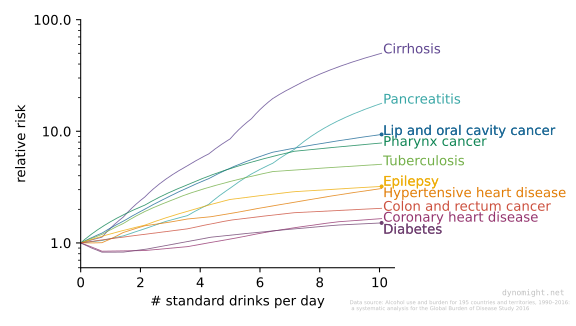
Alcohol even at a level of 1 drink a day is certainly associated with many types of cancer: https://dynomight.net/img/alcohol-trial/issues.svg

However, light to moderate drinking might reduce the risk of cardiovascular disease and diabetes and these might be enough to outweigh the extra risks from cancer. (This is still an active subject of research.)

> The reason alcohol shows up on this particular list is because alcohol abuse is a surefire way to get liver cancer,

It also very much causes esophageal cancer. I've known serious alcoholics who have died from both. It makes intuitive sense that constantly irritating your throat might cause cancer.

> alcohol abuse is a surefire way to get liver cancer

...and even then, in the vast majority of primary liver cancer cases, cirrhosis is already present, and typically precedes the cancer. So yes, it's very likely that the generally unhealthy lifestyle of the alcoholic is the primary contributor, here.

That doesn’t make much sense if the cirrhosis is also caused by the alcohol.
For acetaldehyde, you can take L-cysteine to combat its effects: https://en.wikipedia.org/wiki/Cysteine#Reducing_toxic_effect...