The .gif comparison was a bit... upsetting since the color palettes are so limited and the resolution is so low, so it really didn't put JWST _or_ Hubble in a good light.
It looks like restoration of an old painting where the aged, yellowed varnish is stripped away to reveal the (much brighter and more detailed) original painting below.
No. Webb looks deeper into the infrared and can see galaxies that Hubble can't see. There're some red galaxies in Webb (upper-right especially) that aren't in Hubble's at all.
All the very red galaxies in the JWST image are mostly or completely invisible in the Hubble image. That’s because they’re so redshifted that they’re out of the spectrum Hubble can see. Those are the galaxies that are really far away.
Here's a variant of that GIF that separates out the blue, blue+green, and blue+green+red channels, to (hopefully) highlight which differences are due to the longer wavelengths (and which look more like exposure time difference). Webb's color mapping roughly aligns with the RGB channels, so I think this is meaningful [0].
Comparing both images, there is a perfectly round red dot that's just a few pixels wide, a little up from the most prominent star, which doesn't correspond to another object in Hubble's image. Is that an image artifact or some laser guide?
Could be an internal reflection. The optical path for many JWST instruments is, uh, compact: https://www.esa.int/ESA_Multimedia/Videos/2021/09/Webb_MIRI_... (Every kilo on telescope structure you save by folding the optical path is a kilo you can add in propellant, extending the working life of the spacecraft)
Instrument internals are painted black and heavily baffled, but nothing in optics is perfect. Dithering the direction the telescope is pointed in and image stacking should cancel out most optical artifacts, but internal reflections will be worse for bright objects like stars, which JWST probably isn't usually going to be observing with the imaging instruments.
It is a bit suspicious looking, but there's a lot of very red objects that the Hubble image doesn't catch. Presuming that the red colors in the images are the deeper infrared wavelengths (and thus the most heavily-redshifted objects) I would guess that Hubble just didn't have the detectors to see those.
Yes, that's generally true. Galaxies that are redshifted are moving very fast relative to us. But the only reason for them to be moving so fast is due to the expansion of the universe, and these galaxies being sufficiently far away.
The large white elliptical galaxies in the center of the image are in the "foreground", while the orange-ish galaxies are much farther away in the background. This is why the light from the more distant galaxies is curved and distorted by the foreground objects, creating the lensing effect that we see.
Hubbles law says that astronomical objects that are further away also move away from us more quickly with the constant of proportionality being the Hubble constant
Incredible. If each of those galaxies has on average a few hundred billion stars (our is estimated to have between 100b-400b), and each of those little dots is an entire galaxy, well, that's a lot of stars in this image.
I think you're referring to the age of the universe here? But due to inflation, although the universe is 13 billion years old, the observable universe is quite a bit bigger than that (i.e. we can see stars much further than 13 billion light years away).
Since we're looking at objects billions of light years away, we're looking billions of years into the past. In the context of extragalactic life, it's a bit sad to me that even if we somehow spotted it at those insane distances, in the early versions of those galaxies we see, odds are that it'll be gone by now, and we'll likely be gone by the time any lucky photons born in our solar system can reach those places, too. Even so, it's cool to think that the odds of life being out there somewhere in a universe so vast are really quite good, inaccessible as it may be.
Or maybe not. If you consider how improbable is the origin of life on the earth then maybe it's not even enough planets in the observable universe to start a life. But the universe is much greater than its observable part.
What is the probability of life originating on earth?
We know it is anywhere from 0 (originated elsewhere and found its way here) to 1 (originated here and is guaranteed to originate given the conditions). I don't think we have enough data points to determine improbability yet.
What is the probability of life originating in the universe? We know it is definitely greater than 0..
Humanity has found aminoacids in asteroids. Given enough time and energy, it seems likely to me that structures would form and then evolve in complexity.
Agreed. I realized recently that planets not only need a goldilocks configuration but likely also need to have a liquid metal core to create a protective magnetic field.
It would still occur quite a bit, and some planets with a protective field likely still produce simple life forms.
Some of those shapes are just incredible, like the 4th that looks like a glimpse of what will happen shortly after the Milky Way and the Andromeda Galaxy will collide in a few billion years.
Mainly because most of the pictures I usually see of the galaxies in space, they appear as practically identical dots. Never before I've seen this level of detail and the variety of shapes. Each of these galaxies have billions of stars and planets and they are billions of such galaxies. I know we have read these numbers before but just seeing them "up-close" like this in such a small section just makes it that much more real.
Just imagine how much more vivid they would appear once the technology progresses ever further.
> Mainly because most of the pictures I usually see of the galaxies in space, they appear as practically identical dots. Never before I've seen this level of detail and the variety of shapes.
Do you mean these specific galaxies? If not, you can see many galaxies in amazing detail with very modest equipment. If you know what you're looking for you can faintly see Andromeda with the naked eye.
I think I did see one of them and it was pretty amazing but James Webb images are on a new level. Also, I did know Hubble but didn't know the name Hubble Deep Field - thanks for mentioning that because I searched for it and found this:
I always wonder if we had a sensitive enough instrument, would it get more difficult to pick out individual galaxies? Or, are there enough galaxies that an image taken by a very sensitive telescope would have no black areas?
Highly recommend the full-res image - brings out a great deal of character from a lot of the galaxies that is just not visible in the zoomed-out image.
How about 1.4 Gigapixel image of the galaxy? The new photos by @NASAWebb are stunning. Let's Enhance's AI made them super high res for you to enjoy the clearest view of the Universe.
I couldn't find an exact exposure time for the Hubble image, the press release by the ESA has this quote though:
"This deep field, taken by Webb’s Near-Infrared Camera (NIRCam), is a composite made from images at different wavelengths, totaling 12.5 hours – achieving depths at infrared wavelengths beyond the Hubble Space Telescope’s deepest fields, which took weeks." [1] There is also another comment further down this thread stating Hubble was 140 hours. [2]
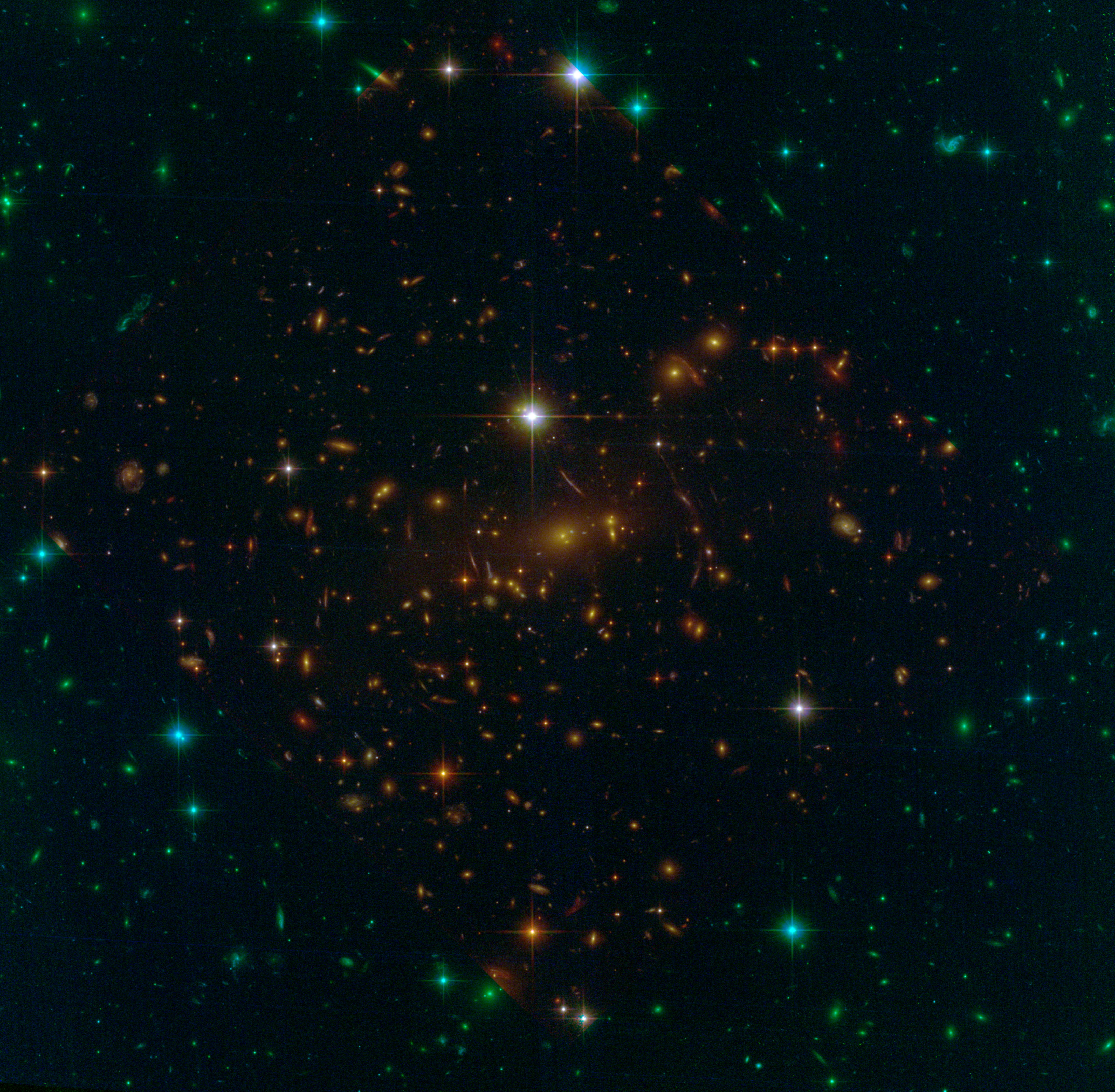
Those exposure times (weeks / 140 hours) are for these images [0,1], Hubble's deep fields. Hubble's photo of this galaxy cluster, the one our root comment shows superimposed over JWST's, took 5 Hubble orbits [2]. I think that's around 2-3 hours of exposure time.
(If you want to verify [2] is talking about the same photo, you can retrieve it from the "SMACS J0723.3-7327" row, from the "Color Images" column/field).
Yes, but Earth obstructs the field of view for about half that time. The way HST refers to an "orbit" for scheduling, only part of the elapsed time is usable observational time, for a single target.
- "HST GO observing time is counted in terms of orbits. Each 96-minute orbit contains a certain amount of useful time when the target can be observed, called the orbital visibility period..."
> This deep field, taken by Webb’s Near-Infrared Camera (NIRCam), is a composite made from images at different wavelengths, totaling 12.5 hours – achieving depths at infrared wavelengths beyond the Hubble Space Telescope’s deepest fields, which took weeks.
12.5 hours total exposure for the JWST image, "weeks" for the HST image
Is the actual comparison HST image being used here from the hubble deep field?
EDIT: Doesn't look like it is -- it is from a more recent 2019-published study of SMACS J0723.3-732 as part of the Reionization Lensing Cluster Survey (RELICS).
Although that paper does mention that this image is the deepest image of the Universe to date, and that the Fine Guidance Sensor image may be the second deepest, both exceeding the Hubble Deep Field image.



https://blog.wolfd.me/hubble-jwst/
The .gif comparison was a bit... upsetting since the color palettes are so limited and the resolution is so low, so it really didn't put JWST _or_ Hubble in a good light.