Hacker News new | ask | show | jobs
by hesdeadjim 1462 days ago
As a AMD fanboy who loves seeing them back on top, I’m just happy we have a competitive CPU market now. I’ll include the M-series from Apple as well, despite being platform locked, because it also forces the other players to up their game.

I would love to see an AMD chip as fully integrated as an M1, moving the RAM fully on die and part of the Infinity fabric directly. The insane memory bandwidth of the M1 is what keeps it competitive.

5 comments

Yes! How awesome is it that we've got companies like AMD, Intel, Nvidia, ARM, Apple + TSMC for M series, and others who are cranking out awesome products?

Sometimes we get lost in the criticism of every little thing that these companies do and forget that honestly, they're all cranking out great products.

we need a fab competition as well. too many fabless like AMD, Apple...etc. deepened on TSMC
Intel is working on expanding their fab capacity and contracting it out like TSMC and Samsung.
ASML deserves mentioning as well.
Don't forget ZEISS
No.

Monopolies don't deserve credit.

They hold a monopoly of merit, many tried EUV and they succeeded in doing something that others were calling impossible even 5 years before they shipped it, not by shutting down competition but simply because no one else could.

The idea that ASML would somehow be more worthy of merit if Nikon/Canon also succeeded is weird.

Would the moon landing me more impressive if Russia and Japan also managed it?

Exactly correct. They're literally more deserving of credit because they've done something that to this day nobody else has been able to do.
Hopefully some serious competition and general normality will return to consumer discrete GPUs sometime soon, too.
I don't know about competition, but I think we'll see prices bottom out below MSRP before the 4000 level cards come out in the next few months.
Do you think so, because the crypto craze is back in the crypt?
We're already close to that point. Low to mid-end AMD cards are already available at / below MSRP (e.g. 6600XT), and nVidia cards no longer command a > 2x premium across the board.

At the height of the craze, I saw a five-year-old card, the GTX 1050 (not even Ti!), going for over 200.

https://pcpartpicker.com/trends/price/video-card/

From February: https://www.techradar.com/deals/looking-for-a-gpu-dont-buy-y...

Yep, the secondhand market is getting flooded.
GPU prices are already coming back to earth, thanks to both improved availability and the collapse of crypto mining.
I would love to see an AMD chip as fully integrated as an M1, moving the RAM fully on die and part of the Infinity fabric directly. The insane memory bandwidth of the M1 is what keeps it competitive.

I know this has been said a million times, but it's worth repeating because somehow the idea is still floating around – the M series very much does not have the RAM on-die. It's not even in the same package – it's standard LPDDR4/5 sitting off to the side with a lot of channels.

So the novel ("novel") idea that M1 is bringing is using high bandwidth LPDDR5 for desktop CPU memory, where it's currently typically used only for mobile CPUs. [1] Intel and AMD CPUs technically support LPDDRx, but no manufacturer exploits this for some reason. [2]

[1]: https://www.bgr.in/top-products/best-phones-with-lpddr5-ram-...

[2]: See other thread. :)

> I would love to see an AMD chip as fully integrated as an M1, moving the RAM fully on die and part of the Infinity fabric directly.

Current rumours suggest that's where AMD is heading, Zen 5 having multiple accelerators integrated and Zen 6 having HBM part of the package (on the datacenter variants):

https://youtu.be/6yFn85I5PbY?t=1222

The memory in an M1 is not "on die" it is plain old DRAM that they buy from the Koreans and solder to the board just like Intel and AMD and everyone else. DRAM is made on a fundamentally different semiconductor process and there will never, ever be a CPU with on-die DRAM. DRAM that can be made on a CPU logic process is called eDRAM. A huge eDRAM is a few tens of megabytes, while a huge DRAM is gigabytes. The bit cell density of eDRAM is slightly better than SRAM and 1000x lower than DRAM.
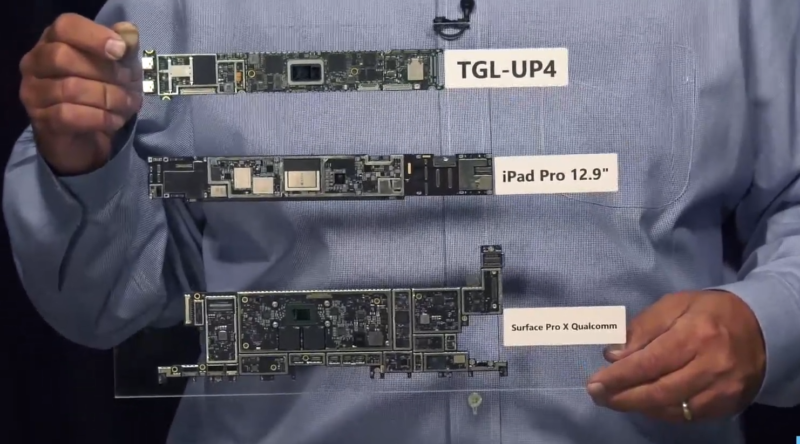
I think the person you are responding too used the wrong vocabulary. Apple mounts the SoC and DRAM together in a system-in-a-package design, which is pretty different from how thin & light x86 manufacturers solder DRAM chips to the mainboard. The proximity between the SoC and DRAM is part of what makes the M1s bandwidth possible.
The M1's bandwidth is possible because Apple uses high end LPDDR ram and a memory controller with a lot of channels. They aren't doing anything exotic.

Consumer PCs don't match this bandwidth because DDR DIMMs generally aren't as fast as LPDDR. Plus AMD & Intel limit their mainstream consumer CPUs to two memory channels, both for cost savings and to segment the market.

> Consumer PCs don't match this bandwidth because DDR DIMMs generally aren't as fast as LPDDR.

What about LPDDR (low-power DDR) allows it to be faster? And, by faster, do you mean lower latency? higher clock rates -> higher throughput? This is unintuitive to me.

My impression is that lower power means that you can't sustain higher clocks as readily (in fact, when overclocking RAM, it's common to increase voltage in the interest of stability).

I can't find anything about CAS latencies for LPDDR DIMMs.

edit: to clarify: when overclocking RAM, your two options are either increase voltage or increase timings, as if you want to sustain higher speeds, you need to either charge your capacitors faster, or wait more cycles for them to be charged.

> What about LPDDR (low-power DDR) allows it to be faster? And, by faster, do you mean lower latency? higher clock rates -> higher throughput? This is unintuitive to me.

By faster I mean higher throughput at similar latency, achieved by higher clock rates. And it is indeed unintuitive as to how this can be done while using less power than standard DDR.

My understanding is that it's down to two major factors:

1. JEDEC has iterated on the LPDDR standards much more rapidly. DDR4 and LPDDR3 both hit the market in 2012. But then LPDDR3e, LPDDR4, LPDDR4x, and LPDDR5 were all introduced before DDR5 was.

2. LPDDR isn't available on DIMMs, it's soldered only.

So given that most laptops sold by companies like Dell and Lenovo use soldered ram anyway, and that Intel and AMD both support LPDDR, then why are PC laptops with faster RAM so rare? I have no idea, maybe it costs a bit more and the manufacturers don't think they can market it as a benefit?

The DRAMs in an M1 system are not really any closer to the CPU than they are in competing ARM and x86 systems.

https://cdn.arstechnica.net/wp-content/uploads/2020/09/tiger...

I should have said "on package", not "on chip".
All this makes me wonder where the Crystalwell concept could have gone if Intel had really stuck it out.
As someone who has recently bought into AMD from a long hiatus, I have to say they've come a long way since and I've been personally impressed with what I've experienced so far on the hardware side. That said, the reverse can be equally said on other matters pertaining to their business as well; more specifically their customer support pertaining to RMA's as of late. Mind you, this is all a personal anecdote so take with a grain of sand.
Agreed, in it's heyday (before Intel dominated in PC era), AMD was my go-to for performance processors.
>As a AMD fanboy who loves seeing them back on top

I am not a fanboy, but a realistic dude.

AMD ruled the last years but Alder Lake overtook Vermeer on both performance and price/performance.

And that is with a process node difference, Intel using 10nm vs AMD using 7nm.

And the future looks like Intel will enhance the distance between its performance and AMD's.

Alder Lake and zen 3 are on comparable processes. Intel 10nm, now renamed Intel 7, has pretty much the same density as tsmc 7nm.
And N7 is almost certainly cheaper (holistically) than Intel 7, from an economic perspective AMD have done more with less.
>Alder Lake and zen 3 are on comparable processes.

Intel didn't use EUV, so no.

I think Intel stands to regain some lost ground over the next year or two, but Alder Lake isn't a compelling argument in a datacenter-focused discussion.

Alder Lake relies on brute force, inefficient power consumption to regain the performance crown. AMD's chips are much more efficient, and efficiency matters in datacenters. There is only so much power and cooling available to each rack unit.

I think Sapphire Rapids holds a lot of promise, but it remains to be seen.

You are right. But parent comment was about desktops, not data centers.

And in desktops performance is what matters. And price/performance ratio, and both are in Intel's favor.

This HN topic is about cloud, and I don’t see anything in the comment you replied to that’s talking about desktop computers specifically.

Both Intel and AMD have plans to integrate memory more tightly onto the package of their datacenter processors in the next couple of years, IIRC, and that seems to be what the OP of this comment thread was hoping they would learn from M1.

But, whatever.

Take a note, that node sizes of different factories aren't comparable, because they are measured quite differently. You can only compare TSMC v TSMC, Intel v Intel etc.
True, but Intel is still lagging at least one node behind TSMC, by whatever way you can measure.
Against apple and I believe amd’s new offering this fall. Not amds last offering.
if by "enhance the distance" you mean Intel will fall farther in terms of price and performance to AMD, you're probably right.