Hacker News new | ask | show | jobs
by WithinReason 1462 days ago
> I would love to see an AMD chip as fully integrated as an M1, moving the RAM fully on die and part of the Infinity fabric directly.

Current rumours suggest that's where AMD is heading, Zen 5 having multiple accelerators integrated and Zen 6 having HBM part of the package (on the datacenter variants):

https://youtu.be/6yFn85I5PbY?t=1222

2 comments

The memory in an M1 is not "on die" it is plain old DRAM that they buy from the Koreans and solder to the board just like Intel and AMD and everyone else. DRAM is made on a fundamentally different semiconductor process and there will never, ever be a CPU with on-die DRAM. DRAM that can be made on a CPU logic process is called eDRAM. A huge eDRAM is a few tens of megabytes, while a huge DRAM is gigabytes. The bit cell density of eDRAM is slightly better than SRAM and 1000x lower than DRAM.
I think the person you are responding too used the wrong vocabulary. Apple mounts the SoC and DRAM together in a system-in-a-package design, which is pretty different from how thin & light x86 manufacturers solder DRAM chips to the mainboard. The proximity between the SoC and DRAM is part of what makes the M1s bandwidth possible.
The M1's bandwidth is possible because Apple uses high end LPDDR ram and a memory controller with a lot of channels. They aren't doing anything exotic.

Consumer PCs don't match this bandwidth because DDR DIMMs generally aren't as fast as LPDDR. Plus AMD & Intel limit their mainstream consumer CPUs to two memory channels, both for cost savings and to segment the market.

> Consumer PCs don't match this bandwidth because DDR DIMMs generally aren't as fast as LPDDR.

What about LPDDR (low-power DDR) allows it to be faster? And, by faster, do you mean lower latency? higher clock rates -> higher throughput? This is unintuitive to me.

My impression is that lower power means that you can't sustain higher clocks as readily (in fact, when overclocking RAM, it's common to increase voltage in the interest of stability).

I can't find anything about CAS latencies for LPDDR DIMMs.

edit: to clarify: when overclocking RAM, your two options are either increase voltage or increase timings, as if you want to sustain higher speeds, you need to either charge your capacitors faster, or wait more cycles for them to be charged.

> What about LPDDR (low-power DDR) allows it to be faster? And, by faster, do you mean lower latency? higher clock rates -> higher throughput? This is unintuitive to me.

By faster I mean higher throughput at similar latency, achieved by higher clock rates. And it is indeed unintuitive as to how this can be done while using less power than standard DDR.

My understanding is that it's down to two major factors:

1. JEDEC has iterated on the LPDDR standards much more rapidly. DDR4 and LPDDR3 both hit the market in 2012. But then LPDDR3e, LPDDR4, LPDDR4x, and LPDDR5 were all introduced before DDR5 was.

2. LPDDR isn't available on DIMMs, it's soldered only.

So given that most laptops sold by companies like Dell and Lenovo use soldered ram anyway, and that Intel and AMD both support LPDDR, then why are PC laptops with faster RAM so rare? I have no idea, maybe it costs a bit more and the manufacturers don't think they can market it as a benefit?

> So given that most laptops sold by companies like Dell and Lenovo use soldered ram anyway, and that Intel and AMD both support LPDDR, then why are PC laptops with faster RAM so rare? I have no idea, maybe it costs a bit more and the manufacturers don't think they can market it as a benefit?

For consumers, the primary application that benefits from higher RAM bandwidth is real-time graphics rendering, and non-Apple PCs optimize for this by using discrete GPUs with their own onboard high-bandwidth memory.

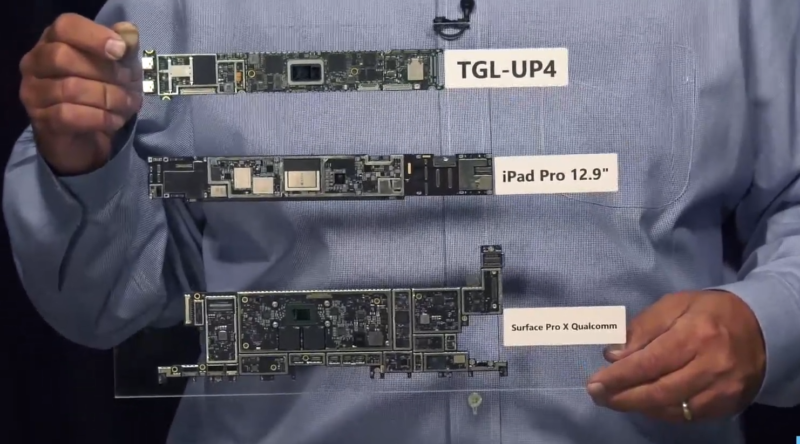
The DRAMs in an M1 system are not really any closer to the CPU than they are in competing ARM and x86 systems.

https://cdn.arstechnica.net/wp-content/uploads/2020/09/tiger...

I should have said "on package", not "on chip".
All this makes me wonder where the Crystalwell concept could have gone if Intel had really stuck it out.