I don't think anybody operates under the delusion that the Federal Reserve isn't applying policy to the economy? That's in stark contrast to the seemingly common delusion that cryptocurrency economics are uniquely free of manipulation.
Well duh, that is the whole point of the fed - tweaking the dials to smooth out the peaks and troughs. Sometimes that doesn’t work, or works only after the fact, but the last 70 years or so has been fairly smooth sailing compared to what came before.
The worst is when it works to smoothen out the peaks but the cost is silently screwing over poor people. So everyone at the top can pat themselves on the back, and people in the middle start blaming capitalism.
1. The chairman of the Fed may not be a directly elected position but is still indirectly elected, because they are appointed by the president and must be confirmed by the senate. Saying they're not democratically elected is about as true as saying the secretary of defense is not democratically elected. Technically true, but mostly irrelevant.
2. You vastly overstate the power of the chairman of the Fed. It's not like Powell can have a bad day and decide to nuke the world. He's more powerful than most people, but society hardly depends on him.
Every time we have seen a government take control over the money printing press, it ended spectacularly bad. There is a reason why most governments have agreed that the central banks need to be as impartial and independent as possible - and countries like Turkey are proving it at the moment.
Just imagine someone like the 45th being able to order the Fed around in a way similar to Erdogan. Complete, utter horror.
Seriously though this is a very wrong analogy. The economy is more like an ecosystem where individuals interact with themselves & the environment. It doesn't need continuous manipulation. In fact it tends to distort than aid.
The economy is not like an ecosystem since there is no reciprocation. Money flows in one direction only, toward the top. I find it particularly frustrating that people don't see the economic distortion caused by monopolies in the private economy, they think it must be the government's doing when it tries to undo some of the harm caused by them.
It's a fact that the majority of wealth increase has gone to the already wealthy over the last few decades. So while not literally true (clearly some money flows in other directions), it is broadly correct.
It's known as the "it's cheaper to be rich" paradox.
You save on buying in bulk and using better made products with longer lifespans, afford better education that makes you more difficult to fool and gets you a higher paying job, make more returns by investing more money, conserve willpower for important decisions by not having to choose between soap and bread at the store.
I find it useful thinking in ecosystem terms as a model. And ultimately, the economy is situated in a real ecosystem and not an abstract manifestation.
>> The economy is not like an ecosystem since there is no reciprocation
If mutual beneficial trade is not reciprocation, then I don't know what is. Reciprocity is more a societal thing than an economic one. I would say historically there have always been reciprocal societies. Smaller ones tend to be more reciprocal than larger ones since their survival depends on it.
>> Money flows in one direction only, toward the top
This is by design i.e intervention. It need not be so.
And there is nothing preventing a species from colonizing an habitat till it exhausts the resources and it's own ultimate demise.
Monopolies, by and large are formed (and broken) by government aid/intervention.
Post the industrial revolution, the government has become involved in more and more areas of the economy, so much so that now it has become the chief driver, to stimulate growth, reduce inflation, boost employment/industries. Given the complexity of interactions in the real world, I don't understand how someone can believe they can understand everything and control it.
Regarding your other comment, I agree, the notion of exponential growth is ridiculous and runs into real world limits.
The idea that monopolies are formed due to government intervention runs counter to my lived experience of watching the Google Search and Facebook monopolies form in largely unregulated markets. The only viable competitors to Facebook were acquired before they could become a threat, Google meanwhile has used its search monopoly to fund monopolistic takeovers of other markets (web browsers come to mind).
You also get into the regulatory capture. Could anyone today create another YouTube with all of the necessary content controls for all the different countries in place? Or create a baby formula making company for current events?
It's possible - just it represents a significant amount of work that needs to be invested in the product before it can see the light of day (compared to other domains where there's less needed to invest).
>> Just like driving a car proves impossible without continuous manipulation by its driver.
> cue autonomous vehicles
In my analogy, the driver can be a machine.
> Seriously though this is a very wrong analogy. The economy is more like an ecosystem where individuals interact with themselves & the environment. It doesn't need continuous manipulation. In fact it tends to distort than aid.
It does if you want to to go where you want to go. Take that away, and it'll drive off a cliff. Maybe eventually it will correct itself, but that'll take too long to help us.
The economy gathers outside energy as the production of value, which is what the vast majority of companies do, and some of it disappears out the other end as consumption of goods with value.
It's perfectly true that the system is perfectly capable of running alone without any external stimulus applies. The economy will keep being the economy no matter how much you tamper with it. The main problem people have with that is not that the economy won't "work", it's that the economy working necessarily means things like heavy business cycles, cyclical unemployment, a general tendency of wealth to move upwards, and a relatively fast accumulation to the level where those who have accumulated wealth begin to have serious power over politics and will impose meddling with the economy for their benefit.
It will work fine, it working just isn't what humans generally want to happen.
That isn't working fine. Any properly working economy is able to represent negative yields and thereby solve the wealth accumulation and unemployment problem.
The idea that your wealth ought to grow exponentially regardless of whether the economy itself is growing and how much you contributed to the economy is ridiculous. What did people expect from this arrangement other than accumulation of wealth at the top?
By the way, the economy won't work, it will collapse at some point, because 3% growth over two thousand years would imply colonizing entire galaxies. People think they have a birthright to eternal 3% growth without even being aware of what it means to grow exponentially for that long.
Thomas piketty already discovered that the growth rate of the economy must be higher than the rate of return on capital. Not all returns actually go to 0% due to monopolies, etc. This means those returns have to be taken from someone else and forcibly growing the economy is just a bandaid so people don't lose what they already have to the rich owners of monopolies.
It is literally their job: The mission of the Federal Reserve System is to foster the stability, integrity, and efficiency of the nation's monetary, financial, and payment systems so as to promote optimal macroeconomic performance.
"When a measure becomes a target, it ceases to be a good measure."
The idea behind prices in a market economy is that they're an information-carrying abstraction. They let producers at every stage of the value chain understand the relative costs that go into different alternate ways of producing a good, without needing to understand every single stage of the supply chain and all the decisions that their suppliers made. And it also gives them information about relative demand, so that producers which make things that nobody want go bankrupt and those make things that lots of people want rake in windfall prices.
The whole point of the Fed is to alter prices, on one hand to keep producers from raking in windfall prices (price stability) and on the other to prevent too many of them from going bankrupt all at once (full unemployment).
Problem is that when you do this too much, for too long, the biggest input to a firm's production decisions becomes the Fed funds rate. When it goes up, time to layoff people, because the cost of capital just went up and you can't do anything without capital. When it goes down, time to go on a hiring frenzy because if there's money for the taking and you're not the one taking it, you get outcompeted by the ones who are. Over time this begins to dominate all other signals that pricing normally provides, like producing goods efficiently and making things lots of people want. You get companies like Uber, which lose money on every transaction but make it up in fundraising.
In turn this increases sensitivity to the Fed's actions, which limits their freedom to take them. If the whole economy breaks when you raise rates to 1.5% (as happened in 2019), it becomes very hard to raise rates above 1.5%. So rates get pegged below the natural rate of interest (which equilibrates supply of savings with demand for productive investment), lots of economically dubious projects get funded, you inflate a perma-bubble, and you can't deflate it without taking down the whole economy.
> The idea behind prices in a market economy is that they're an information-carrying abstraction.
No, the idea behind prices is that they are what the participants in particular trades think it is worth trading at.
The normative argument for the superiority of laissez-faire economies may involve market prices as an information carrying mechanism, but that normative argument is much newer than market economies, and is not the “idea behind prices in a market economy”. The benefits some people see (or imagine) in something after the fact are not the underlying purpose of the thing.
They aren’t. They are different, and one is actually the “idea behind prices in a market economy”, and the other is an academic argument, observing the fact of price setting in a market economy, for why price setting in a market economy is valuable to others besides the direct participants in the individual exchanges.
> Aren’t they, in fact, mutually dependent?
No, there is a one-way dependency between them. The normative argument depends on the fact, but not vice-versa.
> So rates get pegged below the natural rate of interest (which equilibrates supply of savings with demand for productive investment)
But the only body even attempting to determine what "productive investment" is and respond to it is the Fed. Savers are interested in money returns or at least preserving their holding which in many feasible circumstances (chronic instability, zero sum economies with fixed currency supply) is most reliably achieved by not investing in anything productive, not whether their investment makes optimal use of a country's productive capacity. There's nothing more "natural" about production decisions taking the spot price of a commodity the monetary authority has designated as money, or an arbitrary growth rate for money, or how badly undercapitalised wildcat banks are as inputs, and there's nothing about a regime not trying to avoid bubbles or busts that makes it inherently less likely to result in them.
But that's not true: every individual household and business is trying to maximize their profits (or at least, those that aren't are replaced by those that are), reducing their expenditures and increasing their revenues. In the presence of a stable money supply and stable prices, the only way to do this is through innovation and better efficiency: you reduce the value of your inputs, or you increase the value of the outputs. In the presence of external variations in the cost of capital, it becomes more profitable to capture that external capital than it is to increase efficiency.
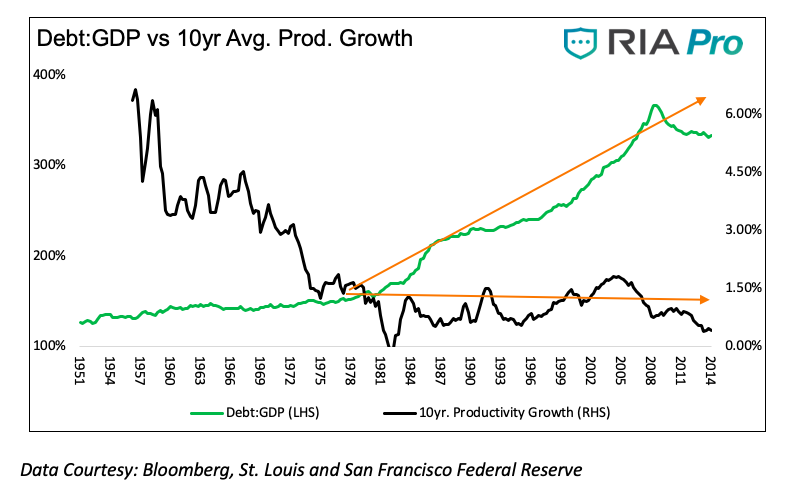
Peter Thiel and many other observers have noted that American innovativeness and productivity growth fell off a cliff c. 1971 [1]. He blames government regulation; however, a more likely explanation is that Nixon turned the U.S. dollar into a fully-fiat currency right around then, incentivizing people to compete for newly-created dollars rather than capture more of the ones circulating through the economy.
The causality might run the other way around too, as the Fed holds rates artificially low to paper over low real productivity growth, but this is not an improvement: it just means that we have a feedback loop between money-supply growth, inflation, and low real economic growth.
> In the presence of a stable money supply and stable prices, the only way to do this is through innovation and better efficiency: you reduce the value of your inputs, or you increase the value of the outputs
Or you decide the winning move is not to play, because borrowing is expensive, the purchasing power of your Benjamins won't diminish if you bury them in the ground, and investing money on capital goods in the hope of accumulating more money has negative average risk adjusted returns if there never is any more money in aggregate. On the other hand the way you capture the share of the growing pie is by increasing efficiency, it ceases to be an adequate investment strategy to just hold your capital in uninvested currency.
And taking a graph like that one where the sharp fall in productivity growth starts a couple of decades before leaving the gold standard and actually stops falling afterwards as evidence that leaving the gold standard caused productivity growth slowdown is peak gold bug dodgy graph interpretation! Bretton Woods collapsed because it was inherently unstable anyway.
My point is not so much that commodity money is stable as that fiat money is unstable. If you'd taken the opposite side of the debate I'd be happy to tell you everything that was wrong under the gold standard: frequent, severe, recessions; a tendency to hoard cash rather than investing it productively; lack of levers for governments to influence economic outcomes.
However, I posit that all of those downsides are inherently necessary to drive innovation and increase the efficiency of the economy. Bankruptcy and unemployment is how you garbage-collect inefficient ways of doing things: you want people to lose their jobs, because that forces them to take employment in more efficient sectors of the economy. Hoarding is how you a.) amass the capital stocks so that you can deploy them on bold opportunities when they arrive and b.) ensure that people are selective about which opportunities they pursue. If you encourage people to immediately invest any spare cash because the value of that cash goes down, you encourage them to seek out any marginal-productivity activity that might remotely be cash-flow, rather than waiting for big innovative opportunities that might take longer to appear.
In other words, I'm saying that there's no free lunch, a concept that should be familiar to any economist. You need failure to drive success. Mitigate failure and you also eliminate success. And the opportunity cost of suppressing serious failure for 50 years is stagnation, low productivity, and inflation, exactly what we've observed. All social systems eventually collapse; it's just that some people who remember how the previous social system collapsed become blind to how the current system is collapsing, because all they can do is think back to the problems it solved.
Their argument is what the graph is actually showing is related to the fact that labour's share of US income peaked around 1970 and then began to drop, not some tautologically-defined concept of "production".
If you can guide a currency and there is some power imbalance in who is doing the guiding, then that can turn out to be a nasty problem. For instance, there is some asymmetric effects if the entity doing the guiding dilutes savings by pumping the money supply and simultaneously buys mortgage products while setting a central bank lending rate of near 0%.