|
|
|
|
|
|
by nostrademons
1486 days ago
|
|
|
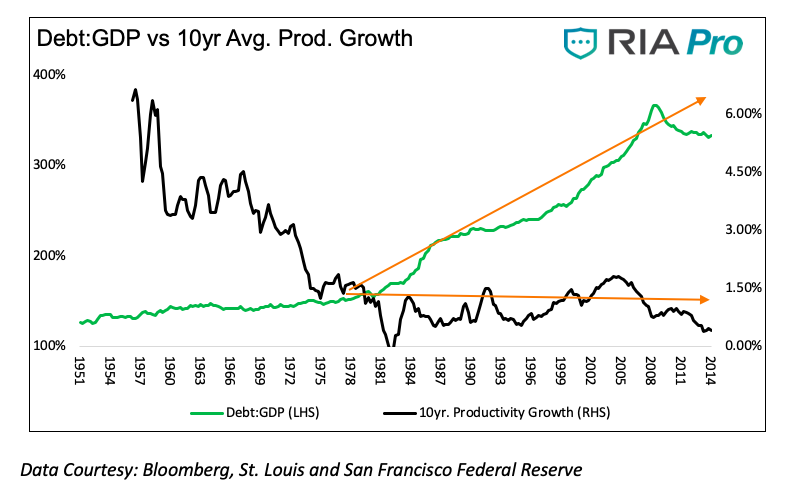
But that's not true: every individual household and business is trying to maximize their profits (or at least, those that aren't are replaced by those that are), reducing their expenditures and increasing their revenues. In the presence of a stable money supply and stable prices, the only way to do this is through innovation and better efficiency: you reduce the value of your inputs, or you increase the value of the outputs. In the presence of external variations in the cost of capital, it becomes more profitable to capture that external capital than it is to increase efficiency. Peter Thiel and many other observers have noted that American innovativeness and productivity growth fell off a cliff c. 1971 [1]. He blames government regulation; however, a more likely explanation is that Nixon turned the U.S. dollar into a fully-fiat currency right around then, incentivizing people to compete for newly-created dollars rather than capture more of the ones circulating through the economy. The causality might run the other way around too, as the Fed holds rates artificially low to paper over low real productivity growth, but this is not an improvement: it just means that we have a feedback loop between money-supply growth, inflation, and low real economic growth. [1] https://www.seeitmarket.com/wp-content/uploads/2019/01/debt-... |
|
|
Or you decide the winning move is not to play, because borrowing is expensive, the purchasing power of your Benjamins won't diminish if you bury them in the ground, and investing money on capital goods in the hope of accumulating more money has negative average risk adjusted returns if there never is any more money in aggregate. On the other hand the way you capture the share of the growing pie is by increasing efficiency, it ceases to be an adequate investment strategy to just hold your capital in uninvested currency.
And taking a graph like that one where the sharp fall in productivity growth starts a couple of decades before leaving the gold standard and actually stops falling afterwards as evidence that leaving the gold standard caused productivity growth slowdown is peak gold bug dodgy graph interpretation! Bretton Woods collapsed because it was inherently unstable anyway.