I suspect that the ranking is somewhat distorted by the data source: every person working in the general field of notary would be represented in those lists of taxed household heads, whereas in e.g. the field of stonemasonry this would only be true only for a few masters I think, but not for their apprentices or various other forms of low-level support. And I suspect that the wandering stonemasons traveling from project to project wouldn't appear there either. In short: I suspect that interpreting the source like that might be a tiny little bit like trying to derive the percentage of Americans working as plumbers by looking at what is listed at the NYSE.
I've seen arguments that most people were literate. Learning to read and write is not hard, and it is a useful skill.
Of course literate was relative: before the printing press there wasn't much to read (book took months to copy by hand). You were reading and writing short notes. Spelling wasn't standardized so you phonetically spelled things and had to figure out what the other person meant. Good enough for letters, but nobody was writing books on anything since teaching in person was (or seemed to be) more efficient.
I'm not a historian, but the above seems like a good argument. Does anyone have a real reference as to the truth?
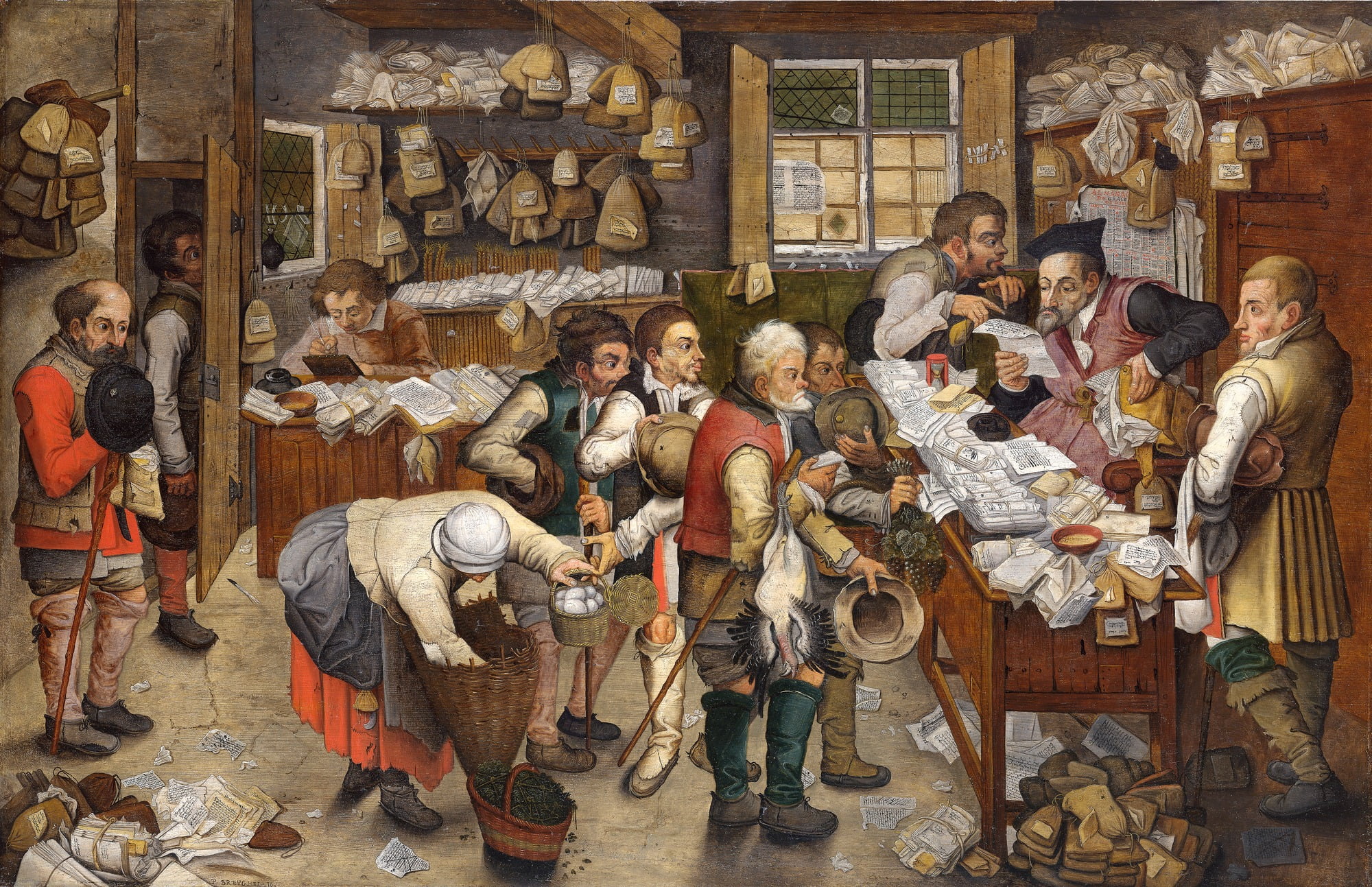
On notaries (and related officials) in the middle ages, see this[1] painting by Pieter Bruegel from around 1615. Here Bruegel mocks the tax collectors that are bamboozling the farmers with paperwork. "The work was boldly socio-critical in its time."[2]
For those who don't know: barbers were also surgeons and dentists until around the middle of the 18th century. Not only did they cut your hair they also pulled out your teeth and performed surgery on you.
And where generally closer to our modern day MDs then real mediaval MDs. As those where theologists coming from christian universities where they received basically zero true medical training.
Secular doctors were also terrible: before the late-19th century, seeing a doctor was more likely to shorten your lifespan than lengthen it. Unless you needed surgery, which meant that you were in serious trouble anyway, so even with the extreme likelihood of infection your odds were a bit better than just leaving it alone.
As far as I can tell, before like 1880 they prescribed mercury for everything.
Even though they were universally terrible, when you read their writings they're no less confident in what they were doing than modern doctors are.
My favorite historical doctor was Benjamin Rush, a "founding father," who was hilariously bad at his job even for the time.
Medival doctors seemd to be fairly good, for their time, when it came to broken bones and such. Basically battlefield injuries that didn't damage inner organs. I remeber when they discovered the bones of an English archer. That guy in hos forties had all kinds of broken bones, healed cuts to his bones and head... That and the Egyptian medics, and before, that drilled holes in heads to relieve pressure. Why know those surgeries where successfup because the bone healed on the skeletons we found. Also back the day people seemed to be not too bad when it came to healing properties of herbs.
But you are right, generally speaking you had the choice between really bad, utterly had, extremely bad and outright killing theit patients bad doctors for the most part of history.
An unknown, but large fraction of all three trace, lately, to sugar, among British subjects and its former colonies. It is probable that declining US life expectancy traces to sugar exposure.
The BBC did a short series called "Victorian Pharmacy" where they attempted to use Victorian-era cures on modern people. Except they couldn't even try most of them because they were too dangerous - opium, arsenic, mercury, cocaine, etc. And the things they could try (excepting Lea & Perrins sauce) were basically torture devices like the Malvern Water Cure[2].
Yep. Apothecaries were the main source of routine medical care for the masses. To the extent that "an apothecaries wages" was an idiom to refer to their high incomes, somewhat pejoratively.
This is still the case in many communities worldwide, a good pharmacist is a real anchor for providing care for day-to-day health care. It's a great filtering mechanism too, the pharmacist as a buffer for frivolous doctor's visits.
Contrast that to here in the US. When's the last time somebody sought out direct medical care from a pharmacist? Pretty much the kneejerk always is go straight to a doctor, no matter how small the discomfort.
You've got to take into account that this is 15th C, after the first big wave of bubonic plague, which sent labor prices from "basically free" to "greater than the GDP of the entire continent". Whole new worlds of financial innovation were needed in this period, and not everyone was buying it. I suspect that this tax record itself was a relatively new project at the time, undertaken in part to control spiraling costs in a world without labor.
I guess people from villages/provinces would maybe travel quite far to the city to notarize something? But barbers would only cut the hair of the city population.