Hacker News new | ask | show | jobs
by sjatkins 1742 days ago
If we generously assume the models which do not have a good record of maching actual data are correct, 2.7C is not remotely catastrophic by the IPCC's own analysis. Average temperature has been up by much more than that at times in the last few thousand years.
12 comments

> Average temperature has been up by much more than that at times in the last few thousand years.

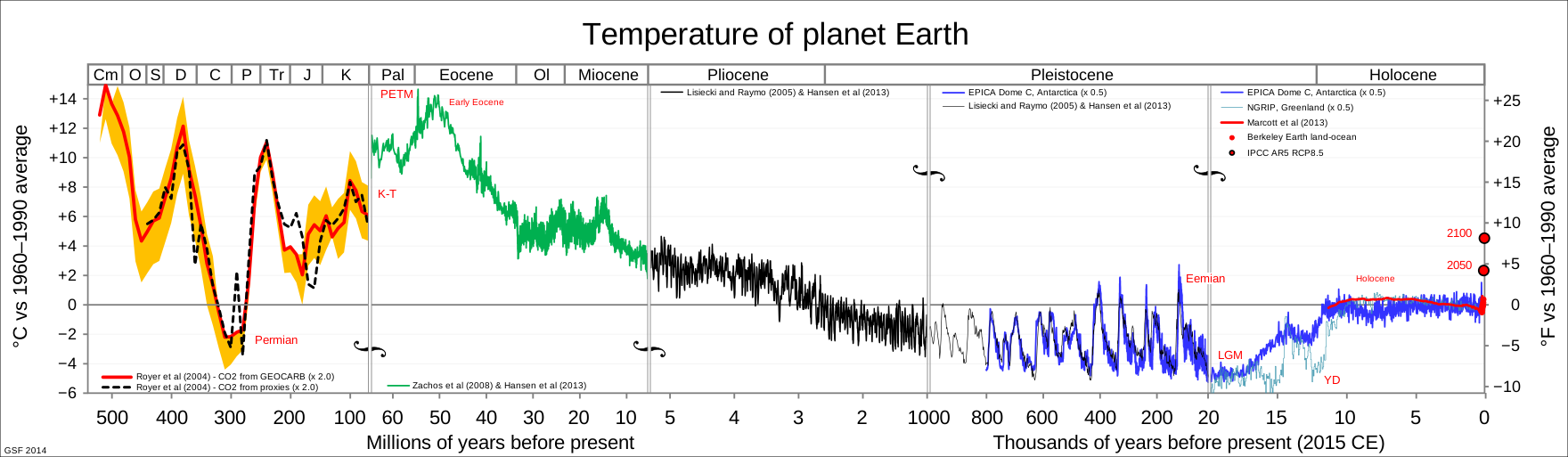
That is simply not true. Global average temperature has been stable for 10,000 years, since the end of the last ice age. It is that long-term stability that made the rise of human civilization possible.

> much more than that at times in the last few thousand years.

When was that?

If you look at this estimate of temperature on Planet Earth[0][1] you can clearly see the last time the planet saw > +2C was the Pliocene.

Even if you look more closely at just the Holocene you don't see > +2C anywhere[2]

[0] https://upload.wikimedia.org/wikipedia/commons/5/5f/All_pala...

[1] https://en.wikipedia.org/wiki/Geologic_temperature_record

[2] https://en.wikipedia.org/wiki/Global_temperature_record#/med...

> the models which do not have a good record of maching actual data

They don't? Which models are you referring to? The model forecast in James Hansen's 1988 congressional testimony was almost spot on.

https://www.realclimate.org/index.php/archives/2007/05/hanse...

The second graph there shows land-ocean measurements being often below Hansen's conservative estimate.
Yes, he didn't predict details like the eruption of Mt Pinatubo in 1991. "Scenario C" was a rapid emissions tapering scenario, not a global lower bound for possible future temperatures. But if it makes you feel better, if you add the more recent data going up to 2020, it still quite closely tracks Scenario B.
Looking at the post you quoted again, in paragraph 2 it says it did include expectation of a volcanic eruption:

> Scenario B and C had an ‘El Chichon’ sized volcanic eruption in 1995.

EDIT: Looking at the graph once again, he predicted in scenario B that we would see more than .6 deg C of warming between 2000 and 2020.

But it appears that we've only had about .3 deg C of warming in the past 20 years: https://climatedataguide.ucar.edu/climate-data/global-land-o...

Your objection was that his prediction was "often below". You can see that a big part of this is 1991-1995, as his volcano guess was a few years late.

This chart is to the same scale as in the realclimate link. As of 2020, we're about 0.1 to 0.2 degrees below the Scenario B forecast, at +1 instead of ~+1.15.

https://data.giss.nasa.gov/gistemp/graphs_v4/

What do you think a good 1988 model prediction would look like?

Your new chart overlays all ten years for each decade over each other with the same color. This is great for obscuring, but not much else. Is there a reason you don't like the more legible chart I posted?

Looking again at your original link, Hansen's scenario B predicts a ~1.45 deg increase from 1988. So, in answer to your question, not that.

> Average temperature has been up by much more than that at times in the last few thousand years.

This is simply false. The last time global average temperature was more than 2.7°C higher than modern times was over 100 thousand years ago.

The models do actually have a very good record of matching the actual data. The way that propagandists convince you they don't is by cherry picking model runs with higher co2 levels and showing a discrepancy between those model runs and reality.

If you instead only look at model runs with co2 levels close to reality you find that the models have done an amazing job of predicting current warming levels. 50 years more than one study showed 1C of warming by 2020 if co2 levels were around 420. Which is exactly spot on to where we are.

Climate modeling predictions are some of the most stunningly accurate predictions in the history of earth science and someone should have gotten a Nobel for it by now.

Yes and society as it exists now is what, at most 200 years old? Your point is moot.

This temperature rise is totally out-of-context for us, and will cause a lot of pain.

A slow, steady increase over millennia of a couple degrees Celsius is fine and possibly even on net good (more agriculture in the northern parts of the globe, which contain a lot of land).

The same increase over a century is disastrous, because infrastructure and capital doesn't change or move nearly so rapidly.

Yes most people on hn will not experience much issues through climate change the other 100million and more will.

They will loose land, health, money etc.

People whoms homes will be burned etc.

We will experience future animal diversity reduction. This is something very depressing but depending in the Person how much you care for such things.

Also we will experience more dramatic Events as well. Like droights and lots of rain. The Impact on you might range from 'not leaving my flat today' to 'I lost everything'. Your surroundings will slowly change. Woods will start looking different.

And still we are not very certain about all those things. It could get much faster much worse through tipping points.

It also forces future generations to already plan their future accordingly: they will know that they will experience an increase of sealevel of 60cm and more.

> most people on hn will not experience much issues

If the AMOC collapses as we are already starting to see [0] then at least the European portion of the HN community will be deeply impacted.

If the American South West continues it's path of aridification [1] then plenty of HN member will be impacted as well.

[0]. https://science.howstuffworks.com/environmental/earth/oceano...

[1]. https://www.pnas.org/content/117/22/11856

I personally do this also as a big risk/tipping point.
Also temps are higher right now at 1C of warming than they have been in 100,000 years. I'm not aware of any scientists predicting 2.7C of warming as manageable. Society may not collapse, but the amount of degradation of agriculture and biodiversity would be one of the worst tragedies in human history.
Every 1C increase results in 2.5m of sea level increase. 8ft of sea level rise will be devastating for Florida for example.

This prediction is for 6.75m of sea level rise or 22ft.

It's an interesting hack for the electoral college, certainly. The state is still going to be there, build an artificial island and be the only person left on the island and you get yourself 3 electoral votes and a personal rep and two senators.
Well, 2.7 from here would be likely not a good thing.

That said, why should we generously assume the models are correct? Because, despite the hundreds of lines of hand-waving in this topic, they have not proved to be correct.