The last two US presidential elections and the way the US population handled Covid has really left me thinking that we're doomed when it comes to global warming.
I will say this: The opposition wants you to think that and to spread it to others. They mean to look implacable - not a novel negotiating strategy, if you think of it.
I think if we got disarmed their narrative of power and implacability, and realized our own power, the issue would be settled promptly. The truth is, most Americans are concerned about climate change and have been for awhile.
And the best solution is extremely popular: Tax carbon production, and use 100% of that tax revenue as a Universal Basic Income (or Negative income tax, same thing)
I believe pretty much every politician in the world, no matter their political side, would do the same. Politicians either do nothing or do too little when it comes to solving problems having very long lifespans, the reason being the need for immediate public approval; every action would require loads of money spent now on something whose results would be visible in decades, long after they would seek for a re/election.
I don't need evidence that the planet is warming, I need a cost/benefit analysis of what meaningful impact (if any) such "strong actions" could possibly have on this trend.
During the last century, CO2 emissions have been steadily rising year-over-year, in line with population growth across the globe. Given that this trend is now stalling naturally, the warming trend should follow suit. This leads me to the question: How bad is the "do literally nothing" scenario really?
> Given that this trend is now stalling naturally, the warming trend should follow suit
Even a cursory argument should make it obvious this is untrue: CO2 is cumulative, so emitting the same amount year over year will continue increasing warming.
This is an oversimplification. If it just stayed in the atmosphere indefinitely after emission, then the rate of increase in CO2 concentration should match the rate of increase of CO2 emission. In reality, this just isn't the case, because an increase in CO2 concentration leads to an increase in uptake on the surface. This increased uptake may well be a negative in some ways (ocean acidifaction), but it may also be a positive in other ways (agricultural yields).
I'm not sure what discussion you are having, but mine is centered around reality.
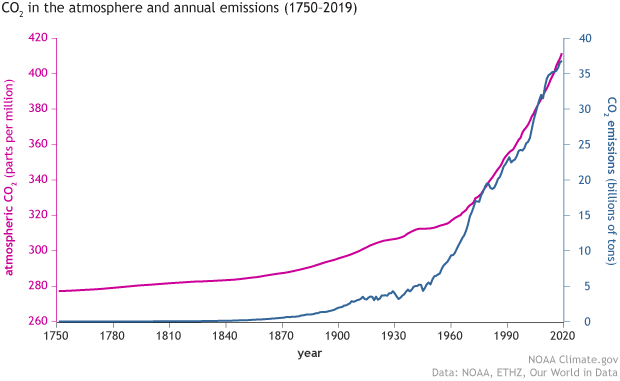
Looking at this graph, if annual emissions stay roughly constant (around WW2) then CO2 levels also stay roughly constant, even though cumulative emissions are rising:
You are badly misreading that graph. Emissions (black line) is the derivative of atmospheric CO2. The fact that they appear to line up doesn't mean what you seem to think it does; the increase in emissions is the cause of the increasing slope of the atmospheric CO2 value, not the direct value.
I haven't seen anyone say that the end of population growth will stop the growth in climate emissions. I have seen it almost universally said that the growth in people with a certain level of wealth (e.g., enough to buy energy-consuming technology such as refrigerators and cars) does cause climate emissions to grow.
Fair enough, let's say CO2 will not stop immediately after population growth stabilizes, but rather after wealth growth stabilizes. However, population growth is strongly related to low levels of wealth, and vice versa.
Activists often like to point at the high per-capita rate of emissions of people in developed countries, but that ignores that there are far fewer such people and that their birth rates are usually below replacement levels. The climate itself obviously doesn't care about emissions per-capita.
This is also another reason why the crux of the problem is not with developed countries. They have all the wealth to optimize and reduce their emissions, but if the developing world is bound towards a similarly high standard of living, that can't really make much of a difference. If anything, the focus should be on making that development as "clean" as possible, which is not the same problem as reducing emissions at home, except for some technological overlap. Alternatively, developing countries could simply be denied our standard of living through international policy. That, of course, would be an injustice.
> This is also another reason why the crux of the problem is not with developed countries.
By far the most emissions, now and historically, are in developed countries. The cause of our current problems is the failure of developed countries, the US in particular, to act.
> By far the most emissions, now and historically, are in developed countries.
If you want to play the blame game for historical emissions, sure, the developed countries are the biggest culprits. That however has no bearing on future emissions.
No policy of today will undo historical emissions, except maybe a significant sequestration effort, but I don't see any of that in the broader discussion. It's all about how the US needs to reduce current emissions, which would still only amount to 15% of worldwide emissions if eliminated completely.
We also can see that the majority of current emissions are coming out of developing countries, unless for some reason you want to count China into the developed countries.
What makes you believe temperature isn't accellerating? CO2 in the atmosphere won't go away on its own for hundreds of years, and trapping more and more heat will have exponential effects leading to chaotic climate instability. CO2 is not declining, even in the pandemic year it is still rising sharply way beyond extreme levels for tens of thousands of years: https://www.co2levels.org/
CO2 concentration will mix with other gases, so the dynamic is different. It is still concerning even though the numbers work differently than temperatures. CO2 accumulates over longer time, so appear smoother also.
"If this trend continues, by the end of the next century atmospheric CO2 would approach 900 ppm—just below levels during the Paleocene thermal extinction 54 million years ago."
That's my point. It won't continue. Nothing grows to infinity. CO2 levels are rising due to an increase in emissions year-over-year. This increase is guaranteed to stop on its own. We don't know what happens if emissions stabilize at current levels. Perhaps CO2 concentration will continue to rise for a while, perhaps it will stabilize rather quickly. Absent any other factors, the long term trend is always for CO2 levels to (slowly) sink.
If I naively extend the following correlation, just going from 420 to 520 would require adding another 30 Gt of CO2 of annual emissions (almost doubling current levels):