I'm not sure what discussion you are having, but mine is centered around reality.
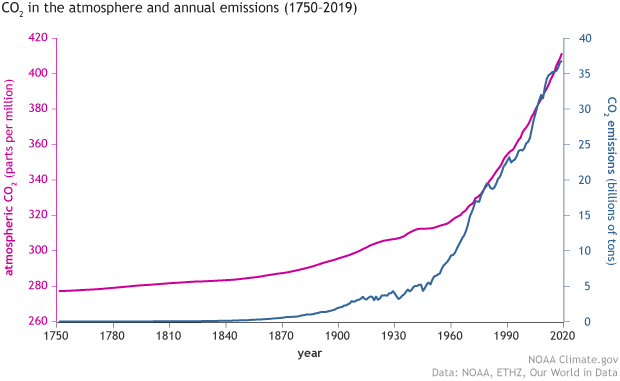
Looking at this graph, if annual emissions stay roughly constant (around WW2) then CO2 levels also stay roughly constant, even though cumulative emissions are rising:
You are badly misreading that graph. Emissions (black line) is the derivative of atmospheric CO2. The fact that they appear to line up doesn't mean what you seem to think it does; the increase in emissions is the cause of the increasing slope of the atmospheric CO2 value, not the direct value.
I can't make sense of this. If CO2 emissions drive CO2 concentration, how can the former be the derivative of the latter?
I can (sort of) make sense of it the other way around: The rise in atmospheric CO2 is the derivative of emissions per unit of time. This isn't true, but maybe it works as a model. It then follows that the derivative of a constant function (i.e. emissions over time stay constant because growth has stopped naturally) is zero (i.e. there is no rise in concentration). In that case, we simply agree.
The derivative of the function is the rate of change in that function. The rate of change in atmospheric CO2 is the rate of emissions.
This is modulo natural sources and syncs, of course, but CO2's half-life in the atmosphere is long enough that on the immediate timescale those influences can be ignored. We're not going to reach a new steady-state for some time even if emissions remain constant; rather than constant emissions resulting in constant concentration, constant emissions will result in concentration rising at a constant rate on any near-term (< century) timescale.