Hacker News new | ask | show | jobs
by Lavery 1809 days ago
Lots of comments here on the causal side of elite production, but just to float an alternate possibility:

This could just as easily be suggesting that "overproduction" of elites is due to, some two decades prior, a creeping sense among the populace of nascent but growing inequality and increased stratification? Or put differently, "Grandpa worked in the plant and made a good life for himself, and I work in the plant and make a good life for my family too, but I see the writing on the all and am going to make certain that my son or daughter becomes a [lawyer/banker/software person/etc]". And the instability today is just that initial rising inequality reaching fruition.

Something like that seems much more likely to me, that creeping change exists that is palpable at the individual level, and expressed through the emphasis given to the next generation.

8 comments

This aligns with the experience I and my parents had growing up in the US. My grandparents worked in factories and did relatively well for themselves, living in the same town in Connecticut that their grandparents worked in as farmers 2 generations prior. They had the notion that factory life wasn't wear the future was and pushed my parents to go to college in the 70s.

By the time I was growing up in the 90s and 00s just 2 towns over the very notion of factory work as a viable career had vanished. Everyone was prepped to live in a 2-tier system of college goers and those who weren't heading to college.

Flash forward to now and it turns out that it was only certain types of college that paid off and everyone else went into unstable service jobs or unstable non-technical disciplines.

If we're building a meritocracy that feels like a lottery people are going to be angry. If it works like a lottery, then the people with the most tickets are going to win every time.

It turns out that all they have to do is split the angry people in two to confuse who to be angry at and that works for decades.
I think it was pretty apparent back in 2012 when I was picking college majors that it was essentially engineering, economics, medical, or you're going to have a rough time.
I suspect the mentality started to shift after the '08 crises. But I know quite a few undergraduate "business" majors who weren't able to find remunerative work from that era.
Business is still one of the most remunerative college majors.

https://www.indeed.com/career-advice/pay-salary/average-sala...

There’s a lot of hidden correlations in that stat.

It’s almost certain that it includes individuals who went on to get MBAs which open big doors in terms of compensation. Would love to see how this stat breaks down by cohort.

>people are going to be angry.

sure. I reckon they are.

70s through 90s wiped the blue collar middle class off the map, there are no other options outside of non-MD healthcare work if you want income that even begins to keep up with inflation. Its gigs and part-time work from there.

Edit: to be clear, I'm agreeing and saying people definitely had time to see the writing on the wall

You should meet my carpenter and plumber and ask them about their nice houses with big yards and new cars.
I saw a lot of people in the trades barely scraping by 5-7 years ago when housing was bottoming out. Housing stock is growing at something like 3x population growth in the US right now. A few more years of that and they may be back in the same situation. Being employed in a heavily cyclical industry definitely has rich years, but it's also got lean ones.
However the housing stock grows, the remaining stock needs maintenance anyway.

So, well, indeed, a good plumber should not see extremely lean years.

(Anecdotally, my son works as a building systems maintenance engineer, without a college diploma. Of course the market for such jobs ebbs and flows, but seems to never dry up: city buildings still need their elevators, HVAC, fire alarm, access control, etc systems working, no matter what.)

Housing stock is not growing at 3x
Housing starts are at ~1.7MM units/year right now, that's enough for about 4.5MM people at current household sizes. US population growth was 1.6M in 2019 and <1MM in 2020. Even with generous estimates on losses of existing housing, I don't think 3x is appreciably off.
Maybe it has something to do with the fact that more than half of the younger generation are currently living with parents [1]. Not because they necessarily enjoy it, but because they can't afford their own home.

Building more housing should lower the effective price of it, and allow many new home buyers or renters to enter the market.

[1]: https://www.pewresearch.org/fact-tank/2020/09/04/a-majority-...

In the San Francisco Bay Area, the housing supply is very certainly behind "balance" by 500,000 units (pre-covid).

source: 15 year professional Urban Planner in California

They are probably business owners. Employed plumbers and carpenters don't make much.
Maybe in the US. In Australia bricklayers currently charge over $100/h, plumbers are pretty close
When GP said business owners I assume they included independent plumbers. I can call the local plumbing franchise and I will pay $150/hr, but the person who shows up at my door is not making anywhere near that.

My friend works for a home security company. They bill $150/hr for labor and he makes $26/hr.

Compared to other countries, Australia is an outlier for tradesmen income, by far. The closest comparison I can think of is software engineer income in the US vs everywhere else.
Working in a trade in Australia is lucrative AF, if you're looking for a way to be relatively wealthy only a couple of years out of high school, apprentice as a shipwright, elevator technician or HVAC technician.
These are skilled trades, it's quite a challenge to compare them with factory work that used to employ a large blue-collar population.
Median carpenter pay was 50k last year for carpenters. Yours are outliers.
That may not be a lot of money wherever you live, but a married couple both making close to that are borderline rich where I live. A single person making that is above middle class. Of course a nice house can also be had for $150k.

And yeah, my carpenter got his HVAC, electrician, and plumbing licenses in prison and now runs his own business with family members and makes a lot more than I do, but it wasn't by luck or fortune. Anyone could have done what he did (skipping the prison part), if they didn't mind working hard.

That's not a lot of money, period, considering the hours and the inflation due to overtime. Consider too that that is the median - many are making far below that.

Most people making money in trades make most of it working more than 40 hours a week, or, like you said, runs his own business (which is completely different. That is no longer a "carpenter" plying his trade.)

> Anyone could have done what he did (skipping the prison part), if they didn't mind working hard.

This is just not true and stated as fact. There is no evidence of this. We have no idea how capable this man really is. I know lots of dumb tradesmen and lots of brilliant ones. He should be proud of what he's done because it isn't as easy as you say.

Do they own their own businesses or are they employees?
Overall that doesn't make much difference. The bottom decile of business owners makes much less and the top decile makes much more. The majority in the middle makes about the same as they would if they were an employee.

http://reactionwheel.net/2019/01/schumpeter-on-strategy.html

Prima facie this makes no sense.

Did you meet up at their respective houses to discuss the work being done on your house?

Worked both those trades and you 100% drive a wrapped mobile advert trade van/truck.

Neither pays well, especially in the residential field.

I call BS.

Just to add some facts to the discussion:

In the US:

Carpenters 2020 Median Pay: $49,520 per year / $23.81 per hour

Plumbers, Pipefitters, and Steamfitters 2020 Median Pay: $56,330 per year / $27.08 per hour

source: US Bureau of Labor Statistics bls.gov

Though for a lot of people those items are acquired via large amounts of debt, and at a much larger multiple of their income than in the past
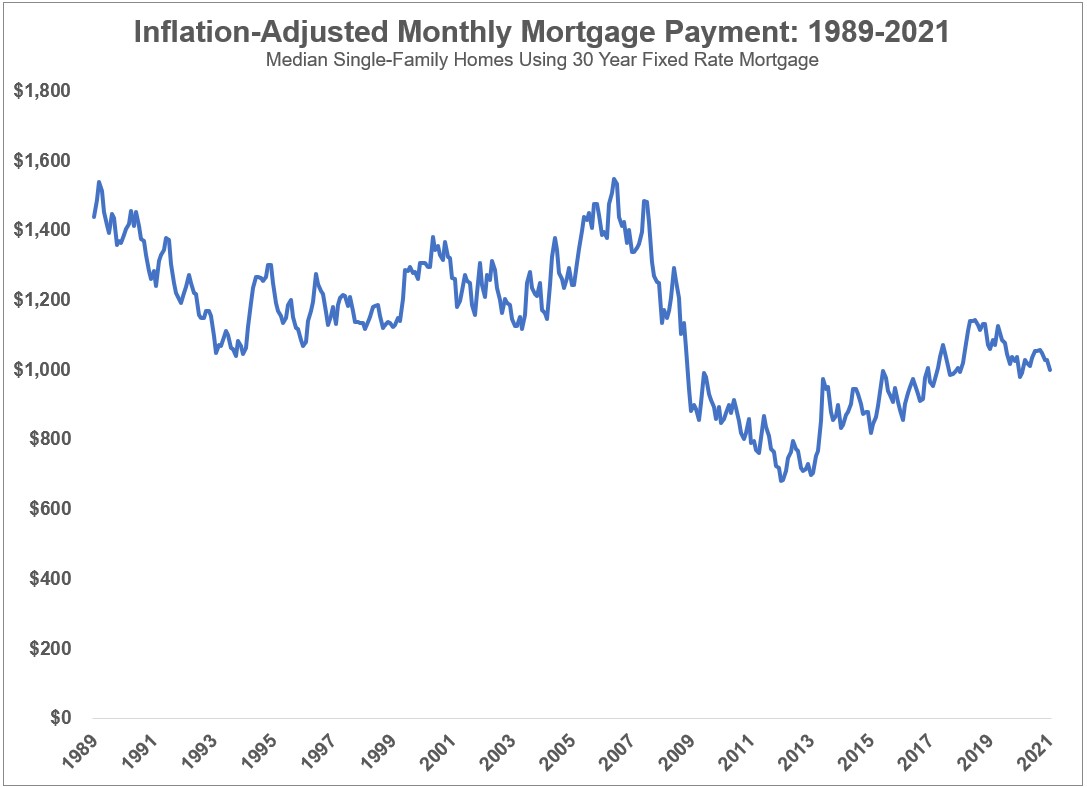
Part of that change is artificial. Mortgage interest rates have plummeted, which have caused prices to go up. The real median mortgage payment is about the same over the last 50 years.
This, unfortunately, also implies an explosion of interest rate risk. Given a fixed monthly payment, I'd much rather be paying it at high rates that have a good chance of dropping, than at low rates that have a good chance at rising.

Edit: Thank you, Americans, for your perspective! I understand now that you have fixed rate mortgages there. That's, for better or worse, not the case in Canada!

Most homeowners have 30 year fixed rate mortgages. There is no interest rate risk. If rates drop they can even refinance.
Most Americans I know, including us, have fixed rate mortgages. So there's no risk of rates rising on you.
It would take a very strange thesis indeed to persuade someone to pay a variable rate these days. I doubt that it happens
I don't understand this allergy towards debt. Oh no, people had the option to take out a loan to access capital they wanted to invest in themselves. If only we could be like the Europeans instead and waste public money to fund whatever stupid whimsy someone fancied rather than make them responsible for the productivity of their choice.
Because children were pressured by society into going to university, on what possibly was false pretences.
> whatever stupid whimsy someone fancied

strange description for democracy.

>70s through 90s wiped the blue collar middle class off the map, there are no other options outside of non-MD healthcare work if you want income that even begins to keep up with inflation.

Is it? According to the CRS[1], real wage (ie. inflation adjusted) growth is up 6.5% even for the bottom percentile.

[1] https://fas.org/sgp/crs/misc/R45090.pdf#page=9

That's against CPI inflation.

Consumer goods have gotten cheaper over the period, so even slow wage growth will outpace the CPI measure.

Housing, education and financial products including health insurance are not included in CPI measures -- https://www.bls.gov/opub/ted/2021/consumer-price-index-up-4-...

>That's against CPI inflation.

Yes, that's implied. If you get to choose your basket you can make inflation seem arbitrarily high/low.

>Housing, education and financial products including health insurance are not included in CPI measures -- https://www.bls.gov/opub/ted/2021/consumer-price-index-up-4-...

Why would you lie like that?

https://www.bls.gov/cpi/tables/relative-importance/2020.htm

Housing: 42.385% of CPI-U

Education: 3.033% of CPI-U

"financial products" (whatever that means, the closest I could find is "Financial services"): 0.229 of CPI-U

health insurance: 1.209% of CPI-U

Ah, my information was bad. The study you originally cited specifically mentions CPI-U as the measure they were using.

I assure you I wasn't lying, and thank you for the correction. (perhaps consider not jumping straight to the lying accusation in the future).

There's still a conversation about housing taking up an increasing share of the pie that doesn't exactly shine through in that top line number, but no point in belaboring it.

> Ah, my information was bad. The study you originally cited specifically mentions CPI-U as the measure they were using.

well the BLS publishes a bunch of CPI numbers, but "the" CPI is just CPI-U. The others are even more specific (eg. CPI-W for clerical workers or CPI for the elderly)

>There's still a conversation about housing taking up an increasing share of the pie that doesn't exactly shine through in that top line number, but no point in belaboring it.

The rise in housing prices has mostly been canceled out (or caused by?) low interest rates. After you adjust for interest rate and inflation, the monthly payment for a house (ie. the price you actually pay) has actually gone down from the 90s.

https://awealthofcommonsense.com/wp-content/uploads/2021/03/...

Housing is not included in the CPI. The housing figure is Owner's Equivalent Rent. They survey owners and ask them what they think that they could rent their home for.
They do include actual rent costs, but the weighting for rent costs has 1/3 of the weighting of Owner's Equivalent Rent. The CPI-U provides an tiny weighting of rent compared to the real rent costs for anyone who is actually renting.
I'm not sure what report your read, but that report very clearly states the following:

> Real wages fell for workers with lower levels of educational attainment and rose for highly educated workers. Wages for workers with a high school diploma or less education declined in real terms at the top, middle, and bottom of the wage distribution, whereas wages rose for workers with at least a college degree.

And that is before you start looking at issues with the CPI-U and how it's price weighting compares to real expenses faced by blue collar workers.

LMAO

Dont you know that equality is a critical aspects of social satisifaction. See everywhere, equality is mentioned as the magic word that described the sacred value of liberal society...

But

It's never applied to personal wealth...

Your thinking is precisely the ludicrous disconnection between the elites' idea of society and the reality... (I am not saying you are elite, just that elitism thinking is so blindly superficial...)

BTW, equality in personal wealth is emphasized nearly 2000 years ago by Confucious 不患寡而患不均.

[1] https://baike.baidu.com/item/%E4%B8%8D%E6%82%A3%E5%AF%A1%E8%...

How is this relevant? The parent poster made a testable statement ("there are no other options outside of non-MD healthcare work if you want income that even begins to keep up with inflation"), and I disproved it by pointing out that even the bottom 10% of Americans are keeping up with inflation and then some.
The idea is that absolute improvement does not change the fact that people are seeing some are much better off than themselves.

It's about why people want to be elites.

As for the inflation, that's irrelevant.

I should have read the comments closely. But it remains the case that such technicality is not at the right direction.

You conveniently left out the rise of the industry known as software engineering.
Software engineering isn’t blue collar work. “A blue-collar worker is a working class person who performs manual labor. Blue-collar work may involve skilled or unskilled labor.” https://en.wikipedia.org/wiki/Blue-collar_worker

Plumber or nurse sure, but staring at a screen or moving Post-it notes isn’t physical labor.

While wrenching on a car is indeed manual labor I feel like it can take similar levels of mental effort, background knowledge, and training as junior dev work. So the parallel isn’t entirely off base. I believe the OP’s argument is that there are new classes of work that didn’t exist back then. Perhaps they’re not as cleanly sorted into white and blue collar lines as before but they occupy similar places in the socio-economic status positioning.
Being a mechanic is extremely repetitive. Occasionally people are faced with something odd, but it’s mostly a checklist job because identical makes and models generally run into the same issues.

Or as a childhood friend out it. It’s boring, but I can zone out and work with my hands.

Non manufacturing blue collar trades are still quite profitable.
Where is cost of living in this analysis? In the Midwest you can still have a nice quality of life with any decent job. Yeah sure, you can’t have such things in SF, NY or LA like maybe you could in the 70s.
You likely pay for it in other ways.
What other ways do you have in mind?
There is no such thing as a free lunch and so reduced real estate costs bring with it an environment of potential poor local governance, poor job market, neighbors that do not share values that are conducive with rising home prices.

A most recent example is poor compliance with things that benefit the masses (ie. Vaccine, mask etc.)

I suspect the next thing will be poor compliance with switching over to energy efficient power generation as the world moves to clean energy + things implemented to discourage clean transportation (ie. extra taxes on EVs/banning solar installs without major caveats). All these boneheaded things drive down the cost of the real estate to its true market value.

We should consider another alternative - elite overproduction correlated with very wealthy societies, and very wealthy societies revert to the mean. So overproduction of elites correlates to decline, and correlation is not causation.

And attaching my pet theory - China has transformed their society, radically for the better, in 1 generation. As far as I can tell the American press has taken no interest whatsoever in seriously figuring out what happened beyond very surface level analysis. Are the policies that worked in Asia even serious contenders for implementation in America?

>Are the policies that worked in Asia even serious contenders for implementation in America?

No. The US prioritises corporate profit over everything else - even to the point of sacrificing its hegemony.

China just wants to be powerful.

China realized a long time ago that that is the American achilles heel and exploited it by creating long term economic dependency on them in exhange for short term profit.

Wow, really well said. I think that's the clearest way I've heard this idea expressed on the US v China competition
China is doing the Marshall Plan in Africa. We in USA can't even improve our own country, let alone another nation.
China implemented capitalism. This lifted millions out of poverty. Capitalism is profit driven. I'm not sure what you mean.
It's only the last 10 years of China's economy that sparks interest/fear/competition in western minds and often the press is slow to pick up that something is different.

The Soviet Union, and Japan both threatened U.S. economic hegemony, but ultimately saw growth stagnate when the economy ran out of people to throw at the growth engine.

China is starting to look like they can keep the growth engine running even in the industrialized city centers, creating new products and services which rival their western counterparts. If this continues then China could reasonably rival the US and EU on both standard of living as well as total economic power.

China has a lot of challenges coming up in the future that is slowing that growth now: https://www.youtube.com/watch?v=vTbILK0fxDY

It's making the CCP jittery, which is a theory behind the increasing authoritarianism in the country now.

Which is ironic because letting the leash out is what has caused the rise of China. A Maoist China would not be an economic powerhouse
Think more like Mussolini than Mao. China is more like a fascist state than a communist one
There are many wealthy societies that keep growing instead of declining, and many poorer societies that get stuck in a trap and decline. That's the billion-dollar question wrt. China that nobody knows the answer to: will they keep growing and reach a Western-like standard or will they fail to pursue the reforms they would need and get stuck with a middling average income, like so many countries in South America today?

As for the policies that worked there - Deng Xiaoping said "black cat, white cat, if it catches mice it's good cat". But today the popular thing in America is to talk a lot about the ideology of being black or white, and just forget about that catching mice thing.

> reach a Western-like standard

implying that this is the pinnacle? May be it is possible that they blaze a new way. May be it is possible that they remain as they are, for extended periods of time, or become the next super power.

China’s economic development (and East Asia’s more broadly) has been one of the most thoroughly studied topics in development economics.
Increased stratification is largely driven by rewards to technical skills, and technical training/STEM degrees are not the main source of "elite overproduction" by any stretch. Quite to the contrary, this is basically all coming from an extremely traditional idea of education (some would say many centuries or even thousand years old) positing that there's some sort of inherent merit to being an "intellectual" (whatever that might mean) being "socially aware" (again, a very fuzzy idea) or musing about "the human condition", even whilst actual technical merit is broadly disparaged as "beneath" one's perceived station.
Increased stratification started when incomes decoupled from productivity growth in ~1979. That was caused by a wave of union busting.
It also corresponded with massive illegal and legal immigration entering the labor force of over 50 million individuals (unions were always against immigration for the labor supply competition reason). In addition, there was not a commensurate increase in housing stock in many urban centers and areas leading to more of your income swallowed by rich landlords.
To be fair the immigrants have a much better life in the US, and if you're worried about the US population dropping, boy would it have dropped more without that immigration wave.
My theory has always been that the decoupling was due to the effects of exponential population growth becoming more linear in the 50s (and taking ~20yrs to kick in). When population growth is exponential everyone has opportunity to "move up the ladder". As the growth rate flattens, demand drops and things get more competitive. This combined with an economic/fiscal focus on GDP and "the stock market" meant workers wages had to bear the brunt, thus leading to a number of things like union busting.
>That was caused by a wave of union busting.

Are you presenting this as opinion or fact?

This question surprised me. In that any one could read a random comment on the internet as anything other than opinion? There most certainly arguments to be in support or against (Reagan busting up the air traffic controllers is an easy example from that era) but the entire notion is clearly one sided and clearly not fact.
>In that any one could read a random comment on the internet as anything other than opinion?

Maybe? eg. something like "subprime mortgages caused the 2008 recession" would qualify as a fact. Maybe what the parent poster said was the academic consensus among labor economists, or is at least a serious competing theory among mainstream academics (ie. not something that only a few marxist economists believe).

Without significant context, your "fact" is not worth much.
I'm puzzled by this comment. You're seemingly trying to explain a secular trend sweeping across the Western world by pointing to a single short-term event that occurred in the U.S. and was but tangentially related to what's actually going on (returns to highly skilled labor have been going up, not down as we might expect from union busting activity!) That doesn't really make much sense, tbh.
The causal event for that was the discovery that the USSR was a hollow giant and the red scare not based in reality. After that communism lost alot of its fear-factor and a take-over was becoming ever more unlikely.
Wow, that is not the way I remember 1979...
Time to hit the history books. 1980s the fear propaganda was still strong, but the three letter agencies had enough material to pass judgment on the USSR.

Example: https://www.jstor.org/stable/1240452

The USSR bought grain when its harvests failed during the 1970s - this is not the action of a superior system about to surpass you and replace you.

>STEM degrees are not the main source of "elite overproduction" by any stretch.

How many of today's billionaires have a tech background?

That's not what "elite overproduction" theory refers to. "Elites" means people with PhDs who can't get academic jobs.
why would the world stress over a dozen people?
Insightful comment.

How would anyone possibly change the perception that you have to be a lawyer or MBA or you're useless? When looked at the way you suggest, this problem is enormous. I'm not sure we'd ever solve it. We just have to accommodate ourselves to a society with lawyers, MBAs, and software people everywhere.

The different between a lawyer and an engineer is that one creates new means of production which grow the pie, and the other procures pieces of pie.
Grows the pie, but only for people on the right side of the inequity divide. I would say tech is winner take all more than almost any other industry I can think of.

So for the people feeling the pressure of the inequality divide, there's little difference between these two. Unless they join the ranks of lawyers or engineers, there's nothing in it for them monetarily speaking.

The people get services that were unimaginable (or expensive and inferior, e.g. dedicated GPS navigators) for free, money-wise. If Google/Facebook/Amazon/... weren't providing value, they wouldn't be making so much money off the people who choose to use them. Tech is actually as close as it gets to literally creating and giving everyone free stuff, as far as the pie goes.
Ordinary people get more personalised advertising.
The theory is based on historical data, and I doubt that an end to middle class blue-collar work would apply to all that many historical cases.

But you might be onto something - elite overproduction could be a concession made by an elite that's facing a potential uprising - whether it's youth unemployment or a weak king or new technology arming the peasants then allowing the most ambitious potential revolutionaries a chance to advance into the elite is probably a good stalling tactic (but will eventually fail).

It's like if a company starts making everyone a "manager". Maybe the leadership is incompetent, and they are more focused on management than work. Maybe they are trying to raise morale by handing out pseudo-promotions. Maybe they can't attract new workers without giving them attractive job descriptions. Whatever the case, it's unlikely to be sustainable (either the management will collapse under its own weight, or the workers will realise their new titles aren't worth what they thought they were).

Good point.

Elite overproduction could come from changing the definition of an elite; we may have lowered the bar w the Internet, self-publishing, etc.

And yet it doesn’t look like highly educated but low paid people are the main source of instability. Kids wanting to take down statues do not cause more instability than football hooligans, and as such can be easily handled by the police. Trump, Brexit or other forms of populism (say Le Pen, AfD, ecc…), which are the main source of political instability in the West, identify their enemies in the “intellectual urban elites” and look for support in the mythological “disenfranchised white working class”.