Hacker News new | ask | show | jobs
by gruez 1809 days ago
>70s through 90s wiped the blue collar middle class off the map, there are no other options outside of non-MD healthcare work if you want income that even begins to keep up with inflation.

Is it? According to the CRS[1], real wage (ie. inflation adjusted) growth is up 6.5% even for the bottom percentile.

[1] https://fas.org/sgp/crs/misc/R45090.pdf#page=9

3 comments

That's against CPI inflation.

Consumer goods have gotten cheaper over the period, so even slow wage growth will outpace the CPI measure.

Housing, education and financial products including health insurance are not included in CPI measures -- https://www.bls.gov/opub/ted/2021/consumer-price-index-up-4-...

>That's against CPI inflation.

Yes, that's implied. If you get to choose your basket you can make inflation seem arbitrarily high/low.

>Housing, education and financial products including health insurance are not included in CPI measures -- https://www.bls.gov/opub/ted/2021/consumer-price-index-up-4-...

Why would you lie like that?

https://www.bls.gov/cpi/tables/relative-importance/2020.htm

Housing: 42.385% of CPI-U

Education: 3.033% of CPI-U

"financial products" (whatever that means, the closest I could find is "Financial services"): 0.229 of CPI-U

health insurance: 1.209% of CPI-U

Ah, my information was bad. The study you originally cited specifically mentions CPI-U as the measure they were using.

I assure you I wasn't lying, and thank you for the correction. (perhaps consider not jumping straight to the lying accusation in the future).

There's still a conversation about housing taking up an increasing share of the pie that doesn't exactly shine through in that top line number, but no point in belaboring it.

> Ah, my information was bad. The study you originally cited specifically mentions CPI-U as the measure they were using.

well the BLS publishes a bunch of CPI numbers, but "the" CPI is just CPI-U. The others are even more specific (eg. CPI-W for clerical workers or CPI for the elderly)

>There's still a conversation about housing taking up an increasing share of the pie that doesn't exactly shine through in that top line number, but no point in belaboring it.

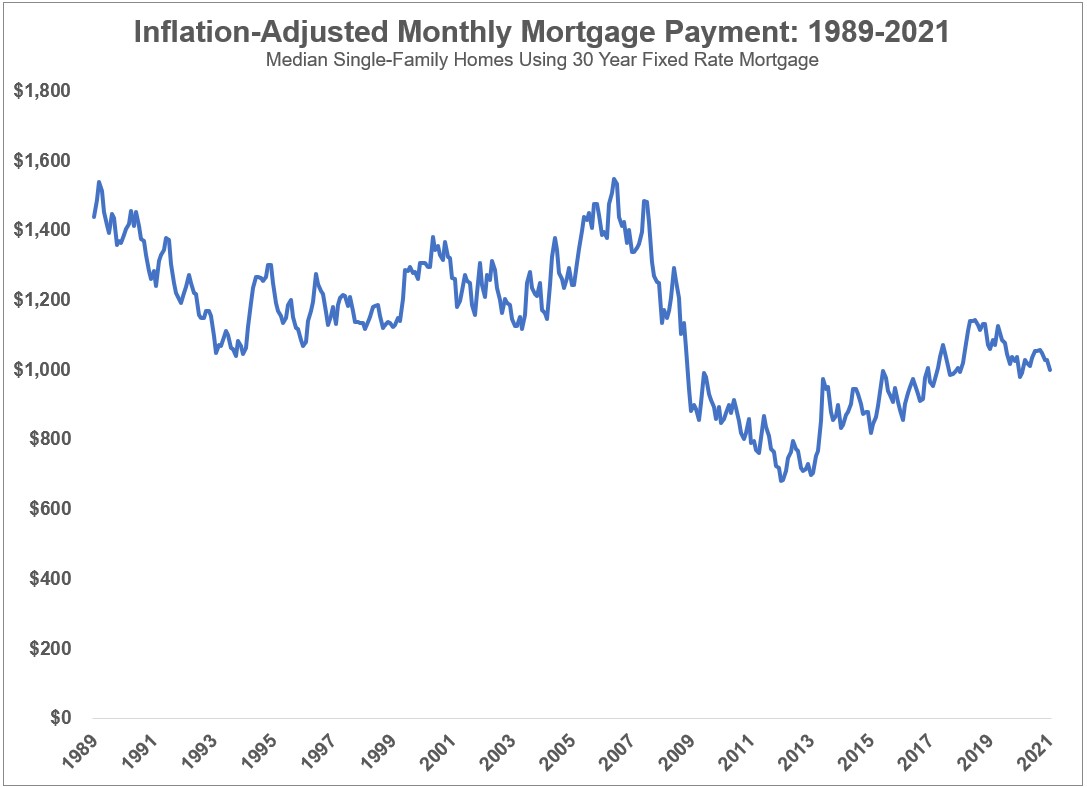
The rise in housing prices has mostly been canceled out (or caused by?) low interest rates. After you adjust for interest rate and inflation, the monthly payment for a house (ie. the price you actually pay) has actually gone down from the 90s.

https://awealthofcommonsense.com/wp-content/uploads/2021/03/...

> The rise in housing prices has mostly been canceled out (or caused by?) low interest rates. After you adjust for interest rate and inflation, the monthly payment for a house (ie. the price you actually pay) has actually gone down from the 90s.

Only if you ignore the tax side of things, housing interest payments are deductible where principal payments aren’t. That ends up having a huge impact when inflation and interest rates drop. It’s not uncommon for mortgages to be less affordable over time. A bump in interest rates without could really mess things up.

> That ends up having a huge impact when inflation and interest rates drop.

How so? The chart in question is for 30 year fixed rate mortgages. You're going to be making the same payment every month regardless of what direction interest rates move.

Housing is not included in the CPI. The housing figure is Owner's Equivalent Rent. They survey owners and ask them what they think that they could rent their home for.
They do include actual rent costs, but the weighting for rent costs has 1/3 of the weighting of Owner's Equivalent Rent. The CPI-U provides an tiny weighting of rent compared to the real rent costs for anyone who is actually renting.
I'm not sure what report your read, but that report very clearly states the following:

> Real wages fell for workers with lower levels of educational attainment and rose for highly educated workers. Wages for workers with a high school diploma or less education declined in real terms at the top, middle, and bottom of the wage distribution, whereas wages rose for workers with at least a college degree.

And that is before you start looking at issues with the CPI-U and how it's price weighting compares to real expenses faced by blue collar workers.

LMAO

Dont you know that equality is a critical aspects of social satisifaction. See everywhere, equality is mentioned as the magic word that described the sacred value of liberal society...

But

It's never applied to personal wealth...

Your thinking is precisely the ludicrous disconnection between the elites' idea of society and the reality... (I am not saying you are elite, just that elitism thinking is so blindly superficial...)

BTW, equality in personal wealth is emphasized nearly 2000 years ago by Confucious 不患寡而患不均.

[1] https://baike.baidu.com/item/%E4%B8%8D%E6%82%A3%E5%AF%A1%E8%...

How is this relevant? The parent poster made a testable statement ("there are no other options outside of non-MD healthcare work if you want income that even begins to keep up with inflation"), and I disproved it by pointing out that even the bottom 10% of Americans are keeping up with inflation and then some.
The idea is that absolute improvement does not change the fact that people are seeing some are much better off than themselves.

It's about why people want to be elites.

As for the inflation, that's irrelevant.

I should have read the comments closely. But it remains the case that such technicality is not at the right direction.