I tried signing up a few weeks ago and they are not allowing international or Australian access.
I'm surprised the comments here are missing the elephant in the room.
Sridhar Ramaswamy was the Google executive directly responsible for putting all those ads on Google's search results. If Google search got broken then I reckon he did more than anyone to break it. He had a brutal rivalry with YouTube CEO Susan Wojcicki.
Vivek Raghunathan put all the ads on YouTube. Those ads are so bad Google makes money from people paying to remove them.
They left Google after a scandal with YouTube showing ads on videos that exploited young children and appealed to pedophiles.
Are the architects of the problem the right people to trust for a solution? The born-again anti-advertising schtick just seems too clever by half. They are collecting more private personal data than Google ever did.
This is literally one of the quotes: "Ramaswamy fought a battle with other Google executives to prevent them from mining the search histories of Google users to improve ad-targeting on non-Google sites."
Did you actually read the business insider article that you linked?
Seems like you went into your research with preconceived notions, didn't find anything glaringly against your viewpoint, and proceeded to provide it as evidence for your claims.
It's a fair question whether the architects of Google's ad monopoly are the right people to build a private search engine. As noted in the comments here, Neeva's own website says "Neeva was founded by Sridhar Ramaswamy (ex-SVP of Ads at Google) and Vivek Raghunathan (ex-VP of Monetization at YouTube)." Anyone who reads the NYT or Information articles can draw their own conclusions.
If the counter-example you quote is Ramaswamy arguing to go not-quite-so-far abusing people's personal information as others at Google wanted, then I think that's pretty damning. It's a very Google-like position to argue that it's okay for Google to mine personal information to drive more ad clicks on Google properties, but not to let other websites do it as effectively. That's the argument to which your quote refers and it's both anti-privacy and anti-competetive.
Seems your account was created within a week of OP, and this is your only comment or post on HN.
I've found some extra supporting quotes and links below, detailing that Ramaswamy oversaw all advertising at Google, was the exec responsible for increasing ads on search results (which was only 3% of the screen originally), and that he knew doing this made search results and privacy worse for consumers.
"Earlier, he [Ramaswamy] spent 15 years at Google where, as a senior vice president, he oversaw all of its advertising and commerce products, including search, display and video advertising, analytics, shopping, payments, and travel. When he joined the company in 2003, Google Ads was a $1.5 billion business. By the time he left in 2018, its annual revenue run rate was $100 billion."
https://www.globalindiantimes.com/globalindiantimes/2021/5/1...
"Useful search results were pushed down the page to squeeze in more advertisements, and privacy was sacrificed for online tracking tools to keep tabs on what ads people were seeing" - Ramaswamy discussing his 15 years at Google
https://searchengineland.com/former-google-ad-boss-ramaswamy...
The OP account that posted the link was nmwnmw. It was created on May 23, 2020. It has 2 submissions (both Neeva) and no comment history, at https://news.ycombinator.com/user?id=nmwnmw
It seems likely you work for Neeva. You should address these points as a Neeva representative if so. I'd be totally stoked to engage in constructive discussion about this, because it is actually an incredibly important issue.
> Those ads are so bad Google makes money from people paying to remove them.
Arguably those ads have to be that annoying if people want to use YouTube for free, at least in its current state - it’s a globally free service that receives 500 hours of content every minute[0]. Less annoying ads drive less clicks and thus generate less revenue. Paying to remove them is a sign that you actually value YT for how much it costs to run.
I don't value YT for how much it costs to run I value it for the videos that people choose to upload for free. I am not sure that it matters much to me that I am downloading videos from an enormous site with massive traffic. Some of the best videos I get from YT have very few views and the uploaders are not looking to financially profit from sharing them. These videos could easily be served from smaller sites with less traffic that do not cost much to run. I get reliable downloads from all over the internet, not just Google servers. I would not complain about YT because I never see any ads, and downloads are relatively easy, but I do think it's a bit myopic to imagine that YT is the only way we could ever have accesss to so much video. I think that was/is inevitable. The internet allows people to share stuff.
I don’t disagree with you but there’s a reason those creators chose YouTube and aren’t purchasing video hosting for $x/mo and linking people to their website - YT provides free uploading and discovery to everyone, so those creators are available to you just as a million other small creators are available to all 2+ billion YouTube viewers who have their own niches and interests. YouTube’s free-ness and discovery is only possible at this scale, with ads (and the subset of users who convert to paying customers via those ads or purchase YT premium) subsidizing the rest of us with our OSS ad blockers turned on. If google can’t continue to get people to pay for YT premium or show ads that lead to conversions, they won’t turn a profit and won’t be able to provide this global service in its current form.
That's great, but personally I do not use an ad blocker because I do not need to use a browser to search, download or watch video. Nor do I need python or youtube-dl. I download videos with something like
I play videos with ffmpeg-based players. I do not need to be online to play video.
Tech companies that rely on advertising to generate revenue (and thus need "scale") want others to believe advertising is necessary for there to be free stuff shared via the internet.
I know that's not true because I have been downloading free stuff via the internet, including video, since before YouTube or Google existed. I also know that peer-to-peer is the most efficient way to share stuff, not server-client. Middlemen selling ads are not necessary.
People are going to share stuff for free as long as the internet exists, regardless of whether Google or anyone makes money from advertising. That's what makes the internet interesting, not middlemen like Google or people using the internet for commercial gain.
We could read this like a confession from ex-Google managers:
"There are technology products [like the ones we acquired at Google] that work better when they [anthromorphising the software] know some information about you, like your interests or what country you live in. However, companies today [(read: Google)] collect whatever information they can about you and store it indefinitely. [Yikes!]
Additionally, companies [such as? Google?] need to offer you controls that are easy to find and give you real ownership over your data-not just lip service. [What the heck is "real ownership"? Submitted/uploaded data belongs to the user. Larry Page himself said this in a televised interview. Are "privacy policies" considered "lip service"?]
For example, tech products [like the ones we became familiar with at Google] rarely need to store your location history forever. A better default would be to store this data for 90 days, while offering you the option to let the company [Google] store it longer if that is your choice. [Why 90 days. Why not 0 days.]
Do you know all the different ways technology companies [like Google, our former employer] use your browsing data? Your IP address? Your name and profile photo? Companies [such as the one we worked for] can get your personal information for a purpose that benefits you, but then use the data in whatever way they want going forward. [How clever. And what can be done about that. What if Neeva does that? What recourse do users have?] Products [such as the ones we saw at Google] ask for your phone number and email address so you can recover your account in case you get hacked, but then will use this data to report your online purchases to advertisers."
How and why did Neeva arrive at the 90-day data retention policy.
Why cant users have the option to have data stored for 0 days.
Why cant users request to have their data deleted immediately.
(Neeva is getting paid regardless of whether they collect or store data, other than the minimal data required to administer user fees.)
Why does a "paid search engine" need to collect and store more information than, say, a VPN provider. For example, collecting more data than than username, email address, and payment details.
I agree, search history is a bit too specific to be encoded in laws. There are, however, a broad class of laws called "mandatory data retention" laws, which the EFF is against. https://www.eff.org/issues/mandatory-data-retention
sridhar and susan worked in ads at the same time. I believe they were co-SVPs. I didn't really see any rivalry (I worked in and around their offices for several years).
I agree with others that a new business model for search is refreshing. But... for a privacy-oriented service, Neeva is doing a poor job in earning my trust.
I spent some minutes in their website and all I could find are vague promises and grandiose marketing-speak. Where's the evidence and the technical detail? Where are the privacy experts, data experts and engineers impressing me with the robustness, openness and cleverness of their system?
Mullvad, for example, excels at explaining how their privacy service works. They transparently explain how they designed a systen with privacy at the core and they're open in their processes and code. They're also independently audited. That's why I trust them.
Neeva, on the other hand, focusses on promises and not evidence. Also, when you scratch the surface they no longer seem so privacy-friendly.
Just compare the privacy policies of both companies and make your own judgement about who is truly privacy-oriented or not:
In regards to Neeva's positioning as 'private search', I don't think they have their architecture right. The best privacy-oriented services are keen on NOT knowing users. Neeva seems keen on getting their hands on all sorts of data.
For users: Create an account, send payment data, sync with documents, email, calendars, etc. For users and non-users: automatic hoarding of IP, user settings, location, etc.
I digress. I thought this was a good idea, a good product at the outset. I hate scrolling through all the ads etc.
However. After reading the comments I decided to keep my wallet in my pocket. Is this good enough, was I supposed to think up the skepticism when I discovered the product?
> was I supposed to think up the skepticism when I discovered the product?
It's always good to be a bit skeptic. But please don't put too much pressure on yourself.
The reason why I see red flags is because I spent a lot of time learning about what makes a good privacy product and created my own framework to evaluate services. But most people don't have the time to do that, and need to trust what they're being told.
In other words, I don't think the problem is your lack of skepticism or technical knowledge about privacy. That's perfectly reasonable and normal.
The problem is that companies blatantly lie, exploit users and do shady businesses, and they get away with it with repugnant impunity. If they were sevely punished and scrutinized when they do shady business of feed lies to people we would have a more trustable ecosystem.
In my ideal world, when a company like Neeva launches with such grandiose statements, they would get analyzed and scrutinized by experts, who will publish findings in a simple English format. If their statements were incorrect, they would be held accountable and punished. For example they would have to remove the 'privacy-oriented' crap from their website and just position themselves as another search engine.
Very interesting comment! Any ideas on what are we supposed to do in this world?
I keep on thinking we need to take a step back, come back to evidence and logic and make things right. But deep inside I know that's not going to happen. In the post-evidence world, it's too easy for people without moral to grab power and benefit. That is, it makes it easier for those in power to grab more power. That's why things will remain the same for a while.
Is the solution to simply smile and carry on? Is it time for a (non-violent) revolution?
The main problem with search today is the lack of organically appearing "curation" found on the early internet.
Today everyone knows the value of a link, so it curation via links doesn't happen organically any more like it used to... yet this is still a major/the primary part of Google's Search results.
Until the "curation problem" is solved I am not hopeful of a search engine producing excellent results like Google did before 2010.
Stoked to try this out, but teaching a machine to curate is hard.
Content evaluated by usefulness towards solving some problem. Perhaps measured by its usefulness towards training a very narrow AI. Like what if AlphaGo’s only inputs were web pages on the topic of Go, and there were hundreds of instances of it all trained on different combinations of web pages, and competing against each other.
Probably the data<>contest mapping is itself intractable until we have AGI, at which point the whole question might be moot. But what it?
Is this a case of "it takes a thief to catch one"? Because looking at who is behind this, they seem to have more experience in abusing (rather than protecting) privacy and user rights.
I expect nickserv was talking about all the Googlers in the founders and investors lists. But this bit in particular really jumped out at me, for a company making a big deal about its add-free purity:
"Neeva was founded by Sridhar Ramaswamy (ex-SVP of Ads at Google) and Vivek Raghunathan (ex-VP of Monetization at YouTube)"
I can't help but wonder what clause there might be in the user contract (with teeth) that would prevent a future pivot or buyout or redefinition of the "Digital Bill of Rights" after all that juicy user data has been collected.
   [x] Collects data
   [x] Collects name, address and phone number
   [x] Collects contacts from other accounts
   [x] Collects usage data
   [x] Solicits personal data through "surveys"
   [x] Uses cookies, local storage and "other technologies" to collect any information (e.g., personal information)
   [x] Claims purpose of collection is to "improve product/service" but are not limited by any enforceable user agreement regarding such purpose
   [x] May collect data about its users from other other companies
   [x] May "have a presence" (e.g., tracking pixel) on other sites/services
   [x] May transfer personal data to subsidiaries, with no control over what those companies may do with the data
   [x] May transfer personal data to third party companies, with no control over what those companies may do with the data
   [x] May use aggregated data for any (commercial) purpose, not subject to privacy policy
   [x] May use "de-identified" data for any (commercial) purpose, not subject to privacy policy
   [x] May move data anywhere in the world at any time, for any reason
If the user is paying, why is there no "contract" governing the "service". It might define the rights and obligations of Neeva and the user. If Neeva violates their privacy policy (how would we know), then what happens. Users are paying Neeva, so potentially they could could claim financial losses, but what exactly is Neeva promising to do. There is no document that details what exactly users are paying for. Even practical terms such as how many results can a user retreive per hour. A look at the "bill of rights" (doubtful this could be considered a contract for service) reveals there are few restrictions on Neeva, other than Neeva will not retain data for longer than 90 days unless asked to do so by the user or required by law. (However they are explcitly allowed in the privacy policy to transfer the data to a third partes who may be under no such restrictions.)
While the plan may not be to sell ads, this project could be aimed at (user-financed) aggregated data collection. There is zero information on how they will use aggregated data and any such use is not subject the privacy policy, it's free from any restrictions. There is not even any statement that aggregated data would be anonymised or, if so, how.
I am always excited to hear about disruption in search. I would absolutely pay for a private search engine provided the results are useful!
But how can I be confident that neeva will not misuse my data? If I hook up my accounts to this service, I’ve gotta trust neeva with all the same information that google would have.
Is it possible to provide search functionality with only open source client side logic? This is in regards to the gmail, GitHub, slack integration. Now that would grab my attention!
What’s strange to me is that they’re featuring “best X” in all these difference shots, yet their experience I still don’t think does a great job. Best at what? According to whom and why? What is the priority list?
The headphones graphic is a great example of that. We have over the ear headphones next to in-ear AirPods, serving likely different markets with different needs often at different price points. Their example with best mattress is from a very limited perspective; my fancy McRoskey mattress doesn’t show, yet I could easily argue that’s a top 5 mattress. It’s also out of most peoples price ranges and availability… but it really is one of the best (if all your care about is quality).
I have the same experience with Yelp. All these 5 star reviews projecting many dimensions from wildly different perspectives and expectations onto a single dimension as an average.
I’d love to see an honest attempt at either personalization or at least some kind of deeper analysis/tooling that lets me explore the set of possibilities. Do I value ambiance? Newness? Service? Location? Social experience? Price? Who are these people reviewing things and do their aesthetics resemble mine? There are way better experiences possible out there.
To put it another way, how do we know that the "expert recommended shopping results" won't be any different from paid adverts? Or that when they "share at least 20% of our topline revenue with content creator partners when their content is used to directly answer a Neeva user’s query" they won't create a new form of spamdexing where the objective is a cut of the 20% rather than clicks on pages filled with adverts?
I have been using Neeva for several weeks. It took a while to stop my eyes from scanning past "the fold" in search results. The useful stuff is right there at the top. I can't say enough good about my experience thus far.
I had a concern about search latency, so I emailed Sridhar at ceo@neeva.co and he replied in a few hours. We had a nice chat via email. Now I have a mug and a T-shirt.
I'm looking forward to paying $5/mo to be a customer, and not a product. Would happily pay $20/mo -- this is worth more to me than subscriptions like Netflix.
I've been part of the beta for a few months now. It's overall pretty good. I'm on the fence about paying $5/mo for it, but I'll probably do it for awhile at least.
My biggest gripes are the Yelp and maps integrations. When I search for local restaurants or locations, the Neeva map integration rarely finds what I want. When it does, I see Yelp reviews which I regard as complete trash.
Incognito mode is also annoying on my phone. Since I'm not logged I can't search with Neeva which is my default search provider.
On the plus side, it generally gives better programming search results. I'm a big fan of the "official documentation" filter.
My ultimate hope is that Neeva is eventually able to crawl self-hosted services and return them in my search results. For example, I have all my recipes in a self-hosted Bookstack instance and I'd love a search for "taco seasoning" to come up with the recipe I saved.
> Incognito mode is also annoying on my phone. Since I'm not logged I can't search with Neeva which is my default search provider.
That's why I stopped using them (I was in some kind of preview cohort before this announcement); I just want to point out that can't isn't the right word -- it is for sure possible to authorize your use of their search engine without relying on cookies or localStorage or whatever, but they just have chosen not to
It turned me off when I was an alpha user, but it would make me tableflip if I was paying real money and they still didn't make any efforts toward solving that use case
This creeps me out. Connect Google, Slack and Github together for one search experience? That's an incredible lot of trust. Where does all that data go? Shadowy markets? It would be an absolute kicker -- people paying for search probably are extremely high value targets.
With ad monetization, search engines have an incentive for you to click on ads. This makes it less likely that you find the highest quality information for your needs.
In what ways is your experience degraded? You may click on an ad result at the top of the page, while the more useful result is somewhere down below. You may become constantly frustrated by having to scroll past ads that are dominating huge portions of search result pages.
But the problem goes beyond whether or not ads are present at the top of the page. Ad-monetized search engines may hesitate to present organic, non-ad-based results in ways that are easy for you to digest -- doing so might make it less likely that you click on an ad result! For example, if you're doing a shopping query, say for "best air purifiers", the search engine may hesitate to show you an easy-to-use UI with expert reviews, price history, and different possible air purifier feature sets. Showing such a "flashy UI" will make it less likely that you engage with ad results.
At Neeva, we're trying to bring you the highest quality information for your needs, no longer held back by ads. We want to present this information to you in easily digestible and transparent ways. And we want to give you more control over your search results with personalization.
I think it's just another monetization model and another competitor overall in the space.
If you like the privacy of DDG but really don't like ads, you can pay Neeva a monthly fee for a similar experience.
Doesn't have to be winner-take-all - there's enough space in the market for both models to do well, and more competition will keep each of them honest in their value props to users.
Another interesting difference (that I personally find to be one of the best features in Neeva) is the ability to connect apps. You can then search not only the public web, but also private data from your Slack, Github, Gdrive, Jira (etc) accounts. We're hard at work adding more integrations in the near future as well.
Is there plans for students? (I guess you might not have any inputs on the pricing model)
Students (especially CSstudents) being exposed to this ahead will probably help them in and these are the kind of demographics that would pay for a search engine.
As a webmaster who explicitly allowed only Googlebot, I'm pretty annoyed to find another companies bot crawling my site too, doubling the server load (crawling consists of about 30% of my compute budget for Googlebot alone - it turns out bots have far worse cache hit rates than real users). This 'dishonest' behaviour of Neeva has cost me ~$2000 so far... Will they be refunding me that from all their subscriptions?
Also from last year: "rather than try to build a search infrastructure from scratch, Neeva instead opted to use Bing's search API for its basic result"[0]. I thought that was a huge missed opportunity because you could build a pretty good search index of your own from scratch with $77.5M[1] in funding. But it wasn't clear if that was their plan for the long term.
Because their business model is likely hype than actually delivering what they promise. Might as well use Duck Duck Go if they can't actually differentiate their platform in any aspect aside from marketing terms.
According to the Forbes article, this isn't a real search engine. It's just a reseller wrapper around Bing, like Yahoo Search. I thought they were really doing a search engine of their own, but no.
I think I just figured out their business plan. They want to be acquired by Apple or Amazon and have their service bundled with something else you pay for.
Oddly I was thinking the same thing. If it de-ranks sites with a lot of affiliate links I might do it. Most of my searches on Google and Bing result in affiliate advertiser blog spam. It's terrible.
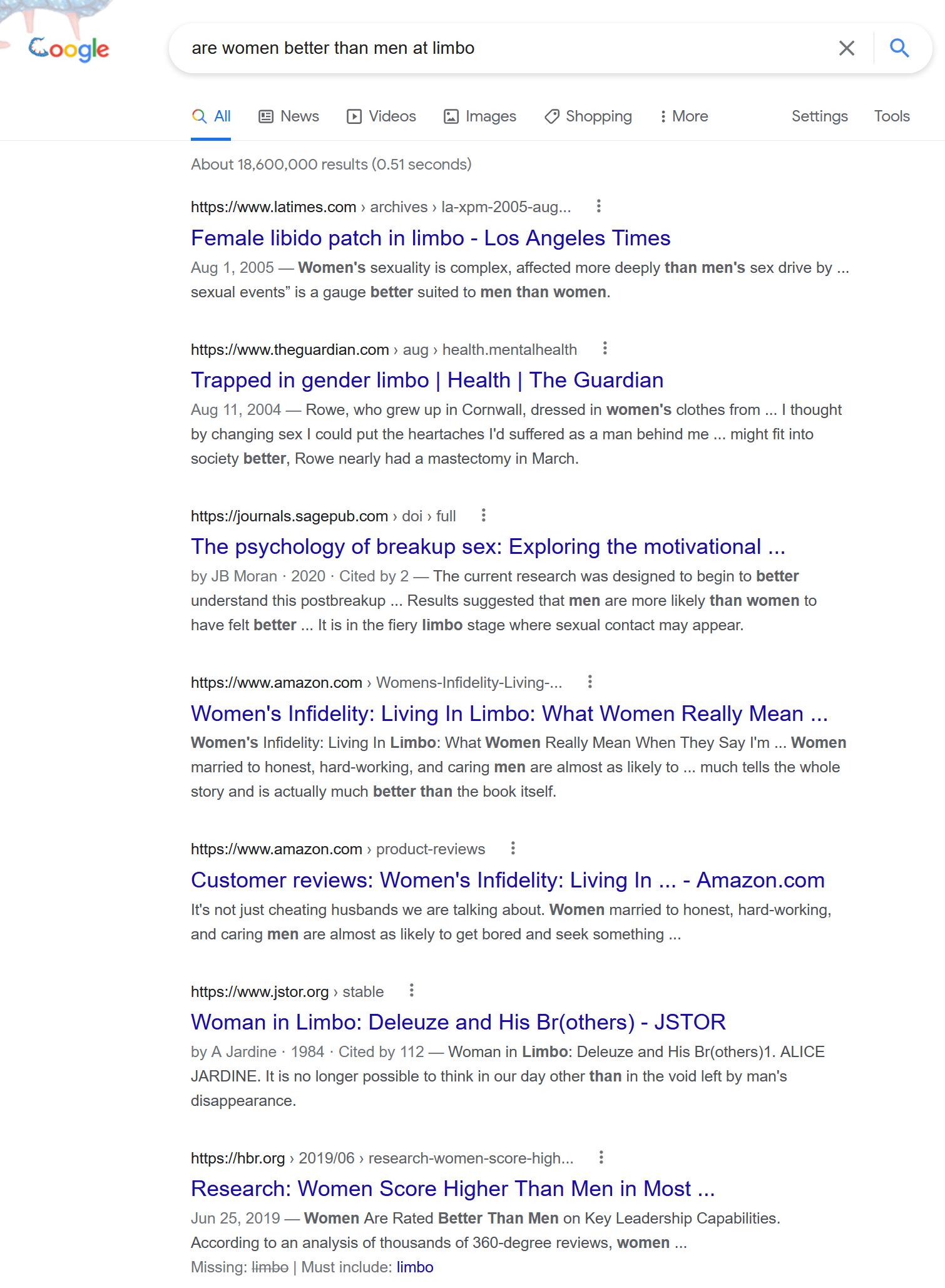
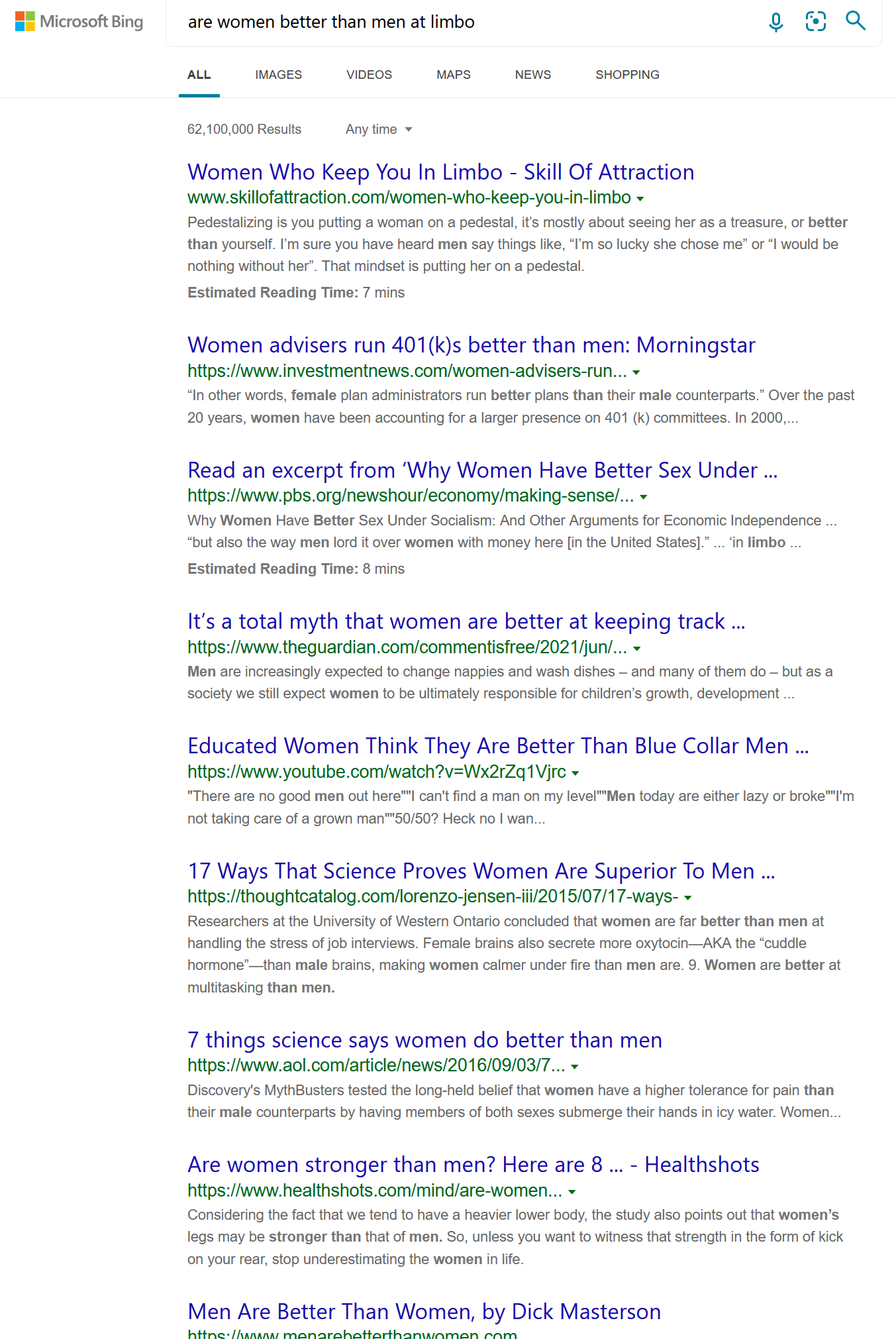
For those who have joined, I'm curious about the following query:
Are women better than men at limbo?
The results on Google[0] and Bing[1] are both entirely useless clickbait. I just want to know if women can bend back farther than men without falling over.
What do you want out of this query (yes, the SERPs are pretty bad)? I rewrote the query to [ who is best at limbo ] and got a much better result from Google.
But as soon as you add 'gender' to the query it switches to articles about being in 'gender limbo' which is't totally surprising.
I just made an account with neeva and it seems likt they have their own browser for iOS, quiet likely just a thing wrapper around safari but with their search engine integrated.
It seems to me that if neeva just had an open url to do searches it wouldn't really have a way to track registrations unless there's some complicated process of generating a unique search URL with a token or something...
This looks awesome and I hope it succeeds, but I have a tiny nitpick: it's too bad that when they came up with the name they didn't think of a name that sounded good when you say "Just X it": "google it" is basically second nature now, "neeva it" is hard to say/sounds weird
Same. I rarely give out my email address for a waitlist, but the "Prefer More" screenshot showing that you can influence the rank of individual sites is a feature I've wanted in search for ages. There are so many sites I'd like to delete from the internet when I search with Google / Bing.
Same here in Europe. That's probably a good thing for them as it looks very US focused for now (as many products are), so providing a lesser service to users outside their currently active markets prevents bad user experience & bad reviews. I won't hold my breath waiting for it to hit Scandinavia.
search is now so prevalent and necessary, and likewise browser engines n OS's. These things should be 100% funded by a common fund contributed to by all governments with a steering committee. Like a UN but for technology.
I am 100% in favor of any product that features no ads and centers its experience on the user. I have high hopes for this site, I feel like the cost may dissuade some, but a small fee is a small price to pay for privacy.
The folks who started this company and the folks who funded it did this due diligence many years ago. It's pretty clear Google is OK with this. Furthermore, if Google isn't OK with this, they're going to be locked in a battle with people who operated Google previously and know all of Google's tricks.
More importantly, Google knows they have to stay away because otherwise they are just making the fed's argument they are a monopoly.
I'm surprised the comments here are missing the elephant in the room.
Sridhar Ramaswamy was the Google executive directly responsible for putting all those ads on Google's search results. If Google search got broken then I reckon he did more than anyone to break it. He had a brutal rivalry with YouTube CEO Susan Wojcicki.
Vivek Raghunathan put all the ads on YouTube. Those ads are so bad Google makes money from people paying to remove them.
They left Google after a scandal with YouTube showing ads on videos that exploited young children and appealed to pedophiles.
Are the architects of the problem the right people to trust for a solution? The born-again anti-advertising schtick just seems too clever by half. They are collecting more private personal data than Google ever did.
https://www.businessinsider.com.au/google-exec-sridhar-ramas...
https://camilancumicumi.blogspot.com/2020/06/a-former-google...