Hacker News new | ask | show | jobs
by eatplayrove 1949 days ago
I have never read the blog, or have any positive or negative association with it, but after all the attention this story has garnered, I just read both the NYT article and Mr. Siskind's response.

The main takeaway from the NYT article is that there is a group of people in whose writings/blog comment sections/etc racists/sexists have found a home, and his is one of them. He does not address this assertion, or what the root cause may be if it is true, or if it is not true, why not. This is the whole point of 1, 3 and 4 in his statement but he does not address it.

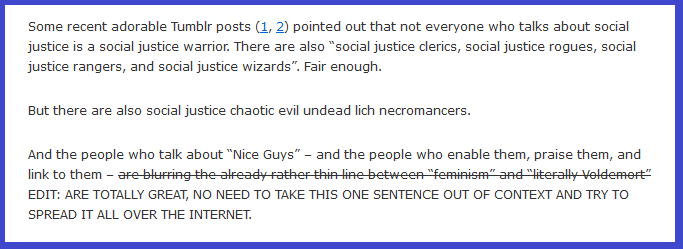
As to the only concrete point he addresses (point 2), he does something that is dishonest. He wrote (pre-edit):

> "blurring the already rather thin line between “feminism” and “literally Voldemort“"

and then claimed it's taken out of context. I read the whole article, especially the surroundings carefully to see if there was any context as to which could change the meaning of what he wrote here, but there is none. This simply states that there is a thin line between feminism and evil. If you believe that, then don't delete it. But if you don't, don't tell the reader it's taken out of context, just admit you made a mistake in writing this, or you have changed your mind despite this was what you believed when you wrote the article.

So there are 4 points in the rebuttal, 3 of them not addressing the point at hand, and 1 point dishonest at best. I am not impressed.

4 comments

A while back I mentioned to my mother that I had been to a "reddit meet up" and my mother, predictably, had never heard of reddit. Later, reddit made the news, I forget exactly what for, but in was the category of harboring child pornographers, racists, or nude celebrity photos. What I did remember is hoping my mother didn't see this news article and conclude that I was out meeting with racist pedophiles.

The thing is, it's not wrong to say that pedophiles and such use reddit. They do, in the same way they use phones, TVs, and cars. It's not an apt description though, if someone asks you what reddit is, to talk about the racism and hate and what not. The reason being is that the bad stuff isn't the typical reddit experience and doesn't describe the whole thing well.

In Scott's post he gives the example of the Wizard of Oz review (girl goes to a surreal landscape, kills the first person she meets, then teams up with three strangers to kill again). Maybe it's technically true, but it's not an apt description. It doesn't really capture what the movie is like.

Where I'm going with this is: maybe you can find neo-reactionary or pro-eugenics or racist comments on the blog. I don't recall any examples of horrible comments from the NYT but maybe they are there. Maybe you can find a line or two, like the "feminists are Voldemort" that seem bad and worse outside of context. That's not really what the blog is about though and in a newspaper article describing it probably shouldn't zero in on minor blemishes or debatable flaws and use them as the main focus. Wasn't this supposed to be about Silicon Valley's Safe Space, or getting into the zeitgeist of the "rationalists"? How did the NYT article even attempt to do that? To my reading the NYT was just focused on complaining about the "problematic" aspects and nothing else.

I think it's fair to talk about problematic comments on a blog but it's not fair to act like problematic comments or loose associations to objectionable figured are the main thing when they really aren't.

Regarding your point about the feminists and Voldemort, if memory serves Scott was referring to a specific group of feminists and not likening all feminists to Voldemort. That's not really the impression I got from the NYT though.

Specifically about the feminist point:

The quote is explicitly only about "people who talk about “Nice Guys” – and the people who enable them, praise them, and link to them". (https://cdn.substack.com/image/fetch/f_auto,q_auto:good,fl_p...)

This leads to several keys questions: Are all feminist such people who talk about "nice guys" and who enable, praise and link to them?

The second question is, are all people who talk about "nice guys" and who enable, praise and link to them feminist?

The third question is if this definition of "nice guy" is the informal term or the sarcastic meaning, and how useful either are to describe a psychology profile or human male stereotype?

The fourth question is if a discussion around "nice guy" stereotype of either profile is of strategist benefit to goals of some feminist theory, and then which ones?

>The quote is explicitly only about "people who talk about “Nice Guys”

He refers to the "already rather thin line between 'feminism' and literally 'Voldermort'", so it's clear that he's talking about feminism more broadly. Elsewhere in his writings there are statements that are completely consistent with this. For example, here he is alluding in passing to the supposed fact that only 30% of feminists are "sane": https://slatestarcodex.com/2013/10/20/the-anti-reactionary-f... At some point you've just got to accept that he's been broadly critical of the feminist movement, and said disparaging things about large numbers of feminists (in aggregate).

My personal take away from this is that editors are good. Scott's ended up writing a long series of unedited blog posts, and as a consequence has made some comments over the years that are flippant, exaggerated, in poor taste, or just plain wrong. Such are the perils of blogging. That's his responsibility. The NYT has no obligation to shield him from it.

One should always avoid finding hidden meanings and attributing quotes to people who has not said them. If he wanted to call feminist voldemort then we would have used the word feminist. Assuming that he actually meant that all feminist are voldemort is simply an interpretation, one which clearly not everyone share including the author.

If the New York Times Article had accused the author of being critical to parts of feminist movement it would likely been more true, and it would likely also be less of a news item to include. A lot of people are critical to parts of the feminist movement. If one wanted to gain outrage then the "sane" quote might have been useful, and at least it would then be a true quote rather than an interpretation. I doubt however it too would sounds enough outrageously, which is why they did not use it.

> If he wanted to call feminist voldemort then we would have used the word feminist

Sorry, you’ve lost me here. Are you nitpicking over the difference between ‘feminism’ and ‘feminist’? I don’t see how that helps. The comparison to Voldermort makes it pretty clear that he’s talking about people and not just an abstract ideology.

> If the New York Times Article had accused the author of being critical to parts of feminist movement it would likely been more true.

This is exactly what it said: “some feminists”. (“He described some feminists as something close to Voldemort.”)

The word "feminists" is not in the quote, and being critical to part of the feminist movement is not the same as calling specific feminist people for being Voldemort.

"He described some feminists as something close to Voldemort" is about as hand wave phrase as it gets, and trying to convince people about an interpretation of a quote is an enterprise doomed before it even started unless the reader already has the same interpretation.

As some last words I have on the subject, I find the whole article utterly dated as well as the quoted sections in it. "Nice guy/bad guy" stereotype hold as much useful utility for social discussions as "Nice girl/bad girl" stereotype. They are example gender based violence direct at getting conformity to gender roles. To the amount the author disagree when people use them I agree with him, and to the amount he himself uses it I disagree with him. Nothing useful can be had from normalize such stereotyping.

I fully understand your point re reddit, but I think a single person's blog is different than that. A blog is like a book and reddit is like a bookstore if you will, if you go to a bookstore selling a book that racists read that is not concerning to me (wrongly concerning to your mom as you said), but if you bought the book in question (even if non/anti-racists read it too) I would be concerned if I were your mother - just to make sure you are not aligned with them.

I am not saying this is the case (as I have no connection with the blog), but if the claim is indeed true that racists/sexists think the blog is great (which is the main takeaway I got from the article), that needs to be addressed as to why they are attracted there, and Mr. Siskind does not do that. If the claim is bogus, then the claim is bogus, but Mr. Siskind does not refute that they are attracted to his blog.

As to the feminism issue, in the full context, he criticizes feminism with respect to specific points and texts from feminists (which he is 100% entitled to), but then ends with the sentence in question that to me whichever angle you look at it from says, feminism and pure evil are not too distant. As I noted, he could have backed away from the statement easily by saying his statement is wrong (if he thinks so), but claiming it's out of context is dishonest and a diversion.

Regarding the difference between a blog and reddit I would say that the comment section harbors people with many different views. Some of the comments may be objectionable (again: I didn't see examples) but so what? That's got to be true of everywhere with a comments section. Why make that a focus?

You write "if the claim is indeed true that racists/sexists think the blog is great" - but this isn't even the kind of thing that could be true. Imagine how you would prove this claim, do you go to the National Association of Racists and ask for their stance on SSC? Is there a poll of racists and their opinion on niche blogs somewhere?

"Racists" is ill defined by itself. People aren't racist or not the way they are right or left handed. Racism is a spectrum and much of it is debatable and nuanced and affected by context and all that. This is like saying "Some number of an undefined group like something. Prove me wrong." That's not a legitimate claim and there is no need to try and rebut it.

I have no doubt that some racists like the blog and other racists don't like it. Do more racists (proportionally) like and read SSC or the NYT? I don't think you can answer that.

Regarding the feminist issue I'll have to go back and read that post before writing more.

Some of our applied social scientists are being allowed to work with very large datasets at places like Facebook and I believe they are increasingly in a position to make quantifiable statements on what racists or any other cluster-able groups of humans like. If by spectrum you mean “distance from a centroid” it might be more precise.

Marketing is essentially the working, reproducible arm of the social sciences, and marketers know a lot about human preferences and how to link them to motivation.

> Some of our applied social scientists are being allowed to work with very large datasets at places like Facebook and I believe they are increasingly in a position to make quantifiable statements on what racists or any other cluster-able groups of humans like. If by spectrum you mean “distance from a centroid” it might be more precise.

Just because you have more data, it doesn't mean that you can identify constructs like racism from this loads of data. You'd need some kind of ground truth mechanism (like an index of behaviour towards different races) which neither Facebook (nor anyone else) has. It's just wildly implausible.

Maybe, in ten years, NLP will be good enough to identify this, but I don't think these constructs are easily identifiable from text, certainly not in a public space such as Facebook.

> Marketing is essentially the working, reproducible arm of the social sciences, and marketers know a lot about human preferences and how to link them to motivation.

I get what you're trying to say here, and maybe that works in a small number of places, but having worked with marketers in analytics for the past decade or so, suffice it to say that I rarely praise the standards of experimention and (lack of) rigour employed by them.

That still relies on the scientists defining and labeling racists which will be an arbitrary process. Regardless - do you think anything of the kind was done by the NYT?
Unsupervised learning doesn’t give us named labels. Someone still has to name cluster 1, 2, 3... etc. So not sure that actually gets around what amounts to a semantic question.
This seems pretty crazy to me - you're saying that if I happen to enjoy anything that also happens to be enjoyed by racists/sexists, you would be concerned? Guess what? Racists and sexists like Harry Potter, and Star Wars, and Marvel movies, and Coca-Cola, and everything else that people who aren't racists and sexists like. I guarantee that you enjoy many, many things that are also enjoyed by people who have detestable beliefs, because people with detestable beliefs sometimes like things that have nothing to do with those detestable beliefs. Racists don't spend all their time reading Mein Kampf and watching Birth of a Nation, they also read the same books you read, watch the same movies and television shows you watch, and, yes, read the same blogs you read.

If the blog has sexist/racist content that attracts sexists and racists, sure, that's a problem, but if the blog had such content, the NYT article wouldn't have resorted to pointing out the commenters, they would have linked the content.

> As to the feminism issue, in the full context, he criticizes feminism with respect to specific points and texts from feminists (which he is 100% entitled to), but then ends with the sentence in question that to me whichever angle you look at it from says, feminism and pure evil are not too distant. As I noted, he could have backed away from the statement easily by saying his statement is wrong (if he thinks so), but claiming it's out of context is dishonest and a diversion.

Specifically, in context, he said "People who go out of their way to be horrifically mean to other people who are pretty unfortunate and unhappy and don't understand why, just for asking why, are pretty much pure evil", it wasn't an attack on all feminists ever, it was an attack on people who he specifically thinks are doing something extremely terrible. That's the context.

I never read that blog and don’t read the NYT but I will say in response only to your comment that racists and sexists don’t seem to enjoy Star Wars like they used to. Someone should write a (hopefully thoughtful-seeming) long form rumination on the parallels between what has (allegedly) happened to Disney and what has (allegedly) happened to the NYT.
>I never read that blog and don’t read the NYT but I will say in response only to your comment that racists and sexists don’t seem to enjoy Star Wars like they used to.

Most of the ire is directly at the sequel trilogy, notably the last two movies thereof. So if one of your coworkers says they hated The Last Jedi but loved The Mandalorian, then you can reasonably report them to HR for engaging in discomforting behavior.

Ah well I'm safe then because I thought Force Awakens was pretty shit and never even saw the following two movies in the ST
I really hope you're joking.
> but if the claim is indeed true that racists/sexists think the blog is great... that needs to be addressed as to why they are attracted there

I'll try to put this as objectively as I can. There is now a cultural overlap between those that support varying degrees of "censorship" and progressives, and between those that support "free speech" and, let's say, anti-progressives. This makes sense because now racism/sexism is more likely to be censored than extreme progressivism. Probably if it were the other way around (if extreme progressivism were more likely to be censored) then those same progressives would become staunch free-speech advocates and anti-progressives would be fighting for more "content moderation".

So if you are generally for the toleration of ideas, perhaps holding some unpopular opinions yourself, and against censorious tactics, you tend to attract extreme anti-progressives as well. For the most part, racists and sexist do not see themselves as racists and sexists, they see themselves as holding true but unpopular beliefs. Another interesting example of this is Sam Harris somehow having a fair amount of Trump-supporting listeners even though he spends a lot of time ranting about how incompetent and morally-bankrupt he thinks Trump is.

It's amusing to watch HN lose its collective shit over the NYT article, which I believe you succinctly and correctly summarize.

This is the highest rated top level post that presents any degree of skepticism at all in Scott's rebuttal, below pages of anger against the NYT "hit." So much for that quality, rationalist examination of the facts. As somebody who read both his blog and HN throughout its run, I find the NYT article on the money.

Scott's own cowardice about revealing his real name is incredibly telling, too. So long as he remained anonymous the NYT actually respected his wishes and buried the story, while this champion of free speech refused to stand behind his own words publicly and lamented the abuse of the MSM coming to dox him. Now that the checks are coming in, he seems to have no problem, though.

My advice to you, dear HN, is to take a look in the mirror. This isn't a hit piece and Scott isn't a saint. If you believe his long winded rants have merit, you should also believe they stand on their own, and you should welcome the scrutiny.

Your characterization of point 1, at least, makes no sense to me. All the NYT article says on that point is:

>In one post, he aligned himself with Charles Murray, who proposed a link between race and I.Q. in “The Bell Curve.” In another, he pointed out that Mr. Murray believes Black people “are genetically less intelligent than white people.”

I don't understand why you would say it is dishonest to dissect that paragraph and point out that Scott agreed with Murray on something non-racist, and quoted a racist statement without agreeing with it. Scott is not agreeing with "The Bell Curve" and Scott has not said that he believes that black people are "genetically less intelligent than white people.” Before defending yourself against such accusations it would be wise to point out that they are baseless, and of course it's much wiser to leave it at that.

Just to clarify, when I said

> 3 of them not addressing the point at hand, and 1 point dishonest at best

I meant counts of points, i.e., three of them not addressing the issue (points 1,3,4) and one dishonest (point 2) - reasons above. So dishonesty was not related to point 1, sorry if it reads like that.

To further elaborate for 1,3, and 4; I don't contend with his explanations - but they do not address the larger question of whether/why racists/sexists find his blog appealing.

>but they do not address the larger question of whether/why racists/sexists find his blog appealing.

Whether or not that is something you can and should address is of course one of the main issues here. The NYT would like if you only quote, welcome, converse, engage with people who are 100% correct and approved in all their views. If you disagree with that then there is also not much to explain. Sometimes unpleasant people like to read good blogs, and sometimes unpleasant people say insightful things that you might want to incorporate in your blogpost. Such is life.

Had I not been prepped by reading about the controversy here on HN, I wouldn't have guessed that the NYT article was a hit piece. On the other hand, had I not noticed that the article came from the NYT, I wouldn't have guessed that it wasn't just another blog.

Lots of blogs praise one another while also including disagreements and disclaimers that they don't fully believe their own writing, much less the writing of others. But they consider the articles to be worth reading anyway.

Some of my opinions are unpopular and may even make people uncomfortable. So I admit with trepidation that I still like the NYT and will continue to subscribe.