| Specifically about the feminist point: The quote is explicitly only about "people who talk about “Nice Guys” – and the people who enable them, praise them, and link to them". (https://cdn.substack.com/image/fetch/f_auto,q_auto:good,fl_p...) This leads to several keys questions: Are all feminist such people who talk about "nice guys" and who enable, praise and link to them? The second question is, are all people who talk about "nice guys" and who enable, praise and link to them feminist? The third question is if this definition of "nice guy" is the informal term or the sarcastic meaning, and how useful either are to describe a psychology profile or human male stereotype? The fourth question is if a discussion around "nice guy" stereotype of either profile is of strategist benefit to goals of some feminist theory, and then which ones? |
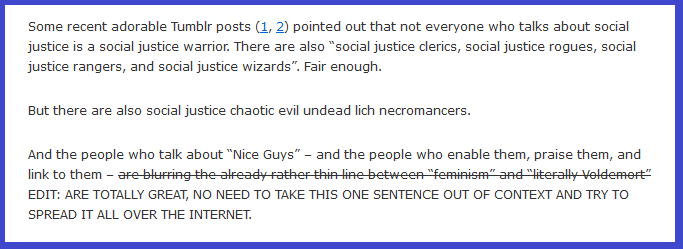
He refers to the "already rather thin line between 'feminism' and literally 'Voldermort'", so it's clear that he's talking about feminism more broadly. Elsewhere in his writings there are statements that are completely consistent with this. For example, here he is alluding in passing to the supposed fact that only 30% of feminists are "sane": https://slatestarcodex.com/2013/10/20/the-anti-reactionary-f... At some point you've just got to accept that he's been broadly critical of the feminist movement, and said disparaging things about large numbers of feminists (in aggregate).
My personal take away from this is that editors are good. Scott's ended up writing a long series of unedited blog posts, and as a consequence has made some comments over the years that are flippant, exaggerated, in poor taste, or just plain wrong. Such are the perils of blogging. That's his responsibility. The NYT has no obligation to shield him from it.