Hacker News new | ask | show | jobs
by Spearchucker 1965 days ago
Thanks for putting that out there. It's super interesting to see what we consider architecture to be. Your approach appears operational, focused on how the completed system functions, i.e. getting a new team member up to speed on the codebase.

Typically I try to start with tiers (1, 2, n-tiers...?) that show how the system might be deployed. I then list list layers (user/facade/business/data), interfaces between these layers, and components within each layer. I do that for each tier.

After that maybe something about quality objectives and how they might be met, eg: availability (MTTF / (MTTF + MTTR) * 100), efficiency, flexibility, integrity, interop, usability and so on.

This leads to a physical delpoyment model, which shows layers deployed to tiers. And yes, I'm rather fond of Visio.

Then a bit about approach (dev/deployment and operational management) risk and stakeholder management, technical reviews (change control board maybe?), and project reviews.

To be fair I come from a predominantly critical systems world (telecoms OSS and BSS, healthcare, transport and some fintech. And in that world architecture is very far removed from actual code until eventually.

2 comments

How do you distill down critical outcomes of the architecture for people considering using your project? Based on my experience so far, engineers will look at a giant document, see phrases like “stakeholder management” and nope the fuck out.

What I want to know is, what are the key performance considerations, failure modes, recovery procedures, etc.

Critical outcomes are defined by quality objectives (I mentioned some above, others are reliability, robustness and portability).

People don't consider using my project. There's a client with a business problem, there's a vendor who solves problems for clients. The vendor produces an architecture document that describes how technology will achieve a solution †.

There is no noping the fuck out, as this is a hospital asking you for a one-off to manage/settle insurance payments. Or an electoral district asking you to merge three emergency response systems into one. Or Nokia asking you to tariff calls going through a switch in real time.

† This is nuanced. Often a client's procurement department invites a number of candidate vendors to submit proposals including a design proposal/architecture and associated cost estimates. Vendors range from the high end (McKinsey, Bain & Co, Ernst & Young) to the mid-tier (Wipro, Accenture and so on) to the niche.

> Or an electoral district asking you to merge three emergency response systems into one. Or Nokia asking you to tariff calls going through a switch in real time.

I’m well aware of what it is. I’ve been on real time telecom stuff (your last example) and know for a fact that engineers nope the fuck out of these huge ass architecture documents that include stakeholders, change control, etc.

Inevitably there is some kind of outage or botched upgrade with lots of finger pointing and then the vendor covers their ass by referencing “page 248 under heading ‘assumptions about bisectional bandwidth’” or some bullshit right before the section on ‘renegotiating requirements during a government declared emergency’.

There needs to be a better way because I assure you, the people using your system are (on average) barely going to skim your document.

Being a “very serious” industry does not change this. Look at the disaster that was Healthcare.gov. That had mountains of documents like you describe they overlooked the simple requirement of scaling identity lookups.

"... the disaster that was Healthcare.gov"

OMG you worked on that? The blame for this one (and Universal Credit) sits with GDS. Their approach at the time was agile or die, and then try to develop an enterprise system like they did the Guardian's CMS (GDS was staffed initally by ex-Guardian devs).

I had the misfortune of reviewing their Government Gateway replacement, which at the time focused singularly on identity federation. GDS was hugely anti-Microsoft, who built the Govrernment Gateway. And so they chose the SAML protocol over the incumbent ADFS, breaking every dependency.

GDS was way out of its league. An inexperienced 25y/o will draft exactly the kind of architecture document you describe.

I feel for you, and I now understand the cyncism.

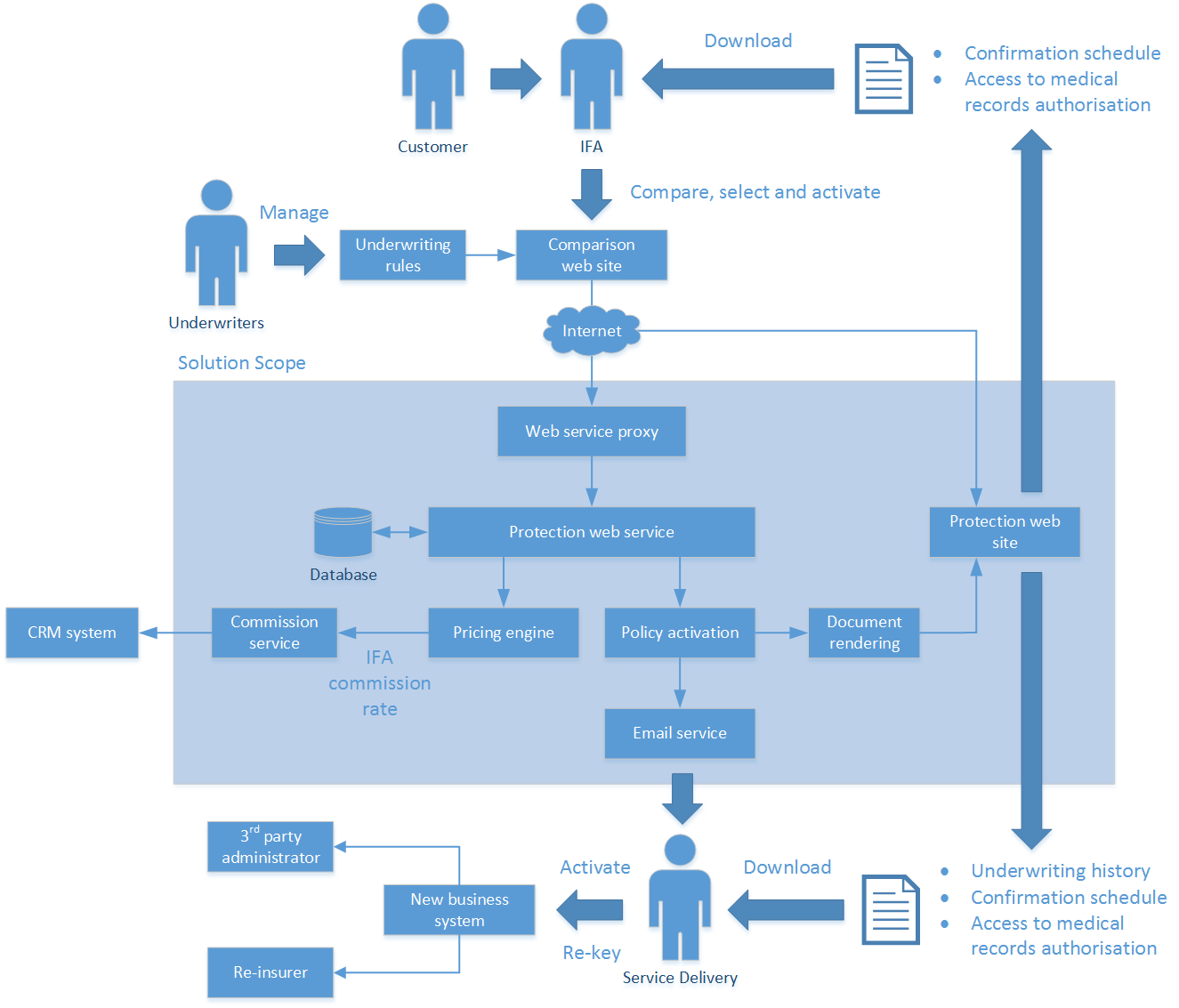
The people using my system never skim my document. Lawyers tend to scrutinize it. As for the document being a war-and-peace epic yes, this happens. Mostly because people cannot write technical documentation. The hugest system can be distilled down to a single diagram which should require no words of explanation.

By way of example - here's a conceptual design for an insurer wishing to participate in a panel of protection providers.

https://www.wittenburg.co.uk/images/consulting/conceptual_de...

If you're in this world all of it is self-evident, none of it a surprise, and you understand the flow. That document leads to other more detailed designs that each address one distinct rectangle in that image.

At some point all of this will become a specification. Again the immensity of that depends on the ability of the authors. On their ability to manage complexity, and their skill as technical writers.

Either way yes, when the wheels fall off that document becomes the truth, the one everyone goes to to settle disputes. And with a capable team it never gets to that because the documentation is succint and agreed to, and what is delivered matches what was specified.

The way to solve that is basically DevOps. DevOps being a solution to a business problem, it is implemented as an array of "features" of integrating teams that work together on a product. It's a multi headed hydra and it's not easy. But the end result is people communicating better, which is the only thing that can really address a developer noping the fuck out. There is no technical thing, no document, no policy, etc that can fix it, as far as I'm aware.
Your approach seems like it would reduce the likelihood of implementation-time surprises. It also seems like different sections would satisfy different audiences. Do you have any book recommendations?
I do indeed. Here's a complete list of books I recommend when asked -

https://www.wittenburg.co.uk/Work/Books.aspx

The one that made the biggest impact on my approach to architecture is "Designing Solutions for Your Business Problems: A Structured Process for Managers and Consultants" by Betty Vandenbosch.

The one that made the biggest impact on me in ever is "Wicked Problems, Righteous Solutions" by Peter DeGrace and Leslie Hulet Stahl. Lots of forehead slapping and kicking myself ensued. Even more applicable today than it was in 1990 when written.

"Peopleware: Productive Projects and Teams" by Tom DeMarco and Timothy Lister comes as a very close second.

Not directly architecture or technology-related is "The Story Factor by Anette Simmons". It... changes you. Really useful for technical writing.

Thank you for the book recommends

Also i read your home > work articles

They are excellent

Thank you.
Two books I that were instrumental for me to learn how to explain the architecture of my software clearly to other people were "The Architecture of Open Source Applications" Volumes I and II (http://aosabook.org/en/index.html)