As someone who’s designed auto interiors, where other people see simplicity like a single touchscreen for all controls, I see an ergonomic disaster motivated by cost cutting.
I'm genuinely curious, could you explain how the touchscreen is a disaster?
I haven't seen a Tesla interior so when you say "all controls" it's a bit concerning. I'm assuming you're talking only of non-driving related control...
Because of the lack of tactile feedback, touchscreens often lead to distracted driving by forcing drivers to take their eyes off of the road to carry out simple tasks. As an example, take HVAC and radio functionality -- in older cars with buttons and knobs, after a short amount of time, people can operate these functions without looking. The same is not true for touchscreens. That's not to say that there is no place for them in cars, but the consensus it's better to use a combination of touch screen (for things you don't often adjust while driving) and physical controls (for things you do). But it's generally cheaper to slap a big ol' touchscreen in cars that does everything, and change configurations in software, rather than investing in custom interior designs for each model of car. And it's not just Tesla doing this, even companies who hang their hat on safety like Subarus are stuffing more and more functionality into touchscreens[0].
Not entirely related, but I always hated the red dash lighting on my car. I thought it looked ugly and wondered why they didn't just go with a cleaner white colour.
Then I read about red light is specifically used in car dashboard lighting and airplane cockpits because it helps with night vision. What I thought at first was just an ugly colour choice was actually a very subtle design decision to help while driving at night.
It always reminds me how complicated and multifaceted good design is. There are always trade offs to consider, but minimalism as a design trend often seems a little too willing to ignore those trade offs and will sacrifice traits like safety, efficiency and flexibility for the sake of cost and simplicity.
Then I read about red light is specifically used in car dashboard lighting and airplane cockpits because it helps with night vision.
Given that there is a stream of not-red lights shining at me in the opposite lane, I've been skeptical of this claim since Nissan did it in the 300Z like 30 years ago. It's there to look cool, not be useful. There's a subtle design lesson in there as well, I'm just not sure what it is.
When I took an astronomy class in college, we'd have "night" class on the roof, with telescopes, and star maps.
We were instructed to bring flashlights, but cover the lens with a red layer, to keep the pupils from closing too much, so we could both look at stars but read our star charts.
The headlights in the other lane don't disqualify the benefits of using red lighting inside the car.
You don't need night vision when headlights are visible in the opposite lane. You'll appreciate it when you are driving on a dark road on a moonless or overcast night.
I don't even have a Tesla, I have a 2013 Prius which has an array of buttons for everything instead. The only knobs are the miniscule (and hard to turn) volume and tune buttons on the radio. They made a token effort but placing indentations on the heater temp and fan speed buttons but after five years I still can't operate anything on the center console without taking my eyes off the road.
I love almost everything about my Prius but the person who designed the interior to look like a Starfleet shuttlecraft should be shot.
As a Model Y owner (who still has his roof!), you very quickly become accustomed to it. Excellent voice controls allow for finding music easily, and adjusting things like the AC is done so infrequently that doing it through the touch screen is a non-issue.
Every human factors study I’ve seen results for indicated that touchscreens were ergonomically inferior. Drivers would take longer to make the same adjustments and were more distracted while doing so. You may be underestimating how much the touchscreen impacts your ability to drive. Voice control is indeed much better, but as others have pointed out, experiences may vary.
or are a non native english speakers.
Sure, not getting voice control to work properly in my language is one thing, but not being able to deal with local accents (which is a majority in the world) makes voice control almost useless.
Even the Ford Mustang Mach E has copied the Tesla center-screen design. At least they also have a short-wide screen behind the steering wheel too, and they've included a big knob embedded into the bottom of the center console screen. Hopefully that helps.
Wow. I feel like I got my Subaru at just the right time when driver assistance tech was somewhat mature but the user interface was still mostly mechanical.
I'm not familiar with Teslas at all, but it sounds like a voice interface might help work around some of these limitations, a la Alexa/Hey Google. Maybe they already have it?
Please no, nothing is more frustrating and distracting to try to get my virtual assistant to fix something they've misunderstood. That's about as fun as arguing with your passenger about directions while driving.
It feels like a specialized voice control interface with a limited set pre-programmed functionality accessible through specific hard-coded keywords (which is what I assume Teslas could be equipped with for this purpose) might have a much easier time getting things right compared to an open ended general purpose virtual assistant that has to deal with completely arbitrary voice commands and unbounded ambiguity.
I used to think that voice recognition sucked until I tried Google Assistant. Holy shit is it amazing when it picks up every single word you utter every single time. Truly impressive and if car manufacturers can license the voice tech from Google I can definitely see the tech being quite useful.
They do. You can control many things with voice in Tesla.
I don't know the comprehensive list of things you can use it for, but so far I used it to:
* Change temperature
* Play a specific song
* Set navigation to a new destination
I didn't put switching music tracks (next&previous)/adjusting volume on that list, because those can be easily performed using the scrollable button on the steering wheel.
If by voice control, you mean asking a passenger to do it, sure. If you mean trying to find the right keywords while driving a vehicle at 65 mph, no thanks. I'm a native english speaker with a california accent and none of the systems I've used have been much help.
It's like playing an old text adventure without the manual, so you don't know the verbs. It uses too much thinking to try to come up with different words while also trying to drive.
> I'm genuinely curious, could you explain how the touchscreen is a disaster?
Touchscreens in cars are a disaster, in general. They're a bad technology for the use case. They're more so in a Tesla, because Tesla relies on them far more heavily than any other manufacturer, and gives users no alternative for most functions.
Cars should be designed to minimize touchscreen use, not maximize it.
I completely agree. They're not as reliable as buttons. A single failure breaks everything. They're not particularly robust to temperature extremes. I can't use them by touch alone. They don't work with gloves.
In fact, the reliance on a touch screen is why I've stricken Tesla off the list while shopping for an EV. I currently drive an old BMW and I love the interface. There are physical buttons for everything and there's no unnecessary fluffy stuff.
The most-modern vehicle I've driven whose interface I've liked was a Skoda Fabia.
Sounds like you are stating an opinion rather than some fact based on data. As proven by exponential growth in Teslas, there is clearly a massive fanbase of people who like touchscreen. I personally absolutely love it, and don't really know why other cars have knobs and buttons.
So if that happens, embrace the touchscreens then? I mean, in the 90s, Microsoft was pretty hung ho about having voice as the main interface to computers in the near future. They kept the keyboard, which, given the history of early noughties voice recognition, was probably just as well.
One thing I’ve never seen mentioned online but a Model 3 owner I know complained about is that the speedometer is blocked if you have your right hand between 3 and 6 o clock on the steering wheel. He had to change the way he’s used to gripping the wheel to accommodate the car which seemed like a high burden for a luxury product.
I truly don't understand how your friend has this problem. I have a Model 3, and after I read your comment, I tried to block my view of the speedometer with my right hand and couldn't do it. I tried sitting closer and farther back, higher and lower. I tried every position on the steering wheel. I flared my elbows out. I tried to imagine my hands and wrists were twice the size. I just don't see how this is possible. I'd love to see a POV pic from your friend that illustrates the problem. For my money, having the speedometer on the central screen makes it more visible. My view of a conventional dash is always partially blocked by the steering wheel.
Think I misremembered slightly, I only rode with him once. I though the speedo was at the lower left of the screen but it looks like the upper left. Think maybe he was used to having his hand between 12 and 3 and had to move? He was a larger guy if that makes a difference
Not a friend, just a former coworker I didn’t keep in contact with so I don’t have any way to follow up.
Almost every modern car has an adjustable steering wheel which you can move around to ensure you have a line to the instrument panel. Cars in the Model 3 price range will often project speed and other driving information into the windshield.
A lot of people have offered other details. I’d add: in the Model 3 even instrument panel information like speed is in the center display.
Touchscreens cut costs because you can ship the same hardware to all SKUs and change features in software. Buttons need to be added or replaced with fillers depending on the options that each car has.
On my dad's old land rover, you can literally operate the radio wearing blindfolds because everywhere is simply placed. It responds instantly, draws no power, and shut up when you aren't using it. His current car just gets in your way, even if it has more features.
It's a design that is getting sold to people who are getting starry eyed over other aspects of the car. They don't care that the fit and finish is befitting an Aveo. They care that they're driving a sexy new EV from the leading manufacturer of sexy new EVs. From the perspective of "keep Tesla relevant and financially solvent-ish" it's a great design. They know what the people they're selling to care about and what they don't and the latter isn't getting much attention.
It's like how the Tacoma has been the turd of it's segment on paper for 20+yr but still flies off the shelves. Clearly the metric don't tell the whole story. In both cases there's an emotional value proposition that's doing a lot of heavy lifting.
And since I know in advance that this comment is gonna piss off a hell of a lot of people here (if I had to pick a demographic that will have both a Tacoma and a Tesla in their driveway HN would be about the perfect fit) I'll ask in advance if any of those people would like to tell me why I'm so wrong.
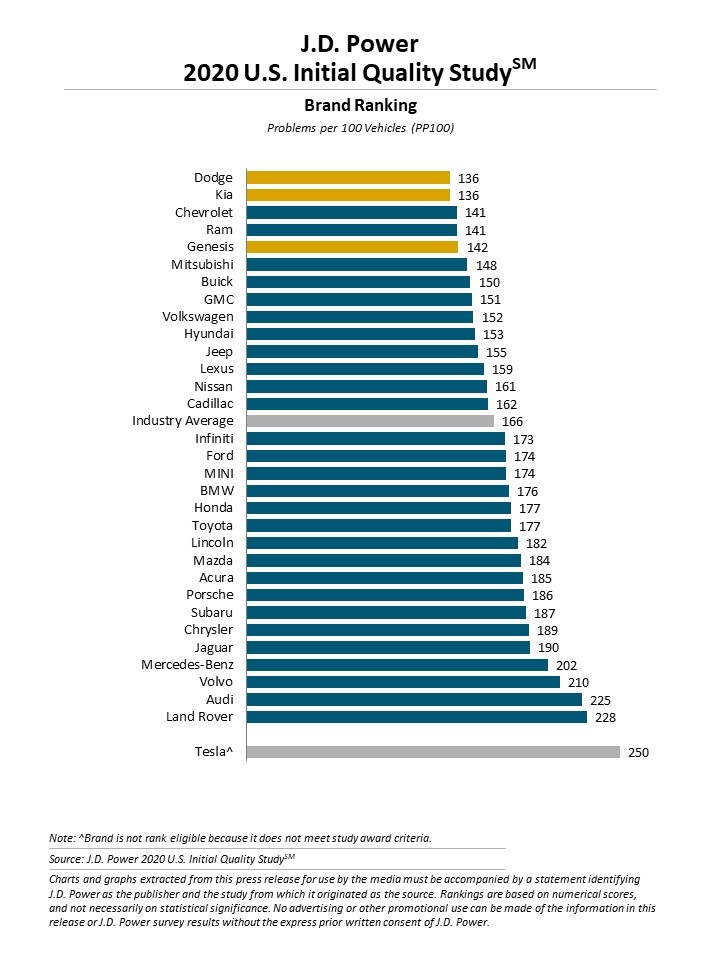
Just my own personal experience, I've owned two Teslas (a 2014 Model S and a 2018 Model 3) and they both had a pretty good number of problems here and there. The S was particularly bad, though that is maybe not surprising since it was one of the first 50k cars the company built, but the 3 has had its share of issues as well.
But the thing is, I've never had any issues that rendered the car undriveable or unsafe, and service has always been a joy to work with. Every problem I've encountered has been addressed quickly and effectively with no hassle or charge. So, I'm willing to forgive some of the rough edges, and I suspect this is why they get such good customer satisfaction ratings despite the relatively high number of issues.
I have a recent X, the panels fit together, no rattles or squeeks and the issues I've had were fixed fast. Last was the voice control button on the steering wheel that failed to work, reported it on last Thursday, they were at my door with mobile service at 9 this Monday.
I did test drive a 2013 S and I decided to wait until they matured at that point but now they seem to have gotten their act together in most cases.
They're actually on par with Audi here in Norway when it comes to customer satisfaction so it's not all bad [1]. Only Toyota, volvo and BMW beat them. They had a dip due to an overcrowded service department at the launch of the Model 3, but they hired a ton of people and trained them.
Now this roof falling off is one area they could improve greatly, factory Q&A. There should be a bumpy test track where they take all their vehicles for a control drive before shipping them to eliminate issues like that roof.
Cars should be available, not spend time in the shop for repairs that could have been avoided. It's great that you are so forgiving but for me a trip to the garage for some small issue would eat up half a day easily and that adds up quickly when there are a number of issues.
I mean, I agree with the sentiment, but also you're assuming you'd similarly waste half a day for a Tesla repair, and that's usually not the way things work. Tesla will frequently send a technician to a customer's home or place of work and fix issues on the spot. Even when I've had to go to a service center in person, they've included free rideshare credits for quick repairs so that I don't have to wait around, or free loaner cars for longer repairs.
Back in the old days when I lived far away from a service center, they once drove hundreds of miles with a flatbed to come pick up my car, and dropped off a free loaner at my house while my car was in the shop, then came back and returned my car and picked up the loaner a few days later. (The loaner was also a nicer Tesla than the one I owned.) They really do go above and beyond to resolve issues as pleasantly and conveniently as possible.
Well, for one example: Tesla Model 3 production was constrained based on the amount of paint their factory was consented to spray every day. When Model 3 production started climbing, customers were seeing very thin and uneven paint application, well below what's normal for a car in this price bracket, and often very light on critical areas like the sills. Owners in snow-bound places where Tesla is popular, such as Scandanavia, were reporting pain stripping within a few months of ownership.
I don't know about you, but my expectation for what is nominally a luxury car would be to have paint standards better than British Leyland in the 70s.
But I designed interior parts, so it's my own Engineering take. Tesla's were not competitive at all. The gaps between panels were so bad, you could stick your finger in it. That's not just an appearance issue, kids and adults will mess around with large gaps and put stuff inside.
And features in the interior were non existent. (Especially for a luxury car)
Interesting that you are just glossing over the fact that a) Tesla trounces all competition on performance and b) Tesla trounces basically everyone on safety as well.
a) for that kind of money, and lack of features, it better go fast (cornering, meh, not so much).
b) You are commenting on an article that talks about a Tesla loosing its roof. That's a new one on me, and I'd thought I'd seen it all back when I was an auto mechanic.