Hacker News new | ask | show | jobs
by ChuckNorris89 2424 days ago
I'm amazed and still can't get my head around how today we can receive images and valuable data from a device which is currently lightdays away from us and was built with 60's technology & know-how and is operating well beyond it's expected lifetime.

I raise my glass to the engineers who worked on this. Makes my daily programming tasks feel stupid in comparison.

Edit: corrected, thanks for the numbers

13 comments

I know a person who worked on voyager. He is a very smart person who has contributed to a wide range of technologies over a long period of time. I have talked to him and the reality is that by the time that project was being done, the people who ran it had a lot of experience, and they applied the hell out of it to the project.

I've spent a lot of time since then looking into how to build reliable systems that operate for decades and... there are no easy answers. You have to have an amazing amount of knowledge about the engineering context (what's it like to run a computer in space), the scientific mission (IE, given this payload mass, what instruments can we fit), judicious software engineering skills (just updating the firmware on a machine that's millions of miles away is a challenging problem, worse yet if updating the firmware bricks your control plane), project management skills (to ensure you make your launch date), and the dedication to keep things going long after most people got bored of them.

After a long time playing with complicated systems I went back and played with 8-bit microcontrollers and they were actually really fun because it forces you to build systems that are reliable without a terminal and resource constrained (you'd have a hard time fitting a program as large as this comment into an arduino...)

The biggest factor working to their advantage was that the tech back then was much simpler and more robust. To get todays tech to work for a decade without interruption would be a very tall order. Layer upon layer of abstraction has made it impossible to know for sure that there are no edge cases that will only trigger once every 3 years or so.
The physical hardware for the computers of 70's probes had more parts and complexity. Voyager used magnetic tape recorders, for example. Newer tech has allowed for simpler computer hardware, but does shift problems into the realm of software and file system management.

Both Spirit (Mars) and New Horizons (Pluto) had down days as issues with file system management puzzled the IT staff.

The New Horizons case was a crazy mad-scramble, as the probe was scheduled to pass by Pluto in a few days whether the probe was working or not. There was no re-do. Dozens of choice careers were in the balance.

Probe chips are still not very powerful by today's standards because they are designed to work in the harsh conditions of space. Thus, they are more comparable to a 1980's PC, and may mostly stay that way, being smaller components don't handle radiation well.

I read somewhere it's estimated that even surface-reaching cosmic radiation fouls up the typical desktop PC roughly once a year. Most just grumble at Microsoft and reboot.

I sort-of agree, although actually there is a lot of older stuff still made on fabs with huge (transistor) feature sizes and limited (software) feature sets that could be used to build extremely reliable long-term systems.
> ...and the dedication to keep things going long after most people got bored of them.

... has become a virtual impossibility in the age of short-lived consumerism and fad-driven development.

Voyager 1 is 0.00234 light years from Earth, Voyager 2 is 0.00194 ly. Or in more useful units: 20.5 and 17 light hours.

Also we do not receive images any more (the cameras were made for planetary encounters and have been turned off long ago).

But yes, getting data (at 160 bits per second) from man made objects that are the better part of a light day away is impressive. Even more so because they have been working for 42 years now, 30 years past the initial planetary mission.

Are they powered via PV? IIRC one of them (satellite/probes) had some nuclear fuel.
Both Voyager 1 and 2 use RTG's (Radioisotope Thermoelectric Generators)[1] for power. Every year the RTG puts out less and less power, so instruments are gradually powered down to preserve the functionality of the critical ones for as long as possible.

According to JPL[2] at least one scientific instrument will continue functioning until about 2025, and the crafts will remain in range of the Deep Space Network until 2036.

[1] https://en.wikipedia.org/wiki/Radioisotope_thermoelectric_ge...

[2] https://voyager.jpl.nasa.gov/frequently-asked-questions/

Let's just hope the Deep Space Network will continue being funded. Further capsizing its budget and shutting it down would make it impossible to stay in contact with one of the greatest achievement of Mankind.
Thanks for mentioning Deep Space Network. I didn't know this is a thing and is more than 50 years old.

https://deepspace.jpl.nasa.gov/about/

If you ever have the chance to check out JPL during one of their open houses, I highly recommend it. They have an exhibit with replica models of various satellites throughout history, and in the entry way there are screens showing data about what is currently being pulled in from the DSN. When I was there, it was pulling down data from New Horizons (at some absurdly low bit rate)!
The interesting thing is that they have plenty of fuel still, but the parts are degrading.
> Are they powered via PV

Consider that light emitted from the Sun will decay with the square of the distance – as it is irradiated in all directions. To Voyager, the Sun looks like an ordinary star – although one much brighter than the others. Not much energy can be harvested there.

Until recently, photovoltaics were useless as far away as Jupiter. Given the tech advancements, we can now use them there (and have). Farther than that and you are bumping into practical limits.

> To Voyager, the Sun looks like an ordinary star – although one much brighter than the others. Not much energy can be harvested there.

This blew my mind. Do you have a reference that talks more on this topic?

Inverse square law: https://en.wikipedia.org/wiki/Inverse-square_law

>(...) Intensity is inversely proportional to the square of the distance from the source of that physical quantity.

Shit gets dimmer at the square of the distance. So if at a distance of 1 a thing has a brightness of one, at a distance of 2 it has a brightness of 1/(2^2), or 1/4. At a distance of 8, you are looking at a brightness of 1/(8^2) or 1/64th.

Voyager 2 is ~122 AU distant. So the sun's apparent brightness would be 1/(122^2), or 1/14884, or 0.00067 % as bright as the sun as perceived at the earth-sun distance (ignoring the atmosphere of course).

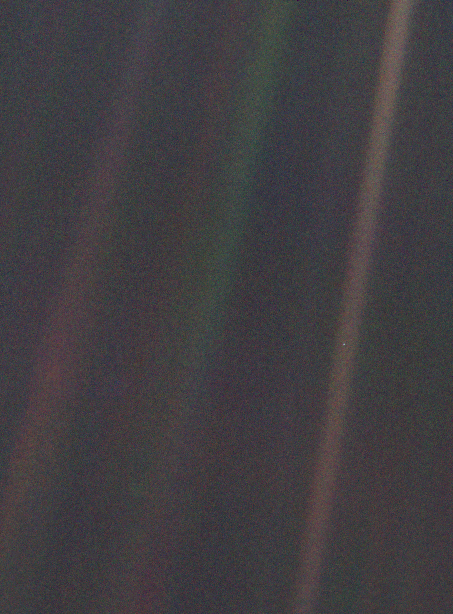
Voyager snapped a picture of our Earch (sorry I thought it was the Sun) in 1990. It's the famous Pale Blue Dot picture. It's the small blue-white speck (or almost pixel) halfway down the brown band on the right. https://en.es-static.us/upl/2012/07/Pale_Blue_Dot.png

EDIT: Ooops, sorry - this is Earth and not Sun :-(.

The pale blue dot is Earth, not our Sun.
That's Earth, not Sun.
Not as far out as Voyager, but I enjoyed this series of depictions of the sun from each planet, which illustrates the general point:

https://www.iflscience.com/space/sun-looks-like-every-planet...

You should look up or play Elite Dangerous, it's (I believe) a fairly accurate / to scale simulation of solar system navigation. You can go at several hundred times the speed of light and you're still waiting for ten minutes to reach your destination.
If you're talking about its apparent size in the sky -- just a guess but I think this one is relevant: [1]

[1] https://en.wikipedia.org/wiki/Angular_diameter

They're powered by Radioisotope Thermoelectric Generators. https://en.wikipedia.org/wiki/Radioisotope_thermoelectric_ge...
I used to have it in my head that the Voyager probes were about as powerful as an Apple II computer. But it's hard to make a direct comparison as the probes have three computers made of two processors each, running at 1/20th or 1/6th the speed of an Apple. So it's not a one-on-one comparison in any way, but for discussion purposes:

An original Apple II used a MOS 6502 8-bit word CPU clocked at 1.023 MHz and typically had 4Kb to 48Kb of RAM. It ran about 500,000 instructions per second [1].

Computer Command System (CCS) - two 18-bit word interrupt-type processors with 4096 words each of plated wire memory. It ran about 25,000 instructions per second. [2]

Flight Data System (FDS) - two 16-bit word machine with modular memories and 8198 words each of memory. It ran about 25,000 instructions per second. [2]

Attitude and Articulation Control System (AACS) - two 18-bit word machines with 4096 words each of memory. The AACS ran about 80,000 instructions per second. [2]

So maybe the total amount of computing power is equal? The total memory on a Voyager was about 32K [3], and since the word sizes were bigger, theoretically they could access larger chunks of memory in a single instruction? What's for sure is that a single CCS is at least an of magnitude less powerful than an Apple II.

More info:

1) http://www.classiccmp.org/cini/pdf/Apple/Apple%20II%20Refere...

2) http://www.cpushack.com/space-craft-cpu.html

3) https://web.archive.org/web/20110721050617/http://voyager.jp...

>So maybe the total amount of computing power is equal?

Probably not. Those 18bit words likely contain 2 bit parity to prevent space radiation from making this go bad. Plus, it's only one machine, not two, the two always run in parallel (for the CSS, the FDS only has one running at a time and AACS is turned off if not needed) and redundantly in case on fails, so in total you're running about 180'000 instructions per second, not 360'000. The memory totals 34 kilobytes (18bit words in two of the memories, 16 in the third), with a simple redundancy like the computer itself (ie, each computer has it's own memory).

The CCS is also responsible for managing the memory of the other two systems (MEMLOAD), so their realistic instruction speed may be limited by slower memory access in memory heavy applications.

Even all systems combined, I don't think the voyager is faster than an Apple II within an order of magnitude.

Just FYI nothing man made is even close to light years away from the Earth.

EDIT: I don't understand the downvotes. Isn't this just fact?

EDIT 2: I see the OP changed his original comment, so I can understand the confusion. Thanks all :)

voyager 1 which is currently the farthest man made object from earth is approx 147 AU away, where as 1 light year is equiv to 63241.1 AU... so it has a little ways to go still :)
> EDIT: I don't understand the downvotes. Isn't this just fact?

Nobody's questioning that fact (barring well-deserved pedantry about radio signals), but GP's claim was light days so the downvotes are probably about the nonsequitur.

OP edited after the fact (says as much)
lol timehackers. It made sense when I wrote it \o/
Do radio signals count as man-made?
Our radio broadcasts are.
Ok, nothing man-made of the spacecraft type...
Imagine the systems that they worked with.

In the 1970s, dealing with primitive electronic systems, often without screen and most definitely without a full OS.

Goosebumps. To imagine that the tech phenomenon that we can only regard as recent (2000-) but there are people from as far as 30 years back before that, working on things that have lasting impact to us.

I recently read bwk's Unix history and memoir, it's a great read, to see many of these pioneers being old and passed away is a great sadness.

You're making it sound like the Voyager software and hardware was developed by poking soft clay tablets with a pointy reed. The systems had OS's, screens were surely available, ICs and high-level languages were in use. The '[computer-ish] tech phenomenon' itself is a fair bit older - 'Silicon Valley' is named after literal, not figurative silicon-based electronic components.
My favorite part is how everyone is jumping down your throat over a simple mistake in what was meant to be an expression of awe and admiration.
Voyager 1 is about 0,0023409 lightyears away from earth (voyager 2 is a bit closer than that).

https://voyager.jpl.nasa.gov/mission/status/

Related, and relevant: https://en.wikipedia.org/wiki/Pale_Blue_Dot

Look again at that dot. That's here. That's home. That's us. On it everyone you love, everyone you know, everyone you ever heard of, every human being who ever was, lived out their lives. The aggregate of our joy and suffering, thousands of confident religions, ideologies, and economic doctrines, every hunter and forager, every hero and coward, every creator and destroyer of civilization, every king and peasant, every young couple in love, every mother and father, hopeful child, inventor and explorer, every teacher of morals, every corrupt politician, every "superstar," every "supreme leader," every saint and sinner in the history of our species lived there--on a mote of dust suspended in a sunbeam.

The Earth is a very small stage in a vast cosmic arena. Think of the rivers of blood spilled by all those generals and emperors so that, in glory and triumph, they could become the momentary masters of a fraction of a dot. Think of the endless cruelties visited by the inhabitants of one corner of this pixel on the scarcely distinguishable inhabitants of some other corner, how frequent their misunderstandings, how eager they are to kill one another, how fervent their hatreds.

Our posturings, our imagined self-importance, the delusion that we have some privileged position in the Universe, are challenged by this point of pale light. Our planet is a lonely speck in the great enveloping cosmic dark. In our obscurity, in all this vastness, there is no hint that help will come from elsewhere to save us from ourselves.

The Earth is the only world known so far to harbor life. There is nowhere else, at least in the near future, to which our species could migrate. Visit, yes. Settle, not yet. Like it or not, for the moment the Earth is where we make our stand.

It has been said that astronomy is a humbling and character-building experience. There is perhaps no better demonstration of the folly of human conceits than this distant image of our tiny world. To me, it underscores our responsibility to deal more kindly with one another, and to preserve and cherish the pale blue dot, the only home we've ever known.

— Carl Sagan

Yes, the notion of engineers knowing what they are doing and actually creating a reliable system seems to be largely alien to the HN crowd.
Anyone has any details of how its implemented ? Arch diagram of some sort ?
"Uptime 15,364 days - The Computers of Voyager" is a pretty good introduction. https://www.youtube.com/watch?v=H62hZJVqs2o
Voyager 1, the most distant probe, is about 0.002 light years away from the earth.
FYI Voyager 1 is about 20 light hours away.
Yeah but did they use Agile methods and have good team velocity as they burned down the backlog? If not, how can we really be sure the project was a success?
Agile shares a lot in common with practices mentioned in „Mythical man-month”, which in turn was based on the good practices from the Voyager era.

Also, extreme programming was based in part on the TDD from Mercury program, iirc.

Having said that - yes, cargo cult agile sucks, we all know that.

The surgical team analogy at the core of TMMM is totally incongruent with agile principles. The book espouses a ton of anti-agile (small a) ideas.
Maybe, I know he highly recommended iterative development in the silver bullet essay: http://eppsnet.com/2006/06/respect-the-classics-man-no-silve...
They had escape velocity.
I like your comment but it got down voted into oblivion probably because you forgot the /s tag. Some folks are serious here.
Hacker News isn't very accommodating of trite humor in my experience, so I doubt /s would have helped much here.
Check their Slack and ask.