Both Voyager 1 and 2 use RTG's (Radioisotope Thermoelectric Generators)[1] for power. Every year the RTG puts out less and less power, so instruments are gradually powered down to preserve the functionality of the critical ones for as long as possible.
According to JPL[2] at least one scientific instrument will continue functioning until about 2025, and the crafts will remain in range of the Deep Space Network until 2036.
Let's just hope the Deep Space Network will continue being funded. Further capsizing its budget and shutting it down would make it impossible to stay in contact with one of the greatest achievement of Mankind.
If you ever have the chance to check out JPL during one of their open houses, I highly recommend it. They have an exhibit with replica models of various satellites throughout history, and in the entry way there are screens showing data about what is currently being pulled in from the DSN. When I was there, it was pulling down data from New Horizons (at some absurdly low bit rate)!
Consider that light emitted from the Sun will decay with the square of the distance – as it is irradiated in all directions. To Voyager, the Sun looks like an ordinary star – although one much brighter than the others. Not much energy can be harvested there.
Until recently, photovoltaics were useless as far away as Jupiter. Given the tech advancements, we can now use them there (and have). Farther than that and you are bumping into practical limits.
>(...) Intensity is inversely proportional to the square of the distance from the source of that physical quantity.
Shit gets dimmer at the square of the distance. So if at a distance of 1 a thing has a brightness of one, at a distance of 2 it has a brightness of 1/(2^2), or 1/4. At a distance of 8, you are looking at a brightness of 1/(8^2) or 1/64th.
Voyager 2 is ~122 AU distant. So the sun's apparent brightness would be 1/(122^2), or 1/14884, or 0.00067 % as bright as the sun as perceived at the earth-sun distance (ignoring the atmosphere of course).
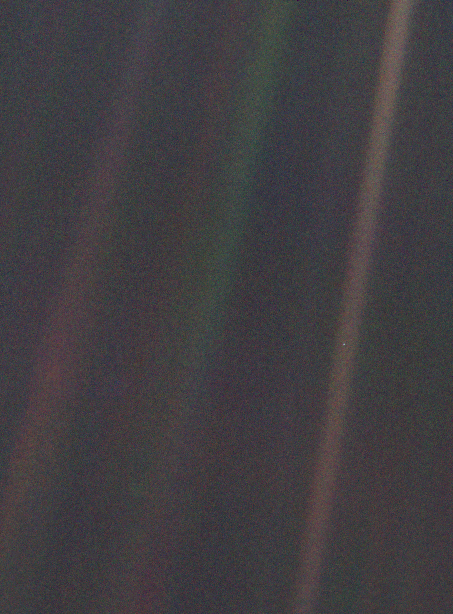
Voyager snapped a picture of our Earch (sorry I thought it was the Sun) in 1990. It's the famous Pale Blue Dot picture. It's the small blue-white speck (or almost pixel) halfway down the brown band on the right.
https://en.es-static.us/upl/2012/07/Pale_Blue_Dot.png
EDIT: Ooops, sorry - this is Earth and not Sun :-(.
You should look up or play Elite Dangerous, it's (I believe) a fairly accurate / to scale simulation of solar system navigation. You can go at several hundred times the speed of light and you're still waiting for ten minutes to reach your destination.
According to JPL[2] at least one scientific instrument will continue functioning until about 2025, and the crafts will remain in range of the Deep Space Network until 2036.
[1] https://en.wikipedia.org/wiki/Radioisotope_thermoelectric_ge...
[2] https://voyager.jpl.nasa.gov/frequently-asked-questions/