>(...) Intensity is inversely proportional to the square of the distance from the source of that physical quantity.
Shit gets dimmer at the square of the distance. So if at a distance of 1 a thing has a brightness of one, at a distance of 2 it has a brightness of 1/(2^2), or 1/4. At a distance of 8, you are looking at a brightness of 1/(8^2) or 1/64th.
Voyager 2 is ~122 AU distant. So the sun's apparent brightness would be 1/(122^2), or 1/14884, or 0.00067 % as bright as the sun as perceived at the earth-sun distance (ignoring the atmosphere of course).
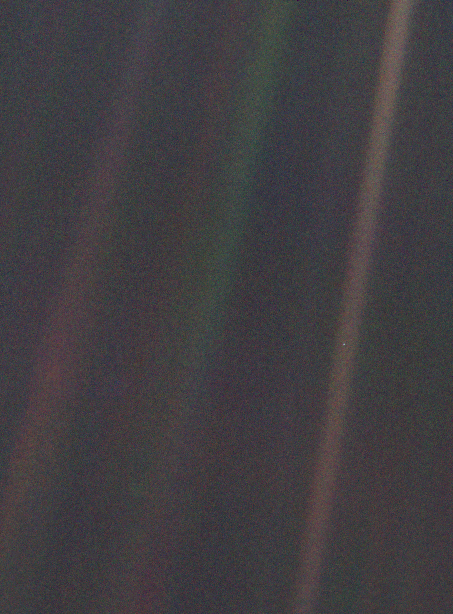
Voyager snapped a picture of our Earch (sorry I thought it was the Sun) in 1990. It's the famous Pale Blue Dot picture. It's the small blue-white speck (or almost pixel) halfway down the brown band on the right.
https://en.es-static.us/upl/2012/07/Pale_Blue_Dot.png
EDIT: Ooops, sorry - this is Earth and not Sun :-(.
You should look up or play Elite Dangerous, it's (I believe) a fairly accurate / to scale simulation of solar system navigation. You can go at several hundred times the speed of light and you're still waiting for ten minutes to reach your destination.
>(...) Intensity is inversely proportional to the square of the distance from the source of that physical quantity.
Shit gets dimmer at the square of the distance. So if at a distance of 1 a thing has a brightness of one, at a distance of 2 it has a brightness of 1/(2^2), or 1/4. At a distance of 8, you are looking at a brightness of 1/(8^2) or 1/64th.
Voyager 2 is ~122 AU distant. So the sun's apparent brightness would be 1/(122^2), or 1/14884, or 0.00067 % as bright as the sun as perceived at the earth-sun distance (ignoring the atmosphere of course).