Hacker News new | ask | show | jobs
by digitalmaster 2765 days ago
So looks like the 80s is when things start going south (increased income inequality) so I looked up who was president during that time, then looked at their wiki page to see their economic policy and found this gem of a quote:

"Soon after taking office, Reagan began implementing sweeping new political and economic initiatives. His supply-side economic policies, dubbed "Reaganomics", advocated tax rate reduction to spur economic growth, economic deregulation, and reduction in government spending."

9 comments

As an engineer and computational scientist, drawing conclusions from correlations like this is absurd. Maybe Reagan was good for income inequality or maybe he was bad for it. Did you control for the other variables before drawing your conclusions? What about:

* The governments' legislation and economic policies in countries like the USSR, China, etc. in the 80s

* Changing technology especially communication technology

* Changing levels of education in the world.

* Lingering/diminishing trends/effects from wars like: Cold War, Korean War, Vietnam War, etc.

* Changing age distribution of humans in western countries,

And on and on. The world economy is extremely complex with heavy nonlinear feedback effects. How can you possibly state things like Reagan caused X w.r.t. the world wealth distribution with such confidence?

>As an engineer and computational scientist, drawing conclusions from correlations like this is absurd. Maybe Reagan was good for income inequality or maybe he was bad for it. Did you control for the other variables before drawing your conclusions?

Drawing absolute conclusions in this area is nearly impossible, and we can't say with any certainty that Reaganomics caused this problem. The evidence does seem to suggest that the policies are not fixing the problem, which is a far easier claim to make. They might not be the cause, but it seems very likely they aren't the solution.

Given that you don’t know what would occur without reagonimics, even that much isn’t safe to say. It’s quite possible that reagonimics is in fact helpful, just not enough to overcome other negatives in the environment (so in sum, a loss). Removal may very well increase the rate of inequality.

In other words, with just the evidence provided, you can’t safely say much of anything beyond “it started getting worse in the 80’s”

>Given that you don’t know what would occur without reagonimics, even that much isn’t safe to say.

Yes, I can. The current situation seems undesirable. While it's possible that the situation would be worse without Reaganomics, the actual situation is still undesirable. Looking towards the future, it seems unwise to continue a plan that led to undesirable results.

Your argument proves too much. Consider the following example:

> You are diagnosed with Type II Diabetes. Your doctor tells you to monitor your blood sugar and take insulin. This situation seems undesirable. While it is possible that the situation would be worse without monitoring your blood sugar and taking insulin, the actual situation is still undesirable. Looking towards the future, it seems unwise to continue a plan that led to undesirable results.

If Reaganomics came from a trained professional who were basing their recommendations on the best theory science had developed through experimentation, I would not advocate changing the policy. That is not the case though, as we both agree that reliable evidence is scant.

Going forward, there isn't a great theory showing that Reaganomics is worth continuing, and the hypothesis that different policies would provide a better outcome seems worthy of testing.

“As an engineer and computational scientist, drawing conclusions from correlations like this is absurd.”

Tell that to Ruby developers... duck typing (if it quacks like a duck and walks like one, it’s definitely a duck)

Oh, and while throwing all sorts of alternative world scenarios in the wild hope one might make a reasonable argument that Neoliberal policies aren’t the driver of inequality...

you forgot Occam’s Razor.

I didn't throw out any "alternative world scenarios". I was just pointing out that a lot of things were going on in the world that could easily have had a very significant impact on things such as income inequality. There are also many examples in economics where a simple/obvious solution actually has the opposite of the intended effect. Rent price control would be an obvious example (https://en.wikipedia.org/wiki/Rent_regulation#Economists'_vi...).

If you want to dig in to the gory details of reaganomics, economists have researched and debated about its effects for decades. There are many economists who make cases both for and against it having appreciably affected income inequality in various ways.

The irony is the right holds Reagan as a shining example of fiscal conservatism.

However, Reagan ultimately tripled the debt while in office. The right loved saying Obama spent more than all other presidents before him combined (which he did, which Bush did...but Reagan the model of fiscal conservatism spent 2x as all presidents who served before him).

Reagan's deficit increase comes mostly due to military spending, something that was regarded as extremely strategically important in an era of potential nuclear holocaust.
Seems Trump is on the way to top that. That's one thing I never get about modern Republicans. When in opposition they throw a fit about deficits but as soon as they have power they forget these concerns but drive deficits up a lot. Reagan did it, Bush did it and now Trump is doing it too.
Its almost as if forcing (rational) people to select D or R via a number of single issue pivot points creates a situation where everyone is guilty of some level of hypocrisy.
> When in opposition they throw a fit about deficits but as soon as they have power they forget these concerns but drive deficits up a lot.

They don't care about deficits, they care about spending priorities. Deficits is just the argument they turn to when they don't have an argument against particular spending priorities.

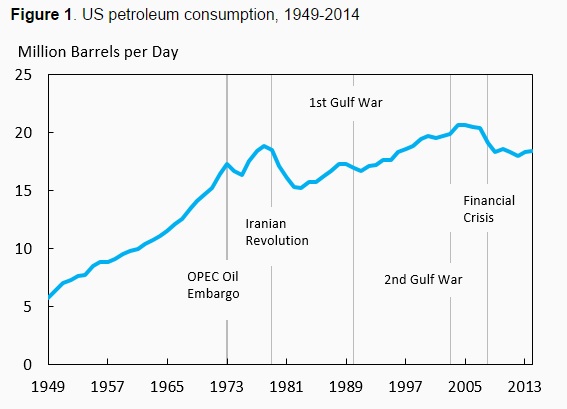
:P Ouch, going right for the partisans. Presidents are important people, but they are a lot more reactive than is generally accepted - what about the theory that Reagan was reforming economics in response to some deeper underlying problem [0]?

[0] https://assets.weforum.org/wp-content/uploads/2015/07/150710...

So the implication is that Reagan instituted broad and substantial tax reduction for the rich in combination with the institution of enormous federal deficit spending in order to offset rising oil consumption following two oil crisis the previous decade?

We saw how oil turned out in the long run. Reagans policies, if anything, only gave dictatorships another two decades of unmitigated dominance in an industry we have seen the US itself rapidly commercialize internally. Most US consumed oil is now domestic, and most of the growth happened in the rebound from the 08 recession. I'd be really interested in comparing the economic policies of how Reaganomics protracted foreign dependence while the late Bush / Obama era bailouts and recovery stimulus somehow exploded the domestic market.

Or that neither of those had anything to do with oil, and that the development of the market and industry as a whole was detached enough from federal law of the US that neither president is responsible for anything in that regard.

The theme I'm replying to is 'Regan's stated policy objectives were implemented in the 70s and were probable causes of rising income inequality'. Maybe policy settings were twiddled, but the sudden stoppage of growth is probably linked to resource growth tapering off. In a counterfactual scenario where some other set of economic policies were in place, you'd probably have seen income growth trail off regardless.

The 'fix' could well be rich people being worse off, not poor or middle income people being better off. Not much of a solution, that.

A fun thought experiment, there are some good answers to this: at the end of the day, a different policy would be redistributing something real away from the rich. That wouldn't be food (rich people eat as much as everyone else), so what would it be? That is to day, what exactly are the rich securing that is unfair? (money isn't a valid answer, the answer is what the money is then used to buy)

The answer is that if everything were the same but the rich had less money, is that the rich would be less in a position to capture the regulatory framework and tilt the playing field in their favor. Eg maybe without trickle-down, the factors that compounded into the Citizen's United decision would have fallen the other way, etc.
But go deeper than even that and determine what is the crux of the unfairness. How are the rich securing a larger percentage of the growth unfairly? If everyone is getting richer, but the rich are doing it faster, what are they doing to capture that excess? Isn't the answer "investing in the economy?"
> Isn't the answer "investing in the economy?"

Or rent seeking through concrete asset accumulation during the bust phase of boom-bust cycles.

This is something that economists have debated over for decades since. Stiglitz specifically attacks Reagan on that front. Milton Friedman defends it.

Reagan was the last president to make a deep impact change in how economics and politics relate. He was unique in the way he self-deprecated government, something that is truly rare for presidents. He would actively advocate the government was the problem not the solution, a famous line by Milton Friedman on his economic ideas.

To this day, I am awed at the air-traffic controller firing. I am from a country with a pervasive strike culture, to the point that even cops strike, and it has been unfathomable for any president , of any ideology, from dictatorships to democratic socialists, to fire a swath of strikers.

> He was unique in the way he self-deprecated government,

This is false on two levels:

First, Reagan was not a monarch who shared personality with the State, so any deprecation of government he did was not self-deprecation

Second, he is not at all unique in that. Bush (43 more than 41) and Trump have done much the same, and even Clinton did it off and on.

What's 43 more than 41?
The Bush that, like Reagan, talked down the (non-national-security, non-law-enforcement parts of) government.

That is, George W. Bush (the 43rd President) more than George H. W. Bush (the 41st).

> First, Reagan was not a monarch who shared personality with the State, so any deprecation of government he did was not self-deprecation

It is absolutely legitimate to characterize the president denigrating government as self-deprecating, splitting hairs about this is silly.

> Second, he is not at all unique in that. Bush (43 more than 41) and Trump have done much the same, and even Clinton did it off and on.

Reagan was more unique in his ability to actually do it, though. The others had much less impact.

> It is absolutely legitimate to characterize the president denigrating government as self-deprecating

No, it's generally not (there may be specific cases where it is), especially when the President in question is selling himself as an ally of the people against government.

> Reagan was more unique in his ability to actually do it

Actually do what? If you mean literally denigrating the Government, no, Trump's done much more of that.

If you meant reducing it's role.. Reagan didn't even do that; he shifted the burden of paying for it, sure. But it was much bigger, more intrusive, and more expensive when he left office than when he entered.

I’m an 80’s kid, and don’t remember the specific rhetoric, but my question has always been: if you dont believe in an organization, why join it and try to ruin it for everyone? Why be president if you think government is bad?

I mean, I think the KKK is bad and should go away, but I’m not going to go try to be it’s leader.

OTOH, there is the adage that says that nobody that wants power should hold it - that the best leader is the reluctant one.

He has some magnificent quotes: contrary to the president "with the best words" he was actually a great public orator.

http://www.ontheissues.org/Celeb/Ronald_Reagan_Government_Re...

From what I have read a lot of those trends were already on the way in the 70s and before. Reagan certainly helped but the banks were looking for more money already before that.
It looks as if it began mid-70s. You can see the red and blue start diverging then, though the line stroke width causes some overlap. The heavy divergence begins in the 80's, as you pointed out.

I think confirming your theory would be as simple as comparing the policies of "Reaganomics" with the policies that emerged in the 70's that caused the initial bump shown on the chart.

There's a fellow that's discovered a piece of legislation in 1970 that was the turning point for all this lobbying taking over congress so heavily. The lynch pin of his argument is that we have to remove lobbyists from the actual physical galleries in congress and preserve the anonymous nature of how each congressman votes so they can vote their conscious and not how their lobbyist handlers choose. It's a counter-intuitive idea because everyone is already sold on wanting to know how their congressmen voted.

https://www.youtube.com/results?search_query=cardboard+box+r...

As ideas go this is a bit of a non-starter. If you can't tell what your congressperson is voting for, how do you know if they are representing you? When you vote, how would it be even theoretically possible to make an informed decision of who you want as a representative?

The only axis of discrimination between politicians would be charisma - which is no predictor at all of what someone will actually do.

EDIT It might be even easier for handlers to corrupt the system, because they could make it known that if a bill gets through, they'll be generous with their largess to everyone - and there will be know way to verify which politicians are the ones who are being bought off.

Charisma is only a problem when your representative is a figure on a screen you never see or interact with. Its definitely fallen by the wayside in recent times with the explosive population and suffrage growth not corresponding to a larger legislature, but there is ample historic record of the aristocratic voters in the decades following the founding of the US also having close relations to their representatives. The voters (the <10% of the population eligible) often had regular, direct access to converse and interact with those they elected.

In more modern terms it would be if you weren't electing a representative for every several hundred thousand people, but had one for every few hundred. Something constrained by Dunbars Number. You wouldn't be electing a caricature but someone you can actually interact with, especially in an era of total digital interconnection.

Fixing representative democracy in the US and abroad is probably the most fundamental issue facing America and most of the world today. Getting back to actual representation by peers has to happen eventually or the widening divide between the political aristocracy and the commoner will revert most of western society back into a model more reminiscent of 16th century Britain.

I don't see how we can make Congress vote anonymously, and I'm pretty sure that's not good public policy.

And in general, I don't like attributing these things to a single cause of "corruption". It's too neat, too easy.

The criticisms of so called sunshine laws are unconvincing. Any one supporting more direct democracy will favor such reforms.

As for why things took a right-wing turn in the mid-70s, I prefer this thesis:

Lobbying America: The Politics of Business from Nixon to NAFTA

https://www.amazon.com/Lobbying-America-Politics-Business-So...

TL;DR: Titans of industry felt persecuted, rolled back The New Deal.

"Lobbying America tells the story of the political mobilization of American business in the 1970s and 1980s. Benjamin Waterhouse traces the rise and ultimate fragmentation of a broad-based effort to unify the business community and promote a fiscally conservative, antiregulatory, and market-oriented policy agenda to Congress and the country at large. Arguing that business's political involvement was historically distinctive during this period, Waterhouse illustrates the changing power and goals of America's top corporate leaders.

Examining the rise of the Business Roundtable and the revitalization of older business associations such as the National Association of Manufacturers and the U.S. Chamber of Commerce, Waterhouse takes readers inside the mind-set of the powerful CEOs who responded to the crises of inflation, recession, and declining industrial productivity by organizing an effective and disciplined lobbying force. By the mid-1970s, that coalition transformed the economic power of the capitalist class into a broad-reaching political movement with real policy consequences. Ironically, the cohesion that characterized organized business failed to survive the ascent of conservative politics during the 1980s, and many of the coalition's top goals on regulatory and fiscal policies remained unfulfilled. The industrial CEOs who fancied themselves the "voice of business" found themselves one voice among many vying for influence in an increasingly turbulent and unsettled economic landscape.

Complicating assumptions that wealthy business leaders naturally get their way in Washington, Lobbying America shows how economic and political powers interact in the American democratic system."

From the graph it looks like it really took off in the 90's and then again around 2010.
Inequality also seems edged up noticeably just after 2000, though by the bottom dropping more than by the top rising.
It was sold to the middle class as "Trickle down economics". Basically, if you make the rich richer, your pie gets bigger too. Sadly, people bought that line.
Trickle down economics is a pejorative term from the 30's. As a proposition it is as naive as trickle-up, which is what the other spectrum usually sells. ('if you give poor people more resources, its good for everyone')

Economics, as the expression of human beings exchanging with each other, accepts neither.

> Economics, as the expression of human beings exchanging with each other, accepts neither.

I will never understand how adults can believe that things like economics, journalism, central banking, and (especially) the US constitution can be non-political.

Because that idea (about economics) has been heavily, and successfully, pushed by interested parties:

'The economy' and 'the market' are sacred things that are disconnected from the dirty world, and work perfectly in their own if you don't bother them. No need for 'political economy' anymore, only 'economics'.

Gotta answer that last sentence. Free market advocates are the exact opposite of disconnected with the dirty world: they advocate for allowing the dirtyness of reality sort itself out, without a neat central order. The most significant advocate for free markets, Milton Friedman, literally wrote the book on the application of Positive Economics: seeing things how they really are, use empiric data, make falsifiable predictions, etc.

Free markets are pro-reality, pro-dirty world.

Well, if you start with the idea that markets exist in the void, you are certainly avoiding the dirty world.

For instance: assuming that property rights exist outside a political framework or power structures.

I am surprised on people that believe politics shape reality, as if a political will could bend laws of nature.
If you think economics is about "laws of nature", then you have a lot to learn about economics.
>>'if you give poor people more resources, its good for everyone')

It's not 'poor people' vs. 'rich people' but the majority vs. a minority.

>>"Economics, as the expression of human beings exchanging with each other, accepts neither."

Economics? what do you mean? There are theories that, in a less simplistic way, come to propose one and the other.

> It's not 'poor people' vs. 'rich people' but the majority vs. a minority.

As silly a proposition as any other.

> Economics? what do you mean? There are theories that, in a less simplistic way, come to propose one and the other.

Mostly politicians and pundits. Economics, neither the mathematically inclined microeconomics nor the formulaic and macroeconomics have such thought or principles behind them.

>>As a proposition it is as naive as trickle-up, which is what the other spectrum usually sells. ('if you give poor people more resources, its good for everyone')

Incorrect. It has been well-documented that when people have more disposable income, their spending increases. This increase in economic activity grows the economy.

If they have more disposable income, their spending decreases. If you have no disposable income, your spending 100% of your income.

Moreover even if that proposition were somehow true, spending is not a measure of progress of any kind, not nominally and not in real terms. Inflation is a good exercise on this topic.

It's a funny thing that trickle-up is never ridiculed in the public eye.

> Incorrect. It has been well-documented that when people have more disposable income, their spending increases. This increase in economic activity grows the economy.

It has been well documented that when you give people who have proven themselves capable of efficiently allocating capital (i.e. the rich) more capital, they continue to allocate it to its best and most productive use for society.

Everyone's got a narrative, and they're both right. To an extent.

>>when you give people who have proven themselves capable of efficiently allocating capital (i.e. the rich) more capital, they continue to allocate it to its best and most productive use for society.

You are making some wild assumptions that require evidence. Specifically, you need to prove that the reason rich people are rich is because they "have proven themselves capable of efficiently allocating capital", as opposed to (or at least independent of) other factors, such as luck, inheritance, etc. You also need to prove that the way the rich allocate resources, even when "efficient" (i.e. provides the most return) is actually good for society as a whole, and not just the rich.

> You are making some wild assumptions that require evidence. Specifically, you need to prove that the reason rich people are rich is because they "have proven themselves capable of efficiently allocating capital", as opposed to (or at least independent of) other factors, such as luck, inheritance, etc.

I'm not making any assumptions. In aggregate, by definition, wealthy people are better at allocating capital than non-wealthy people. Yes, not all wealthy people are good at it. But in general, they are. That's why they're wealthy. The fact that exceptions exist is irrelevant to my point.

> You also need to prove that the way the rich allocate resources, even when "efficient" (i.e. provides the most return) is actually good for society as a whole, and not just the rich.

Do you have evidence that the way the poor allocate additional capital is more socially useful?

> It was sold to the middle class as "Trickle down economics".

No, it was sold as “supply-side economics”, “Trickle-down economics” was a hostile characterization (as was Geore H. W. Bush’s “Voodoo economics” characterization.)

I’m not sure why you are getting downvotes, but that was precisely the line that was used.

The economics and finance professors I took classes with had a good laugh at that idea.

Yea also not sure why this is being downvoted. That was exactly the narrative at the time.
David Harvey has a fantastic book on this, "A Brief History of Neoliberalism", it's quite a read but it's very well structured and I'd recommend it to anyone looking to investigate the recent (by this I mean second half of the 20th c.) trends in global capitalism and society.
I think more pertinent are Economism by James Kwak (on the naive use of Econ 101), Global Inequality by Branko Milanovic (a better, or at least much more legible, analysis of inequality within and among countries than Piketty's tome), and maybe Dark Money: The Hidden History of the Billionaires Behind the Rise of the Radical Right by Jane Mayer (about campaign financing in the last two decades in the US).