7 years ago you'd have to jump into a yellow cab before telling the rider if you were going from Manhattan to Brooklyn or Brooklyn to Brooklyn. If you told them before you got in, they'd speed off.
You used to have to walk to arterial roads in hopes of finding a yellow cab (in the outer boroughs). That is if you lived in neighborhoods that the article points out now skews towards Lyft. Well to do, post gentrification areas. If you didn't live in those neighborhoods, forget finding a yellow cab.
If you didn't find a yellow cab, you call a car service like Arecibo or Eastern. You say "73 Atlantic Ave, at Hicks st.", they say "10 minutes" and hang up. 25 minutes later a beat up town car with an illegal tint job pulls up, and you walk to the passenger door and knock on the window, or, if the window no longer works, open the rear passenger door -- but you don't get in. Instead you say the neighborhood you are going and the guy sort of waffles and says... 20. You say, forget it and go to close the door (but you don't), he says 18. You say 12, he says 15. You get in the car. Last week you paid 10 for the same ride.
The last time I called an UberT, a few years ago, the green taxi pulled up and someone ran over and threatened to fight me since they'd hailed the cab first. That's the last time I messed around with the old way of doing things and it sounds like a lot of New Yorkers feel the same way.
Fellow Brooklynite here, and I agree 100%. I can't believe the hubris of these guys, trying to get me to get out of the cab after they hear I live in Brooklyn. And BTW, I'm JUST over the bridge in Brooklyn, about 10 minutes from the E River in traffic! It's the tourists that suffer, or the newbies, who aren't as rude as us New Yorkers - they'll doubtless exit the cabbie who says, "Sorry, not going there." I don't exit cabs when legally they can't ask me to.
But it gets worse with yellow cabs. First of all, they never clean their cars. Half the time it smells like a goat has been freshly transported. Secondly, they don't care about noise - at least half of them use the radio speaker system to conference call in either their wives or their fellow drivers and yap away while you get to hear that, on high volume. Sometimes there's awful music. That's rude and inconsiderate and doesn't often happen with Uber and Lyft.
I'm going to say something mean: the cabbies get what they deserve. They can whine all they want, and I do have some sympathy that these drivers moved to this country only to get stuck in what is a failed monopoly structure. The reason why cabbies were successful before Uber and Lyft and medallions used to cost 1 million dollars was because they operated under a monopolistic environment with no competition.
I remember once the cabbies went on strike because they were mandated to install GPS tracking devices and credit card machines. The machines made them furious, and for a year after a lot would be taped up: "Sorry sir, machine doesn't work."
It makes my blood boil just thinking about some of the awful experiences I've had with yellow cabs.
The best part of car services may be safety. About 1 out of every 10 cab rides entailed crazy and/or dangerous driving. I don't think I've ever seen that in Uber or other car shares, because if a driver drives poorly, they'll be rated poorly. And the mutual-rating system seems to improve passenger behavior too.
I've been in cabs where it was clear the driver did not have a license, or had somehow cheated the system in order to get one. One man did not understand basic concepts like how to turn left at a red light. He believed he had the right of way to turn left at all times (I guess he was confused into thinking having a "green arrow" was standard for all lights even if they didn't have one) and when oncoming cars would keep coming at him he would slam the brakes out of fear instead of punching the gas - stopping in front of traffic! Thankfully no one t-boned us but when the oncoming traffic drivers would honk at him he would honk back and get angry (whilst stopping in place due to slamming the brakes). I was only in the cab for about 1.5 miles but this happened at 2 or 3 lights. This was in Queens! I shudder to think of what would happen to him and his passengers in Manhattan.
another Brooklynite here. this is 100% true. You absolutely needed to "trick" the driver into letting you into the car. I've had taxis drive off, or refuse to let me in. When I was in the car, they would say they can't take me to my destination because their "shift was ending" and they had to go in a different direction. Many of these incidents happened in the LES, which is right next to the bridge I had to cross!
Taxi drivers also never know the destination, I got pretty good at giving my directions speech (to a well known neighborhood)
And taxis cost more!
As far as I'm concerned, the old way of hailing can rot, the old taxis can rot. they can't hold a candle to uber, and they'll never be able to become competitive on price or quality given the cost of a medallion.
This still doesn't address the fact that the reason Uber experiences are different from this is purely down to subsidy. If drivers weren't being subsidized to provide the unprofitable rides that yellow cabs are forced to provide by law (and which drivers try to avoid), then Uber also wouldn't provide this.
Basically, your comment is the same as saying, "I am glad VCs are giving me reduced-cost rides and subsidizing drivers to provide ride stock for intrinsically unprofitable routes and locations."
You're not saying that the Uber experience is better than the old yellow cab experience. You're saying that the experience where VCs give away money for free in order to finance a ride you could otherwise never expect to get (except at much higher price) is nice.
This isn't a property of Uber or any transformation of taxi services. It is just a temporary property of VCs being willing to artificially increase supply, artificially increase car quality, and artificially reduce prices via subsidy, while not providing any evidence that it could persist without subsidy.
I finally understand what you are saying: it's as if Uber is like Kozmo.com and Uber's service of safe, convenient, affordable transportation, despite existing in reality now, won't exist in some near future, much like Kozmo's subsidized service of same day turnaround of food, groceries, alcohol, coffee, home goods, etc. was part of a fleeting moment never to be realized again...
Yes, that is a good comparison. With Uber though, it is dramatically worse, since all obtainable data about their finances shows that Uber has created, by far, the biggest losses among VC-funded companies in the start-up / post-tech-bubble era. The degree of Uber's published losses is _staggering_ to a level not seen before. And yet, there has so far been no accounting or financial data to support any path to profitability, let alone a path that could keep prices at levels that drivers and riders are happy with. So it's not just something like "will Uber make it or not?" It's more like, "with losses of X _billion_, when do we stop pretending the 'business' is anything other than a donation from VCs to consumers?"
Naked Capitalism's multi-part series goes into this with extreme detail on the finance and business model side.
I disagree with the assessment of car services - in my experience they've always been very professional and with good quality cars. Maybe I've just gotten lucky.
The hailing situation in NYC was definitely awful. But now apps like Curb bring a yellow cab to you, and they don't have surge pricing, so at times I'll be content to get a cab instead of a Lyft/Juno, and it'll be cheaper.
The taxi lobby in NYC was terrible, and I'm very glad to see it broken. But I'm not convinced an Uber monopoly would be any better, and I'm still wary of seeing it. I don't ever use Uber simply because competition is good for me as a consumer, and I have no desire to see a company with the business practices of Uber corner the market anywhere. The service I get with Lyft and Juno is identical to that with Uber anyway.
I had to make a throwaway as well just because I couldn't believe this comment. This is so utterly false. You're essentially claiming that the value of these services is all based on the innovation of the _hailing_ functionality, but there are countless apps that recreate this functionality _exactly_ whether for 'regular' taxis or separately licensed cars. If what you want is for a driver to come to your exact location very quickly, you can get that _anywhere_. This, as a business model alone, is like Dennis on 30 Rock with his basement coffee business. It's so easy an ubiquitious that it's not worth mentioning as a differentiator _at all_.
Separately from this, it ignores the fact that there are cost-based reasons for these kinds of behaviors. Drivers, for example, have to think about round-trip cost. If you ask me to drive you from Washington Sq. Park to Astoria, I have to think about what fare to charge you such that it covers my expenses on the longer trip _as well as_ the likely problem of not picking up a return fare that takes me back to a high-traffic area.
This is all discussed with much greater statistical depth in the Naked Capitalism articles on Uber, but the basic problem is that none of the ride hailing services have found a way to make this any cheaper, except through massive subsidy (to pay drivers to be the ride stock in low-profitability zones they others wouldn't be in). And even with an innovation like self-driving cars, it would only make a difference if it is not a commodity. If it is a commodity (which, IMO, is the overwhelmingly most likely outcome for self-driving cars), then either Ubers completely captures all relevant IP for end-to-end commercial solutions ahead of any competitiors, or else Uber is licensing out the cars just like everyone else, and for whatever cost reduction it buys them for getting rid of drivers, it just creates a new price war race to the bottom on who can charge the least for the self-driving based rides.
I'm just so tired of all the mental gymnastics defending them. It really is total ownership of all IP for commercial self-driving cars or bust for this business model.
And if it busts, you'll see that all the niceties you describe in this comment are mostly the product of either (a) massive investor subsidy, or (b) easy and cheap-to-copy innovations like a map and location-enabled hailing app.
> This is so utterly false. You're essentially claiming that the value of these services is all based on the innovation of the _hailing_ functionality, but there are countless apps that recreate this functionality _exactly_ whether for 'regular' taxis or separately licensed cars.
There wasn't before Uber showed up. Last time I took a Juno, the driver asked me if he could text me a promo code so I could send it to me friends, that's when I stopped shopping around
> Separately from this, it ignores the fact that there are cost-based reasons for these kinds of behaviors. Drivers, for example, have to think about round-trip cost. If you ask me to drive you from Washington Sq. Park to Astoria, I have to think about what fare to charge you such that it covers my expenses on the longer trip _as well as_ the likely problem of not picking up a return fare that takes me back to a high-traffic area.
It's illegal in NYC for a yellow cab to refuse a ride request to any of the five boroughs. As for the livery cabs, the pricing was inconsistent for the same trips, over and over. Doubt any of it had to do with anything other than maximizing fare, which is their prerogative, since there there are no checks in place for that kind of behavior.
> This is all discussed with much greater statistical depth in the Naked Capitalism articles on Uber, but the basic problem is that none of the ride hailing services have found a way to make this any cheaper, except through massive subsidy...
I understand this. It doesn't invalidate the sea change in the experience of moving around NYC, particularly in the evening and late night.
> And if it busts, you'll see that all the niceties you describe in this comment are mostly the product of either (a) massive investor subsidy, or (b) easy and cheap-to-copy innovations like a map and location-enabled hailing app.
Let's hope (b). I doubt these innovations would have spontaneously arose from the taxi commission or the livery cabs.
> It's illegal in NYC for a yellow cab to refuse a ride request to any of the five boroughs...
Yes, of course. But the reason you don't see Uber drivers doing the same thing (or outright avoiding these unprofitable trips) is that they are subsidized to provide that unprofitable ride stock in areas where it's intrinsically not economical to provide ride stock. When you compel a yellow cab to do it, it means the prices have to be higher. This is why it makes less sense to compare the Uber experience to the yellow cab experience. It's like saying, "Would you prefer if a celebrity donated their first class Emirates seat to you, or a coach seat with United?" It ignores the mechanism by which the experience can be afforded to the end user (in Uber's case, huge subsidy, with no sign that the prices could be sustained absent the subsidy).
Overall I understand your comment and I realize you are aware of the counterpoints I'm making. The thing for me is that highlighting the good experience actually _is not a useful point of comparison_ with older, crappier cab experiences, specifically because everything we experience with Uber right now is inherently part of this huge ambient subsidy-based perception distortion field.
Ultimately no one did anything about the experience I brought up in the OP until Uber. This isn't an endorsement of Uber, more of a statement of fact. That anyone can now avoid all the old PITA of moving around NYC is good.
I generally don't consider the long term sustainability of the companies I purchase goods from. I do try to apply a vague and probably non-uniform ethical filter to them.
That said, I'm a software developer and my very generous salary is the indirect (via the demand curve) result of the destruction of manifold entrenched business models at the hands of VC subsidies. If I spent all day hailing yellow cabs it wouldn't make a difference.
> I generally don't consider the long term sustainability of the companies I purchase goods from.
We could probably go on at length about the moral problems here, but likely not productive in a comment thread.
> That said, I'm a software developer and my very generous salary
I'm not sure how to read that. I am also a software engineer, and even very high salaries in wealthy urban zones are typically not 'generous' in the sense that good software labor creates a vast wealth surplus for the shareholders and ownership, to such a degree that the high salaries are still not very fair.
> the indirect (via the demand curve) result of the destruction of manifold entrenched business models at the hands of VC subsidies.
Sure, but usually companies are expected to demonstrate evidence that the subsidy wouldn't be _permanent_ .. that there is evidence of a path to profitability.
The reason it's worthwhile to draw much more attention to the VC subsidy situation with Uber is that they have not been able to do that, and have instead generated unprecedented losses without making any progress towards profitability. It makes it incredibly different than typical cases when VC subsidy creates a short term runway to profitability. That is not what's going on.
The people who get punished here are the tourists and people who are new to town. If you're new and don't know the rules, or you don't speak English natively, it might be hard to argue against some yellow cabbie who suddenly shakes his head and mumbles and points out the window while you're anxiously trying to get a cab for the second or first time in your life.
Also if you report them they do have a GPS tracker that can validate their location - supposedly, or so I'm told, TLC will take that seriously and 3 dings against the driver will trigger some sort of penalty.
yeah I had a yellow cab pick me up from Chelsea Piers once and not turn on his meter. It was a short trip and the driver turns around and asks for $20-something. I laughed in his face and left. I'm sure he got plenty of tourists on the same scam.
Consumers do not care about market externalities. Consumers do not care about the "cost based reasons". Yellow taxis were given a monopoly in NYC, the trade off was to accept all rides within the City.
I lived in Brooklyn Heights and DUMBO for years, and quite routinely filed TLC complaints about drivers who refused to take a trip from even Lower Manhattan to DUMBO.
I live in Manhattan now, and after a series of extremely bad Yellow Taxi rides, have given up and switched to using Lyft.
Uber/Lyft/et al are clearly using investors' funds to subsidize their businesses. And it's completely irrelevant to me as a consumer. I need to get from one point to another in a safe, economical manner, and NYC's Yellow Taxi fleet is failing at that.
I agree generic consumer opinion won't really take into account the subsidy and unprofitability situation.
That is in fact my entire point: because generic consumer opinion or anecdotes don't qualify themselves based on the subsidy mechanism, it means generic consumer opinion or anecdotes are largely irrelevant for purposes of comparing with older taxi experiences or assessing a claimed value-add of a newer ride-hailing company.
In other words it doesn't add information to say that consumers like to be given better quality things for free.
> I need to get from one point to another in a safe, economical manner, and NYC's Yellow Taxi fleet is failing at that.
This seems like a red herring tacked on at the end, since Uber is not providing this either (because of the subsidy) and from an analytical perspective, it's irrelevant if average consumers are aware of this yet or not.
> An analytical perspective which ignores consumer sentiment in a market economy is academically moot.
Nobody is saying to ignore it... where are you getting that? I'm saying to analyze it _more carefully_. We definitely should analyze the fact that consumers like the app experience, increased supply, etc.
But you are saying to stop there and declare victory for Uber. But I am saying go further.
Then you see the experience exists only because of an intrinsically unsustainable subsidy, so it's not actually comparable to preexisting taxi services, driver behaviors, etc. Only after this point of carefully analyzing consumer sentiment qualified by the factors actually driving it can we realize that the consumer sentiment on its own really doesn't matter _in this particular case_.
I think you're trying to say that consumer sentiment, if not backed by an actually profitable business model, is like selling a dollar for 90 cents, and the happy consumer sentiment would totally not be indicative of a business model that can sustain the factors that the customers actually like... which is also what I am saying!
> Perhaps you're seeing people defending them when other people are just trying to share their experience? If so, I agree, that would get tiring.
The context of when they choose to share experiences casting Uber as a catalyst for significant improvements provides a lot of evidence that it's not just an anecdote in a vacuum, but rather is meant to defend Uber.
I'm all for positive experiences, and I _really want_ ride hailing services to somehow be profitable, because it could add competition and create various experiences that I am willing to pay (the current subsidized prices) for.
What's tiring is seeing repetition of the positive anecdotes without the necessary accompanying asterisks that qualify it based on the _inherent_ profitability issues with any service that tried to solve these problems. Then we can at least acknowledge that the nice, upgraded experiences from these apps is purely a _donation_ from a group of investors, which means it's irrelevant as a comparison with prior taxi experiences unless those investors are willing to make it a permanent donation.
I feel like you don't really disagree with the parent comment, you're looking at a separate issue.
From the lived experience of the consumer in NYC Uber was a revolution in convenience, reliability and overall experience. We already had car services, and Uber was functionally similar to a car service plus a hailing app, but it ended up being so good it competed with taxis as well. The quality has diminished and there are competitors now, but Uber is still better in most situations than taxis or traditional car services, and isn't significantly worse than Lyft or other apps.
From a business model perspective you can say that Uber is only competitive because it burns money, and eventually if SDCs don't come quickly enough they will be forced to jack up prices or go out of business. It's a valid argument, but doesn't have anything to do with how consumers experience Uber today.
There is one more issue: Uber and Lyft massively increased supply. It is not clear, as you mention, whether this could have happened without investor aubsidy - but it is likely. Medallion allocation is a political subject which does not necessarily correlate with demand; and the established way medallion owners rent them out results in it being uneconomical for drivers to do more than a given amount of rides per shift - a result of which is that supply at peak demand (rainy days) is significantly lower than even what the medallion system allows for.
This isn't very relevant for discussions about NYC, since all drivers have to be licensed, and many drivers work for fleet owners who rent out the cars for shifts. Few (if any) NYC drivers user their personal vehicle, and it is very likely they lose money spending that time as drivers when they do.
So this issue is extremely complicated. Yes, medallion politics are inefficient. Are they as bad as overtly scammy practices to leverage up supply by exploiting poor economic judgement of the class of people who consider being an Uber driver?
Honestly, it's not clear to me, but certainly should not be seen as some type of free enterprise victory over the medallion system.
I disagree but think you make a good point that shouldn't be downvoted.
The issue here is really a fundamental conundrum around providing services that are of general utility to the public. At one point, people in the country couldn't get electricity, because densities were low and profitability low as well.
NYC has the same issue with cabs, which is addressed by regulation but also required savvy consumers willing to complain. Uber/Lyft address this in their apps and via subsidy... and they do this because the promise of universal service is essential. Once you allow exceptions, you get back into the situation where you can't get a ride to a black neighborhood or can't get a ride if you're the wrong ethnic background.
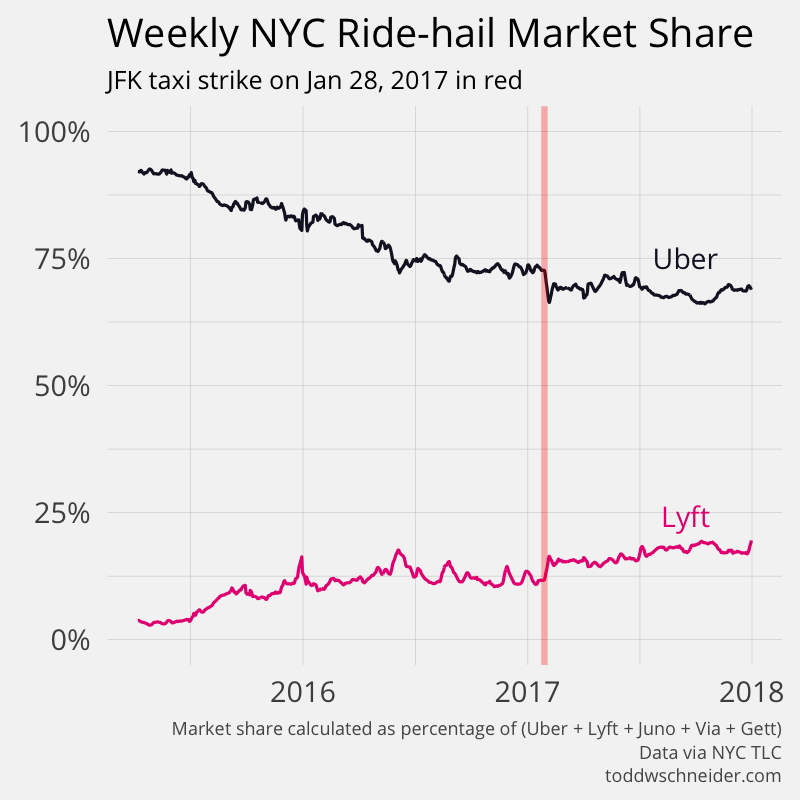
So since this information was so hard to pull out of the article, I've summarized it according to the weekly ride-share dominance chart[0]. Pre #DeleteUber, Uber sat at about ~75% of the weekly rideshare dominance. Currently, Uber sits at about ~68.5% of weekly ride share dominance. While it sounds like there were about half a million people that requested their account be deleted, at least in NYC (remember these charts are JUST NYC ride hailing) the campaign has had a negligible impact.
Judging by the demographic of people that protest, and are protesting on twitter, I'd be more curious about judging the impact of #DeleteUber by looking at ride-hailing rides around epicenters of people younger than 30. Fortunately though, he covered this also, touching on Lyft's growth in Brooklyn. I'd also be curious about ride hailing stats around universities too.
This is one of the more interesting things that I learned from the article:
"Uber’s share of all ride-hailing trips has generally declined since 2015 as more competitors entered the NYC market, even as its total number of trips has increased dramatically."
That would have me worried, if I was an investor in Uber.
I think in general investors are aware that Uber will need self driving cars to stay relevant.
Transportation is going to become a monthly flat rate like a cable bill for local travel via autonomous vehicles and the winners will be the companies that own the fleets and get to charge the tolls.
Owning your own car will be a luxury item.
Owning a gasoline powered car will be an extremely niche luxury item.
Obviously this won’t happen tomorrow but it’s not hard to see the parallels to the horse and buggy industry in this transition.
New players will emerge to be the big names in this new industry and Uber investors hope it will be one of the winners.
That would seem to be a very urbanite view of the world. A lot of people have good reasons for owning their own personalized vehicle. (Gear, kids, mobile storage locker, etc.) So long as you live somewhere with enough space that storing a vehicle isn't expensive/difficult, given that most of the costs are in mileage, it's hard to see most people giving up ownership.
And, in any case, full door to door autonomy, in at least most locations, is likely a long ways off. Certainly outside of the relevant horizon for Uber investors.
Urbanization rates continue to rise, what is true yesterday might not be true tomorrow. Also, in much of the world this doesn’t hold even today. The USA (and to a lesser extent Canada and Australia) are unique in private car oriented culture.
The United States is indeed near the top of the list in percentage of car ownership, but it's pretty high in most of the developed world. Arguably, there's less of a "private car oriented culture" elsewhere but most adults still own cars nonetheless.
Yes, and they often pay a lot more for parking as well as for things like tolls; let's also not forget the cost of the cars themselves, which can be much more expensive than the states (e.g. Denmark, Singapore) or have crazy fast depreciation rates (e.g. Japan). The economics of these different markets are very Unamerican.
Kids is a big thing -- needing specific car seats means taxis are out until your kids are 12.
That said the average car costs $34k in the US and lasts say 10 years, that's $3,400 a year. Maintenence, taxes, etc another $1500 at least, that's $5k/yr before you move an inch.
While automatic cars may not get rid of everything, many 2 or 3 car families, especially in the suburbs, may drop to 1.
Your last point is certainly true. Even today, I know people who would have been stereotypical two-car households who now get by with one car + Uber/Lyft/Zipcar/etc. The various services available today definitely make a difference at the margin of one car vs. two cars or barely need to own a car.
Normal car expenses are around $0.55/mile for an average car. The average joe pays about $8,000-$8,500 annually for all car related expenses. Some pay more for fancy stuff or utility.
That's why suburbs exist. Financially, it's a much better deal for families on just about any axis.
With an average 13-15k miles a year, at 20-30mpg that's about 400-750 gallons a year, or $1000-$2000 a year in gas, leaving the vast majority of expense in deprecation and maintenence.
>I think in general investors are aware that Uber will need self driving cars to stay relevant.
Uber won't have self-driving cars for many years. There's no reason to be long on Uber with everything that's happened to it. Especially if Lyft goes public.
> Transportation is going to become a monthly flat rate
> Owning your own car will be a luxury item.
Sorry, but I hate it when people talk about the future like a certainty. It has yet to unfold and many predictions turn out to be wrong. I definitely would not bet against car ownership, especially in the country side.
And maybe there will be an open renting framework where everyone can buy a few cars and put them into the system for anybody to rent for a drive. If Uber does not make the self driving software, what would be their role and strength in 20 years?
While it seems inevitable, I really hope there's going to be a way to do all this without having to authenticate and link a name, credit card and cell phone. I really don't like the idea of not being to travel more than a few miles without being tracked, I hope enough people feel the same way.
Uber will still be irrelevant even with self driving cars because the automakers will just run their own services without uber. Uber has an app and a user base, that's it.
Let me guess... you live in a city and don't have kids. Come back and make this comment in 5 years.
We have monthly flat rate transportation -- it's called a car or a bus. There's no model where trips will be flat rate, because the economics don't work and the marginal value of a trip at a peak time is much higher. There are few <1,000 mile trips that are less expensive on a common carrier than a private car.
There are plenty of reasons to worry if you're an investor in Uber but (IMHO) this isn't one of them.
NYC is big. Really big (like space). It can support a number of wannabes. But you need a certain number of drivers to be able to serve users and the value of Uber is in the areas where you can't support half a dozen wannabes.
For example, I was in Australia recently and discovered that not even Lyft works there (in Perth anyway). This is in a city approaching 2M population and is very much a developed nation (well, except for the Internet).
Think about that: that's a ton of people who are being trained to use Uber. When they travel do you think they're going to pick up whatever the local ride-hailing wannabe app is for some specific city? No.
Uber has a whole bunch of problems but it's clearly a valuable brand at this point.
I don't know, every local market has always supported loads of private hire firms. It's a very price sensitive market. And Uber's support for cities isn't great anyway, from my experience.
Like here in Nottingham Uber doesn't support the suburbs 2 years after arrival. You can go there with Uber, just not come back, no-one's around.
A local app with better suburb support is ultimately going to win, as if you can only go one way, Uber becomes annoying.
I think he's saying there just isn't much driver availability. I live 40 miles outside of Boston and whenever I've looked there has been little or nothing available. Uber and Lyft might as well effectively not exist in my town although, yes, I can fire up the app and request a ride.
Yes, if you go 5 miles outside of Nottingham city centre, you're usually not getting an Uber back. Unless there happens to be one dropping someone off. It's a bit of a chicken and egg problem.
At least with other private hire firms you can phone them up and they'll be there in 10-20 minutes rather than just saying no drivers available.
> Think about that: that's a ton of people who are being trained to use Uber.
Well, they're also being trained to use ridesharing generally. It's pretty low friction to move from Uber to Lyft or another competitor. Think of all the other entry points into that market, like Google or Apple Maps (or any other mapping company) for instance. Once autonomous transportation arrives it also moves from an opex to a capex problem, and that changes the barriers to entry, the headwinds to critical mass, and the competitive landscape significantly.
This is a key feature of uber. I used uber in LA last year because I've used it in New York, Washington, Toronto, Singapore, Delhi, Sydney, Cairo, Brussels, Paris, Nairobi, Glasgow, London, Manchester, and many more cities.
When I arrive in town I don't research which app to download and register with to get the best solution, I use the one that is the path of least resistence, that's firstly uber, secondly a local cab that's on the street or that the hotel will call for me.
In NYC, Juno is cheaper in most circumstances, and you get better drivers. Otherwise, Via or Lyft. There are so many options instead of cludgey old Uber.
Install N apps where N is the number of markets you eventually travel to. If you only ever travel to one other market maybe 2 is fine. If you need to download tens or hundreds of apps that might be a bit much. Not everyone will travel to that many markets, but for those who do, they might care.
1) Find out what the required app is
2) Keep them all uptodate
3) Keep your details registered with them, despite using them once every 2 years
4) Remember which app to use in which city
Uber just works. Sadly apart from where I live, which is like the 1990s in terms of taxi provision.
I won't say it's vanishingly small but, relatively speaking, there aren't a huge number of people who have a problem with needing taxi services in a bunch of different cities. I travel about 100 days a year and I don't use these services very much and I don't think I've used Uber in a year or two. Worldwide availability of a brand just doesn't seem like a huge deal.
For me, it's more that I'd have no idea which app is the go-to taxi hailing app in a given city, or if one even exists. Like if you were going to visit Miami or Phoenix, would you know what to install besides Uber/Lyft? I wouldn't. Would the difference in quality/price be enough for you to spend time trying to figure it out?
You're correct that there are not a huge number of people who travel for a living and need this, but for those that do they have very likely been early Uber adopters and I'd guess are over-represented in their current customer base. They also likely spend far more per year on car services than average.
I know I only use Uber simply due to the whole "I really don't want to install 2 dozen apps" problem. My girlfriend who is in sales travels 70% of the time to about 3-4 dozen cities per year - if there is no Uber available she simply rents a car for the day. "Installing random app #34" is not even on either of our radar, and I don't think we're the exception to the rule.
As Uber/Lyft/etc. get larger of course this segment of the riding population becomes less and less important. I of course find this sad for selfish reasons!
There are some places where brands like Uber is extremely valuable, like Manila, where taxis are very apt to rip off free-off-the plane foreigners. Heck, most of SE Asia (there are local services also, but I’d rather not track them down before each trip).
That may be the case but my point was that hopping off-the-plane in SE Asia and grabbing a cab is not such a routine occurrence for most Westerners as to be a viable business model for VC-backed companies.
Outside of america, how many people routinely travel by taxi/rideshare/etc. In my experience, most locals take public transport. The international businessperson (on expenses) is a large market -- look at the size of the market for hotels, airlines, etc.
The one place I see taxis in use as mass transit by normal people is Singapore, where they are mostly ubiquitous (in the centre) and cheap. Even then getting a taxi if you're a couple of miles out (say in Hougang, where I spent a month) is hard work - Uber wasn't perfect but it worked well enough.
There are many western cultures who travel more than Americans. Much of Norway migrates to Thailand during the winter, for example. As for viability, you might be right, but global ride sharing services have been a game changing feature for me. Even at a premium, it would still be a useful service.
See, I guess I'm funny about cabs. For my lifestyle, I mostly ride the MTA - buses, subway, etc. I plan based on that cost and timing. When I've had an interview and needed to take a direct above ground route, I always take a yellow cab. I also make it very visible to the driver that I'm photographing the driver's number and name before I enter the vehicle. I don't do Uber/Lyft because I don't trust their consumer protections as much as I do those from the City or the T&LC.
Of course, I also have a prepaid phone & I have no desire to waste my data on hailing a cab. And I prefer to pay in cash where possible.
You used to have to walk to arterial roads in hopes of finding a yellow cab (in the outer boroughs). That is if you lived in neighborhoods that the article points out now skews towards Lyft. Well to do, post gentrification areas. If you didn't live in those neighborhoods, forget finding a yellow cab.
If you didn't find a yellow cab, you call a car service like Arecibo or Eastern. You say "73 Atlantic Ave, at Hicks st.", they say "10 minutes" and hang up. 25 minutes later a beat up town car with an illegal tint job pulls up, and you walk to the passenger door and knock on the window, or, if the window no longer works, open the rear passenger door -- but you don't get in. Instead you say the neighborhood you are going and the guy sort of waffles and says... 20. You say, forget it and go to close the door (but you don't), he says 18. You say 12, he says 15. You get in the car. Last week you paid 10 for the same ride.
The last time I called an UberT, a few years ago, the green taxi pulled up and someone ran over and threatened to fight me since they'd hailed the cab first. That's the last time I messed around with the old way of doing things and it sounds like a lot of New Yorkers feel the same way.