Same thing there: to get the actual thing: a 5120 x 2880 IPS LED screen you have to pay a pretty hefty premium. Quick search shows the LG is around $1300-$1500. (?)
You can get a computer with "80-90%" the specs of this, and pay 50% the price. But the point is if you want to match 100% of the spec you'll likely pay 100% if not 110% of this price too.
Yep 70-80% for 50-60% of the price is about right, you can replace the Intel Xeon for a cheaper i9 or even cheaper AMD TR or even cheaper Zen if you don't care about matching the performance.
TBH most of the savings are from the CPU/motherboard once you drop the Xeon.
You quickly get into the whole "It's definitely not professional without ECC" and the stupid intel market segmentation. Intel makes it really hard and expensive to build quick (as in single core quick) workstations with ECC. If you are absolutely hellbent on 5K and a 4Ghz+ with ECC then it's going to cost a bit. So while you could get a lot of the performance at a lower price point, things like the ECC makes it hard to compare in some aspects.
Really good doesn’t mean professional. Reference monitors are well over 10k dollars and the factory calibration on Apple screens is fairly close. Certainly better than you’d get on a < 1000 dollar monitor.
Nope, the closest thing you can get to the iMac Pro display is likely something like a the Dell PrimeColor UP2718Q which costs about $1500 or the UP2715K which goes for around $1300.
I specifically didn't suggest it because you can't connect it to anything that doesn't supports Thunderbolt 3 monitors since it doesn't have a display port connection, so you can't use that with a PC in any reliable way.
Yes, that's what I said. Parent price breakdown comment had "~$1300 for a professional 4K monitor" but I'm assuming you meant 5K monitor instead of 4K.
There aren’t good 5K monitors really for the PC they are either 30hz or requir 2 display port connectors which means you see 2 screens and there are calibration and sync issues the LG ones simply don’t work.
So my closest thing would be a 10bit calibrated 4K professional monitor which is well over $1000.
Ah, interesting. I've seen the 27" 5K Dell, didn't realize it needed two DP connections.
I assume that in theory the graphics drivers should be able to merge the displays and present it to the OS as a single screen. That's how my UP2414Q works, which is two halves driven by multi-stream-transport over a single cable. It was rather unreliable in Windows though.
EDIT - While my experience has been that the screen worked better on a Mac and sucked on Windows, other people have had similar experiences with multi-display problems in Mac land, so I wouldn't write it off as just a Windows problem. Recent discussion thread here https://news.ycombinator.com/item?id=15881207
So yes, a built-in display that probably works more reliably is definitely a bonus for the iMac Pro. Counterbalance that with the fact that when the computer's obsolete you're dumping the screen along with it.
The GPU doesn't emulate anything, it sees 2 displays so does the OS.
Which causes the problem, you effectively have 2 panels which can have difference in color recreation and there are some sync issues which can cause tearing with full screen applications.
For professional use especially video editing the best monitor I can think of is the UP2718Q.
The UP2718Q is a true 10 bit panel.
It supports a very wide color spaces: 100% of sRGB/Adobe RGB and Rec.709, 97.7% of DCI-P3 and of 76.9% Rec.2020.
It supports HDR which is becoming important for content creators these days and has a peak brightness of 1000nits which would allow you to produce HDR content and verify the end result in the same workflow without having to push it to a secondary true HDR display.
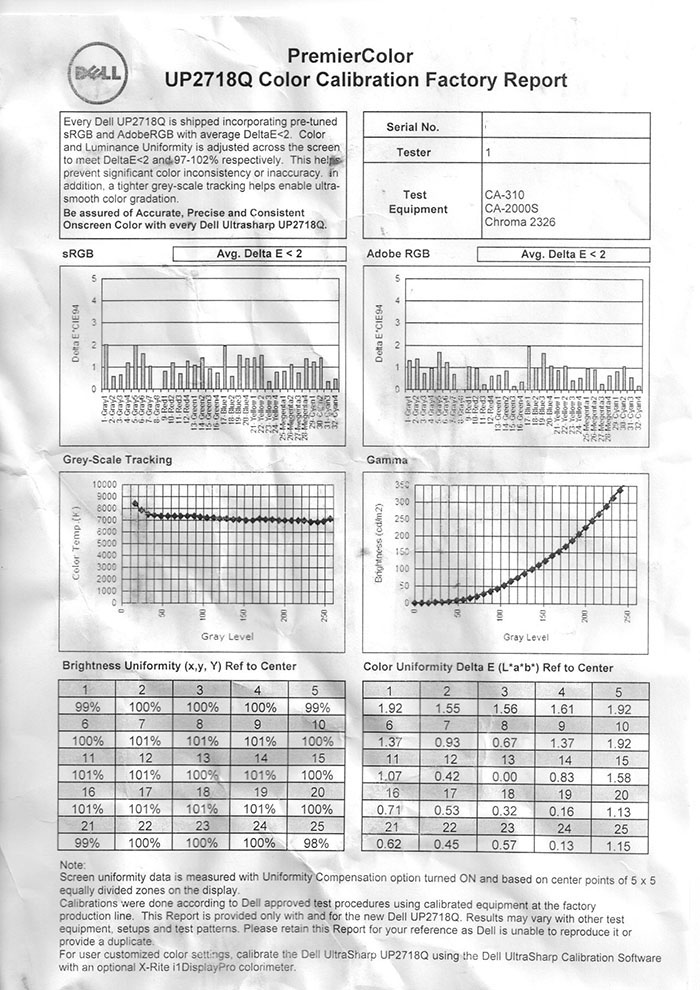
And since it's a PrimeColor display from Dell each monitor is individually calibrated at the factory and you get a full calibration chart with each PC monitor (they used to do it for each Ultrasharp, but these days it has to be US Primecolor) like this one: http://www.tftcentral.co.uk/images/dell_up2718q/img061.jpg
And most importantly it supports full hardware calibration so you can actually go into the OSD start the calibration process and update the hardware LUT table in the monitor itself rather than having to rely on color profiles.
You can get a computer with "80-90%" the specs of this, and pay 50% the price. But the point is if you want to match 100% of the spec you'll likely pay 100% if not 110% of this price too.