At Sun, during the dark days of Solaris, when everyone was depressed and wanted to quit, our manager sat down with each of us and asked: "I want to know your happiness index, a number from 1 to 10. You can use any algorithm you want to come up with it, just use the same algorithm each time so we can track how it changes over time."
I had a BS degree in Computer Science, but I was never taught an algorithm for calculating my happiness index, not even in my Artificial Intelligence class. So I had to wing it.
To protest, one of my cow-orkers made "rpc.happyd", a Sun RPC server whose function it was to track the happiness index of the team members over the network, and "HappyTool", a graphical user interface to rpc.happyd which drew a face for each team member, with a slider under your own face for adjusting the face from happy to sad.
Here's a demo of the HyperNeWS version of HappyTool, which I wrote in NeWS PostScript, and which lets you copy an encapsulated PostScript happy face to the clipboard that you can paste into other HyperNeWS applications (like pasting into the customizable clock face to make happy and sad clocks):
I might just try this 'use the same algorithm' approach for my short- to midterm happiness. Very interesting idea, and it seems to fit within the zen/CBT approach I've been working on. Thanks!
The main reason I never liked filling out surveys is not because their websites didn't work well (but of course that was true too). It was because they were usually pointless. Surveys are always gamed by management. Positive results were used by management to pat themselves on the back, and would affirm that nothing needed to be changed. Negative results would be ignored by management, and therefore nothing needed to be changed.
Maybe I'm just old and cynical.
Taking that humorous example further, you could go down both questions, still have a have a final "Yes" to both questions, but then have a final question to ask which one of the two a particular voter is worried about. e.g.
I completely agree with that. Employee satisfaction surveys are always biased. But for me, this product looks much interesting when it comes to lead generation and customer satisfaction surveys. I would be curious to fiddle around, if I get a chat like personalized popup, for my opinions when I visit a website I use frequently. I feel like chat based interface for collecting feedbacks is a way to go. Congrats Shihab and team!
Reminds me of one of Microsoft's original dynamic HTML demos: It had two buttons, one labeled "Our Web Site", the other labeled "Our Competitor's Web Site".
When you moved the cursor into the "Our Competitor's Web Site" button, it would quickly slide out from under your cursor so you couldn't press it!
Then when you stopped moving the cursor around, the "Our Web Site" button would sneakily slide in right underneath your cursor.
I congratulate to the startup idea! And I wish all the best!
BUT! And excuse my critical note, but I absolutely loathe the idea that my company would intrude my personal private life on whatsapp! You know what's the first thing I do when I leave the office? I turn off each and every channel which is connected in any way to my company. Complete radio silence. No email, no hangout, no slack, no nothing. Zero, zilch, zip, nada.
Seriously? You want to answer company surveys in whatsapp? Seriously? I doubt it. I sincerely doubt it.
Same. Might be a cultural thing or something but I'd absolutely hate the idea of being pinged about work things on personal channels (whatsapp, messenger, etc), especially after working hours. I know because I used to work at a place where I'd receive feature requests and bug reports, after working hours, on facebook messenger. Nope.
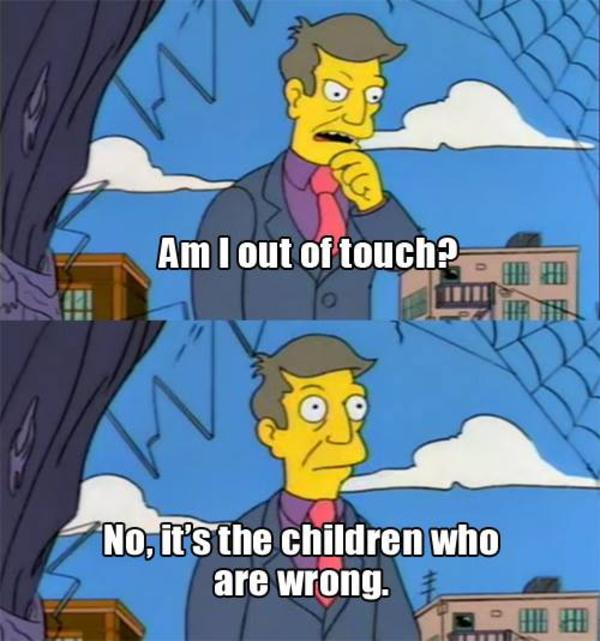
I am often willing to participate in surveys, as I realize that, when well-done, they can be useful, but I am often turned off by questions (and answer choices) that are irrelevant, simplistic, based on flawed assumptions, or pushing an agenda. I would urge any organization performing surveys to ask themselves the question, 'does this make us look out-of-touch, self-absorbed or incompetent?' I was half-expecting the article to be along the lines of 'these HR surveys helped me realize that I was wasting my time at this company.'
I had a question - From my personal experience the difference between a normal feedback (someone asking you directly) vs an employee survey are framing and scope.
For example, questions asking feedback on "leadership". Most people, specially freshman, care about feedback on the guys they are reporting to - it can be a lead, manager, director etc.
But the surveys tend to gauge all levels - project leads, managers and then company executives. So they put in questions like -
do you feel you get timely feedback?
do you feel people are held accountable?
do you feel you understand company vision?
etc.
Everyone attributes these to different people in management but then the HR tells them otherwise. This causes a lot of people to be disillusioned by the surveys from the time they start the careers.
Thank you so much. I do agree with asking a different kind of questions to get feedback on different insight
Another way to handle this issue is to segment your employees to multiple lists. Create different surveys for each level and you can be little more accurate. Say for freshmen you can have a list, while for your directors another list. Automate the different surveys. Finally, analyse the result from different perspective
I am actually going to recommend this to my friends in HR right away. Very impressive user experience.
I have not played with the product beyond the onboarding demo but I have to say the sign up was very impressive too and much to learn there for my own work.
Having worked with surveys over the years the problem I find is that testing takes longer and longer. Sometimes you are filling in a form and sometimes you will have an optional page, e.g. in a custom job application form you may have a page on education that only the person with a degree has to fill in, this implies two testing paths through the form and therefore doubles the time to test. So testing time goes up by the cube of form complexity, or so it seems.
Years ago it would take a whole evening to make a C90 compilation cassette of songs for someone. Just the interface of the cassette deck, turntable and other cassettes would mean that it would take 5-6-7 hours to put it together, even if you knew all the songs and knew what you were doing.
Nowadays if I want to put together a playlist for 90 minutes of music I could do that and think what I was doing to get it done in ten minutes, not hours. I wouldn't be using cassettes or record players or even CDs. Just tick boxes in a UI.
So the key thing for me is that how-long-does-it-take question and much like how with compilation cassettes you still had to play it back to test it, with a survey you need to do some testing, ideally with that test time not going up 'by the cube' of form complexity.
Being the creator of many surveys myself, what I would suggest to workaround this problem is, survey creators have to put themselves on the shoes of survey takers and create the survey. Survey takers are giving the feedback for free, spending their valuable time. Survey should be very precise and directly into the point.
I guess it is hard for the survey platform to solve this problem. This problem should be addressed by the one who creates the survey.
TL; DR
I will stop answering the survey if it takes more of my time. Keep on asking questions. It should be short.
Very cool story. I found it humorous that your first office was a tiny 100sf (for apparently 2 people), and now you have 9 people and a 400sf office. Truly an admirable startup workspace :)
So it's a survey in a chat window? I don't see how this is any more or less annoying for either side. If anything it sounds like this one is more invasive.
Now people are used to "WhatsApp" or messaging kind of UI than a normal form filling experience. The reason is those experiences provides by WhatsApp and FB messenger are more engaging. If we engage the survey takers, the completion rate will improve, that the whole funda behind a conversational experience
I can't help but think that after the third WhatsApp survey people will no longer think "what a novel experience", they'll be used to it and think "Yet another survey...".
The reason behind your motivation to start off things looks super-motivational to every aspiring entrepreneurs. BTW it seems like you got pissed off by the HR executive. :P
One fun question, is that HR guy still surviving at your previous organization for provoking you to start your own? :D
I believe the future of surveys are conversations! With 68% of emails opening in Mobile devices the surveys should give more messaging kind of experience

I had a BS degree in Computer Science, but I was never taught an algorithm for calculating my happiness index, not even in my Artificial Intelligence class. So I had to wing it.
To protest, one of my cow-orkers made "rpc.happyd", a Sun RPC server whose function it was to track the happiness index of the team members over the network, and "HappyTool", a graphical user interface to rpc.happyd which drew a face for each team member, with a slider under your own face for adjusting the face from happy to sad.
Here's a demo of the HyperNeWS version of HappyTool, which I wrote in NeWS PostScript, and which lets you copy an encapsulated PostScript happy face to the clipboard that you can paste into other HyperNeWS applications (like pasting into the customizable clock face to make happy and sad clocks):
https://youtu.be/avJnpDKHxPY?t=13m24s