Hacker News new | ask | show | jobs
by dougmwne 3144 days ago
The author was quite harsh on the soft sciencies and humanities and I'm going to attempt a defense. First, he characterises these subjects as merely what, facts to be learned, instead of how, skills to be mastered.

Let's take history, which seems very what, full of dates and names. A great course in history teaches you how to think differently and with deeper context about world events and your country's politics.

I suggest that a society only interested in the workings of machines rather than the workings of people will soon treat people as mere machines. Let the nightmare begin.

16 comments

The charactetization is incorrect. The liberal arts do teach “how.” Creative writing or political philosophy or history teaches you skills you can use to analayze scenarios and communicate with people in different ways to different effect.

Where the author is correct is that in those fields the output isn’t falsifiable. Your math skills allow you to construct proofs that can be verified. Your study of history allows you to write accounts explaining and putting in context historical events in a way that is pursuasive to other people. But they are not falsifiable.

I agree with holding the former in higher esteem. Being able to communicate with people is important, but it’s an impoverished basis for an education. It’s terrifying that many students manage to graduate without much exposure to the world of objective reality and truth that exists around them (and which makes their lifestyles possible).

I think you're mischaracterizing humanities as not falsifiable as if it should be like mathematics.

The content is not wrong in the same way a math question is, but many humanities classes are explicitly about taking arguments presented in essays, books, journals, by the government, by public interest groups, by private industry, and testing them against "objective reality and truth that exists around them." No humanities course just takes every argument at face value. Every argument is subject to intense scrutiny.

At least from my takeaway, just saying someone or an argument is "wrong" is not really what the humanities are about anyway. The humanities focus on the reasons people have and give for their claims. Often reasons are complex and are tied into complex human contexts. Reasons are not just evidence, they are the entire baggage of argument, logic, context, culture, and history. The humanities focus on understanding those reasons. Whether deciding whether those reasons and claims are wrong is important, but not the entire purpose of the humanities, and never was.

To be sure, there are people who come out of humanities programs with distorted views of the world. I have met many, and it worries me in some ways what more and more do to the humanities.

But there are also those that come out of STEM fields with wildly distorted views of the world as well. And I think that is because they lack a solid humanities education.

> Every argument is subject to intense scrutiny.

The reason we have a "left" and "right" in politics is it is impossible to prove one true and the other false. No matter how intense the scrutiny or clever the arguments.

No, it's because people have fundamentally different end goals.
>No humanities course just takes every argument at face value. Every argument is subject to intense scrutiny

Here is Orwell on the matter:

>"When the nautical screw was first invented, there was a controversy that lasted for years as to whether screw-steamers or paddle-steamers were better. The paddle-steamers, like all obsolete things, had their champions, who supported them by ingenious arguments. Finally, however, a distinguished admiral tied a screw-steamer and a paddle-steamer of equal horsepower stern to stern and set their engines running. That settled the question once and for all."[1]

Feynman:

>"It doesn't matter how beautiful your theory is, it doesn't matter how smart you are. If it doesn't agree with experiment, it's wrong."

People lived for a very long time without a proper appreciation of controlled, repeatable experiments, and progress was very slow.

1 - www.orwell.ru/library/essays/lion/english/e_saw

Until we come up with a mathematical model for human interaction or other humanities, we have to make do with what we've got.

Who knows if it is even possible to model human interactions?

I have an unpopular view, that physics is probably the easiest science. Chemistry is harder, biology is even harder. Heading up the chain into social sciences is just unbelievably hard to get good answers.

With physics, you can build a machine an test to your hearts content to determine what the underlying rules are. That's real tough to do when you're studying, say, an economy.

So, i don't mean this as a slight to physicists. It would never occur to me to use oil drops to measure the mass of an electron. It was a brilliant insight. But, with modern tools, I kinda think i could replicate that experiment in my apartment. Evolution? I mean, golly, that's a really subtle insight. I might be able to do something with petri dishes and poisons, but that seems like a pretty tough thing to detect. I'd like to compare Darwin to Newton, but Darwin is probably closer to Aristotle. We haven't begun to get to the really good stuff yet.

I'm skeptical of phycology, there are issues with replication all the time. But clearly they're on to something. The whole advertising industry is built on psychological insights.

I've dealt with crazy race conditions that make me want to pull my hair out. They're not consistently reproducible. Eventually i work out the logic and things fall into place. But i have access to the source :) I can't imagine how hard it is to get anything out of random interactions of black boxes. Social sciences just aren't for me.

Anyway, yeah, i believe it's possible to model human interactions. We do it all the time. As with all things, some models are just more useful than others.

I think your unpopular view is very true. Worse, it's the key to finance and politics.

I used to know someone who had nothing but contempt for developers and the IT team, because while he was busy playing the corporate ambition game, they just wanted to do a good job.

As far as he was concerned, this made them easy prey.

Guess which kind of person runs the world?

Engineering and science won't teach you this. You can finish your PhD with a completely unrealistic view about how politics works, and how political outcomes are generated.

Neither science nor engineering are immune to this. Popular beliefs and high-status areas of research are decided politically, not dispassionately.

It's tempting to say that things would be better if we had dispassionate objective AIs deciding policy, instead of individual and tribal ambition - but of course one of the challenges of AI is that instead of simply automating math, AI has the potential to automate and amplify influence and persuasion.

When you don't really understand influence and persuasion - but others do, in practice if not in theory - that's not necessarily a good place to be.

Yea, and even if it were possible, it would still only be the realm of theory until it could be experimentally proven
Look up Peter Turchin.

http://peterturchin.com

That is argument for experimentation against theorizing. Math people have awful habit of theorizing and even rejecting experiment that is right there in front of their eyes. They will argue for hours based on what systems/people/departments are assumed to do in simplistic model they did in their head, ignoring what is actually happening. They are also masters in cherry picking when it comes to history and it is especially bad when they talk about history.

They also have tendency to take conflict like the above, completely ignore politics and motivations that drives the arguments (meaning involved money), pretend it was all technical question people magically could not figure out until someone did something simple.

How is that Orwell "on the matter" of humanities vs. hard science?

> People lived for a very long time without a proper appreciation of controlled, repeatable experiments, and progress was very slow.

And now that we strive to only see what we can count and repeat, and worship our own creations as objective reality, progress seems to shift into the pathological. Even just the concept of "progress" as some kind of thing you can get more and more of, rather than a journey on an tree with infinite branches every moment, is in lockstep with that and betrays an incredible impoverishment of thought. Every single great scientist who also loved wisdom seems to have pointed out something along those lines which mediocre scientists seem to ignore.

Hannah Arendt in Vita Activa has a bunch of relevant parts, here is one:

> The rise of the natural sciences is credited with a demonstrable, ever-quickening increase in human knowledge and power; shortly before the modern age European mankind knew less than Archimedes in the third century B.C., while the first fifty years of our century have witnessed more important discoveries than all the centuries of recorded history together. Yet the same phenomenon is blamed with equal right for the hardly less demonstrable increase in human despair or the specifically modern nihilism which has spread to ever larger sections of the population, their most significant aspect perhaps being that they no longer spare the scientists themselves, whose well-founded optimism could still, in the nineteenth century, stand up against the equally justifiable pessimism of thinkers and poets. The modern astrophysical world view, which began with Galileo, and its challenge to the adequacy of the senses to reveal reality, have left us a universe of whose qualities we know no more than the way they affect our measuring instruments, and — in the words of Eddington — "the former have as much resemblance to the latter as a telephone number has to a subscriber." Instead of objective qualities, in other words, we find instruments, and instead of nature or the universe — in the words of Heisenberg — man encounters only himself.

> [The German physicist Werner Heisenberg has expressed this thought in a number of recent publications. For instance: "Wenn man versucht, von der Situation in der modernen Naturwissenschaft ausgehend, sich zu den in Bewegung geratenen Fundamenten vorzutasten, so hat man den Eindruck, ... dass zum erstenmal im Laufe der Geschichte der Mensch auf dieser Erde nur noch sich selbst gegenübersteht ... , daß wir gewissermassen immer nur uns selbst begegnen" (Das Naturbild der heutigen Pkysik [1955], pp. 17-18). Heisenberg's point is that the observed object has no existence independent of the observing subject: "Durch die Art der Beobachtung wird entschieden, welche Züge der Natur bestimmt werden und welche wir durch unsere Beobachtungen verwischen" (Wandlungen in den Grundlagen der Naturwissenschaft [1949], p. 67).]

------------

My sloppy/literal translation of Heisenberg:

"When one attempts, beginning with the situation of modern science, to feel towards the fundaments that have been set in motion, one gets the impression [..] that for the first time in history man on this Earth is only facing himself [..] that we kind of only meet ourselves"

and

"the type of observation determines which traits of nature are defined and which traits we muddle with our observations"

This would be true if the only listeners you’d encounter were computers.

But we live in the world of people, and demonstrating proficiency in only one insistent cultural mode because it is the most dedicated to rationalism is an impoverished worldview.

And "the world of people" needs to be driven by a coherent set of principles. So far the western world subscribed to rational thought and the socratic method.

The question is, to what extent the current shape of humanities is aligned to those principles?!

I think one quick glance around yourself these days and you can see that these principles have failed completely to account for the society that they would produce. In fact the insistence on Correctness implying superiority and the Right to undermine all other approaches is itself the first best example of how bankrupt this approach has become in the face of the problem of unifying a society around common beliefs and goals.
To the extent that the humanities are not "rational", whatever that means, they are a valuable and useful complement, and the world need not be driven by rationalism alone.

The humanities teach how to look from multiple perspectives, our values, what we believe and why, our self and our relation to society. It teaches critical thinking and analysis of complex, nonquantifiable factors, such as: should we declare war on North Korea? What does it mean to be Chinese American? Should I trust this person, website, or TV station? The humanities are about life, and virtually all the themes are immediately applicable in daily life.

As a history professor, it's good to see such a civil and thoughtful discussion of the value of the humanities on HN. Thanks :)

For what it's worth, I enjoyed Prof. Rota's piece and didn't particularly object to his "what"/"how" distinction. I agree with commenters above that it's a misrepresentation of historical research, which can be deeply empirical. Unfortunately a huge amount of history education, especially k-12, does boil down to a rote memorization of past events, so I can't really fault him for the generalization.

Postmodernism revealed what happens when you look (intently) at ALL possibilities before you properly define YOUR identity and set of values.

Surprisingly, even Macron articulated that maybe Western world needs "great story arcs", which is code word for SHARED IDEALS.

War is always an attribute of survival and the problem is that US population is pretty insulated from acute strife on the survival front. But the risks are there and can only be appreciated once you train in geopolitics.

If you look at business, there is certainly winning and losing but not necessarily falsification. If one business fails, this doesn't prove that nobody else could succeed. Maybe things have changed?

Court cases are won or lost, but sometimes overturned on appeal. Even Supreme Court rulings can be overturned by later rulings.

Artists create art that can win or lose in the marketplace. Art can also gain or lose status based on how it appears to critics. Artists can be popular, notorious, or obscure.

Similarly for writers. Politicians win or lose elections. Nations win or lose wars.

Winning and losing in competitive situations seems more fundamental than falsification. (Take evolution for example.)

Defining rational thought and Socratic principles is pretty much exclusively within the wheelhouse of the humanities, I would think. Philosophy is a humanities subject.
Ironically, the very concept of "objective reality" is not falsifiable.
Quite a few folks these days seem to make very non-trivial philosophical claims, then claim that philosophy is not worthy of attention in the same breath. It's very odd to see.
> and which makes their lifestyles possible

Arguably computing as a discipline is an important part of what makes contemporary lifestyles possible, and most of it, especially the practical parts, resembles the liberal arts more than it resembles mathematics. Especially areas like programming languages overall operate more through argumentation and analogy than through proofs. Sure, there are subsidiary proofs involved that can tell you something useful about the building blocks, but the type-related theorems you find in appendices of POPL papers are just low-level machinery, not the real goal, which is a usable programming language that people can do real work with. That requires constructing an overall language and ecosystem through a pretty liberal-arts style methodology: looking at what worked previously, reasoning what went well and badly about that, critically considering illustrative examples (often carefully constructed examples designed to illustrate a point, similar to the thought experiments in philosophy), and attempting to improve things on the basis of all that. If you look at a Rich Hickey talk, for example, that's pretty much entirely how he proceeds. And even in POPL papers, that's what you find in the meat of most influential papers (as opposed to the appendices): the real result of an influential paper is typically a qualitative argument about programming constructs, where the argument is convincing and well supported by examples, by not "proven" in any mathematical sense.

>Especially areas like programming languages, in their applied parts, operate more through argumentation and analogy than through proofs.

I think the virtue is not in the value of the arguments, but whether the argumenrs are falsifiable.

Programming has the virtue that it has to work for it to have value. Social sciences and humanities have to convince someone that it would work.

PLs arguments are very rarely falsifiable, if that's your criterion. I mean, yes, a programming language has to work in some sense, but that's a pretty low bar; C and Lisp work and have for decades, so we could just say we're done, disband the research field. The rest of PLs exists because they claim that they're building something that is in some way "better" than C or Lisp. But that's a pretty fuzzy argument, difficult to falsify. There is a small area of empirical software engineering that does try to measure things like whether certain constructs can measurably reduce bugs in real-world usage, which would be a testable hypothesis. But they've been able to establish very, very few solid things about PLs, and the vast majority of PLs doesn't look at all like that. It's more design argumentation.

To pick a concrete example: Rich Hickey introduced transducers into Clojure a while ago, using an argument, illustrated by a number of examples, for why they're useful. Is this argument falsifiable? In principle some version of it might be, if you made "useful" more precise (useful to whom? in which contexts? how would you know?). But the kind of empirical work it would take to measure it in a non-toy setting is quite difficult, so afaik nobody's tested it, or even really formulated the question precisely enough to test it. In practice, you accept or reject the construct based on what you think of the argument, or you try to find a counterargument that makes them look like an inelegant/awkward construct, but in either case you probably aren't attempting to rigorously validate or falsify a scientific hypothesis relating to them. Basically all of PL design and evolution looks more like that than like Popperian science...

I basically agree with you, but we're arguing to different ends.

What I am saying is that there is nothing wrong with these arguments or with using them usefully. What is wrong is when nothing is falsifible or able to proven, either. So in other words, arguments are useful, but it does matter if it has to agree with scientific experiment.

Programming does, at the end of the day, agree with fundmantal truths for it to work. Its foundations are on the metal, and everything is reducible experimentability.

Perhaps everything except the human element: most aspects of modern product development involve programming language improvements that have to do with improving human interaction with a computer. But even here, we have a sort of market for ideas in that developers who adopt better ideas will be more successful.

It seems fundamental that you're building artifacts for users. In user interface design there's no hard science, no falsification. An application that wins now might lose later when things have changed, and this can be based on fashion.

Of course, it has to work. But a sculpture has to "work" too in the sense that it shouldn't collapse. Structural integrity is only part of the goal. Similarly for programs.

> PLs arguments are very rarely falsifiable

You mean PL design, don't you? Performance work is very empirical. If my new type of inline cache is better then I need to prove that and it's falsifiable (using benchmarks, which I admit aren't ideal).

In fact! I can falsify your claim that PL research isn't falsifiable by using some PL research!

http://cis.upenn.edu/~cis501/papers/producing-wrong-data.pdf

> Of the 133 papers published in the surveyed conference pro- ceedings, 88 had at least one section dedicated to experimental methodology and evaluation

Still, the benchmarks are usually toys and it's pretty easy to find contradictory benchmarking reports. Very few projects do online benchmarking comparisons of different design choices on real workloads
> But they are not falsifiable.

I disagree. Historians are constantly making predictions of events happening today, based on their knowledge of history. Some are accurate, some are not. They can then take this output, and use it to refine the views of history.

This doesn't even cover how history is written by very unreliable narrators, and historians have to do more than learn the "what" to uncover the "how".

Your argument is also somewhat limited to History, when Philosophy, Psycology, and other liberal arts degrees do not have the same limitations.

“Falsifiability” is a word with meaning. If you identify a single counter example to a mathematical conjecture, the conjecture is wrong. That is not true for history, philosophy, psychology, or the other liberal arts.
Your statement is obviously false (counter example: analytic philosophy produces conjectures that are black-or-white-falsifiable on the exact same basis as mathematical conjectures). Since you are engaging in epistemology, you may appreciate that the above is also an example of what falsification looks like when it is not formal. I'd suggest reading some Popper.
Seconded. I'd add Wittgenstein and Quine to the list.

Two Dogmas would be a good place to end up.

You can certainly counterexemplify philosophical arguments.

It's also weird to suggest that no historical claims are falsifiable. That seems to put real history on a par with nutty conspiracy theories.

> It's also weird to suggest that no historical claims are falsifiable. That seems to put real history on a par with nutty conspiracy theories.

In my humble opinion the scarceness of falsifiability in history is the reason why it is so easy to create nutty conspiracy theories about history vs, say, mathematics or physics.

There are plenty of nutty mathematical or physics theories around.

History is roughly as falsifiable as astronomy or biology.

But then why do you judge the conspiracy theories to be nutty, if they are on just as firm an epistemological footing as actual history?
That is not true for psychology, biology, chemistry ,or physics either. They all choose some p-value as a boundary for deciding what is real.

Falsifiable means subject to test. It doesn't mean provabe on the sense of math. Only math is provable like math.

> Historians are constantly making predictions of events happening today, based on their knowledge of history

Could you provide some examples?

But it is falsifiable. A new document or artifact may contradict an account and thus falsify it.
People are exposed to objective reality in their everyday life. You can't just get into humanities. There is a whole education before that.

How does this perspective that people are stupid gain ground? It seems to be a self serving, self important and extremely judgemental perspective held by some insular techies.

The world is as much about politics, people and culture as it is about science. A failure to understand how the world works not just scientifically but politically, culturally and economically, the history of societies and accompanying philosophies gives individuals no context or understanding of their world. A one dimensional perspective both ways impoverishes rather than enlightens.

Your argument would be more convincing if brought as falsifiable science-style theory.

In its current humanities-style argumentative form, you somewhat contradict yourself: either your argument holds power, then why do you dismiss this family of arguments as inferior? Or your argument doesn't hold power, then why would you expect us (or even yourself) to be convinced?

From time to time “history” has shown us history in textbook can be deliberatly false because the regime/authors/publishers do not approve the “accurate” version.

In the end, I think education is also the veichel and a platform for students to have the intellect to question and to challenge established facts.

But falsifiability is not the purpose of liberal arts creation is. This is one of the reasons I don't believe that it belongs in an academic discipline were critical thinking seems to be of higher value than constructive thinking.
Funnily enough, critical theory is a liberal arts discipline!
I know thats the irony.
Keep in mind that mathematics is only falsifiable in that sense because it is built entirely on assumptions.

Mathematics isn't really a science.

I think you've taken Gödel too far.
Point me to an experiment that could falsify a mathematical theory. :-)
Exactly. Next thing you know people will be claiming that it's possible to generate ambiguities in any formal system.
For anyone interested in learning more about people (and yourselves) I highly recommend Jordan Petersons' lectures on youtube. I believe he has started working on an online university for the humanities with all the money he's bringing in from patreon (he wisely hid it recently but it was close to 60k per month last time it wasn't)
I really enjoy his lectures but people should be aware that he's been in the middle of some controversy over LGBT legislation in Canada and has attracted a following of vocal red pill types. The comments on his YouTube videos are kind of disturbing. His psychology lectures are great and I mostly share his views on post modernism, but I wouldn't want to be associated with his fan club.
Don't forget Peterson's claim that only men have high enough motivation to be successful in competitive industries. His view is problematic because some VCs grill female founders not on their products but on their motivation level and how they will take care of their kids. Most power couples I know hire nannies. It's common enough where people shouldn't ask.

Anyway, I concede people can be good in one way or another while also being a total shitstain. See Spacey, etc. But Peterson has always been too angry for me. He's like Colbert with no satire.

I was curious to see if he'd actually said that or if you were misrepresenting a more reasonable claim. I'm not familiar with Jordan Peterson but managed to find this video:

https://www.youtube.com/watch?v=NV2yvI4Id9Q

... in which he says that high-powered careers are very unpleasant due to hyper-competition among people who are exceptionally willing to tilt their work-life balance way toward work, and that most (but not all) of such people are men. Which doesn't sound like that unusual a claim, really: it's a fairly mainstream belief that women average more family-focused than men, and you only need a small difference in means between populations to get a big difference in representation at the far tails of a trait's probability distribution. (I would have preferred that he make the point with less bluster and more graphs, but that's just a matter of taste.)

Is that what you were alluding to, or does he somewhere else contradict this to make the crazy and very different claim that "only men have high enough motivation to be successful in competitive industries"?

Thanks for the link! This thing is hilarious!

About 7:00: "And you think when you're 19, 'cause you're so clueless when you're 19, you don't know a bloody thing, you think, "well, I'm not really sure I want children anyway". Like, oh, yeah, you can tell how well you have been educated. Jesus. Dismal. Dismal. Without fail.

"I've watched women go through their professional careers, many, many of them. It's a very rare woman who at the age of 30 who doesn't consider having a child her primary desire. And the ones that don't consider that, generally, in my observation, there's something that isn't quite right in the way that they're constituted or looking at the world.

"Sometimes you get women who are truly non-maternal, you know, by temperment. They have a masculine temper [-ment?], disagreeable, they're not particularly compassionate, they're not maternal, they're not that interested in kids. Fair enough, man. But there aren't that many of them and there's plenty who will not admit to themselves that that's what they most desperately want."

Right? He's like a caricature from the Mad Men era. No wonder so many of the MRA or whatever they are called love him.
The funny implied that interest in kids and being agreeable are kind same thing is not even funny. Where is that particular bs coming from?
No, that would be at least be a somewhat defensible claim. Peterson literally says some men have crazy high motivation and women don't. It's not from this video.

I saw it when one of my co workers started sending my Peterson vids. God, I wish I never heard of this guy.

Okay, I made the mistake of watching the linked video. At one point he claims the old boys' club doesn't exist at law firms. I mean...where did the term come from?

"At one point he claims the old boys' club doesn't exist at law firms."

Well, sure, you see, those hyper-competitive men who happen to like that sort of environment would never, ever, do anything dishonorable or unethical to reduce their competition. It's purely "market determined right to the core"[1].

[1] Yes, I went back to get the quote.

Lame that you'd say this without posting the source.
> Peterson's claim that only men have high enough motivation to be successful in competitive industries.

Hmm...pretty much everything you claim here is wrong.

First, his is not a claim from first principles or ideology, but an observation from many years working with at least one highly competitive industry: lawyers. So independent of what you want the world to be, this is what he says he observes in reality.

Second, his claim is not about "success". It is about reaching the top of whatever dominance hierarchy you find yourself in. Per definition, only very few people can be in that particular place, and his central argument is that equating these two (your personal success = reaching the top of some dominance hierarchy) is a losing proposition for almost everyone, simply because there isn't enough to go around.

Third, and maybe most importantly, he says that even if you are one of the few people who have the ability/luck/desire to achieve this very dubious form of success, it is almost certainly a losing proposition because it sucks on just about every other metric of having a good life, unless you are psychologically structured in such a way that this alone will make you happy.

Fourth, he notes that women are generally smart enough to figure this out. As are most men. There are a few men who don't, who will subordinate everything else in life to reaching the top of that dominance hierarchy. His claim is that most if not all of these people will not have good life.

And finally, as usual, this says nothing about individuals, but only something about populations. In his case, he says that law firms are doing everything to keep their highly qualified, super smart and highly effective female lawyers, but they can't, because most of them just drop out of that race to the top.

Are you claiming this is not true?

Oh god I didn't know he was that crazy.

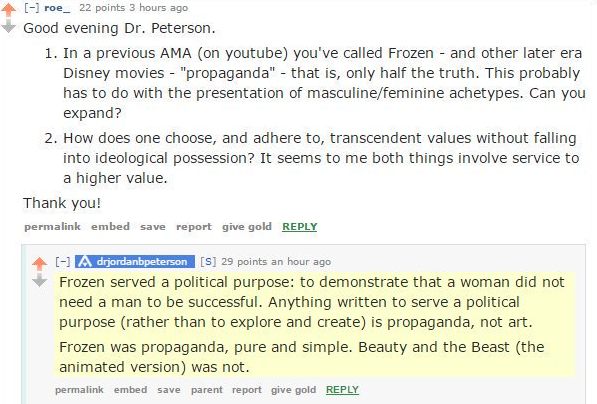
>"Frozen was propaganda, pure and simple."

https://2.bp.blogspot.com/-b2VPRvIfTvs/WXt9SllI4XI/AAAAAAAAC...

I did not check every claim in that article.

What I did check, did not check out.

They show a video of Peterson arguing that being a CEO of a billion dollar company is basically pointless stupid competitiveness and men happen to be more pointlessly stupid in that regard, and the blog interprets it as him saying women should not try to be CEOs

That video is the center of the argument (the thing the post 'builds up to') in the blog's own estimation.

https://www.youtube.com/watch?v=hU7AewaHr0Q

He also says, in the other video mentioned in this thread, that pointless stupid competitiveness is how you end up running things, so there's that.

I wonder if you could actually get him to agree that everything wrong with the world is due it being run by pointlessly stupid, hyper-competitive men.

From an article (https://thevarsity.ca/2017/09/18/professor-jordan-peterson-w...) about the announcement[1]:

"Peterson has emphasized his desire to provide students with better and more affordable education. “There is absolutely no reason why high quality education can’t be made available to masses of people at low cost,” said Peterson in a recent interview on CTV’s Your Morning. “I think it’s a scam pretty much from top to bottom and it’s a very expensive scam.”

"He has not clearly stated when he will form the online university, though he said on Your Morning that he will soon start a website that will distinguish between postmodern and classical content and “cut off the supply to the people who are running the indoctrination cults.”

"Peterson also expressed that his online university would be an alternative to traditional universities, which he believes “have abandoned the humanities.”

"“About 80 percent of the humanities papers are never cited once and the humanities have been dominated by a kind of postmodern neo-Marxist, cult ideology,” said Peterson. “[The humanities have] abandoned their mission to students. Their mission should be to teach students to speak, to think, and to read, and to become familiar with the best of the world fundamentally.”"

[1] I think they're talking about this video (http://www.ctvnews.ca/video?clipId=1169448), but CTV doesn't seem to do transcripts and I live in the wrong "region".

Thanks but I'll take a pass on getting my education from an anti-education religious ideologue.
He’s an engineer or scientist. The world needs engineers and scientists, and it makes them feel good to assert their superiority.

At the end of the day, these guys always work for somebody, who is usually some sort liberal arts or business major. It’s something to keep in perspective when somebody asserts that math and science run the world.

>At the end of the day, these guys always work for somebody, who is usually some sort liberal arts or business major.

Usually that someone is a liberal-arts major because they had a trust fund, not because the liberal arts turn you into an insightful, far-seeing, compassionate leader.

Liberal arts help you to analyze information in front of you and express the outcome of such analysis in prose or speech.
Math and science does run the world, but the mathematician and scientist does not. I believe this is more accurate.
Once stuff is discovered and productized, the scientists and math people often become redundant. My grandma doesn’t know what machine learning is, but can benefit from it greatly on her iPhone or spam filter.

Hell, once the frameworks get mature, even the programmers don’t need to know much. My understanding of the math behind crypto is incomplete, but I successfully implemented validated systems with other people’s “Lego bricks”

Check the background of the CEOs of the largest businesses in the world. You'll surprise yourself.
I wouldn't say he was harsh. I would just say he is mischaracterizing them and creating a split that doesn't hold up to scrutiny.
I don't think he was that harsh, and he actually praised the "knowing what" subjects. He simply meant that at MIT, the "knowing how" is more important.
I think mistaking History for a "knowing what" subject rather than a "knowing how" subject is a terrible misconception.

Understanding how societies and civilizations reacted to different pressures and how the structure and nature of their institutions evolved and handled those pressures is much more important than remembering what happened where.

Those who fail to learn from the mistakes of history are doomed to repeat them, as they say.

I think what the article means by "how" is knowing how to personally do something; the "how" for history is knowing how to do historical research.
What I don't understand about this comparison is that there's actually an awful lot of "knowing what" involved in math and science too. You won't get far in solving math problems if you try to derive everything from first principles. You could make fun of historians for learning lists of dates, but you could also make fun of mathematicians for learning lists of trigonometric identities.
It is true that you need to remember a lot of things to do math effectively, but a big difference between knowing dates and knowing theorems is that you can re-derive the theorems by yourself given enough time. A not-insignificant reason I got into mathematics was that I have difficulty remembering specifics, so I could lean on reinvention.

I frequently forget the trig identities, but I know the basic definitions of trigonometry and that there ought to be certain identities, so I know I can re-derive them or look them up. But, I only need to do this when I teach calculus.

You can also re-discover the dates by doing your own historical research, if you want to. And of course, historians don't really spend much time literally learning lists of dates. More realistically, there are lots of causal and logical connections between historical events that enable a historian who knows the details of a particular period to infer certain facts that they've forgotten from facts they remember.
Don't worry, I'm not completely ignorant about the work historians do.

> You can also re-discover the dates by doing your own historical research

My point was that you can put a mathematician in a closed room with only pencil and paper, and they could redevelop an entire theory if needed. A historian in the same position would be unable to do any work -- they need primary sources. I went with your "learning lists of dates" as a stand-in, since, like primary sources, you can't derive dates from scratch.

Sure, history has a "how" of research methods, but the research products must rest on the "what." Mathematics is almost entirely "how." The "what" for a mathematician is mainly knowing what's been done and what needs doing, for the purposes of directing research and giving attribution.

Also, I am pretty sure G.C. Rota was being somewhat facetious in quite a lot of the article. These are "lessons of an MIT education." Lessons aren't necessarily truth.

That's just to say that history is an empirical discipline whereas math, to a large extent, isn't. There are also limits to the amount of useful work that, say, an astronomer or biologist can do with just a pen and paper.
It seems like a mathematician should be able to derive a trig identity if asked? Otherwise you don't know it very well.

Often mathematicians will make informal arguments but the idea is that you should be able to add rigor when needed.

Sure, and a historian who knows a particular period should be able to explain what evidence is available that event X happened on date Y.
He does say, 'By and large, "knowing how" matters more than "knowing what"' as the heading of that section. I have a lot of trouble with the claim that there are no skills to be mastered in subjects beyond the hard sciences and sports. I agree with him that the factoids themselves are trivia.
I'd argue that "learning how" to write good texts or understanding a person psychologically, for example, is a rather valid example of a soft science having a real impact on the world that can easily compete with engineering problems. It's a bit like arguing that construction work is more valuable than planning architecture, which might be true in a hierarchical sense but ultimately it's just a matter of perspective and scale.
"Begin"? The prior century is replete with horrific examples of societies, spanning - perhaps defining - the modern ideological spectrum, which behaved in precisely such fashion.

I agree that the study of history is the best method yet found for recognizing the errors which produced those enormities, in order to avoid repeating them. But I'm not sure how effective undergrad history courses, or even history specializations, are likely to be in equipping their students with the tools for such study. Granted I've never taken such a course myself and so cannot speak with authority on even one example of the type - but I have found it not at all unusual for people who do have such education to be surprised in even so elementary and recent a matter as the American origin of the eugenic idea. Quite aside from being in my opinion a necessary antidote to the idea that the United States are somehow blessed with a permanent immunity to such enormities as we here discuss, such ignorance, on the part of so many supposedly educated in history and - if you're to be taken at your word - historical analysis, does not inspire enormous confidence in the value of such education.

> I agree that the study of history is [a] method [...] for recognizing the errors which produced those enormities, in order to avoid repeating them.

Why? Do we have any evidence for that it helps at all?

Here's what I find weird: when one is talking about learning history, usually the "pro" side cites the importance of the subject, and the "no" side, the methodological "flaws". It seems that this discussion is a bit pathological: Everyone agrees that if a certain avenue of study can reduce the probability of genocide, it should be undertaken. The question is that maybe (probably) these avenues of study do nothing of the sort.

Of course, we can disagree about that. But how would we settle/improve our knowledge of the question?

Those who study history are doomed to watch others repeat it.
I'll offer a specific example of historical context. The University of Virginia offers an undergraduate level Coursera course on modern history.[1]

That course's treatment of the causes and importance of the industrial revolution suggests that access to cheap energy is the key difference between an agrarian and high technology civilization. That idea and that particular history professor's connections to Washington (he was executive director of the 9/11 commission) helps to explain a forever war in the Middle East and climate change denial.

[1]https://www.coursera.org/learn/modern-world

That looks to be an excellent treatment of the subject. Are many undergrad courses, or even just Coursera courses, similar in quality, or is this one exceptional?
Anecdotally, as a history undergrad and grad student, almost all collegiate history courses are like that if they’re any good at all. You do occasionally get low-level surveys that seem more like laundry lists of names and dates, but overwhelmingly in my experience courses will focus on the question of why. You’re studying the interplay of people, ideas, economies, technology, et al to understand how and why a particular thing happened.
>>A great course in history teaches you how to think differently and with deeper context about world events and your country's politics.

Context matters. If you are studying history when you are about to be promoted to be the general of your army, or pursuing a career in diplomacy these things make sense in the context of your career.

For general folks the value of this information for all practical purposes is zero. Compared to say an education in STEM where many concepts can readily used applied across other disciplines, as its just Math at the end of they day.

For this very reason, some civil engineering graduate can pick CS way easily than say with a graduate degree in history.

It's also releveant that the author feels perfectly justified in making recourse to a hypothesis about history which far from easy to test: “The idea of genius elaborated during the Romantic Age (late 18th and 19th centuries) has done harm to education.”

Compared to what? Clearly he doesn’t know how to make a historical argument — perhaps he considers such arguments beneath him.

That's a rather unreasonable criticism. I'm sure if you could ask the author (before he died a few years ago), he could provide you with more detail.

Requiring an author to expand on every question a piece brings to the readers' mind is just an unreasonably high bar.

It may be relevant that the author held dual chairs in Mathematics and Philosophy (phenomenology, I think).
> [The author] characterises these subjects as merely what, facts to be learned, instead of how, skills to be mastered.

Indeed. I owe a significant amount of my professional and financial success to being able to communicate my/my teams' ideas and breakdown and communicate company strategy to my teams.

After a certain base level of excellence in engineering or another technical field, the distinguishing characteristic among levels of accomplishment seems to be communication, not a further 0.5% better at engineering. I see so many great technical people who are unable to communicate effectively and suffer badly from this.

> I see so many great technical people who are unable to communicate effectively and suffer badly from this.

I learned a lot of my communication skills studying the arts, and staging plays, musical performances, etc. My best teachers about clearly communicating expectations and deadlines, and giving meaningful feedback in a respectful way, have been people in the arts.

At my first hackathon, I got the same vibe I often did in the last few days before a play or concert. Then when I started running a civic tech project, more and more patterns with working in the arts became apparent. Lots of volunteers, everybody has day jobs, you need to provide people with opportunities to do work they care about, but not pressure. And you need to provide leadership without being a dictator, and meet external milestones with a "show must go on" attitude when the time comes.

An MIT professor can be naive. A history major learns how to read and analyze documents...and how to write. An art major learns how to create art. An even more significant difference between these and many contemporary STEM subjects is that an undergraduate is expected to know how to create original work...there's no copying art homework especially not in an advanced class.

These days I think that the creative element of programming is why software is eating the world at the pace it is. Undergrads can look at each other's code and say Wow! while one titration is fungible with every other.

These days I think that the creative element of programming is why software is eating the world at the pace it is. Undergrads can look at each other's code and say Wow! while one titration is fungible with every other

That's simply not true. The reason that software is eating the world is that the rate on investment return is so much higher. Every time I read a publication from Phil Baran's group I have to pause several times to think it through, it's very deep, very subtle. Website is here, btw: http://openflask.blogspot.com/

It's actually worrying that computing has overtaken science and engineering. Back then, Arnold Beckman made a fortune in scientific instruments and enabled the world to do better science. Nowadays, Google and Facebook sit on huge corpora of natural language texts, and the only thing they do is build better AI for better targeting of ads.

It is entirely true that I think that, these days.
Don't do that. That notion does not conform to observable reality.
One might find familiarity with Hume useful here.
These days I think that the creative element of programming is why software is eating the world at the pace it is. Undergrads can look at each other's code and say Wow! while one titration is fungible with every other.

Seeing past this level of understanding is an attrition gate in any subject. What I mean is, the students who got past freshman chemistry to become good chemists are the ones who saw the creative element in chemistry.

Those same students may have taken the programming course and seen different codes as fungible with one another. Or in math, proofs, or in English, essays. I know people who came away from the freshman programming course, with the conclusion that "it's all just memorization." Clearly it means they didn't get it, but it also means it's a widespread impression.

As for chemistry, for reasons we don't know, part of developing creativity as a chemist is to get what they call "hands," which means being able to take care of yourself in the lab without wreaking havoc on everything. You need to have a sense of what can and can't be done in a practical process, in order to see your way through a difficult project.

The 'good' chemists I know eventually wound up at places like Coca-Cola making sugar water after a post-doc or teaching titration...after a post doc.
Every field has its own sugar water, and its own titration.

Advertising and GUI design are the sugar water of computer science.

The "coding interview" tells me that at least some aspect of programming is akin to titration.

I could give GUI design a tenuous connection if pressed, but what on Earth does advertising have to do with computer science?
As I understand things, it's possibly the biggest employer of people with computer science degrees, as well as the biggest revenue driver for the software industry.

But perhaps to generalize, the relationship between "look at how creative this discipline is" and "look at what people actually do with it in the real world" is an issue facing every academic field.

Google hires a lot of computer scientists. Advertising is it's core business.
>I suggest that a society only interested in the workings of machines rather than the workings of people will soon treat people as mere machines. Let the nightmare begin.

So far the society that treats people as mere machines is constantly mouthing platitudes about the humanities to itself, chanting, "Think about people! Think about philosophy!" as though this will actually alter the balance of class power.

USAians already take more humanities courses in a STEM degree than almost anyone else in the world. It doesn't seem to accomplish much to turn everyone into fluent humanists.

AFAICT, in many cases (e.g., history) that's just to catch up with the rest of the world's pre-university humanities' level (and that the same applies in reverse for the humanities degrees).
AFAICT, that's pretty similar in STEM, except that Americans who don't take STEM degrees don't ever take what other countries would consider pre-university STEM courses.

Mind, other countries specialize their students in early or late secondary school, so the differences may not be quite commensurable. A UK, French, or German student going into a STEM degree will probably have taken calculus and linear algebra by the end of secondary school, but they may not have taken an equivalent to America's AP World History. If you told them they ought to take a first-year university course in world history to get into a STEM degree, they'd look at you a bit weird, but this is admittedly how American admissions works.

I also know an American who basically took every available AP course, had a perfect grade average, volunteered in Girl Scouts, won valedictorian of her well-regarded high school. She ended up wait-listed to MIT, admitted with no financial aid to Cornell, admitted with a moderate scholarship to McGill, and admitted with a full-ride and honors to her state flagship school. She took the full ride.

(Also, we met and later married :-p.)

This contrasts with Technion (I did research there), where you could get into the top-flight STEM institution of the whole country just by earning sufficiently high marks in your matriculation exams.

It really does give me the impression that both other countries educate more rigorously at the secondary level, and Americans have a perverse fetish for inhumanly grueling competition. I think this may be precisely the opposite of a good system: a good system would assure that everyone has a very solid baseline, and then maximize the fraction of top talent that makes it through the training pipeline to do the most difficult work.

Ya, lots of history courses have a discussion along side that teach how to interpret texts instead of fact memorizing. These skills are surprisingly useful.
> treat people as machines

We are machines. Squishy, carbon-based machines with certain unique computational capabilities, I'll grant - but still, machines.

Armed with this insight, does it actually help us interact with humans? I'd argue that it does not...
Bayesian brain theories are very helpful for interacting with other humans, actually.
Yes, it does. Provide input, expect output, send to maintenance dept. when errors occur.
People are machines - simply meat machines. The underlying mechanics and operating systems differ, but the processes and 'tasks to be done' are similar. =) IMHO
Meatsack.WhoIs:[your_owner] Meatsack.PurchaseRequest:[internal_organs]
I found this darkly funny;Despite being downvoted, I am suggesting that one can observe the body as computer's systems and processes emulate a biological system at a certain level.
If the purchase-price being offered exceeds the sum I think I'll be able to give my heirs as inheritance, then I should actually accept that transaction.
In that case I have A Modest Proposal.

http://art-bin.com/art/omodest.html

Well, is the total lifetime earning potential of an 18th-century Irishman greater than the value of the meat on an infant? If not, then his proposal would have had merit outside of satire...