Hacker News new | ask | show | jobs
by schwarrrtz 3244 days ago
> Migrants coming to Canada, many from countries such as China, India and Pakistan, are often relatively well-educated and ambitious to see their children get into professional careers.

> Prof Jerrim says these families have an immigrant "hunger" to succeed, and their high expectations are likely to boost school results for their children.

Speaking from personal experience as a native Canadian, this can also motivate non-immigrant children to work harder. When half of your peers have an immigrant's work ethic it can be a real positive influence.

Disclaimer: this is an anecdote, my personal experience may not generalize, etc.

7 comments

Hanging out with immigrant kids in the US I would tend to agree. A few years in the Persian Gulf with mass immigrant youth mixing with a GCC citizen subset in schools as a policy requirement still provided lots of anecdotes that those GCC students care a lot less than expat kids despite pressure on the latter. They can get jobs slated for GCC nationals only with lax requirements. Many see little value out of college beyond the elite who wanted out.

Now immigrant and expat to me means overlapping national and ethnic and national backgrounds. It is an issue of the intended period of their residency.

I think govt policy was hoping for the later in institutions like the one I worked at, and it made me sad.

Yeah, I'd like to see these stats broken down to immigrants. I'd guess that the immigrants are actually leading the way.

My guess is that Canada is careful about selecting those allowed to migrate for education which helps a lot here.

Requirements for immigration is difficult and if everyone had to pass the same bar my family had to then it's almost guaranteed that most immigrants are well above average. Or put another way, the average of immigrants is probably higher than the average of native born citizens.

That said, the opposite is true for refugees. The only thing you need is to somehow get inside the country. If you can convince some judge that you have a moderately believable story about why you will be in danger if you go back to your country you can get refugee status.

So there's basically two classes of immigrants. Those that are selected with very high standards, and those who just get in with almost no standards.

I'm guessing the latter group does not even send their kids to Universities.

By definition of the word refugee, a refugee is expected to restart her life from scratch. Bootstrapping like that takes years and education in many cases becomes second priority. Comparing a refugee with an immigrant is unjust. One chooses to abandon her home town, the other is either forced to leave or escapes for survival.
That's not the real difference though.

Immigrants also have to restart from scratch. Everything in Canada is completely different from what we're used to in our countries of origin. Often, parents who were engineers in their home countries have to work blue collar jobs to make ends meet.

I think the actual difference is in average IQ and other desirable traits like industriousness.

Immigrants tend to be at the higher end while refugees tend to be at the lower end.

>I think the actual difference is in average IQ and other desirable traits like industriousness. Immigrants tend to be at the higher end while refugees tend to be at the lower end.

Why would people fleeing war zones be on average less industrious or less intelligent? That doesn't make any sense.

I'm 42, just old enough that many of my classmates in school (in the USA on the west coast) were at the tail end of the boat people refugee exodus of ethnic Chinese from Vietnam. Well, Chinese are always smart and hard working right? It was still true, somewhat, as that was their stereotype in Vietnam as well.

However, being a refugee means going through a much more traumatic process than being an immigrant. You are literally thrown from your home with little left and have gone through a difficult process to get out and resettled in a new country. So drug abuse, gang activity, crime, not doing well in school, depression, etc...were problems for that community even though given normal circumstances they would have been similar to other Chinese immigrants.

Because of Canada's immigration policy, most of the immigrants are highly educated, they wouldn't be an immigrant if they didn't finish high school. Refugees is everyone else who couldn't immigrate and had to go the other route. So you might have a Sudanese immigrants who are highly educated and Sudanese refugees who are more likely to be illiterate (a bit generalizing but still).

This is very different from US where you have a green card lottery and your typical immigrant is just an average population because everyone has the same chance of winning lottery, it doesn't matter if you are a farmer or aircraft engineer.

The above average people just establish a new life in a neighboring country.
Uh, no. I immigrated to Denmark. I went with a year's worth of savings, a place to live lined up when I arrived, a job and Danish lessons organized, and a fallback plan to return home if it doesn't work out. When you have time to plan, you start lightyears ahead of those who have to leave their homes on the run and go wherever fate takes them.
I would say refugees tend to be on the more average end, rather than lower end.
If what you mean by IQ is "opportunity to access quality education before immigration", then you may be right. But in that case IQ becomes a function of wealth which is not that common among refugees. Inequality is not genetically but sociologically inherited.
> Comparing a refugee with an immigrant is unjust

The refugee system in Canada is frequently abused. I hear anecdotes from my friends about kids from rich families in safe Easter European countries, that pay thousands to immigration lawyers and apply for refugee status simply because the partied too much and didn't manage to get enough points to go through the point based system. Such "refugees" can be safely compared with immigrants.

Eh, sounds a lot like the overblown "Welfare Queen" syndrome that so many in the US worry about so much. Yes, there are most likely people who abuse the system, but most people who get assistance are genuine refugees.
Our selection process is as follows: "Does your daddy have money?"
Your lack of prejudice is really admirable.
What else was he supposed to do?

"These immigrants, coming over here, getting better grades than the rest of us"?

That just becomes an admission of stupidity.

"These immigrants come and use the facilities we deserve to use".

Common is sense is not common.

Edit: Just to be clear, my first comment was really a compliment. No sarcasm intended.

> "These immigrants come and use the facilities we deserve to use".

Speaking from the perspective of an immigrant with tons of immigrant friends and whose friends around the world tend to be travelers by nature, I have noticed a lot of commonality in migrants and travelers that locals would do well to mirror if they want to succeed:

More often than not, if the immigrants didn't use the facilities, they would go unused and close and people would lose jobs, hurting the economy. Nobody would benefit from this. Indeed, frequently immigrants don't even use the facilities that you as locals are afforded. We're not allowed to claim welfare, we work hard, we pay taxes, we create jobs, we make friends, we integrate, we are neighbours, we laugh, we joke, we add richness to your lives just as you do with ours.

There is a pervasive mentality that we come over and hog your resources and take your jobs. Immigrants don't come and take anything, they come and do whatever it takes to succeed. They do the shit jobs that nobody else wants while they endlessly scour the economy for opportunities to succeed. If locals had that same hunger, they wouldn't be blaming their lot in life on external forces and they too would be successful.

Immigrants by and large are immigrants because they took charge of their situation and moved to where they can get a better life. Residents who relocate for work have the same take charge attitude, going where they can make a difference and leveraging opportunity.

People that complain about "people coming and doing or using what we deserve to use" by and large want opportunities handed to them, and when they're not blame the world around them for that.

People with a strong external locus of control tend to blame others for their problems in life. People with a strong internal locus of control tend to just get on with leveraging the opportunities they find. They are in charge of their own destiny instead of allowing their destiny to be controlled by others.

If I were to make a broad sweeping statement, which we all know are flawed for many reasons, but I will make it anyway:

Immigrants tend to have a strong internal locus of control.

People complaining about immigrants tend to have a strong external locus of control.

If you change your locus of control and be in charge of your own destiny, you'll care far less about immigrants. Indeed, you will become much more like us, you will identify with us and you too will succeed.

I think I need to be more clear here. That statement in quotes is not my opinion. It is some toxic line of thought I hear every once in a while.
No it isn't admirable means its some how not the expectation.

Lack of prejudice is and should be the norm. Having prejudice should be detestable, you shouldn't get a pat on the back for not being prejudice no more than you should for being a polite normal person who treats people with common decency and respect.

Lack of prejudice is the norm in the vast majority of places in the western world, despite what the world-is-burning media says.

Residential segregation rates might not have changed much since the 1960s in the US (when there was a political push to reduce it) but I'm not convinced that's purely the result of prejudice rather than a natural human instinct to congregate in culturally homogenous groups. That doesn't mean various groups can't peacefully coexist and thrive together. Culture can still transfer across neighbourhoods and there will always be public/private places where each group mixes.

Canada is known for our multi-culturalism but cities such as Toronto are highly segregated into various ethnic enclaves. And it's a great feature of the city that I've never heard people complain about. I've only heard people say how much it contributes to a great and varied restaurant scene and plenty of unique festivals (for ex: Taste of Little Italy street fair, Chinese new year parade, etc).

Prejudice: "preconceived opinion that is not based on reason or actual experience".

The poster is "speaking from personal experience", so it's not really surprising.

Not only motivate but provide more motivated/mature peers. Most of my friends in school were immigrants for this reason.

Mind you, I also know high school graduates who never bothered to learn English. They find a way to make their living in Chinatown (which is slowly expanding across the city).

The majority attitude of a classroom was ultimately how I tried to behave during highschool.
So you are arguing for skills/intelligence based immigration policies?
I mean that's what happens in reality
> When half of your peers have an immigrant's work ethic

That many?

Ok so I have some actual stats now:

> More than 45 per cent of Metro Vancouver residents are foreign born, according to the 2011 census. There are only three major cities on the globe that have a higher percentage of foreign-born residents.

> They are Dubai, Brussels and Toronto.

http://vancouversun.com/news/staff-blogs/vancouver-fourth-fo...

And yet all these people are united in their love for Vancouver, and Canada.

Canada draws strength from diversity.

I could see an American conservative looking at this list and shudder in fear from the "loss of white culture", and how immigrants couldn't possibly love their second country as much as native-borns.

Yet we do. And Vancouver is proof. Source: Am Immigrant Vancouverite (presently living in Europe)

* Obligatory footnote acknowledging our dark past with Japanese internment, and dark past and present with dealing with social problems that affect first nations communities disproportionately.

I appreciate your view point and wish it were true, but Canada is way less diverse than the United States. (https://en.wikipedia.org/wiki/Demographics_of_Canada)

Research shows that as diversity increases, so do political difficulties. Homogeneity is credited for a lot of policy successes in Scandinavia. Canada is simply another example of this, plus it is one of the earth's biggest petro-states.

It is less a cosmopolitain melting pot and more like Minnesota with the oil wealth of Texas. Vancouver and Toronto are admirable exceptions.

You're not wrong. I grew up in the most Conservative area of Ontario (Ottawa Valley) and can't imagine ever going back. It's one of those places where people are always pointing out that "hey not everyone is racist around here", but everyone knows a few guys who after a couple beers will go on rants about 'sending them all back'.

I now live in the most diverse part of Toronto. My building probably has speakers of a least a dozen languages. I love it here.

Unrelated to my other reply...

> plus it is one of the earth's biggest petro-states.

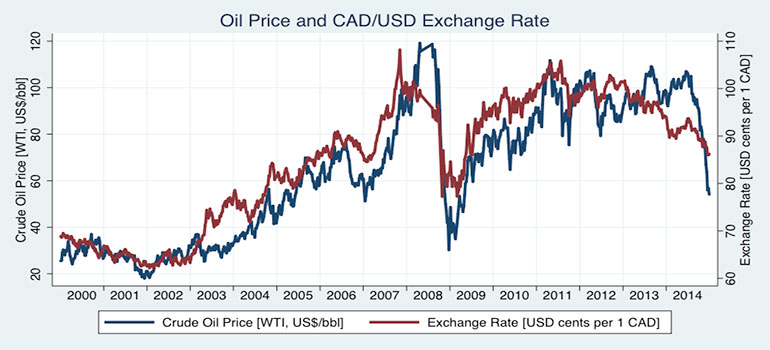
This is killing us economically. Ten years of Harper's policies pushing us harder into economic reliance on oil, now oil is way down in price and our economy is going with it.

This is why we need immigration and education: to build a stronger economy that isn't reliant on natural resources.

If you're going to argue against oil, at least be impartial. Justin Trudeau is essentially continuing Harper's efforts to increase oil production in the oilsands.

You're vision of "a stronger economy that isn't reliant on natural resources" is one of the main points of the Alberta Heritage Fund [0]. Even Albertans recognize that you can't rely on natural resources forever. However, it is naive to think you can't use them to help you change the future. In terms of education, the article states that Alberta as a sovereign state would be in the top 5 in science education on the PISA international test.

Also, "now oil is way down in price and our economy is going with it" is completely fallacious as the only reason why our economy could fall is because our oil industry was propping it up. Here is a nice graphic to show the parity between the two [1].

At the end of the day, it takes time to convert your entire country to clean energy sources. Even in Canada where we have 2/3 already renewable, the amount of time it would take to make that 100% is going to take decades. Until then, my main argument for the oilsands is that I'd rather have people earning honest wages in a country where the companies are held liable to environmental destruction instead of the Middle East.

[0] - https://en.wikipedia.org/wiki/Alberta_Heritage_Savings_Trust... [1] - http://news.ubc.ca/wp-content/uploads/2015/04/diagram770.jpg

I think it's easier to be laid-back about immigration here because of how diffusely populated Canada is. I think for the 'cultural mosaic' model to work the different cultures need to feel they have the space to be themselves as well as have edges and margins where they can interact. That is probably a bit easier in a country with the geographic footprint of Canada.
> 'cultural mosaic' model

Heh. It used to be sold as the 'melting pot'.

In the US, sure. In Canada, we have differing labels because it's a different model.
If you're comparing to the US, the US is still sparsely populated by any means. Sure, the metro areas might be crowded. But I've never hear "lack of space" as the reason for denying immigration.
I keep reading this "Canada draws strength from diversity" line but I've never seen anything to substantiate it. Could you please give it a shot?

Because I'm an immigrant living in Toronto. The diversity here, while "nice", seems to be a significant weakness if anything - a highly fractured, multi-cultural society simply tolerating one another's existence with no real united identity, goals or vision for Canada's future.

Canada has never had a united identity. It has always been fractured between English Canada and French Canada. That's an unstable arrangement, with two opposing poles of cultural power, and it's actually remarkable we have never gone to civil war over that divide.

Transitioning from a bi-cultural society to a multi-cultural society is actually an improvement, because it reduces the power of English and French cultures to simply strong minorities among many. It's resulted in a balance-of-power arrangement, where neither has any hope any longer of dominating the whole of Canada.

It means it's unlikely that either English Canada or French Canada will try to go to civil war with the other, because they have nothing to gain and everything to lose. That's a remarkable achievement all on its own.

The Conservative party of Canada has huge immigrant outreach and is very multicultural because it can't get elected any other way, similarly if your party doesn't work in Quebec you aren't getting elected. The multicultural vibe of Canada really kills the us vs them mentality in politics
So increasing diversity limits voting options and political power for the previous population? Wouldn't they see that as a disadvantage?
Are you confusing "white" culture, for western culture, and yes, there are aspects of western culture that should not be sacrificed in the name of multiculturalism, like free speech, pluralism, religious freedom, etc. I don't think anyone has issues with immigration as long as the immigrant adopts the culture here, and does not try to make their new place be more like back home and imposes their old culture on the new area to in an effort to respect their heritage, when the cultural values back home are half the reason things were so bad there. America is made up of immigrants of multiple races, but at some point we all agreed to adopt the values of the nation we lived in, the issue comes with those that want to impose their conservative or traditional values from back home on the society they moved to, including their prejudices, views on the value of women, etc. They come here for all the great opportunities, but they don't want to give up the things and attitudes that are incompatible with our cultural values or possibly part of the problems they had back home to begin with.

NYC and Toronto are success stories in multiculturalism, where people come, become educated, and integrate into the local culture, but ethnic/cultural enclaves that have been forming in cities overseas are not (https://www.youtube.com/watch?v=Y9r6ZCwQxZk).

It's not quite that rosy on the guns and butter issues there. I moved to Van for grad school from the Midwest looking for opportunity, worked for two years after my degree and then moved back stateside. One makes so little money there, housing is really steep, and it's hard to responsibly start a family. But you do get to feel good about that other stuff.
>One makes so little money there, housing is really steep, and it's hard to responsibly start a family.

How's that different from your average major metro area in the USA? Or, for that matter, anywhere else in the First World right now?

I can't really speak from experience on the Canadian mid-major metros, as I only experienced 'big' Vancouver. But there is a bevy of American cities where you can actually save and have little ones (Minneapolis, Cincinnati, Sun Belt, Des Moines). Maybe it's like that in Ontario? Anyways, looking over the next twenty years of my life, the opportunity cost of living in Vancouver was huge, and not just because of the exchange rate.
> immigrants couldn't possibly love their second country as much as native-borns.

I think they're more worried that immigrants won't love whites as much as other whites do.

And why wouldn't they? Would you move to China if you didn't like Chinese people? Yet I've noticed this phenomenon recently, in which new Canadians think it is appropriate to disparage the old ones despite their choice to move to Canada. Racism never ceases to amaze me.
Disparaging certain demographics, namely white people and men, is trendy these days and there's no shortage of self-loathing people in Canada with an apparent eagerness to provide a platform to enable and facilitate that/those trend(s).
I understand your logic, but I don't believe its an accurate paradigm. Most immigrants don't migrate for cultural reasons, its more for economic ones. Most of my immigrant friends wouldn't give a shit what color the majority people were in the country they moved to as long as it was 1) Tolerant and 2) Provided better economic opportunities and quality of life.

I'm not saying non-whites hate the whites or anything. I'm suggesting that's not the primary motivation for immigrants. For refugees... they literally just want to escape their hometown to escape death, so I think survival comes before anything else really.

Depends on where you are. In major cities like Vancouver[1] and Toronto[2], you have over half of the population belonging to "non caucasian". Although this doesn't directly mean all of them are immigrants, subsequent generation tend to carry (or at the very least but influenced) by their parents cultural values, like work ethic. Anecdotally, I'm a second generation Taiwanese living in Vancouver and I consider myself to have the "asian" work ethic.

[1] https://en.wikipedia.org/wiki/Demographics_of_Vancouver [2] https://en.wikipedia.org/wiki/Demographics_of_Toronto

Depends on the area you live in. Immigration tends to focus on certain spots (larger cities, areas where people from the same region already live, areas with international schools from that country). This effect occurs independent of the wealth of immigrants.