Hacker News new | ask | show | jobs
by pale-hands 3292 days ago
Opposite of the topic (ultra-nonconserved?), "butterfly" is a word that is strangely different in even closely related European languages (Romance, Teutonic, Slavic). Doing a cursory check in Google Translate now, but I've one found one language pair where the words appear to be related: French: "papillon", Catalan "papallona". Otherwise: mariposa, бабочка, motyl, schmetterling, vlinder, sommerfugl, fjäril, farfalla, пеперуда, leptir ...

I'd love to hear a linguistic explanation for this.

EDIT: Latin: "papilionem" (papilio?), so at least French and Catalan have conserved it, and I can see that Italian "farfalla" could be cognate.

EDIT EDIT: All the Slavic languages known to Google Translate have a word related to motyl, except for Russian: бабочка (butterfly) (but мотылек (moth)), so there is less to this phenomenon than meets the eye!

6 comments

I was amused to realise that Turkey (the animal) has a wide range of different names, often a country foreign to the language.

i.e in Turkey they call Turkey Indian, in Portugal they call it Peru, in Malay it's a Dutch Chicken.

https://en.wikipedia.org/wiki/List_of_names_for_turkeys

Turkeys are native to the Americas, so it showed up around the 1500s. Usually things from the Middle Ages and the Renaissance have very different words in different European languages. Words that are from Roman times or before are similar because they derive from Latin.
Why 'strangely' different? Why would you expect such exotic animals to be ultra-nonconserved?

Schmetterling may be semantically linked to butterfly via 'batter-fly' (beater-fly)

also:

motyl~moth sommerfugl~summer-fly

interesting that wiktionary for papillon shows a puppy :) might also be linked to big pupils and fake eyes

[0] https://en.wiktionary.org/wiki/papillon

> Schmetterling may be semantically linked to butterfly via 'batter-fly' (beater-fly)

No, it's semantically linked via 'butter'. Schmetterling comes from Schmetten or Schmand which is a sort of heavy cream. There used to be a folk believe that butterflies would consume milk or butter if left uncovered. They were also sometimes called Milkdieb or milk-thief in German.

See: www.etymonline.com/index.php?search=butterfly

https://skeptics.stackexchange.com/questions/27471/does-the-...

Adds a little too, looks like the idea of butterflies stealing butter may come from their voids looking like butter.

I'd also like to imagine a story being made about them stealing butter to encourage children to cover the butter.

> Schmetten or Schmand which is a sort of heavy cream.

Is "smetana" a false friend?

That is disputed. Most scholars say that germanic "schmand" has different roots and is cognate with English "smooth" - some scholars however consider schmand a very old loan word from proto-slavic smetana.
Interesting.

Butter + Schmetten/смета́на • (smetána) probably still come from beat:schmettern<>smith and or smeltan:smelt.

Where do Schmeissfliege (blowfly) and Schmalz(molten fat) sit? ;)

Or maybe not: βούτῡρον (boútūron, “cow cheese”), compound of βοῦς (boûs, “ox, cow”) and τῡρός (tūrós, “cheese”). tūrós <> Taurus = cow hmmm
You would expect closely related languages to have similar words for a common animal, i.e. to be at least somewhat conserved. I do find it mysterious. Another one: Dutch vlinder, Afrikaans (very close descendant) schoenlapper.

I think the papillon dog breed has big, butterfly-like ears!

But the main reason closely related languages tend to have similar words is because the word existed before the languages diverged. When the already distinct languages borrow a word independently, the word might have a different story or source behind it.
But Butterfly isn't exotic in most of indoeuropean-speaking countries?
>EDIT: Latin: "papilionem" (papilio?), so at least French and Catalan have conserved it, and I can see that Italian "farfalla" could be cognate.

Sure, "farfalla" is relatively recent, in old italian it is "parpaglia" or (still used in some dialects "parpaja" or "parpajon"), according to some sources:

http://www.etimoitaliano.it/2017/02/farfalla.html

There is seemingly an Indo-european root "s-par" or "s-pal" or "s-far" and the Greek "pallo" with the meaning of something that vibrates.

The root seems the same a "palpebra" (eyelid) which is paupière in French, párpado in Spanish and pálpebra in Portuguese.

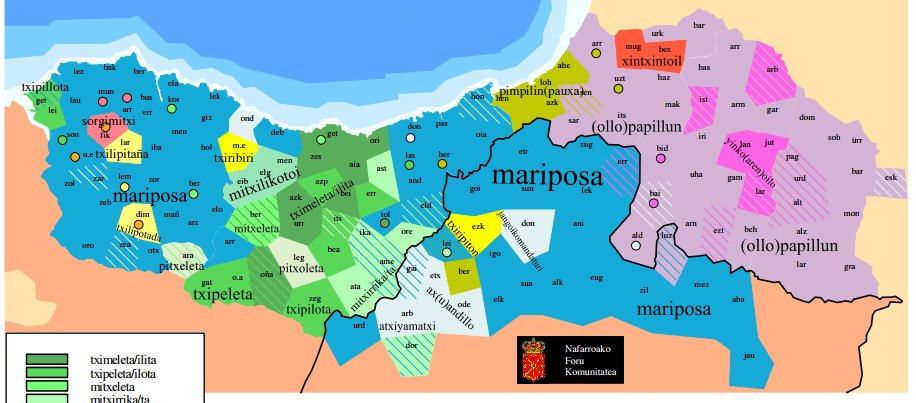
Seems like that word is very fragmented. Here's a map of the different ways of naming it in Euskera (Basque language). In a very small area you have a lot of ways of naming the same animal...

Any reason why there's something special about butterflies that we don't agree on their name?

https://pbs.twimg.com/media/CsK-lFaXEAA7zpT.jpg

Hypothesis: they attract folklore because of their beauty, fleeting appearances, etc. and so get named according to local tales?
In Slavic languages apparently motyl etc comes from motit (motać się) = to move around randomly. Kinda fitting if you've seen a flying motyl.
> All the Slavic languages known to Google Translate have a word related to motyl, except for Russian

In Serbian and Croatian the word for butterfly is лептир/leptir.

Which relates to the Greek word used as a base for lepidopterist?

https://en.m.wikipedia.org/wiki/Lepidopterology

pt*r being PIE wing as in pterodactyl ?