Hacker News new | ask | show | jobs
by Animats 3344 days ago
Well over 40% of US electricity is still from coal. Despite all the hype, renewables other than hydroelectric are only 3% in the US.

What's driving energy prices is cheap natural gas. Natural gas is cheap to extract and can be extracted fast. But after a while, it's all gone. Britain's North Sea Gas boom is over.[1] Gas fields also drop off faster than oil fields. The cheap natural gas boom won't last forever. It's created the illusion that the energy problem is over.

Nuclear is discouraging. After Fukushima, nuclear plants are scary. Fukushima was a reasonably good plant which got hit by a larger than expected tsunami and lost site power. That was enough to cause a major disaster. Nuclear now looks like a technology where every decade or two you lose a city. The small-nuclear enthusiasts are a bit scary; some argue they need fewer safety precautions because their reactors can't melt down. What could possibly go wrong? Big, expensive containment vessels are a good thing; when Three Mile Island failed, the containment held it in.

Battery technology will help. Wind and solar are intermittent, and can't carry too much of the load until there's more storage. But it's going to take a lot of batteries.

[1] http://www.crystolenergy.com/assessing-future-north-sea-oil-...

6 comments

Sorry if this is nitpicky but fyi, coal in 2016 was almost exactly 40%, not 'well over': https://www.eia.gov/electricity/monthly/epm_table_grapher.cf...

But you are absolutely right that its entirely due to natgas and that will maybe last us a decade or two but certainly not three.

In fact its just enough time to build a fleet of nuclear plants, but as you also point out, fear rules that decision far more than physics.

Wind and solar and batteries are awesome, but even in very optimistic case scenarios we need an alternative to coal and the temporary surge of natgas to handle baseload between here and ~2040. It should be nuclear, but, sigh.

> Sorry if this is nitpicky but fyi, coal in 2016 was almost exactly 40%, not 'well over'

Grandparent post was just missing a comma:

"Well, over 40% of US electricity is still from coal"

"Wind and solar and batteries are awesome, but even in very optimistic case scenarios we need an alternative to coal and the temporary surge of natgas to handle baseload between here and ~2040. It should be nuclear, but, sigh. "

Wind and solar's bigger problem isn't really the intermittency of availability of electricity, it's the distribution of availability. It needs a more sophisticated grid. America's grid operators (who also own generators) would be shooting themselves in the foot by upgrading the grid since renewables eat into their bottom line (they want to sell natgas/coal/nuclear electricity, not buy solar from your rooftop or set up windfarms that makes a razor thin profit...).

Utility operator lobbyists thus have a marked tendency to overstate the problem of renewable intermittency.

Nuclear is cost competitive with solar and wind but it's only cost competitive if the liability is capped. Remove the liability cap and mandate that nuclear insurance cover the cost of a Fukushima style cleanup and there's no point in ever building a plant ever again. Whereas if you remove all the tariffs (e.g. things like the 40% solar import taxes) and subsidies, renewable prices probably wouldn't change all that much.

Data on national scale, like the eia stuff you link to, is vital to understanding and debate.

What I realize I don't understand is the meaning of "Generation at Utility Scale Facilities" in the header of the table. What does this exclude and how meaningful is the exclusion?

According to the table, net generation at utility scale has decreased 10% over the last decade. How much of that is driven by non-utility scale generation versus decreased energy usage? (Alternatively non-utility scale generation has outpaced total growth in energy use - I'm ignorant of total consumption data so I don't know what is really going on).

Either way, the numbers do seem to suggest a case for new nuclear generation overall.

Commercial and Residential solar are excluded. Those might add up to half a percent or so. The other 9.5% is probably due to energy efficiency.
Residential solar is hard to pin down because it's "behind the meter"; it doesn't look like generation, it looks like demand reduction.
> But you are absolutely right that its entirely due to natgas and that will maybe last us a decade or two but certainly not three.

Currently our known natural gas reserves will last over a century. And we're still finding vast new pockets of it:

http://oilprice.com/Energy/Natural-Gas/Massive-Natural-Gas-D...

>...But you are absolutely right that its entirely due to natgas and that will maybe last us a decade or two but certainly not three.

Citation? Unfortunately it looks like there are large proven reserves of natural gas:

>...The U.S. Energy Information Administration estimates that as of January 1, 2014, there were about 2,474 trillion cubic feet (Tcf) of technically recoverable resources of dry natural gas in the United States. At the rate of U.S. dry natural gas consumption in 2014 of about 26.6 Tcf per year, the United States has enough natural gas to last about 93 years.

https://www.eia.gov/tools/faqs/faq.php?id=58&t=8

It is unfortunate because for those who care about climate change, there are inevitable methane releases from fracking and from distribution of natural gas and those are now known to be much worse for the atmosphere than previously thought:

>...Back in August, a NOAA-led study measured a stunning 6% to 12% methane leakage over one of the country’s largest gas fields — which would gut the climate benefits of switching from coal to gas. We’ve known for a long time that methane is a far more potent greenhouse gas than carbon dioxide (CO2), which is released when any hydrocarbon, like natural gas, is burned. But the IPCC’s latest report, released Monday (big PDF here), reports that methane is 34 times stronger a heat-trapping gas than CO2 over a 100-year time scale, so its global-warming potential (GWP) is 34. That is a nearly 40% increase from the IPCC’s previous estimate of 25. ...The IPCC reports that, over a 20-year time frame, methane has a global warming potential of 86 compared to CO2, up from its previous estimate of 72. Given that we are approaching real, irreversible tipping points in the climate system, climate studies should, at the very least, include analyses that use this 20-year time horizon. Finally, it bears repeating that natural gas from even the best fracked wells is still a climate-destroying fossil fuel. If we are to avoid catastrophic warming, our natural gas consumption has to peak sometime in the next 10 to 15 years, according to studies by both the Center for American Progress and the Union of Concerned Scientists.

https://thinkprogress.org/more-bad-news-for-fracking-ipcc-wa...

As we use more and more natural gas, we can expect more and more methane disasters like the leak from Aliso Canyon in CA which was the largest methane leak in US history. This released over 100,000 tons of methane into the atmosphere and required 11,000 residents to be evacuated.

http://www.bbc.com/news/science-environment-35659947

>...It should be nuclear, but, sigh.

Yea, nuclear has so far been the safest form of base load power we have ever used. Unfortunately anything at all related to nuclear is covered by the media orders of magnitude more than other power sources so people have an understandable perception that it is much more dangerous than other sources of power. What if the Alison Canyon was a nuclear storage site (instead of a natural gas storage site) and 11,000 people had to be evacuated - how much would the media have covered that? Another recent example would be the evacuation at the Oroville dam - almost 200,000 people were forcibly evacuated since the worst case failure scenario would have have been a tidal wave of water 30 feet high rushing down stream. This made the news for maybe a day. I can't blame some for being afraid of nuclear power, but there are many who should know better.

"Yea, nuclear has so far been the safest form of base load power we have ever used. Unfortunately anything at all related to nuclear is covered by the media orders of magnitude more than other power sources so people have an understandable perception that it is much more dangerous than other sources of power."

I thought it was telling that the only world leader who reacted to Fukushima by mandating the end of nuclear power wasn't a hippy but a physicist.

I don't see the problem being that nuclear can't be made safe. I see the problem being that operators are motivated to stretch the margin of safety in order to make a buck and lawmakers appear to be prepared to let them and the one thing nuclear operators will never, ever, ever, EVER stand for is allowing the privatization of that risk (i.e. let insurance companies instead of taxpayers shoulder the risk).

"I thought it was telling that the only world leader who reacted to Fukushima by mandating the end of nuclear power wasn't a hippy but a physicist."

It's worth noting that even formally qualified scientists are susceptible to bias, and politics. There are even scientists who are practising religious adherents.

Angel Merkel was previously the minister for Environment and Nuclear Safety. I'd suggest that is potentially more informative than that she has a doctorate in physical chemistry.

>...I thought it was telling that the only world leader who reacted to Fukushima by mandating the end of nuclear power wasn't a hippy but a physicist.

Are you trying to argue that keeping coal plants and shutting down nuclear plants is a good idea?

From a previous comment someone made, here are the death totals for generating power:

Energy Source Mortality Rate (deaths/trillionkWhr)

Coal – U.S. 10,000 (32% U.S. electricity)

Natural Gas 4,000 (22% global electricity)

Solar (rooftop) 440 (< 1% global electricity)

Wind 150 (2% global electricity)

Nuclear – U.S. 0.1 (19% U.S. electricity)

>...I don't see the problem being that nuclear can't be made safe.

Actually you are wrong - NOTHING can be made 100% safe. Anyone who promises you something is 100% safe is simply a liar. Walking down the sidewalk has risk, much less walking down a street. When making choices the only thing you can do is choose the safer alternative. Planes are safer for a long trip than driving a car, but how many people are afraid to fly vs afraid to drive? Nuclear has has a very good safety record compared to the alternatives (utility solar farms might end up lower, but all others are much higher) but to the people who fear nuclear power, I know the numbers don't really matter - much as the person who is afraid of flying doesn't care it is safer.

"Are you trying to argue that keeping coal plants and shutting down nuclear plants is a good idea?"

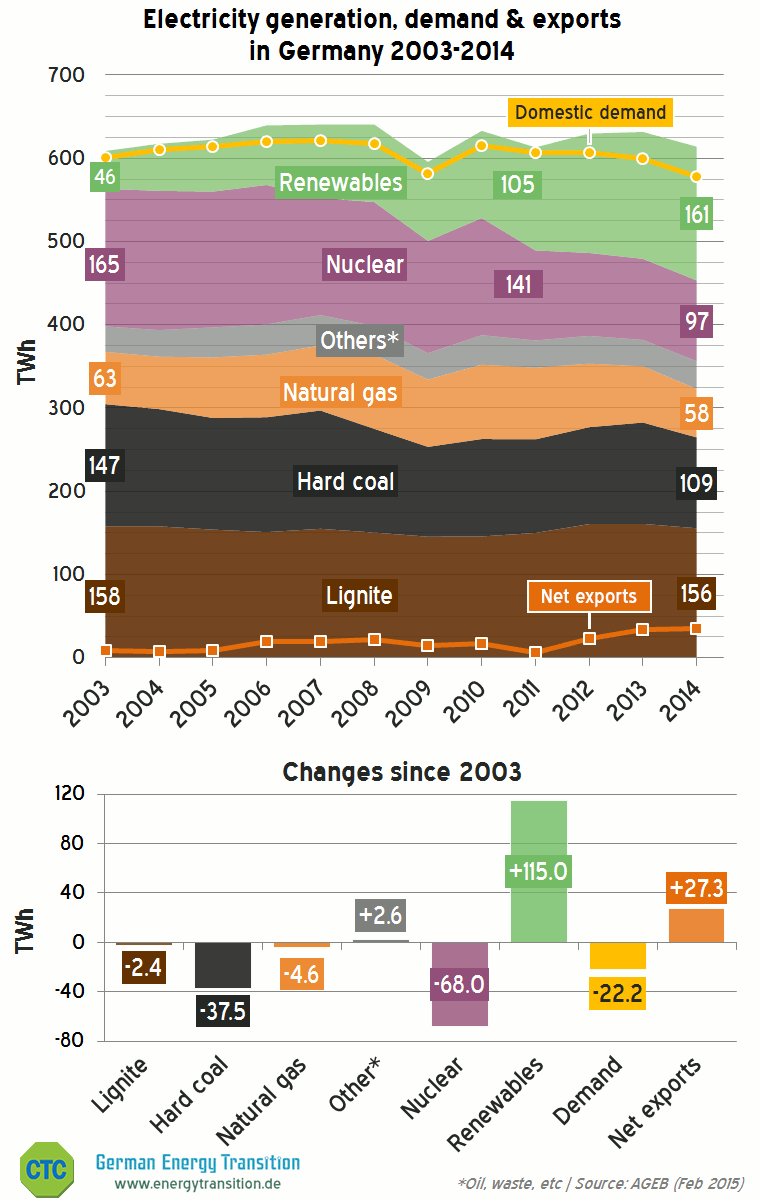
Nope. I'm arguing that shutting down both is a good idea - which is why Germany is shutting coal plants too:

https://energytransition.org/wp-content/uploads/2015/05/germ...

So... straw man?

"Actually you are wrong - NOTHING can be made 100% safe."

I'm pretty sure my implication of "acceptably safe" was fairly clear.

So... another straw man.

>...Nope. I'm arguing that shutting down both is a good idea - which is why Germany is shutting coal plants too:

What you actually wrote was "I thought it was telling that the only world leader who reacted to Fukushima by mandating the end of nuclear power wasn't a hippy but a physicist."

You made an appeal to authority and didn't mention coal in your original statement.

>...which is why Germany is shutting coal plants too

You are somewhat misrepresenting the energy situation in Germany.

>...Coal is still the largest source of power in Germany. ...In 2007 German Chancellor Angela Merkel and her party agreed to legislation to phase out Germany's hard coal mining sector. That does not mean that they support phasing out coal in general. There were plans to build about 25 new plants in the coming years. ... No concrete plan is in place to reduce coal-fired electricity generation. As of October 2015, the remaining coal plants still under planning include: Niederaussem, Profen, and Stade. The coal plants currently under construction include: Mannheim, Hamm D, Datteln, and Willhelmshaven. Between 2012 and 2015, six new plants went online. All of these plants are 600–1800 MWe ...A coal phase-out for Germany is implied in Germany's Climate Action Plan 2050, environment minister Barbara Hendricks said in an interview on 21 November 2016.

https://en.wikipedia.org/wiki/Fossil_fuel_phase-out

To eliminate a non CO2 producing energy source and continue to use the most dangerous source of power which is also the major producer of CO2 for a couple more decades (best case), is pretty irresponsible.

Fukishima was a major accident and resulted in zero deaths to the public. You wrote: "I don't see the problem being that nuclear can't be made safe." and also seemed to approve of an entire county abandoning nuclear power when they are using power sources orders of magnitude more dangerous. It did sound like you meant that any accident from nuclear power would be unacceptable to you since the alternatives Germany will be using for decades are more dangerous to the human health and the environment. You now say that you meant "acceptable risk" - unfortunately that is a somewhat meaningless subjective term. You can only compare a choice against its alternatives and since we know we need to generate terawatts of power for our civilization to function, the real question is what is the relative risk from generating power from different sources. From a previous comment someone made, here are the death totals for generating power:

Energy Source Mortality Rate (deaths/trillionkWhr)

Coal – U.S. 10,000 (32% U.S. electricity)

Natural Gas 4,000 (22% global electricity)

Solar (rooftop) 440 (< 1% global electricity)

Wind 150 (2% global electricity)

Nuclear – U.S. 0.1 (19% U.S. electricity)

If you demand zero risk when producing terrawatts of power, you aren't going to find it. In the same way that if you were afraid of jet travel, all anyone can say to you is that jet travel is safer than driving, not that there will be no plane crashes.

>I thought it was telling that the only world leader who reacted to Fukushima by mandating the end of nuclear power wasn't a hippy but a physicist.

What was telling is she didn't want to do it but was forced by public opinion, the fact that she proceed to run to the front of the parade notwithstanding.

> Nuclear now looks like a technology where every decade or two you lose a city.

No, it's a technology where if you use power plants decades out of date, that have known safety issues, and then cover-up the magnitude of the problem once a catastrope occurs then you have a very expensive clean-up operation.

Cleaning up Fukushima will be expensive, there's no denying it, but it's arguably the case that the Deepwater Horizon rig mess could cost significantly more.

Moreover, what's driving low natgas prices in the US is the use of hydraulic fracturing -- 'fracking' -- which injects some fluid, often water, horizontally along an entire layer of shale to free the trapped gas. This technique enabled formations like the Marcellus Shale [1] in WV, PA, OH, NY to be economically viable to extract, and this formation grew to be the largest producer of natgas in the US.

There are many unanswered questions about the long-term impact of hydraulic fracturing on seismic stability and on groundwater, and the technique is under scrutiny in many parts of the world. Predictably favored by energy-lobbyists and opposed by environmentalists, fracking remains a contentious issue whose future in the US could depend on a "simple" party change -- hardly a sure bet.

[1] https://en.wikipedia.org/wiki/Marcellus_Formation

Oklahoma is getting some answers. Try their interactive earthquake map. Look at earthquakes in 2016 vs 2010 vs the 1980s. They show disposal wells on the same map. The big problem is not the fracking injection itself, but disposal wells for all the waste fluid involved.

[1] https://earthquakes.ok.gov/what-we-know/earthquake-map/

Natural gas is great as an energy that can be used "on demand", combined with wind and solar, there is a lot of synergy (use NG when wind and solar can't meet demand). We could build out renewables so that we don't deplete NG for just routine energy uses.
My impression (from talking to engineers at my local electric utility here in the southwest US) is exactly that: renewables can be unpredictable, and not always available when demand is high. NG generators, unlike coal or nuclear, are relatively easy to spin up on demand. (Perhaps someone more knowledgeable out there could fill in details.)

I do think there are many experiments with different storage technologies to smooth out supply, so this particular advantage of NG could change in the next few years.

For the U.S., I think the cost overruns of nuclear have been a bigger problem than change of public opinion due to Fukushima. If Westinghouse's four new units at the Summer (South Carolina) and Vogtle (Georgia) plants had come in on time and on budget, there would be states and regions willing to build more nuclear, even if it remained unpopular in many parts of the country. But the extent of the construction problems there and Westinghouse's subsequent bankruptcy are going to discourage any new construction and financing for a while.
why do you exclude hydroelectric?
Too geography dependent, and we will probably never build another large hydro project because of the environmental impacts.
Great quote: "All the good dam sites were gone by 1940".

The ideal dam site is Hoover Dam. One dam at a narrow point created a large lake with a high drop for power generation. No population to displace; the surrounding land is desert. Few other sites in the world are that good.

There's nothing anywhere near that good left in the US. China has some good hydro sites in the west, and they're building hydroelectric dams there. Million-volt DC lines going thousands of kilometers are being used to move the power to the loads in eastern China.

Not the OP, but usually hydro is excluded because it's "old renewable" and most potential sources have already been developed.
Due to silting, most hydro isn't really renewable either iiuc. It's just looks that way for long enough that we tend to talk about it that way.
Reservoirs filling with silt may reduce storage which would turn the dam in to a run of river plant. Less control over when the electricity is made. Also reservoirs could be dredged out to allow the silt to continue its way downstream.