Hacker News new | ask | show | jobs
by opo 3346 days ago
>...But you are absolutely right that its entirely due to natgas and that will maybe last us a decade or two but certainly not three.

Citation? Unfortunately it looks like there are large proven reserves of natural gas:

>...The U.S. Energy Information Administration estimates that as of January 1, 2014, there were about 2,474 trillion cubic feet (Tcf) of technically recoverable resources of dry natural gas in the United States. At the rate of U.S. dry natural gas consumption in 2014 of about 26.6 Tcf per year, the United States has enough natural gas to last about 93 years.

https://www.eia.gov/tools/faqs/faq.php?id=58&t=8

It is unfortunate because for those who care about climate change, there are inevitable methane releases from fracking and from distribution of natural gas and those are now known to be much worse for the atmosphere than previously thought:

>...Back in August, a NOAA-led study measured a stunning 6% to 12% methane leakage over one of the country’s largest gas fields — which would gut the climate benefits of switching from coal to gas. We’ve known for a long time that methane is a far more potent greenhouse gas than carbon dioxide (CO2), which is released when any hydrocarbon, like natural gas, is burned. But the IPCC’s latest report, released Monday (big PDF here), reports that methane is 34 times stronger a heat-trapping gas than CO2 over a 100-year time scale, so its global-warming potential (GWP) is 34. That is a nearly 40% increase from the IPCC’s previous estimate of 25. ...The IPCC reports that, over a 20-year time frame, methane has a global warming potential of 86 compared to CO2, up from its previous estimate of 72. Given that we are approaching real, irreversible tipping points in the climate system, climate studies should, at the very least, include analyses that use this 20-year time horizon. Finally, it bears repeating that natural gas from even the best fracked wells is still a climate-destroying fossil fuel. If we are to avoid catastrophic warming, our natural gas consumption has to peak sometime in the next 10 to 15 years, according to studies by both the Center for American Progress and the Union of Concerned Scientists.

https://thinkprogress.org/more-bad-news-for-fracking-ipcc-wa...

As we use more and more natural gas, we can expect more and more methane disasters like the leak from Aliso Canyon in CA which was the largest methane leak in US history. This released over 100,000 tons of methane into the atmosphere and required 11,000 residents to be evacuated.

http://www.bbc.com/news/science-environment-35659947

>...It should be nuclear, but, sigh.

Yea, nuclear has so far been the safest form of base load power we have ever used. Unfortunately anything at all related to nuclear is covered by the media orders of magnitude more than other power sources so people have an understandable perception that it is much more dangerous than other sources of power. What if the Alison Canyon was a nuclear storage site (instead of a natural gas storage site) and 11,000 people had to be evacuated - how much would the media have covered that? Another recent example would be the evacuation at the Oroville dam - almost 200,000 people were forcibly evacuated since the worst case failure scenario would have have been a tidal wave of water 30 feet high rushing down stream. This made the news for maybe a day. I can't blame some for being afraid of nuclear power, but there are many who should know better.

1 comments

"Yea, nuclear has so far been the safest form of base load power we have ever used. Unfortunately anything at all related to nuclear is covered by the media orders of magnitude more than other power sources so people have an understandable perception that it is much more dangerous than other sources of power."

I thought it was telling that the only world leader who reacted to Fukushima by mandating the end of nuclear power wasn't a hippy but a physicist.

I don't see the problem being that nuclear can't be made safe. I see the problem being that operators are motivated to stretch the margin of safety in order to make a buck and lawmakers appear to be prepared to let them and the one thing nuclear operators will never, ever, ever, EVER stand for is allowing the privatization of that risk (i.e. let insurance companies instead of taxpayers shoulder the risk).

"I thought it was telling that the only world leader who reacted to Fukushima by mandating the end of nuclear power wasn't a hippy but a physicist."

It's worth noting that even formally qualified scientists are susceptible to bias, and politics. There are even scientists who are practising religious adherents.

Angel Merkel was previously the minister for Environment and Nuclear Safety. I'd suggest that is potentially more informative than that she has a doctorate in physical chemistry.

>...I thought it was telling that the only world leader who reacted to Fukushima by mandating the end of nuclear power wasn't a hippy but a physicist.

Are you trying to argue that keeping coal plants and shutting down nuclear plants is a good idea?

From a previous comment someone made, here are the death totals for generating power:

Energy Source Mortality Rate (deaths/trillionkWhr)

Coal – U.S. 10,000 (32% U.S. electricity)

Natural Gas 4,000 (22% global electricity)

Solar (rooftop) 440 (< 1% global electricity)

Wind 150 (2% global electricity)

Nuclear – U.S. 0.1 (19% U.S. electricity)

>...I don't see the problem being that nuclear can't be made safe.

Actually you are wrong - NOTHING can be made 100% safe. Anyone who promises you something is 100% safe is simply a liar. Walking down the sidewalk has risk, much less walking down a street. When making choices the only thing you can do is choose the safer alternative. Planes are safer for a long trip than driving a car, but how many people are afraid to fly vs afraid to drive? Nuclear has has a very good safety record compared to the alternatives (utility solar farms might end up lower, but all others are much higher) but to the people who fear nuclear power, I know the numbers don't really matter - much as the person who is afraid of flying doesn't care it is safer.

"Are you trying to argue that keeping coal plants and shutting down nuclear plants is a good idea?"

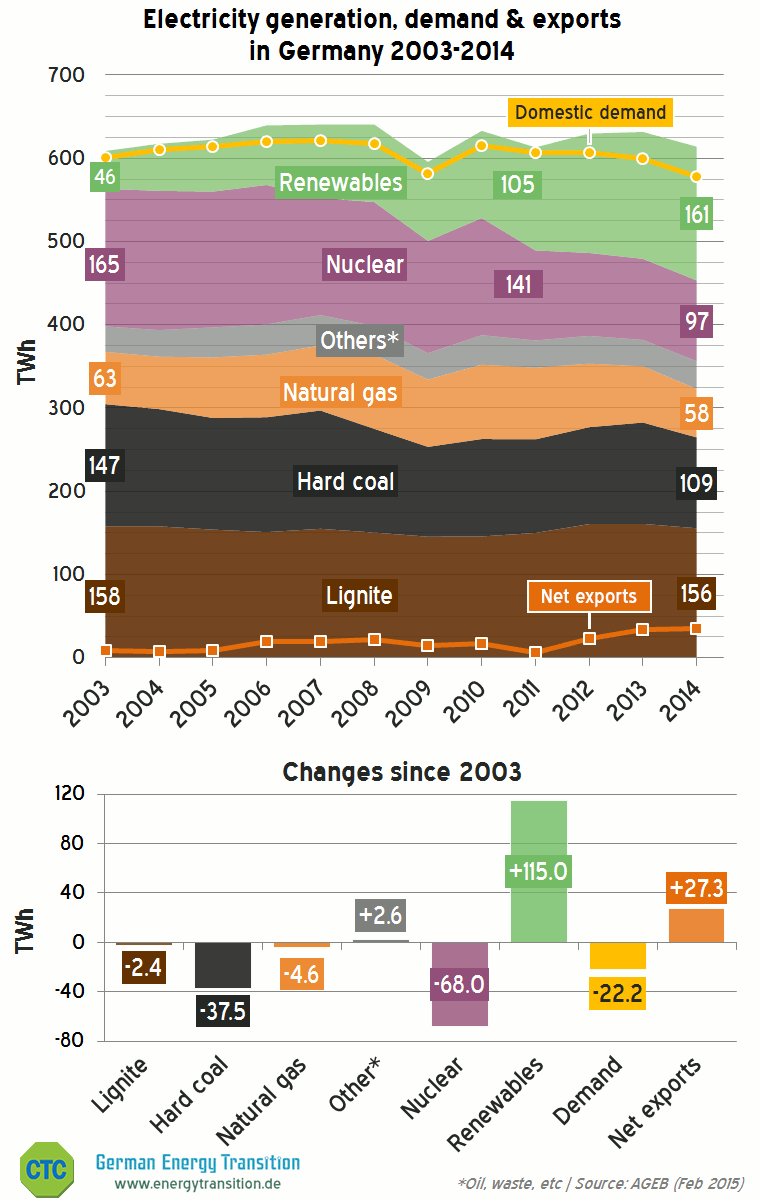
Nope. I'm arguing that shutting down both is a good idea - which is why Germany is shutting coal plants too:

https://energytransition.org/wp-content/uploads/2015/05/germ...

So... straw man?

"Actually you are wrong - NOTHING can be made 100% safe."

I'm pretty sure my implication of "acceptably safe" was fairly clear.

So... another straw man.

>...Nope. I'm arguing that shutting down both is a good idea - which is why Germany is shutting coal plants too:

What you actually wrote was "I thought it was telling that the only world leader who reacted to Fukushima by mandating the end of nuclear power wasn't a hippy but a physicist."

You made an appeal to authority and didn't mention coal in your original statement.

>...which is why Germany is shutting coal plants too

You are somewhat misrepresenting the energy situation in Germany.

>...Coal is still the largest source of power in Germany. ...In 2007 German Chancellor Angela Merkel and her party agreed to legislation to phase out Germany's hard coal mining sector. That does not mean that they support phasing out coal in general. There were plans to build about 25 new plants in the coming years. ... No concrete plan is in place to reduce coal-fired electricity generation. As of October 2015, the remaining coal plants still under planning include: Niederaussem, Profen, and Stade. The coal plants currently under construction include: Mannheim, Hamm D, Datteln, and Willhelmshaven. Between 2012 and 2015, six new plants went online. All of these plants are 600–1800 MWe ...A coal phase-out for Germany is implied in Germany's Climate Action Plan 2050, environment minister Barbara Hendricks said in an interview on 21 November 2016.

https://en.wikipedia.org/wiki/Fossil_fuel_phase-out

To eliminate a non CO2 producing energy source and continue to use the most dangerous source of power which is also the major producer of CO2 for a couple more decades (best case), is pretty irresponsible.

Fukishima was a major accident and resulted in zero deaths to the public. You wrote: "I don't see the problem being that nuclear can't be made safe." and also seemed to approve of an entire county abandoning nuclear power when they are using power sources orders of magnitude more dangerous. It did sound like you meant that any accident from nuclear power would be unacceptable to you since the alternatives Germany will be using for decades are more dangerous to the human health and the environment. You now say that you meant "acceptable risk" - unfortunately that is a somewhat meaningless subjective term. You can only compare a choice against its alternatives and since we know we need to generate terawatts of power for our civilization to function, the real question is what is the relative risk from generating power from different sources. From a previous comment someone made, here are the death totals for generating power:

Energy Source Mortality Rate (deaths/trillionkWhr)

Coal – U.S. 10,000 (32% U.S. electricity)

Natural Gas 4,000 (22% global electricity)

Solar (rooftop) 440 (< 1% global electricity)

Wind 150 (2% global electricity)

Nuclear – U.S. 0.1 (19% U.S. electricity)

If you demand zero risk when producing terrawatts of power, you aren't going to find it. In the same way that if you were afraid of jet travel, all anyone can say to you is that jet travel is safer than driving, not that there will be no plane crashes.

"didn't mention coal in your original statement."

Correct. You brought it up along with the presumption that I'm in favor of it.

>You are somewhat misrepresenting the energy situation in Germany.

Actually I think you are:

"The coal plants currently under construction include: Mannheim, Hamm D, Datteln, and Willhelmshaven. Between 2012 and 2015, six new plants went online."

Plants take a long while to go from planning to complete. These plants were ALL planned and approved before Merkel made her decision. No new coal plant has received a permit since 2009, 2 years prior to Fukushima, meanwhile many others are slated for early closure.

Coal is most assuredly on the way out in Germany, NOT, as you seem to presume, making up for all of the lost nuclear power.

>Fukishima was a major accident and resulted in zero deaths to the public. You wrote: "I don't see the problem being that nuclear can't be made safe." and also seemed to approve of an entire county abandoning nuclear power when they are using power sources orders of magnitude more dangerous.

I approve of them abandoning both, which they are doing. It wasn't ever going to happen overnight and it is ridiculously unrealistic for you to expect that it will.

>You now say that you meant "acceptable risk" - unfortunately that is a somewhat meaningless subjective term. You can only compare a choice against its alternatives and since we know we need to generate terawatts of power for our civilization to function, the real question is what is the relative risk from generating power from different sources.

Do you have a problem with the risks presented by wind and solar which are both replacing the power from the nuclear and coal plants which are slowly going offline in Germany?

Do you have a problem with this trend continuing? I don't.

>Fukishima was a major accident and resulted in zero deaths to the public.

573 deaths are attributed to it, and it's projected that between 130 and 1100 deaths from cancer will be attributable to it.

>If you demand zero risk when producing terrawatts of power, you aren't going to find it.

I'm okay with the risks presented by the solar and wind. Most importantly there are no large scale tail risks for solar and wind, unlike nuclear. Falling off a roof is typically easier to mitigate than cancers following nuclear disasters, too.

>Correct. You brought it up along with the presumption that I'm in favor of it.

No, what I said was "Are you trying to argue that keeping coal plants and shutting down nuclear plants is a good idea?"

>>>You are somewhat misrepresenting the energy situation in Germany.

>Actually I think you are:

No, what I wrote was from the wikipedia page. If you think you are right and they are wrong, you are free to edit the page with more accurate info.

>..."The coal plants currently under construction include: Mannheim, Hamm D, Datteln, and Willhelmshaven. Between 2012 and 2015, six new plants went online." Plants take a long while to go from planning to complete. These plants were ALL planned and approved before Merkel made her decision.

It would obviously have been easier, less disruptive and cheaper to cancel plants that are still in construction and not actually generating power. Much more costly and dangerous to the world to shut down nuclear power plants to build more coal plants.

>...Coal is most assuredly on the way out in Germany, NOT, as you seem to presume, making up for all of the lost nuclear power.

No, I did not say that nor did I imply that. What I said was: "To eliminate a non CO2 producing energy source and continue to use the most dangerous source of power which is also the major producer of CO2 for a couple more decades (best case), is pretty irresponsible." They are using less coal and have finally stopped subsidizing the coal mining industry this year - these are all good things. If they had kept their nuclear power plants, they could have eliminated that many gigawatts of coal burning right away. I don't think what I said was difficult to understand. And as I think you agree, coal is far more deadly than nuclear power.

>...Do you have a problem with the risks presented by wind and solar which are both replacing the power from the nuclear and coal plants which are slowly going offline in Germany?

Replacing coal with any other power source is an improvement - I think everybody (well except those who own a coal mine) agree with that. Roof top solar and wind have been more dangerous than nuclear, but these 2 power sources don't place massive negative externalities on the rest of the world like coal does, so they are preferred over coal.

>...573 deaths are attributed to it, and it's projected that between 130 and 1100 deaths from cancer will be attributable to it.

It is misleading to not put the 573 number in context. These weren't people who were killed by an explosion or radiation poisoning, etc, but instead were labelled as "disaster-related" in the areas near the nuclear power plant. This is when a local death was considered to not be directly caused by a tragedy but by a "fatigue or the aggravation of a chronic disease due to the disaster". With the earthquake causing more than 18 thousand dead or missing and 6 thousand injured, extensive structural damage, including fires in many areas, etc. It isn't clear how well one can separate out the stress of moving people out of the area with the stress caused by a massive earthquake and its 11 thousand aftershocks. Other reports don't reference that claim.

Both the WHO and UNSCLEAR reports predicted any deaths from radiation would be low enough to not be detectable in the statistics - and they based this on using the linear no-threshold model. I think your 130-1100 deaths estimate was from a report done by Stanford and in that report, the range was 15-1100, not 130-1100. (It isn't clear to me how the Stanford report got its numbers.)

>...I'm okay with the risks presented by the solar and wind.I think of any death as being a tragedy, whether it makes the news or not.

I think of any death as being a tragedy, whether it makes the news or not.

>I thought it was telling that the only world leader who reacted to Fukushima by mandating the end of nuclear power wasn't a hippy but a physicist.

What was telling is she didn't want to do it but was forced by public opinion, the fact that she proceed to run to the front of the parade notwithstanding.