Hacker News new | ask | show | jobs
by ohnomrbill 3598 days ago
It's a form of culture jamming to disrupt the cognitive processes by which we accept things as "truth" or "reality".

Can you express this a bit more clearly? "Culture jamming" is not a broadly understood term. It's not clear why the words "truth" and "reality" are quoted. Additionally, it seems odd to combine a specific term like "cognitive processes" with a ultra-broad term like "things".

If there is an argument for postmodernism being something more than word salad, your comment does not make it well.

1 comments

You can read more here about culture jamming:

https://en.wikipedia.org/wiki/Culture_jamming

As an example of the problem he's addressing, look closely at your constructions like "is not a broadly understood term", "it's not clear", "it seems odd", and "your comment does not make it well".

These are all your personal opinions, and yet you've cast them in the language of objective fact, of truth. You assert without evidence that your view is identical with reality. Others reading you could take on those fact-shaped opinions as actual fact, especially if you have high social standing.

So by talking about "truth" or "reality", I believe he refers to the jointly held, socially constructed opinions that people mistake for fact.

An obvious political example of that is the way the various US state declarations of secession during the civil war assert that black people are naturally inferior, fit only to be slaves. To them it was experienced as truth.

There are also plenty of examples in the sciences; look at any major paradigm shift and you can see "truth" diverging from truth, "reality" diverging from reality. This is why Planck wrote, "A new scientific truth does not triumph by convincing its opponents and making them see the light, but rather because its opponents eventually die, and a new generation grows up that is familiar with it."

> A new scientific truth does not triumph by convincing its opponents and making them see the light, but rather because its opponents eventually die, and a new generation grows up that is familiar with it

It's going to be great once AI exists and we can point more concretely to something that doesn't work the way you describe (ie a purely evidence driven epistemology).

While we wait for that, I'll just point out that the pace of technological progress we're seeing in society -- faster than a cycle per generation -- indicates that technical theories don't work the way you claim. Math theorems don't become "true" because the opponents die.

There would be something deeply wrong with a theory that requires ignorance of the old ideas for someone to accept it. If science actually worked that way it would be no better than the humanities.

Physics theories are of course true (or not) regardless. But their "truth" (that is, the socially agreed set of things broadly agreed upon as true) does definitely vary as people die. Relativity has always been true, but it gradually became "true" in the first half of the 20th century. Luminiferous aether theory has always been false, but it was "true" for hundreds of years before.

And science really does work that way, which is exactly Planck's point. And Kuhn's, of course. It's a human enterprise, an essentially social one.

I also think that you're overfocused on Kuhn's words. He was being modestly hyperbolic. People are modestly capable of relearning, but the ability declines with time and they're better at it for marginal learning than foundational change.

Technology is not a counterexample. I've been coding for 30+ years now, and my dad started coding 50 years ago. I work very hard to keep up, but it's easier for someone new because they don't have to unlearn anything. They don't have to reconcile new data with a vast amount of old data.

A lot of technological progress happens because our field has been continuously expanding for decades, providing a flood of new people who seize upon the latest trends. And we work in a commercial context that heavily rewards innovation. Most major tech companies were founded by people who were young. There's a reason for that.

I think relativity is a red herring in this discussion because it was so famously hard to prove. That a theory which took on the order of a generation to satisfactorily prove required a generation for mass acceptance isn't in my opinion evidence for Kuhn's hypothesis, or particularly noteworthy. If you look at the different (though also foundational) example of Watson and Crick's discovery of DNA you won't see skepticism from the old guard but rather excitement. This is because the discovery, though revolutionary, was easily proved -- every cell has DNA, as can be verified by anyone once they are told how to look for it.

More broadly I think you will find that for every relativity-like-theory that was slow on the uptake (which is to say difficult to prove), there are also 10-100 promising theories which were discarded... and that the very real risk that a theory could be wrong is the principal reason for the eventually-winning-theories' slow uptake among scientists.

(Incidentally while double checking this critique and my DNA example, I found out it's one of the more common critiques of Khun's work. See http://plato.stanford.edu/entries/thomas-kuhn/#6.1)

With that out of the way, let's take a closer look at your claim that technological progress isn't a counterexample. Your point that the expansion of new people into tech should count as a new generations is well received, and I think a good and interesting one... but you also admit you yourself have changed paradigms in your lifetime. Does that not count as you putting yourself forward as a counterexample, and agreeing with respect to tech more generally?

I do agree that as I've gotten older I grumble a bit more when I have to learn a new way of thinking about something I'm already familiar with... but when it can be shown concretely that the new way is better (for example the results from deep learning) I do spend the time to relearn. This reticence seems more than enough to account of the data Kuhn is using, so don't see why a fancier hypothesis involving me (and more broadly everyone) secretly refusing to give up on lesser ideas is needed.

DNA doesn't strike me as a good example. I don't think it was a paradigm shift. Crick and Watson didn't discover it; they just showed how this particular molecule fit well into people's expectations for what was going on.

As to this:

> you also admit you yourself have changed paradigms in your lifetime

I don't know that I have, really. Sure, some things have changed. But I'm still writing OO code that isn't that different than what I was writing in the late 1980s. I still build systems on Unix-ish OSes on collections of discrete servers. The major difference is that the servers are virtual, but that's hardly a difference.

As an industry, the phrase "virtual server" is a sign we're still struggling to make a paradigm shift. It's like "radio with pictures" or "horseless carriage". But look at how much hate the possible alternatives, like containerization or serverless computing get. And that pattern of hate is a common thing in technology. A large proportion of people just won't use anything new unless circumstances force them. [1]

> Does that not count as you putting yourself forward as a counterexample, and agreeing with respect to tech more generally?

No, because nobody is claiming that people never change. The notion is that they change more slowly than a completely rational actor would, especially when social status is on the line. The actual speed depends on a variety of factors. Planck exaggerated for rhetorical effect.

> so don't see why a fancier hypothesis involving me (and more broadly everyone) secretly refusing to give up on lesser ideas is needed.

I don't think that's the right question to look at.

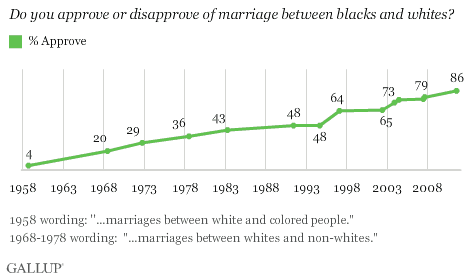
The pattern of people holding on to old ideas because they're comfortable or socially beneficial is pervasive. For example, consider this graph:

http://content.gallup.com/origin/gallupinc/GallupSpaces/Prod...

The change there is very close to the death rate. Or look at the way religions change.

I think question with science is, "Is it essentially different than almost anything else people do?" And I think the answer there is no. Science is somewhat better due to having real data. But it's still a social enterprise among people embedded in status-driven primate dominance hierarchies. This leads to results like the issues surrounding the measurement of the mass of the electron:

https://en.wikipedia.org/wiki/Oil_drop_experiment#Millikan.2...

That's easily explained if you treat science as another human social activity, but hard to explain otherwise.

[1] https://en.wikipedia.org/wiki/Technology_adoption_life_cycle

> DNA doesn't strike me as a good example. I don't think it was a paradigm shift.

> I don't know that I have, really. Sure, some things have changed. But I'm still writing OO code that isn't that different than what I was writing in the late 1980s.

Hmm, okay, I think the issue we're hitting here is something like "no true paradigm shift" -- I would have thought that the introduction of, say, the world wide web in the 1990s would count as a paradigm shift with respect to technology. Perhaps it is incremental? That you have experienced no paradigm shifts working in tech since the 1980s (or at least none you have adopted) seems like a surprising claim.

> Crick and Watson didn't discover it; they just showed how this particular molecule fit well into people's expectations for what was going on.

With respect to Watson and Crick I have to admit I only have surface knowledge of the history of science here. I can say that googling for "Watson Crick discovery" does show a bunch of pages discussing a discovery, many of which seem to think of it as a paradigm shift.

> The notion is that they change more slowly than a completely rational actor would, especially when social status is on the line. The actual speed depends on a variety of factors. Planck exaggerated for rhetorical effect.

I agree with this. Inferential differences in humans has been experimentally demonstrated in the Cognitive Biases literature (psychology, not sociology).

> I think question with science is, "Is it essentially different than almost anything else people do?" And I think the answer there is no.

This is a place that we disagree then, although you may (perhaps rightly) come back and claim I'm taking a "no true scientist" position. To me the remarkable thing about science is how radically it differs from normal human cognition. The desire to submit ideas to falsification, and discard them in the face of data is not a very natural idea for humans, at least judging by history.

> it's still a social enterprise among people embedded in status-driven primate dominance hierarchies.

And here's the bit where you can claim I'm no-true-scientisting: I think much of good science is about subverting the status-hierarchy. This is why you're linking material on electron charge (which requires a stunning amount of agreement on physics to be of interest). If science and scientists behaved like the rest of society, it seems to me we'd still be dealing with the question of atoms existing. For another more concrete difference, willfully falsifying results isn't always grounds for dismissal in other professions (it mainly depends who you falsified them to). That's not true for science.

Which is to say I agree with you broadly ("yes, science is done by scientists who live in a social hierarchy"), but I disagree that this is a particularly useful insight -- if you had tremendous amounts of experience on other professions operating in a social hierarchy your predictions of scientists would be poor.

> [link] That's easily explained if you treat science as another human social activity, but hard to explain otherwise.

"A Bayesian is one who, vaguely expecting a horse, and catching a glimpse of a donkey, strongly believes he has seen a mule." - https://doingbayesiandataanalysis.blogspot.com/2011/07/horse...

Which is to say I don't think the principal feature of that story is that scientists didn't want to embarrass themselves or others, but rather that there was a real possibility that their experimental apparatus was faulty. The Feynmann quote you linked to doesn't even believe they were doing it for status reasons, but rather something akin to the the https://en.wikipedia.org/wiki/Streetlight_effect

Thank you for the link. I suspect we agree more than we disagree. It's good to be reminded that we can only falsify theories, not prove them. It's also good to check assumptions from time to time - your example of slavery is very apt.

I am not, however, going to modify the way I speak and write to emphasize that I am speaking my own opinions, with my own assumptions. That should be obvious.

You should certainly speak however you please. But there are three big reasons reason I often explicitly mention when something is my opinion. One, it signals to others that I am not one of those people who confuses my opinion with objective fact. Two, it creates conversational room for others to express differing opinions without the discomfort of interpersonal conflict. And three, it helps me remember that my map is not the territory, that my opinions really are just imperfect opinions.