| You can read more here about culture jamming: https://en.wikipedia.org/wiki/Culture_jamming As an example of the problem he's addressing, look closely at your constructions like "is not a broadly understood term", "it's not clear", "it seems odd", and "your comment does not make it well". These are all your personal opinions, and yet you've cast them in the language of objective fact, of truth. You assert without evidence that your view is identical with reality. Others reading you could take on those fact-shaped opinions as actual fact, especially if you have high social standing. So by talking about "truth" or "reality", I believe he refers to the jointly held, socially constructed opinions that people mistake for fact. An obvious political example of that is the way the various US state declarations of secession during the civil war assert that black people are naturally inferior, fit only to be slaves. To them it was experienced as truth. There are also plenty of examples in the sciences; look at any major paradigm shift and you can see "truth" diverging from truth, "reality" diverging from reality. This is why Planck wrote, "A new scientific truth does not triumph by convincing its opponents and making them see the light, but rather because its opponents eventually die, and a new generation grows up that is familiar with it." |
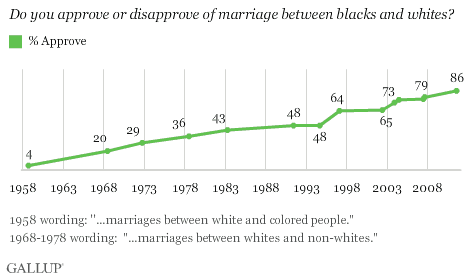
It's going to be great once AI exists and we can point more concretely to something that doesn't work the way you describe (ie a purely evidence driven epistemology).
While we wait for that, I'll just point out that the pace of technological progress we're seeing in society -- faster than a cycle per generation -- indicates that technical theories don't work the way you claim. Math theorems don't become "true" because the opponents die.
There would be something deeply wrong with a theory that requires ignorance of the old ideas for someone to accept it. If science actually worked that way it would be no better than the humanities.