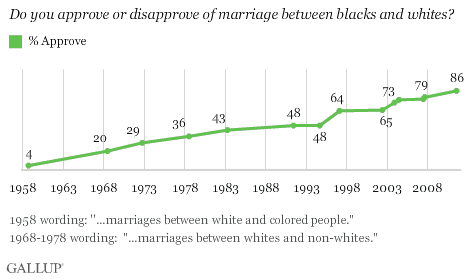
| DNA doesn't strike me as a good example. I don't think it was a paradigm shift. Crick and Watson didn't discover it; they just showed how this particular molecule fit well into people's expectations for what was going on. As to this: > you also admit you yourself have changed paradigms in your lifetime I don't know that I have, really. Sure, some things have changed. But I'm still writing OO code that isn't that different than what I was writing in the late 1980s. I still build systems on Unix-ish OSes on collections of discrete servers. The major difference is that the servers are virtual, but that's hardly a difference. As an industry, the phrase "virtual server" is a sign we're still struggling to make a paradigm shift. It's like "radio with pictures" or "horseless carriage". But look at how much hate the possible alternatives, like containerization or serverless computing get. And that pattern of hate is a common thing in technology. A large proportion of people just won't use anything new unless circumstances force them. [1] > Does that not count as you putting yourself forward as a counterexample, and agreeing with respect to tech more generally? No, because nobody is claiming that people never change. The notion is that they change more slowly than a completely rational actor would, especially when social status is on the line. The actual speed depends on a variety of factors. Planck exaggerated for rhetorical effect. > so don't see why a fancier hypothesis involving me (and more broadly everyone) secretly refusing to give up on lesser ideas is needed. I don't think that's the right question to look at. The pattern of people holding on to old ideas because they're comfortable or socially beneficial is pervasive. For example, consider this graph: http://content.gallup.com/origin/gallupinc/GallupSpaces/Prod... The change there is very close to the death rate. Or look at the way religions change. I think question with science is, "Is it essentially different than almost anything else people do?" And I think the answer there is no. Science is somewhat better due to having real data. But it's still a social enterprise among people embedded in status-driven primate dominance hierarchies. This leads to results like the issues surrounding the measurement of the mass of the electron: https://en.wikipedia.org/wiki/Oil_drop_experiment#Millikan.2... That's easily explained if you treat science as another human social activity, but hard to explain otherwise. [1] https://en.wikipedia.org/wiki/Technology_adoption_life_cycle |
> I don't know that I have, really. Sure, some things have changed. But I'm still writing OO code that isn't that different than what I was writing in the late 1980s.
Hmm, okay, I think the issue we're hitting here is something like "no true paradigm shift" -- I would have thought that the introduction of, say, the world wide web in the 1990s would count as a paradigm shift with respect to technology. Perhaps it is incremental? That you have experienced no paradigm shifts working in tech since the 1980s (or at least none you have adopted) seems like a surprising claim.
> Crick and Watson didn't discover it; they just showed how this particular molecule fit well into people's expectations for what was going on.
With respect to Watson and Crick I have to admit I only have surface knowledge of the history of science here. I can say that googling for "Watson Crick discovery" does show a bunch of pages discussing a discovery, many of which seem to think of it as a paradigm shift.
> The notion is that they change more slowly than a completely rational actor would, especially when social status is on the line. The actual speed depends on a variety of factors. Planck exaggerated for rhetorical effect.
I agree with this. Inferential differences in humans has been experimentally demonstrated in the Cognitive Biases literature (psychology, not sociology).
> I think question with science is, "Is it essentially different than almost anything else people do?" And I think the answer there is no.
This is a place that we disagree then, although you may (perhaps rightly) come back and claim I'm taking a "no true scientist" position. To me the remarkable thing about science is how radically it differs from normal human cognition. The desire to submit ideas to falsification, and discard them in the face of data is not a very natural idea for humans, at least judging by history.
> it's still a social enterprise among people embedded in status-driven primate dominance hierarchies.
And here's the bit where you can claim I'm no-true-scientisting: I think much of good science is about subverting the status-hierarchy. This is why you're linking material on electron charge (which requires a stunning amount of agreement on physics to be of interest). If science and scientists behaved like the rest of society, it seems to me we'd still be dealing with the question of atoms existing. For another more concrete difference, willfully falsifying results isn't always grounds for dismissal in other professions (it mainly depends who you falsified them to). That's not true for science.
Which is to say I agree with you broadly ("yes, science is done by scientists who live in a social hierarchy"), but I disagree that this is a particularly useful insight -- if you had tremendous amounts of experience on other professions operating in a social hierarchy your predictions of scientists would be poor.
> [link] That's easily explained if you treat science as another human social activity, but hard to explain otherwise.
"A Bayesian is one who, vaguely expecting a horse, and catching a glimpse of a donkey, strongly believes he has seen a mule." - https://doingbayesiandataanalysis.blogspot.com/2011/07/horse...
Which is to say I don't think the principal feature of that story is that scientists didn't want to embarrass themselves or others, but rather that there was a real possibility that their experimental apparatus was faulty. The Feynmann quote you linked to doesn't even believe they were doing it for status reasons, but rather something akin to the the https://en.wikipedia.org/wiki/Streetlight_effect