Long, straight lines for borders usually imply that the territory through which they are drawn was neither well explored nor terribly important to the people drawing them. Sometimes that's because the territory is mostly uninhabited and nobody really has a strong claim to want their particular patch of land to be on one side or the other, but frequently its because the mapmakers either don't know or don't care about the cultural affinities and loyalties of the people who live on or near the proposed border.
This is one of the main reasons why a lot of central Africa is a shit show politically. Most of the modern borders were drawn during the colonial era without much consideration as to which tribes and city-states ended up in which countries, so there's not a strong relationship between "nations" (i.e. culturally similar groups of people) and "countries" (i.e. demarcated stretches of land) like there is in most of the rest of the world.
Exactly. Assuming that countries are united on the basis of some common characteristic (language/culture), the likelihood of this unity following a particular longitude or latitude (both European creations) with such mathematical precision is quite small. Straight borders are not exactly prevalent in Central Africa but the existing borders do not make sense in the slightest, and the dysfunction you see is largely a legacy of European meddling in the region.
Speaking of West Africa, you don't really have to think hard to figure out why Gambia's borders were drawn the way they were.
To add a bit more, if you zoom a bit, there almost always will be some weird straight lines throughout the borders of a country. There are many towns in Turkey, for example, half of which went to Syria. I guess because no one from the people who came up with the borders knew the town was there and/or cared enough. There is even a Turkish movie about this: http://www.imdb.com/title/tt0216986/
The border between Canada and the US, the longest international land border on Earth, is very rectangular, consisting largely of the lines 49 degrees north latitude and 141 degrees west longitude.
It is very likely that those drawing the border did not care one little bit about the opinions of those who already lived there, and it was definitely unexplored by them.
It applies perfectly. The 49° N section of the border was set in the Treaty of 1818 [1], at which point all affected regions were still populated by native americans.
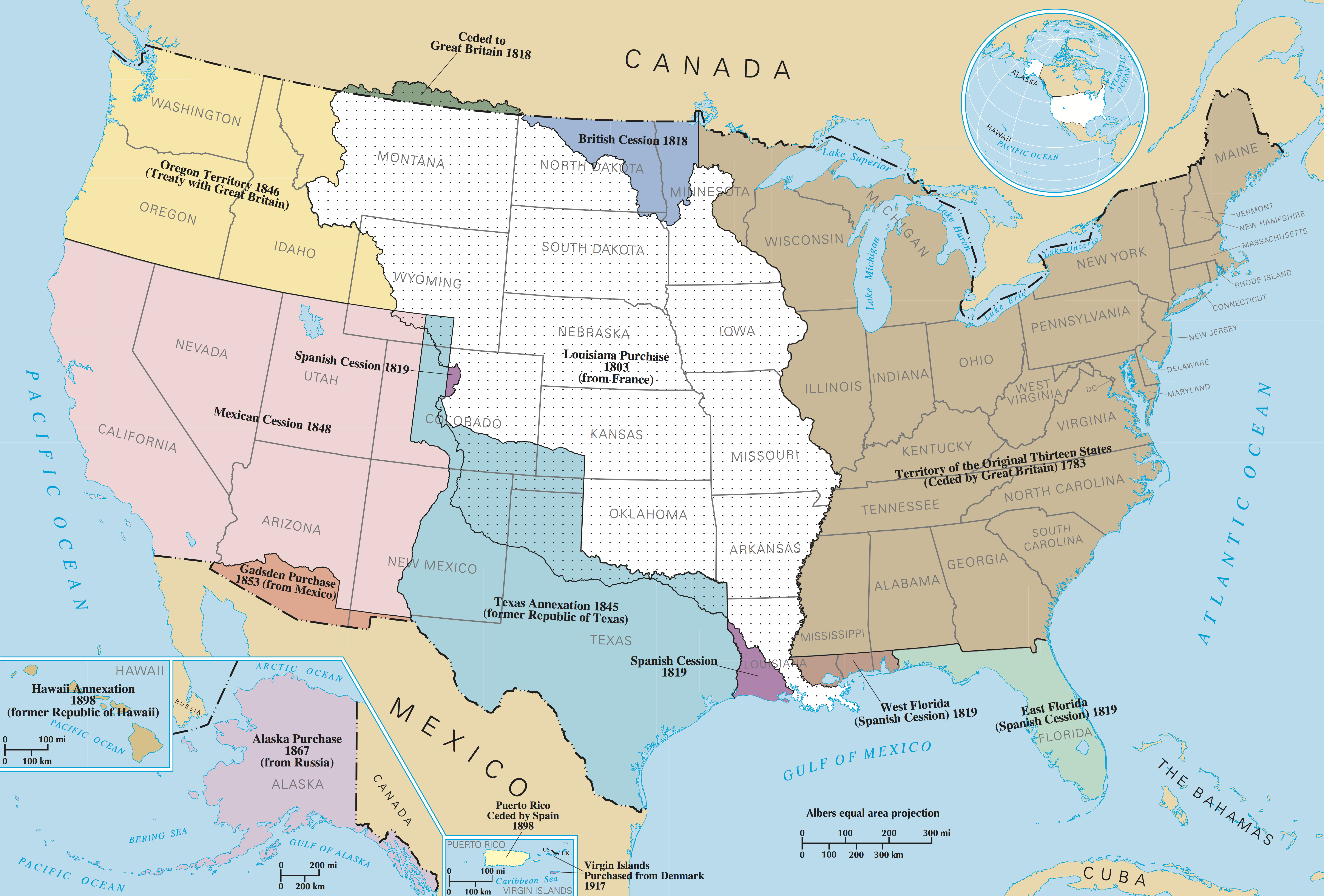
You can see on this territorial expansion map [2] of the United States, how the lay of the border differs between the first-settled east and the later-settled west.
Arizona's not a country, so not quite germane (unless you are talking about its southern border, which is clearly an example of the effect suggested.)
In the case of the borders among countries in the Sahara, my understanding is that lots of those were disputed borders settled by people pretty remote from the areas with the straight borders, so I'm not sure they provide a counterexample. "It's a desert" may increase the likelihood that decisions get made by people living far out of the region (since it reduces the number of people living close by), though.
Dividing geography with existing populations and long histories into discrete countries is always going to produce tricky ethnic issues. It's just that in Europe those issues were worked out violently over a period of centuries up to and including the second world war. The process is so big, that people don't notice it.

This is one of the main reasons why a lot of central Africa is a shit show politically. Most of the modern borders were drawn during the colonial era without much consideration as to which tribes and city-states ended up in which countries, so there's not a strong relationship between "nations" (i.e. culturally similar groups of people) and "countries" (i.e. demarcated stretches of land) like there is in most of the rest of the world.