Hacker News new | ask | show | jobs
by alwaysAttending 3880 days ago
In a country that looks down upon unions and guild-like structures meant to protect their workers, you'll never have enough people who trust apprenticeships. Dedicating yourself to one specific task within the private market is too foolish of a thing to do for any smart person in America.
3 comments

That's how most folks get trade jobs now! You work in a shop while taking some classes at community college (welding, bookbinding or whatever). You then get promoted after a couple of years, or even save your money and open your own shop.
And how economically sustainable is that turning out to be for most people? I've automated my own job a couple fo times, and although I've enjoyed working int he arts over the last couple of decades there's constant downward pressure on earnings driven by technology. I'm not a very entrepreneurial person by nature, rather I grew up revering craftsmanship and buying into the idea of a social contract that supported some degree of economic continuity. This has not worked out well for me in economic terms.

Now, I don't blame entrepeneurship or technology for that, but it's not so simple to just change your personality to fit the economic imperatives of the day, and I simply don't desire to spend all my time as a disruptive wealth maximizer. The whole 'software is eating the _____ industry' mindset is the technological equivalent of slash-and-burn agriculture - it's not a sustainable strategy for the population at large, and we're seeing that reflected in many countries by the drift towards electing increasingly radical politicians of both left and right.

This directly leads to lots of older workers who only know one skill and can't get a job. Right now States are dumping these people on Social Security Disability to keep them off their welfare / unemployment rolls, because industries are just not that stable and younger workers are healthier and cheaper.

PS: 65 - 18 = 47 years. Just how many bricklayers do you need with 45 years experience and back problems?

My personal war cry is "Details matter." It's something that many people in software development don't appreciate as much as they ought to; a detail is often the difference between something that is right and something that looks like it should be right but manifestly, strongly, isn't. And, there's a lot of details in software.

But a corollary of my version of "Spoon!" is that skills matter, too. They're how you know the important details from the unimportant ones, and how to manage the important ones. The only way to get that kind of skills is by experience. To use your own example, have you seen the difference in efficiency and results between someone who's just been shown how to lay bricks and someone with 45 years of experience? Or even better, a team with someone with 45 years experience to tell the others when they're not doing it right?

Judging by the brickwork on my house, the answer to your question is "More than we have now."

Besides laying bricks, brick layers who really understand their craft can supervise and train others on proper technique. Here's an excellent article lamenting the lack of "master masons":

  A master architect and a master mason

  Back in 1891, when the Citizens Bank building was under 
  construction, there were two essential people on the job 
  site. One was the architect. I imagine that the architect — 
  someone who clearly cared about water management details — 
  visited the job site regularly. The project was also 
  blessed with the presence of a master mason — perhaps a 
  recent immigrant from Italy — who knew how to sift sand and 
  wield a trowel. Both of these people oversaw the work of 
  others, and both insisted that every worker on the job site 
  needed to adhere to high standards of quality.

  The results of their work included the impeccable mortar 
  joints at the Citizens Bank building.
http://www.greenbuildingadvisor.com/articles/dept/musings/qu...
That sounds great, but, we don't have a huge exponential growth rate or short lifespans.

So, you can easily end up with vastly more people with 25+ years’ experience than <5 years’ experience. That's not a problem for programing or electricians, but for highly physical skills your body breaks down and you don't need 3 supervisors for every worker. For some jobs older workers are simply worse.

Now, with a solid general education these people can move on to less physically demanding work, but trying to plan out the economy 40 years into the future is a bad idea.

"So, you can easily end up with vastly more people with 25+ years’ experience than <5 years’ experience."

That seems to be false in practice.

Depends on the field. This does happen in fields with low turnover and high longevity. The point is if you want to railroad people into apprenticeship programs you need to limit it to fields that people can do for 30+ years.

Otherwise as I said in a different post you end up handing out medical disability early retirements to lots of people which is extremely expensive.

The gist I'm seeing here tends to view apprentice opportunities for skilled manual labor. What about software? I work with a developer in his 60s who only came into programming late in the game because after years of self-employment he realized he'd need to pay more into social security to get any benefits.

Old dogs might not learn new tricks, but people can.

From what I've heard (to be fair, mostly on HN/reddit), age discrimination is a thing, and it can be very hard for older developers to find jobs
Sounds like he was a new developer, hence no wage premium. Old but junior.
Yeah but wage premiums aren't the only reasons for age discrimination -- there's also a perceived lack of current technical expertise, or lack of malleability/flexibility, right?
if he was a full-time employee getting paid-for health insurance, an older person costs the employer dramatically more, like 300% more than a young person, for health insurance at least.

Of course, even then you are only talking a grand or two pre-tax, which isn't the world, when it comes to programmer sallary, unless the old person has a bunch of dependents and the employer is paying for dependents.

I think it's pretty common for the employer to pick up most or all of the bill for the employee, and then have the employee contribute for their dependents, but it varies from company to company.

Not only is ageism a real thing, but in order for software development apprenticeship to work you have to have a supply of skilled engineers with the time to mentor. And as I've found out the hard way, the people that are the most qualified to effectively mentor engineers are the same people who don't have time for mentorship because they are founding startups.

Y Combinator and, to a lesser extent, the better coding bootcamps, are trying to solve this problem and I feel we should be supportive of that and encourage more of those initiatives (and I'm not looking to start another subthread about the effectiveness of coding bootcamps, but merely pointing out that they are an attempt to solve the problem of mentorship at scale).

We work in higher education, where we invest in people, not throw them away like yesterday's pizza.
Cold pizza is the best pizza.
Older workers with one skill is more related to the drastic change of incrased longevity in only a generation or two. And with the global population aging and a diminishing 18-65 work force, the surplus of workers we've had in th 20th century could easily be reversed.

Trades also are inherently focused on a single area. Plumbers can't just pick up a rig and start pressure welding.

...and yet, its an efficient way to learn a trade. How else? We can't yet run a tape through your brain to program skills.
It's an efficient way to subsidies industry's. Do you want to set up 62 year old apprentices? We need to have job training programs that work quickly without undermining or subsidizing the older workforce.

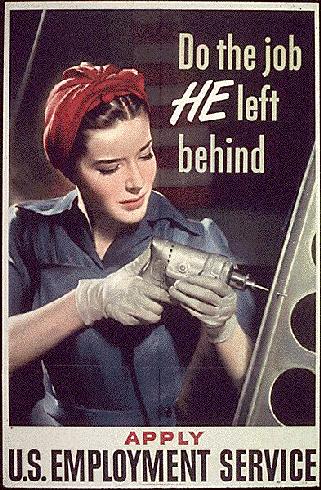
PS: Back in WWII we had job training programs that worked and worked quickly. http://militaryhonors.sid-hill.us/honors/images/dothejob.jpg Today, we have a surplus of workers.

Most of my family and a significant number of my friends are in trades and I've always found their educations models enviable. Here in Canada, hours are accumlated on the job prior to classes and the time spent in a classroom is small (4-6 weeks 2-3 times a year). Unemployment insurance considers trade school a legitimate leave so students receive 55% of their wage for those weeks. Certain high schools even offer accelerated work experience programs where one semester is spent on core classes and the other on a job site. An individual could leave high school with enough work experience to have a ticket within 2 years of graduating. Not to mention making significantly better wages without having to work evenings and weekends.

Compared to arts and science degrees with substantial debt loads, years of no applicable experience, and a high probability of employment outside your field, the economic model of trade schools seems significantly better.

On the contrary, there are multiple industries where apprenticeships are the norm. There are even a few very successful companies doing software with the apprenticeship model.
What's contrary about this? You haven't actually addressed any of alwaysAttending's criticisms. It's just a tangential point.
I have neither the time nor the crayons to explain to you why existing examples of successful apprenticeships are a disproof of alwaysAttending's claim that apprenticeships aren't trusted enough to be a good choice for a smart person.
>In a country that looks down upon unions and guild-like structures meant to protect their workers, you'll never have enough people who trust apprenticeships.

You are associating two things that have gone together in the past (guild-like systems and apprenticeships) - that don't necessarily need to go together. I am, well, very American in my personal attitudes towards unions. (Okay, maybe I'm a little more tolerant; I don't have a problem with unions in general, I just know they aren't for my personality.)

I've worked in the field for the last 20 years without a degree, and I've been educated, largely, by things that could be called apprenticeships or internships; jobs where I got paid little to do IT work or programming, usually with some, but not very much supervision. Sometimes it was an official-ish internship, sometimes they just wanted an IT guy and didn't want to pay more than minimum wage. I personally didn't see too much difference between the two types of jobs. It was pretty great socially, too; I'd credit it with being one of the major forces that got me out of high school without physical harm or a record. It was really neat being a 16 year old kid who everyone treated like, well, a 16 year old kid (meaning some species of especially disgusting mud) - and then to go to work for three hours a day in an office where nobody else was below 45, where they treated me as a human; a human who could do adult work.

From the age of fifteen I worked at a local computer store, then later some county offices... by the time I got out of high school (in '97, and yes, I know just how lucky I got) I had just a few more months of low-paying work (phone tech support, that time) before I got my first programming gig.

Just because of my personality at the time, I don't think I could have functioned in an official union setting. It took me more than a decade before I could accept that sometimes you need to follow rules that you disagree with, and sometimes... sometimes when you learn more, you start to agree with those rules. I mean, I guess that's what most people do in college, learn how to "play the system" - But the capitalist free-for-all worked really, really well for me; I didn't have to play the system. I could do my work, tell my boss what I thought, and if that caused enough problems, I could get another job.

I'm not saying that it's the best system for everyone; just that it worked really well for me... and there's no way I would have made it in an organization with standards and rules like a union, and unions have very different values; To this day, the idea of working at the same place for a decade seems really weird to me. Some of this, I'm sure, has to do with the fact that I came of age during the first dot-com, and I know how much "loyalty" you are going to get from the company you work for... but some of this is that I really do value the freedom of being able to walk, with two weeks notice, of course, with almost no consequences.

Now, I do see some benefits of unions; in airlines, my understanding is that they've been able to capture a lot of the value (for the workers) that would otherwise have been profits for shareholders. This is not happening in the computer industry. Sure, we get paid pretty great compared to plumbers or mechanics or what have you (I mean, plumbers or mechanics who don't own a company) but compared to the industries we enable... we capture a pretty small portion of that value in terms of salary.

Still, I do really well in the "perceived merit" system we have now, even though all my statistics are terrible or non-existent. No certifications, no degrees, lots of time as a contractor, I've run my own business, etc, etc, - I think like so many others in the computer industry, I feel like a more objective scale is going to rate me less highly than the current system, and I have no evidence that a union could, in fact, obtain more of the surplus value for the workers.