It's too challenging and bleak. Beneath the light tone, it mercilessly drives home the truth that all of modern society exists in a temporary historical juncture that is not stable over a timespan of mere centuries. Instead of the smoothly increasing "better everything" over time that was practically a secular religion in the latter half of the 20th, we're told that things will change drastically in the not that distant future, and not in the manner we've believed.
This concern about economic growth in 1000+ years is entirely academic. The more relevant question is whether exponential growth (at whatever rate) is feasible for the next few decades and even centuries, and to me the answer to that question is yes, just using the examples from the article. So we can build appropriate policies for the present and near-ish future. Our descendants can decide for themselves at that point whether it's reasonable to continue economic growth, based on knowledge and science and experience they have gained.
I mean, how many physical theories can be argued to work into the infinite future? Does quantum mechanics or GR hold past the end of the universe? It's not even a meaningful question. Why hold economic models to the equivalent standard, when all that is needed is whether they hold in the relevant domain?
I feel that this question and argument is often used to try to draw the conclusion that we must stop trying for economic growth NOW, because infinite growth is impossible. Maybe it is impossible, but I don't think something happening or not happening at infinity or even in a thousand years has any bearing on what we should be doing now.
From what I got out of it, they were talking about smaller timescales, on the order of a couple centuries. The 1400 years was a sort of upper limit (our planet consumes as much energy as the sun, hotter than the sun). 400 years was where the atmosphere reaches the boiling point. Those of course are the steady 2%-3% increase numbers though, and assume there's actually enough energy to reach those states, which there probably isn't.
But it's not the 1000-year timespan that's facing limits.
Looking at total energy and net heat production just hammers home that within an exceptionally short timeframe by historical measure growth of human activity on Earth must come to an end. And if you look at more complex systems models, there's strong argument that sustainable carrying capacity has been exceeded. When and by how much provides a wide range of estimates -- I've seen good arguments for from 50m to 10 billion, though lower-end estimates in the 500m - 2 billion range strike me as most plausible.
The first-order argument is to demonstrate that infite growth is impossible that's what Murphy demonstrates here.
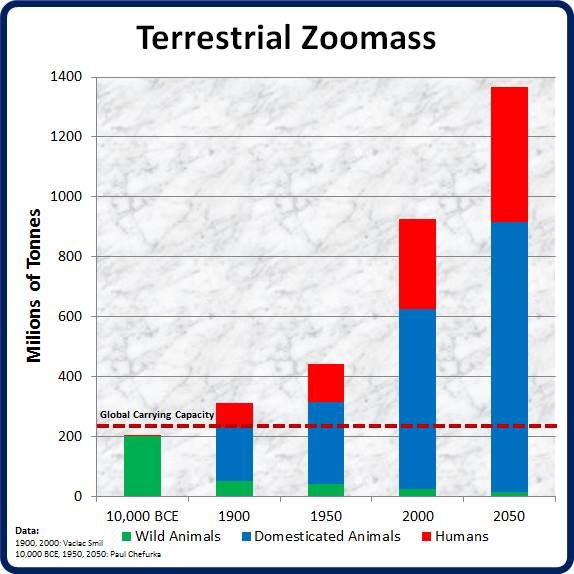
Then there's the question of assessing what actual physical resource needs do exist. Looking at total population, relative biomass of humans vs. other terrestrial vertebrates (http://i1176.photobucket.com/albums/x330/chefurka/Zoomass_zp...), land area per person, human appropriation of net primary production (a fancy term for "how much plant growth to humans consume directly or indirectly), total arable land, available critical and limiting resources (particularly freshwater, topsoil, phosphorus, copper, and of course, fossil fuels, see Leibig's Law: https://en.wikipedia.org/wiki/Leibig%27s_law), incident solar flux per person, the situation for effluent sinks (sewerage, CO₂, industrial pollution, heavy metals, radioactive waste), systemic risks (see David Korowicz, "Financial System Supply-Chain Cross-Contagion": http://www.feasta.org/wp-content/uploads/2012/06/Trade-Off1....).
On land area and solar flux per person, if you assume that the only long-term energy option is solar (meaning: solar, wind, hydroelectric, wave, and biomass, all of which derive from it, but excluding tidal, and geothermal energy, as well as nuclear), then we're looking at, with 8 billion people on the planet, less than 0.5 MW of total available recoverable solar, at present conversion rates, per person via photovoltaics. This is with blanket coverage of the planet in PV panels. Yes, that's in excess of how much energy an American ses on an ongoing basis (about 10 kW continuous), by about 45x, but that excludes conversions to other factors, including liquid, solid, or gas fuels for later or mobile consumption. It's also a total land-area usage: 3.18 million km² without storage and fuels allowances. On a large-scale engineering basis, I'd really like a far larger margin of error. In 1850 it would have been 250x, in 1AD, 20,000x.
At some point, the prospects of 1) Business as Usual, 2) "developing world" advancement to first-world standards (even EU vs. US, at about 50% of per-capita resource consumption), demographic transition, and surviving even a "modest" 8-9 billion total humans on the planet ... looks exceptionally dicey.
An exceptionally common response is wishful thinking, expressed variously as "there's no problem", techno-optimism, "they're" working on it (whoever "they" might be), etc. A significant problem with the techno-optimist viewpoint is that there's a compelling argument that technological level (complexity) is dependent on, not independent of, net energy throughput.
The more I've looked at the situation, the less credible I find any of these options. And "solving" any one issue (e.g., energy, which YC have addressed with several recent startups), still leaves multiple other challenges.
AKA: "physicist frames discussion with economist in terms of things he is intimately familiar with but economist isn't, feels smug about his own perceived superiority". Probably a reflection on his frustration with feelings of being so much smarter than those 'economists' yet not being taken half as serious. The fact that he thought this was even worth spending 2-3 hours on writing up shows more about his lack of understanding of what economics is, than what he probably thinks is an "exposure" of the inadequacies of economics as a field.
(not an economist, but broad-minded enough to recognize someone who has spend so much time in his own field to be completely rigid-minded about it. An affliction rather common to CS types too, I'm sad to say, since as a software engineer in research I spend quite some time around those)
It can certainly read like that, but there is a note before the exchange begins that explains his representation will be naturally biased, if by nothing else than by his remembering his argument better than the opposing argument. Additionally, he does concede some ground at the end.
That said, I'm not sure it's a real exchange. It feels somewhat manufactured to me. But that's somewhat irrelevant to the point, as long as the arguments each side presents are conceivable for their professions and the current prevailing beliefs within them (which I'm not qualified to judge).
In the end though, that's all irrelevant. The real question is whether you find the facts of the argument compelling and whether it changes your view on anything.
I apologize for not sticking it out until the end of the article, but it got really painful about a third of the way through.
I am tempted to save this and put it under a file titled something like "why scientists should not be economists" but I'm afraid it's a little too involved for that purpose.
I mean no disrespect to the author: these all seem like good and reasonable questions. To understand why this form of analysis does not work is to cut to the heart of what the difference between economics and hard empirical sciences. I will give a couple of examples, but I fear that folks who missed it the first time around will not get it this time.
First, note that no matter what period in human history this conversation occurred, it would follow the same pattern. "Here is a chart of the rate of fishing from the pond near our Roman village. Certainly catastrophe awaits us in just a few years", or one that actually occurred, "Population growth will stagnate and we will have famine when the 1900s come. Why? Because we will have ran out of grazing land for all the horses we will need"
Growth lines can't continue forever. Seems obvious. Yet somehow it always turns out the thing you were measuring wasn't the important thing all along. Sure, you can only fish so much -- but there are other ponds. Yep, can't have that many meadows -- yet meadows aren't a constraining factor.
The reason why such analysis fails is that science is always seeking a constrained and known system. Given controlled conditions, the falsifiability and reproducibility of science says that given these inputs, these outputs are likely to occur. Economics, because it deals with what people want, is under no such constraints. Let's say you give everyone on the planet all the food, shelter, and healthcare they need. End of money, right? Nope. People would trade Justin Bieber concert tickets, or autographs of Elvis Presley. People always want stuff they don't have, and they always like trading for it. That's economics.
If economic systems were the same as physical systems, wow, we'd have a lot of physicists who have made fortunes playing the stock market. We do not.
OK, so I'm neither a physicist nor an economist. But I don't get why aggregate economic value couldn't grow indefinitely. For example, consider software.
Poorly written code might not be very valuable, because it's slow and crashes often. Well written code would arguably be more valuable. It would also waste less electrical energy, and produce less heat.
Indeed, code could do entirely new things, using less material and energy inputs, that are worth much more. Maybe I'm missing something, but that seems distinct from increasing efficiency. There's a limit to efficiency, but no limit to value.
The author seems to be (accidentally or intentionally) part of an ultra-heterodox economic school that believes that all economic value, across all times and places, comes from the consumption of energy.
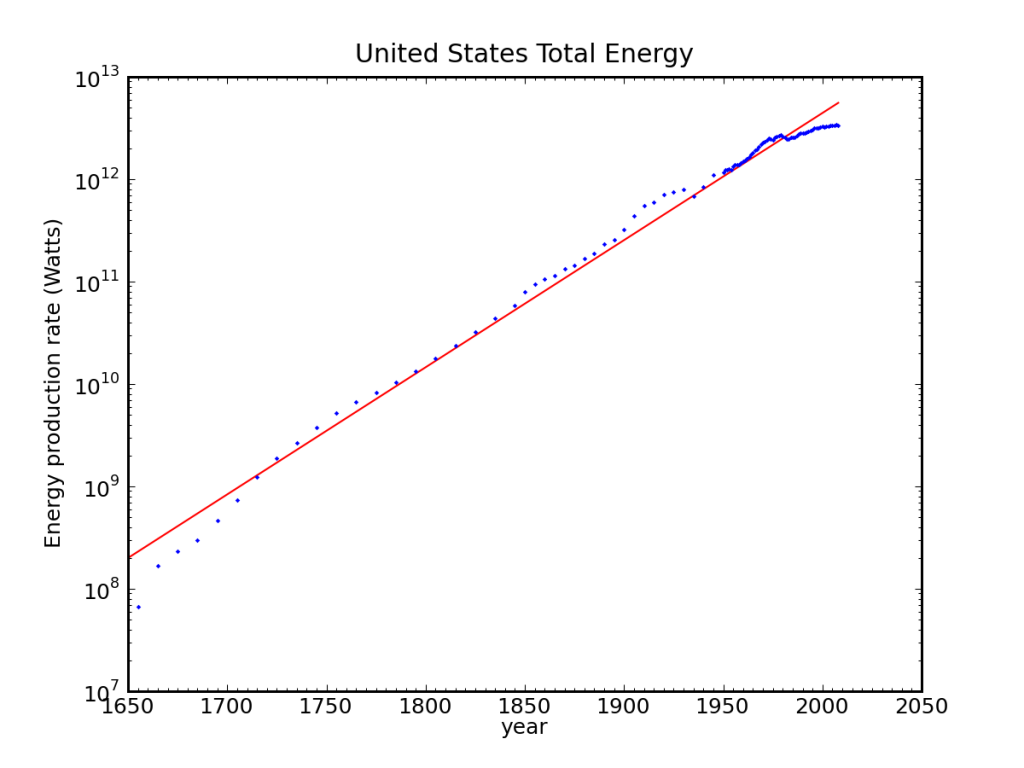
They base this mostly on that graph near the top of the article that shows that energy consumption was growing exponentially during the industrial revolution.
He then goes on to imagine that 3% economic growth means that in 200 years we'll all have 400 times as many cars and refrigerators (or maybe just one car the size of a luxury yacht), eat 400 times as much food, have houses 400 times as big, etc.
> The author seems to be (accidentally or intentionally) part of an ultra-heterodox economic school that believes that all economic value, across all times and places, comes from the consumption of energy.
Ultimately all life is based on exploiting energy gradients. Economic value without using more energy is ultimately an efficiency improvement, an investment of past energy which is proving beneficial.
> Note: This conversation is my contribution to a series at www.growthbusters.org honoring the 40th anniversary of the Limits to Growth study. You can explore the series here. Also see my previous reflection on the Limits to Growth work. You may also be interested in checking out and signing the Pledge to Think Small and consider organizing an Earth Day weekend house party screening of the GrowthBusters movie.
I do agree that exponential growth in energy use won't end well. I'm reminded of the polar heat radiators on Trantor in Foundation by Isaac Asimov ;)
I also find the linear fit in log energy use vs time[0] somewhat dubious. It's confusing to just look at energy use. What matters is the relationship between economic growth and energy use. I'm sure that's been done. I'll look into it and report back :)
> He then goes on to imagine that 3% economic growth means that in 200 years we'll all have 400 times as many cars and refrigerators (or maybe just one car the size of a luxury yacht), eat 400 times as much food, have houses 400 times as big, etc.
I read it as an explanation of why in 200 years we won't have 400 times as many cars and refrigerators. Looked at another way, freed from material and energy constraints, why wouldn't we have a fleet of drones and other appliances to fulfill our needs? Why wouldn't we have, if not a giant house or property, at least properties spread around in all the geographic locations we cared about? I think the answer is constraints on space, material and energy.
Alternatively, you can read that growth curve not as the individual's increasing utilization of resources, but as the increase of individuals themselves and the increase of resources this entails.
That just seems odd to me because it runs counter to how companies (at least in manufacturing) operate. Why waste energy on goods produced in one market? That can only go on for so long before two things occur: the company is ran out of the market by falling prices and over saturation or they get bought out (then sold off piecemeal) by the competition. Either way, markets do adjust to physical limits quicker than the author may be assuming.
The point was that exponential growth is probably impossible, not just any growth.
The most serious objection to the propositions in the article is refuted at the beginning, when they agree that our future will be tied to one planet - "I assume you’re happy to confine our conversation to Earth". There are good reasons to expect that this will be invalidated somewhen in the next 400 years.
"I write SF for a living. Possibly because of this, folks seem to think I ought to be an enthusiastic proponent of space exploration and space colonization. Space exploration? Yep, that's a fair cop — I'm all in favour of advancing the scientific enterprise. But actual space colonisation is another matter entirely, and those of a sensitive (or optimistic) disposition might want to stop reading right now ..."
Kim Stanley Robinson on interstellar / interplanetary colonisation:
"Q: What about interstellar colonization, in particular?"
"A: There are a lot of people, even powerful, influential people, who seem to think that the goal of humanity is to spread itself. I want this book to make people think really hard about — maybe there's only one planet where humanity can do well, and we're already on it."
OK, but let's say that value isn't related in any fixed way to material or energy inputs. It's based only on market forces. In that case, why is exponential growth in value not possible?
Yeah I'm not buying the argument. Whether or not we may one day do so, we're talking huge timescales here [1] where we'll be effectively in steady state. Not to mention the insanity of having our economic theory based on this hail mary.
Since the use of economic theory is in guiding our long-term decision making, I'd rather that theory be focused on getting it right with what we have, and be pleasantly surprised if we get a bit more growth from a distant space rock, rather than being reliant on the never ending (and growing) series of space rocks.
[1] Few space rocks besides Mars are particularly habitable, each subsequent one we chase after will be less so, and after that we're going outside the solar system where timescales are massive. Our best knowledge of physics/engineering today is that we can colonize these things, but our best knowledge is not that we can reach them at anywhere near FTL.
The biggest barrier to doing interesting industrial stuff in space is the energies required.
But the whole context of this discussion is a society that has thousands of times more energy available than we do today. That's why it's not at all unreasonable to include space in the discussion. It's hardly fair to posit advanced technology that decreases the cost of energy by a factor of a many thousands while claiming that dropping the cost of space transport by a mere factor of 100 is unreasonable.
No new physics is required. We already know how to build lasers that could lift cargo into orbit -- it's just a question of energy cost.
Habitability is irrelevant: space is for robots. We already know that population growth will level off in only a few decades, so "more people" is not the problem -- it's "more industry". The industry doesn't need to be where the people are -- not when our robots are already good and getting better very fast.
This comes down to the really interesting point in the article, which sadly is hidden a ways into it (just after the "Main Course" section begins):
"If the flow of energy is fixed, but we posit continued economic growth, then GDP continues to grow while energy remains at a fixed scale. This means that energy—a physically-constrained resource, mind—must become arbitrarily cheap as GDP continues to grow and leave energy in the dust."
It goes on to describe the paradox that if we can generate arbitrary wealth in such a system (through software, for example), it becomes possible to just buy all the energy[1] and break the system, which means that this doesn't constitute a really valid economic model.
And yes, it goes on to say that you can still have growth, perhaps even something that can be called "economic growth," but we've placed a fundamental limit on the growth of the GDP- the natural way economists would consider economic growth today.
[1] "Corner the energy market," if you're an Alpha Centauri fan.
Yes, but what is that code doing? If it's operating a self-driving car better software gives better mpg, a faster journey, a shorter, safer journey. Maybe it's optimizing airline seat usage and routing again. Maybe it's running a just-in-time manufacturing or logistics system. Perhaps it's a medical diagnostics system helping people live longer more productive lives. I use a smartphone to message home so my meal is cooked when I arrive and doesn't need to be cooked in advance and then re-heated. Even hedge fund investment systems channel funds to more efficient productive companies because those are the ones yielding better returns. In the end, these are all yielding energy efficiency gains through reduced or more efficient resource utilization. Name any useful jobs software improves, and I'll show you a resource utilization efficiency, and all resource production and delivery is based on using energy.
Some years ago, I found myself in a very small art gallery in a very expensive place. In front of my face was a weathered pine board, with 96 (as I recall) small red rubber serum caps nailed to it, in a reasonably regular array.
I did say 'useful jobs', by which I mean any purpose that itself contributes to economic activity. Some software is consumed by itself and serves no useful purpose in that sense, such as computer games or computer art. Those do contribute to GDP, so I was wrong to exclude them, but the impression I got from the poster was that software 'doesn't count' when it comes to the relationship between economic activity and energy utilization, whereas mostly it certainly does. Although the post seems to have been edited since, so the last paragraph does now acknowledge that software can improve resource utilization.
Maybe this isn't relevant to your point, but I think there might be parallels between Moore's law, which the author argues will end, and OP's argument against exponential energy growth.
Sure there's a physical ceiling to energy generation but I feel like there's a great degree of oversimplifcation in his argument.
Take for example solar: right now, pretty much all of that energy (sans the work performed for propelling ocean currents and production of future fossil fuels via photosynthesis of plants) is irradiated back into space anyway. Using more of that energy to perform work on surface of Earth won't change a thing from global thermodynamics perspective. That energy is already on the books.
Or consider hydro (a consequence of solar itself): the moving water already carries energy and performs work. Re-purposing that energy in the form of electricity would have no impact on the overall energy budget.
Granted the energy growth is theoretically limited, but the limit might not be as near if we consider that much of energy generation could be essentially energy conversion.
Consider this: a) at some point our energy budget will exceed total Sun radiation reaching Earth, and b) indefinite "re-usage" of energy is impossible (entropy).
I actually considered this, making a disclaimer at the beginning and the end of the post :)
My point was that the timeframe would likely be quite different, e.g. millennia instead of centuries. From theoretical perspective doesn't change anything, but perhaps makes the argument a bit less dramatic.
What he did was to take the economists golden calf, the 3% growth pr annum, and run with it in physical terms. Demonstrating how, if economists managed to maintain that growth curve, the energy requirements would be staggering.
To "convert" energy, you need an entropic gradient.
Those are fundamentally limited.
Here's your inventory:
Total human annual energy consumption presently is about 560 million terajoules (TJ), 156,000 TWh, or 530 quad (quadrillion BTU), or 13.3 billion tons of oil equivalent (btoe), or 91.5 billion barrels of oil, or 19.1 billion tons of coal, or 4 million tonnes of processed uranium nuclear fuel.
Oil, gas, and coal combined are 11.0 btoe, or 83%, of all energy consumption. Nuclear and hydro, both possibly close to tapped out, account for another 1.4 btoe.
● Solar. About 1kW/m² at Earth's surface, modulo conversion efficiency -- 37% max for single-layer PV, 85% max for infinite layer, or concentrated solar power at Carnot efficiencies determined by input/output thermal differentials, 40-45% likely upper bound. And spacing factor (dependent on latitude, about 55% if you're in the continental US, lower in Europe, higher in the tropics), capacity factor, 20-30%, the amount of time you can capture sunlight.
● Solar-derived: biomass, wind, hydroelectricity, and wave energy are all based on solar flux. Biomass is largely tapped out and competes with both human food and natural ecosystem uses.
● Biomass is stubbornly persistent as a part of human energy consumption. It's also heavily dependent on fossil-based inputs: fertilisers, pesticides, equiipment, transport, processing, refrigeration and storage. About 6% of present net energy, unlikely to change. Recognise that all wastestream sources (food waste, sileage, sewerage, animal waste, forestry waste, and garbage) either derive directly from biomass or fossil fuels. I've penciled these out to at best 1-2% of present fuel consumption. Britain might be able to run its bus fleet on sewerage-derived biomethane, but that's about it.
For the US, most biofuel crop yields would require multiples of total national land area to provide the present level of fuel consumption.
● Hydro's similarly largely tapped out, though some third-world potential remains. My suspicion is that hydro will increasingly fill a storage / dispatchable load role. Mind that it is among the highest return on energy investment options available. It's just not very available.
● Wind actually has good metrics on per plant return, though at roughly 3-4 MW per turbine, you'd need a lot to address global energy requirements (about 4.4 million nameplate, 12-21 million at 21-35% capacity factors). Oh, and the best sites get picked first, so output/capacity will likely fall with build-out.
● Geothermal. Absent a few global hotspots, not likely a large player. Already surprisingly well developed in Iceland, the US, Japan, New Zealand and the Philippines. Possible potential in Kenya, Indonesia and a few other regions. Proven, but limited. Enhanced geothermal, using boreholes and consumptively extracting heat has proven both expensive and disappointing to date. Total global1potential of 35 GW to 2 TW (306 TWh/yr - 18,000 WTh/yr). At the high end, that's 12% of present total energy consumption, which isn't to be sneezed at. But it's also not "unlimited potential underneath our feet".
● Tidal. This is far more limited, difficult to extract, and distributed than people seem to think. It also has massive local environmental impacts. Locally, plants with a few tens of MW of continuous capacity might be created. As storage systems, they're likely more useful than energy. Potential of 0.26% of global use per Tom Murphy.
● Nuclear. Conventional uranium resources are finite, with roughly 60 years' supply at present rates of use. Ramped to full human energy consumption, they'd be good for about six years. Suggestions are that lower-grade ores, or recovery from seawater might be possible, but this is generally unproven at scale. Likewise thorium, despite much cheerleading. Nuclear might offer potential, but it comes with numerous extreme challenges and risks, not all well or fairly discussed by proponents. .
And that's pretty much it. There are some extremely long shots:
● Fusion: still not working after all these years. First successful sustained nuclear fission was achieved within four years of theoretical understanding. Applied plants were operating within a decade, and significant commercialisation within two. Though those plants haven't been without their problems. Now, 70 years after first demonstration, nuclear proponents are assuring us they've got all the kinks worked out. I'm dubious.
● Space-based solar. Factor in several kg per kWh capacity, and launch costs of $200-$10,000 per kg. Your benefits are:
More sunlight per panel. No day/night factor, no latitudinal losses, no weather losses. Greater total area potential. Net gain is about 3 over ground-based desert siting. Half that is lost in transmission to Earth. Launch costs to geosync orbit are $20k/kg. Murphy follows a NASA study which assumes $100-200/kg costs (presently a few thousand to LEO is still quite good). At 1kW/kg, that's 17.7 megatonne of material, and $354 trillion in launch costs -- a transport bill alone, on top of engineering, fabrication, manufacture, etc. Murphy sees this as at least 4x the cost of ground-based installations.
Black holes or antimatter might offer more extreme options, but again those would be exceptionally difficult to engineer and are now entirely theoretical.
Don't waste your brain cells on this, people, move along.
To the author: you scoot off to /r/badeconomics. Sure. OK. Economic growth cannot continue to look like it currently does forever. Gasp, some economists may not have ever pondered that particular limit case, given the importance to their everyday lives. I know that it was super thrilling experience for you ("That should not have happened!" as if the economist were a debate club champion and superhuman?) but trapping a man in a word game over dinner is does not mean you've shattered his profession - not even if he falls into your clever trap. The whole discussion has no bearing on what economics is or what economists do.
To be more concrete: what economists do involves more data, accepting that there is a use to building mathematically tractable models with limited domains of explanation even if it means some implausible assumptions in limit cases, and it certainly involves less worrying about what the world will look like 2500 years from now. I'm not saying we shouldn't care about the ultra-long-horizon future of humanity. I'm sure there are some smart people working on those issues, but econ departments are not where people do it. There are no data, no way to establish causal links that far out, no arguments that could make it into a respectable economics journal.
I also didn't much like the tone of the article (and I'm a physicist). However there is something to be said about working with data and not being aware of the most fundamental approximations you've done, how long can they hold, under what assumptions they will break.
As a familiar example in physics, take Hooke's law: a spring will try to retract with a force that is proportional to its extension. I think everyone will agree that this is only an approximation, and as soon as you start pulling too much you'll get out of the linear regime, or if you pull long and hard enough you'll start seeing plastic effects and the spring will change shape permanently.
This is to say that having a linear model of springs or an exponential model of economic growth is very useful, but it is important to train scholars to know the limits of their approximations so that they can recognize the need to use a more complex theory.
Did you just say that research about our far out economic future is not supposed to be a job of academic economists?
It doesn't have to be a main research area for all of them, but it _should_ be for some. And all economists should know the basics (physical limitations, ...) about this area of economics.
P.S. Always interested in some decent reading material about this one!
I said there is very little that can be said scientifically using economic methods about the distant future. You may as well be talking to Singularity crowd, global warming scientists, asteroid impact researchers, or SETI. GDP growth researchers should follow Wittgenstein's advice.
There's far too much that we don't know about the economy right now to include wild speculation, even if it's mysterious and thrilling, in the category of economic knowledge.
It sounds like just the type of thing that has no use until one day it suddenly does. Ideas like these need a long time to gestate - better to do that before they're needed rather than after.
I also got the feeling of this being no more than hard-science-guy bashing the soft-sciences-guy.
As an admitted guy-in-the-middle, I'll add this deliberate provocation to the physicist/hard science guy: if the soft science guy dealt with simple systems as the ones you study [1], then maybe he would care about 100% abstract/infinitely-proof theories.
[1] Simple, as in, without complex organisms and interactions. Simple, as in, with less (or a finite set of) variables to account for.
Impracticality of physical economic analysis aside, I'm now curious about the engineering problem of cooling down a planet overheating from sheer exothermal industry. Can you pack enough waste heat into a canister that launching it into space is a net decrease in energy? Can space elevator tethers be used for evaporative cooling into the vacuum?
As I recall, in Niven's books an alien race moved their planet away from its sun in order to deal with the problem, but I assume that wouldn't even buy us an order of magnitude in planetary energy dissipation capacity.
Those discussions always seem to miss the point.
I think it is really obvious that our economic system struggles with stagnation, but really seems to break if an econmy (god forbid) shrinks for whatever reason.
If not for that constraint i guess economies in western countries would have already shrunken quite a bit due to automatisation. For me the cause seems to be to a fundamental bug in our intertemporal trade system.
This is very unlikely to be a real conversation. A real economist would note that the economy can grow through provision of services that require very little energy relative to the value they add. Consider Google, for example. Sure, they use some electricity, but relative to their revenue that's extremely limited compared to a factory.
So this whole "discussion" is totally wrong-headed.
He goes through pains to explain why that doesn't really matter for the argument. Punting the football a few decades down the line does not solve the underlying issue he's trying to illustrate.
The dialogue is about energy sources, but that's irrelevant when there are whole lines of economic activity that consume very little energy. A service economy can deliver economic growth while energy consumption falls.
This whole dialogue is utterly wrong-headed, and I don't for a second believe that that economist is a real economist.
If some technology analogous to a Mr. Fusion is ever developed, then perhaps the economy could reach a point where energy is free, but heat pollution is heavily taxed.
The outcome would be that people start migrating into space, where heat can be rejected more freely.
Heat can only be radiated in space. Also, think about it, earth is in space. Heat is only ever radiated or temporarily dumped into sinks such as planets, which eventually radiate it.

https://news.ycombinator.com/item?id=5814769
https://news.ycombinator.com/item?id=6346156
This is from the same site, from the title looks to be prior work on the same topic, also submitted previously (6 years ago) with no comments:
http://physics.ucsd.edu/do-the-math/2011/07/can-economic-gro...