Hacker News new | ask | show | jobs
by bcoates 3933 days ago
You're not missing anything.

The author seems to be (accidentally or intentionally) part of an ultra-heterodox economic school that believes that all economic value, across all times and places, comes from the consumption of energy.

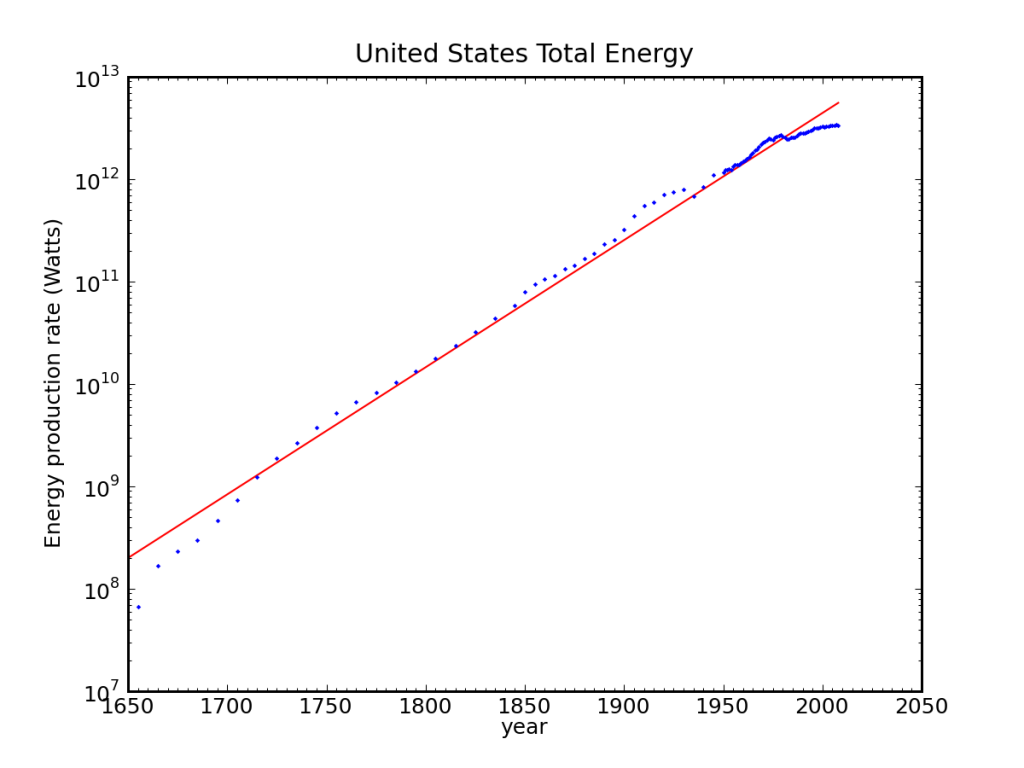
They base this mostly on that graph near the top of the article that shows that energy consumption was growing exponentially during the industrial revolution.

He then goes on to imagine that 3% economic growth means that in 200 years we'll all have 400 times as many cars and refrigerators (or maybe just one car the size of a luxury yacht), eat 400 times as much food, have houses 400 times as big, etc.

5 comments

> The author seems to be (accidentally or intentionally) part of an ultra-heterodox economic school that believes that all economic value, across all times and places, comes from the consumption of energy.

Ultimately all life is based on exploiting energy gradients. Economic value without using more energy is ultimately an efficiency improvement, an investment of past energy which is proving beneficial.

On top of that you get Jevon's Paradox.

https://en.wikipedia.org/wiki/Jevons_paradox

Basically that improvements in efficiency leads paradoxically to more usage, as new uses becomes feasible.

OK, I didn't read carefully at the end:

> Note: This conversation is my contribution to a series at www.growthbusters.org honoring the 40th anniversary of the Limits to Growth study. You can explore the series here. Also see my previous reflection on the Limits to Growth work. You may also be interested in checking out and signing the Pledge to Think Small and consider organizing an Earth Day weekend house party screening of the GrowthBusters movie.

I do agree that exponential growth in energy use won't end well. I'm reminded of the polar heat radiators on Trantor in Foundation by Isaac Asimov ;)

I also find the linear fit in log energy use vs time[0] somewhat dubious. It's confusing to just look at energy use. What matters is the relationship between economic growth and energy use. I'm sure that's been done. I'll look into it and report back :)

[0] http://physics.ucsd.edu/do-the-math/wp-content/uploads/2011/...

The tie between energy, population, and GDP growth rates to various points back to 1 AD, via the Angus Maddison datasets, is fairly well established:

http://ourfiniteworld.com/2012/08/29/the-long-term-tie-betwe...

There are very good thermodynamic reasons to suspect the relationship will continue to hold.

> He then goes on to imagine that 3% economic growth means that in 200 years we'll all have 400 times as many cars and refrigerators (or maybe just one car the size of a luxury yacht), eat 400 times as much food, have houses 400 times as big, etc.

I read it as an explanation of why in 200 years we won't have 400 times as many cars and refrigerators. Looked at another way, freed from material and energy constraints, why wouldn't we have a fleet of drones and other appliances to fulfill our needs? Why wouldn't we have, if not a giant house or property, at least properties spread around in all the geographic locations we cared about? I think the answer is constraints on space, material and energy.

Alternatively, you can read that growth curve not as the individual's increasing utilization of resources, but as the increase of individuals themselves and the increase of resources this entails.

That just seems odd to me because it runs counter to how companies (at least in manufacturing) operate. Why waste energy on goods produced in one market? That can only go on for so long before two things occur: the company is ran out of the market by falling prices and over saturation or they get bought out (then sold off piecemeal) by the competition. Either way, markets do adjust to physical limits quicker than the author may be assuming.
Right on!

Although tbh I find the exercise of imagining an economy with abundant (yet limited) energy quite difficult.