Hacker News new | ask | show | jobs
by mirimir 3936 days ago
OK, so I'm neither a physicist nor an economist. But I don't get why aggregate economic value couldn't grow indefinitely. For example, consider software.

Poorly written code might not be very valuable, because it's slow and crashes often. Well written code would arguably be more valuable. It would also waste less electrical energy, and produce less heat.

Indeed, code could do entirely new things, using less material and energy inputs, that are worth much more. Maybe I'm missing something, but that seems distinct from increasing efficiency. There's a limit to efficiency, but no limit to value.

5 comments

You're not missing anything.

The author seems to be (accidentally or intentionally) part of an ultra-heterodox economic school that believes that all economic value, across all times and places, comes from the consumption of energy.

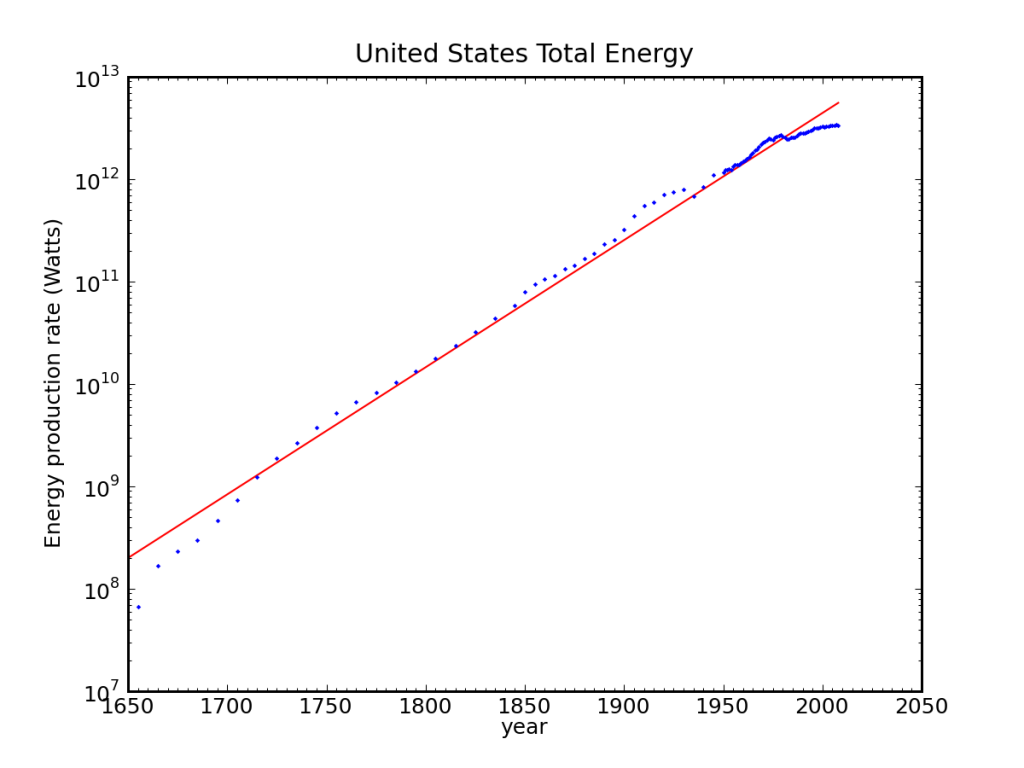
They base this mostly on that graph near the top of the article that shows that energy consumption was growing exponentially during the industrial revolution.

He then goes on to imagine that 3% economic growth means that in 200 years we'll all have 400 times as many cars and refrigerators (or maybe just one car the size of a luxury yacht), eat 400 times as much food, have houses 400 times as big, etc.

> The author seems to be (accidentally or intentionally) part of an ultra-heterodox economic school that believes that all economic value, across all times and places, comes from the consumption of energy.

Ultimately all life is based on exploiting energy gradients. Economic value without using more energy is ultimately an efficiency improvement, an investment of past energy which is proving beneficial.

On top of that you get Jevon's Paradox.

https://en.wikipedia.org/wiki/Jevons_paradox

Basically that improvements in efficiency leads paradoxically to more usage, as new uses becomes feasible.

OK, I didn't read carefully at the end:

> Note: This conversation is my contribution to a series at www.growthbusters.org honoring the 40th anniversary of the Limits to Growth study. You can explore the series here. Also see my previous reflection on the Limits to Growth work. You may also be interested in checking out and signing the Pledge to Think Small and consider organizing an Earth Day weekend house party screening of the GrowthBusters movie.

I do agree that exponential growth in energy use won't end well. I'm reminded of the polar heat radiators on Trantor in Foundation by Isaac Asimov ;)

I also find the linear fit in log energy use vs time[0] somewhat dubious. It's confusing to just look at energy use. What matters is the relationship between economic growth and energy use. I'm sure that's been done. I'll look into it and report back :)

[0] http://physics.ucsd.edu/do-the-math/wp-content/uploads/2011/...

The tie between energy, population, and GDP growth rates to various points back to 1 AD, via the Angus Maddison datasets, is fairly well established:

http://ourfiniteworld.com/2012/08/29/the-long-term-tie-betwe...

There are very good thermodynamic reasons to suspect the relationship will continue to hold.

> He then goes on to imagine that 3% economic growth means that in 200 years we'll all have 400 times as many cars and refrigerators (or maybe just one car the size of a luxury yacht), eat 400 times as much food, have houses 400 times as big, etc.

I read it as an explanation of why in 200 years we won't have 400 times as many cars and refrigerators. Looked at another way, freed from material and energy constraints, why wouldn't we have a fleet of drones and other appliances to fulfill our needs? Why wouldn't we have, if not a giant house or property, at least properties spread around in all the geographic locations we cared about? I think the answer is constraints on space, material and energy.

Alternatively, you can read that growth curve not as the individual's increasing utilization of resources, but as the increase of individuals themselves and the increase of resources this entails.

That just seems odd to me because it runs counter to how companies (at least in manufacturing) operate. Why waste energy on goods produced in one market? That can only go on for so long before two things occur: the company is ran out of the market by falling prices and over saturation or they get bought out (then sold off piecemeal) by the competition. Either way, markets do adjust to physical limits quicker than the author may be assuming.
Right on!

Although tbh I find the exercise of imagining an economy with abundant (yet limited) energy quite difficult.

The point was that exponential growth is probably impossible, not just any growth.

The most serious objection to the propositions in the article is refuted at the beginning, when they agree that our future will be tied to one planet - "I assume you’re happy to confine our conversation to Earth". There are good reasons to expect that this will be invalidated somewhen in the next 400 years.

"There are good reasons to expect that this will be invalidated somewhen in the next 400 years."

Citation required.

There are awfully good reasons to believe it won't.

https://xkcd.com/1389/

Even people whose job it is to be optimistic about space and science aren't.

Charlie Stross:

http://www.antipope.org/charlie/blog-static/2007/06/the-high...

"I write SF for a living. Possibly because of this, folks seem to think I ought to be an enthusiastic proponent of space exploration and space colonization. Space exploration? Yep, that's a fair cop — I'm all in favour of advancing the scientific enterprise. But actual space colonisation is another matter entirely, and those of a sensitive (or optimistic) disposition might want to stop reading right now ..."

http://www.space.com/29862-kim-stanley-robinson-aurora-inter...

Kim Stanley Robinson on interstellar / interplanetary colonisation:

"Q: What about interstellar colonization, in particular?"

"A: There are a lot of people, even powerful, influential people, who seem to think that the goal of humanity is to spread itself. I want this book to make people think really hard about — maybe there's only one planet where humanity can do well, and we're already on it."

OK, but let's say that value isn't related in any fixed way to material or energy inputs. It's based only on market forces. In that case, why is exponential growth in value not possible?
What exactly is it that you're "valuing" here?

What's it tied to?

How does it grow without some real, resource-based, basis?

What evidence do you have for such a thing existing?

How about evidence that it cannot? What would falsify your premise?

"There are good reasons to expect that this will be invalidated somewhere in the next 400 years."

I keep hearing this but I'm very doubtful we could or even should do it.

Yeah I'm not buying the argument. Whether or not we may one day do so, we're talking huge timescales here [1] where we'll be effectively in steady state. Not to mention the insanity of having our economic theory based on this hail mary.

Since the use of economic theory is in guiding our long-term decision making, I'd rather that theory be focused on getting it right with what we have, and be pleasantly surprised if we get a bit more growth from a distant space rock, rather than being reliant on the never ending (and growing) series of space rocks.

[1] Few space rocks besides Mars are particularly habitable, each subsequent one we chase after will be less so, and after that we're going outside the solar system where timescales are massive. Our best knowledge of physics/engineering today is that we can colonize these things, but our best knowledge is not that we can reach them at anywhere near FTL.

The biggest barrier to doing interesting industrial stuff in space is the energies required.

But the whole context of this discussion is a society that has thousands of times more energy available than we do today. That's why it's not at all unreasonable to include space in the discussion. It's hardly fair to posit advanced technology that decreases the cost of energy by a factor of a many thousands while claiming that dropping the cost of space transport by a mere factor of 100 is unreasonable.

No new physics is required. We already know how to build lasers that could lift cargo into orbit -- it's just a question of energy cost.

Habitability is irrelevant: space is for robots. We already know that population growth will level off in only a few decades, so "more people" is not the problem -- it's "more industry". The industry doesn't need to be where the people are -- not when our robots are already good and getting better very fast.

This comes down to the really interesting point in the article, which sadly is hidden a ways into it (just after the "Main Course" section begins):

"If the flow of energy is fixed, but we posit continued economic growth, then GDP continues to grow while energy remains at a fixed scale. This means that energy—a physically-constrained resource, mind—must become arbitrarily cheap as GDP continues to grow and leave energy in the dust."

It goes on to describe the paradox that if we can generate arbitrary wealth in such a system (through software, for example), it becomes possible to just buy all the energy[1] and break the system, which means that this doesn't constitute a really valid economic model.

And yes, it goes on to say that you can still have growth, perhaps even something that can be called "economic growth," but we've placed a fundamental limit on the growth of the GDP- the natural way economists would consider economic growth today.

[1] "Corner the energy market," if you're an Alpha Centauri fan.

Yes, but what is that code doing? If it's operating a self-driving car better software gives better mpg, a faster journey, a shorter, safer journey. Maybe it's optimizing airline seat usage and routing again. Maybe it's running a just-in-time manufacturing or logistics system. Perhaps it's a medical diagnostics system helping people live longer more productive lives. I use a smartphone to message home so my meal is cooked when I arrive and doesn't need to be cooked in advance and then re-heated. Even hedge fund investment systems channel funds to more efficient productive companies because those are the ones yielding better returns. In the end, these are all yielding energy efficiency gains through reduced or more efficient resource utilization. Name any useful jobs software improves, and I'll show you a resource utilization efficiency, and all resource production and delivery is based on using energy.
OK, here's a funny story.

Some years ago, I found myself in a very small art gallery in a very expensive place. In front of my face was a weathered pine board, with 96 (as I recall) small red rubber serum caps nailed to it, in a reasonably regular array.

The price was ~$1000 ;)

Anyway, maybe the software is just charming.

I did say 'useful jobs', by which I mean any purpose that itself contributes to economic activity. Some software is consumed by itself and serves no useful purpose in that sense, such as computer games or computer art. Those do contribute to GDP, so I was wrong to exclude them, but the impression I got from the poster was that software 'doesn't count' when it comes to the relationship between economic activity and energy utilization, whereas mostly it certainly does. Although the post seems to have been edited since, so the last paragraph does now acknowledge that software can improve resource utilization.
I enjoyed this post from a few weeks ago: http://idlewords.com/talks/web_design_first_100_years.htm

Maybe this isn't relevant to your point, but I think there might be parallels between Moore's law, which the author argues will end, and OP's argument against exponential energy growth.