|
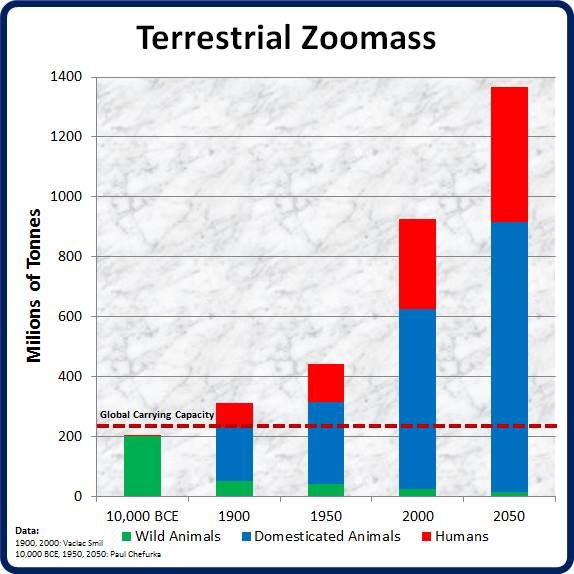
But it's not the 1000-year timespan that's facing limits. Looking at total energy and net heat production just hammers home that within an exceptionally short timeframe by historical measure growth of human activity on Earth must come to an end. And if you look at more complex systems models, there's strong argument that sustainable carrying capacity has been exceeded. When and by how much provides a wide range of estimates -- I've seen good arguments for from 50m to 10 billion, though lower-end estimates in the 500m - 2 billion range strike me as most plausible. The first-order argument is to demonstrate that infite growth is impossible that's what Murphy demonstrates here. Then there's the question of assessing what actual physical resource needs do exist. Looking at total population, relative biomass of humans vs. other terrestrial vertebrates (http://i1176.photobucket.com/albums/x330/chefurka/Zoomass_zp...), land area per person, human appropriation of net primary production (a fancy term for "how much plant growth to humans consume directly or indirectly), total arable land, available critical and limiting resources (particularly freshwater, topsoil, phosphorus, copper, and of course, fossil fuels, see Leibig's Law: https://en.wikipedia.org/wiki/Leibig%27s_law), incident solar flux per person, the situation for effluent sinks (sewerage, CO₂, industrial pollution, heavy metals, radioactive waste), systemic risks (see David Korowicz, "Financial System Supply-Chain Cross-Contagion": http://www.feasta.org/wp-content/uploads/2012/06/Trade-Off1....). On land area and solar flux per person, if you assume that the only long-term energy option is solar (meaning: solar, wind, hydroelectric, wave, and biomass, all of which derive from it, but excluding tidal, and geothermal energy, as well as nuclear), then we're looking at, with 8 billion people on the planet, less than 0.5 MW of total available recoverable solar, at present conversion rates, per person via photovoltaics. This is with blanket coverage of the planet in PV panels. Yes, that's in excess of how much energy an American ses on an ongoing basis (about 10 kW continuous), by about 45x, but that excludes conversions to other factors, including liquid, solid, or gas fuels for later or mobile consumption. It's also a total land-area usage: 3.18 million km² without storage and fuels allowances. On a large-scale engineering basis, I'd really like a far larger margin of error. In 1850 it would have been 250x, in 1AD, 20,000x. https://ello.co/dredmorbius/post/_bi5UhywbDyukHFY-EaYJw https://d324imu86q1bqn.cloudfront.net/uploads/asset/attachme... At some point, the prospects of 1) Business as Usual, 2) "developing world" advancement to first-world standards (even EU vs. US, at about 50% of per-capita resource consumption), demographic transition, and surviving even a "modest" 8-9 billion total humans on the planet ... looks exceptionally dicey. An exceptionally common response is wishful thinking, expressed variously as "there's no problem", techno-optimism, "they're" working on it (whoever "they" might be), etc. A significant problem with the techno-optimist viewpoint is that there's a compelling argument that technological level (complexity) is dependent on, not independent of, net energy throughput. The more I've looked at the situation, the less credible I find any of these options. And "solving" any one issue (e.g., energy, which YC have addressed with several recent startups), still leaves multiple other challenges. https://www.reddit.com/r/dredmorbius https://www.reddit.com/r/dredmorbius/wiki/faq It's complicated: https://www.reddit.com/r/dredmorbius/wiki/tboapw |