But if I grab a torrent to the 4K version of the movie, I can play it on my computer.
Do people still legitimately wonder why so many people flock to torrents? Hollywood (and by extension, other large content producers) have the most sincere form of Ostrich Syndrome[0] that I know of.
That was about stuffing promo's and ads in before the movie but this feels very similar. You can get a better experience by getting a torrent over streaming legally. I pay for Amazon and Netflix but I will still download content from time to time that I can get on them (for no additional cost) because I can get a better experience: no buffering, no quality yo-yo-ing as network speeds fluctuate, no ads, reliable watched status (Using Plex, this is more an issue with Amazon which keeps track of your position in a video but doesn't have watched/unwatched status so it's sometimes hard to pick up in a series where you left off).
Spotify (IMHO) is a great example of a level of service/features (even at a price) beating piracy. I'm still waiting on the "Spotify of TV" (Or movies) and no I don't think it exists out there yet. I would be all over Hulu expect I refuse to pay for a service AND see ads. I would rather pay $20/mo and not see ads then pay the $10/mo and see them. Almost as bad as having to see ads in the first place the ads on Hulu are painfully repetitive at times.
>I would be all over Hulu expect I refuse to pay for a service AND see ads. I would rather pay $20/mo and not see ads then pay the $10/mo and see them. Almost as bad as having to see ads in the first place the ads on Hulu are painfully repetitive at times.
You are going to have to make a better offer to the studios that are currently charging customers $80/mo AND forcing them to see ads.
Hollywood would have to slim down significantly if it was going to go Netflix-model primary on all its content.
I'd argue "hollywood" and media companies are significantly bloated as is, and slimming down would only be in consumers best interests. They have so much money they don't know what to do with it all.
They charge $80/mo (sometimes much more) and show ads because they can get away with it And we let them. There are also other old economics (like paying for channels you'll never watch) at play that are no longer applicable with the internet.
The netflix model is tricky. On the one hand, it's a constant stream of income. On the other, there is ever increasing licensing fees and questionable return on investment when they produce a new show. I don't know that it's an ideal model, in those regards.
I think (or hope) that what will win out is the ability to vote with your wallet. I watch some shows, and I want the shows I watch to do well and stay on the air. Equally, i don't give a crap about the shows I don't watch. But I think a barrier to that will be the price tag they attach, which will likely not be anything reasonable.
And this circles back to the topic of hollywood: a few companies in control of the majority of the market, inflating prices to line their pockets. But the internet levels some of the playing field, so an independent could come along with little more than a youtube channel and compelling content and bypass all their nonsense. And I think that will be the best thing: competition.
In terms of content production I think the only economics that have changed significantly have been production technology (CGI, cameras, which has gotten more expensive) and distribution (which is now near free).
That said I don't buy the claim that "they have more money than they know what to do with". Content Production is expensive. Netflix spent $100M in total on House of Cards, and it looks like they are spending $4-5M per episode on their original shows. I'm unsure that without big budgets that small budget productions other than "Let's Plays" and talking heads will ever be successful.
And not only is it expensive, but it is hit driven, your hits have to be able to cover the cost of your other 5-6 failures. You have to have enough cash in bank to weather a lackluster season.
It's doubtful the Netflix model @ $20/mo will be able to cover the million dollar salaries that movie, tv, and voice actors are accustomed to. I'm also unsure they will be able to cover the CGI and production budgets of current big budget films. And currently the internet has yet prove you can support a small production team producing anything more than 3-5 minute content using the internet without a big sponsor. It's also unlikely that you will ever be able to vote with your wallet - bundling ensures that the successful films you watch also pay for the the 3 or 4 failures that came from that studio.
In short my point is its going to take a lot more than cutting a few executive paychecks.
> production technology (CGI, cameras, which has gotten more expensive)
Absolutely not. Production (at a given level of quality) is cheaper than it's ever been. Consumer standards might be respectively higher, but that's not apples to apples.
> It's doubtful the Netflix model @ $20/mo will be able to cover the million dollar salaries that movie, tv, and voice actors are accustomed to.
These actors might have to get accustomed to less, like everybody else.
> Hollywood would have to slim down significantly if it was going to go Netflix-model primary on all its content.
Similar to the contraction the music industry is going through because music isn't as valuable when there is so much more of it to listen to (ie Taylor Swift vs Spotify)?
I'd argue its different because the music industry only really every had one lever - marketing and distribution, and the internet made the former really cheap and destroyed the latter. Taylor Swift's label is technically an indie label, and I'm willing to bet the budget and people employed in the production of her latest album is a tiny fraction of what Michael Bay employed in his latest Transformers flick.
Due to the huge budgets and returns movies still have, studios are a lot closer to venture capital firms than distributors. If it ever contracts it would likely be in the form of making less content and making safer bets rather than paying everyone less.
You're right, but it's worth recognising that few people realised what bad businesses Spotify or Pandora actually are. The margins just aren't there, and so for film/tv you're going to see a persistent effort to continue to "add value" which really means adding value for the seller, and not adding value for the consumer.
that image is wonderful! And its spot on. People just want the content, none of the extra bullshit that they classicly tack on. And denying someone who just bought a dvd the ability to skip over all that nonsense is downright sinister; and they wonder why people want to pirate.
There was a long ad on hulu for some drug that had nothing to do with me. At first I said "swap ad" but then that option magically disappeared the next time I saw it, so I said "no" to the "is this ad relevant to you?" question... about 5 times. Still kept appearing during every. single. commercial. Downright infuriating. But clearly there's some logic behind the scenes where no matter if they swap it, or say its not relevant, or even pay for hulu plus; that ad should play because the company paid a lot of money for it to be played; and it doesn't matter how many times a user has had to sit through it.
And that's the thing. They don't give a shit about you. They don't even try. We're just a product for them.
Spotify only allows mobile playing for paid accounts, but PC works unpaid with ads. That wasn't for DRM purposes but had the same effect, introducing the kind of platform segmentation you and the article are complaining about.
Do people flock to torrents? No one I know does. They all watch content on their tv, obtained through a legit streaming service or a cable subscription.
Personally, I don't feel right grabbing torrents, but I also don't want the hassle. I think that legit digital delivery for music and video has, for the most part, crossed the threshold where it's just easier than the alternatives.
I pay for Netflix every month. Still I use XBMCtorrent to watch most TV series and movies. Many things are not available on Netflix or a similar service. Even if they're available on Netflix, most of the time they don't have subtitles in my native language, seeking is slow, there is not flexibility in the resolution. XBMC just provides me a better user experience.
> Do people flock to torrents? No one I know does.
I know quite a few people who use torrents (or usenet) as their primary source of TV. Combining Plex + Sabnzbd + Sickbeard you get a internet DVR with little to no maintenance once setup (other than adding more capacity as/if needed). They all have a hulu-like (next day) experience, they get it in HD, and there are no ads.
Legit delivery for music has crossed the threshold but video has not. You still have to use multiple services to watch everything you want.
1) at this point, i just want it to work. if i don't have to do it, don't enjoy doing it, or don't get paid for doing it, i don't want to waste any time on it. time spent in setup and maintenance of torrent/media servers in the past has permanently put me on the netflix/hulu/amazon/spotify/roku side of the cost-to-benefit equation. i'm even one of those weird people who pay for netflix dvds.
2) there's so much content out there, that if your content is NOT available in the ecosystem, sorry, but my family doesn't bother to consume it. it's an attention economy and your (mr. content producer!) content strategy is putting you below the poverty line.
I would guess this is also selection bias. Australians are pretty much the global leaders (per capita) of torrent consumption. Everyone I know, tech savvy or not, downloads torrents. Our TV situation is pretty bad, the cable situation is extremely expensive (extra $20 a month for HD.. really?!), and we don't yet have any decent streaming services.
Once streaming services hit mainstream here I believe we'll see a significant drop off for torrents. Netflix is just about to enter this market in a few months, so it'll be interesting to see how that plays out. I just hope they don't add an Australian tax, otherwise the torrenting will continue.
I have to use different services to get all the music I want. iTunes is great for mainstream stuff but that's about it. Amazon's offering is "eclectic"
> Do people flock to torrents? No one I know does.
Who do you know? I estimate 80-90% of the people I know who are technical download "pirated" movies via torrents or usenet. Most also use paid services like Netflix and Amazon Prime but the content on those networks sucks.
A mix of technical and non-technical people. The technical people I know have basically the same attitude as me: it's not worth the hassle during our free time.
My mother gets all her TV from TPB and she's really not technically skilled at all. When it went down this week she asked me for an alternate place to download from.
I put it in quotes because I don't particularly like the term. Real piracy involves theft, downloading a digital copy of something you wouldn't pay for otherwise is not theft.
Literally every technical person I work with pirates movies, because of poor availability, restrictive DRM, or because they like to have local media in the format of their choosing.
All of these people also use netflix, amazon, itunes, etc., but it's hardly a catch all.
It's easy to give away a 4k torrent when you haven't had to pay anything for the right to distribute it or invest in the necessary infrastructure. If there are quality problems or whatever, there's no obligation to fix them. People have much higher expectations when they're paying, even if they're only paying a small amount.
I tried to rent an HD movie (the family man (hey, its the holidays)) on amazon but was told my device (27-inch imac) is not "compatible". Super WTF. A torrented version gives me none of that BS. And its free.
Piracy is mostly a matter of market. The more DRM BS you try to force upon me, the more I'm going to do to not give you any of my money at all.
Even if most people pay for content, any level of piracy is "unacceptable" to these companies. It's not enough that they make a buck, or make quite a few. They have to crap all over the experience in an attempt to stop piracy, which is a fools errand and hurts the people who DO pay for content.
I'll start being reasonable when they stop being unreasonable.
Another example: hulu plus still shows ads. I'd happily pay for hulu but not if it means I still have to watch their ads. Classic corporate double-dip. Fuck that, and fuck hulu.
Haha, yes, Amazon, where they offer digital copies of movies that can only be downloaded when your physical copy arrives in the mail. Fooking ridiculous.
? All the times I've done that, Amazon sends me a disc in the mail and then gives me an immediate 48 hour rental. I don't wait for the disc. Unless you're talking about the "UltraViolet" or "Digital Copy" thing, but that's not Aamzon. That's the studio. You get the same thing in a store.
I worked for a company that had a media encoding lab approved by 5 of the major Hollywood studios, and I can assure you, this is purely studios not approving PCs and not allowing Amazon or Netflix to talk about it. Good lord do studios hate technology if they don't feel they control it completely. I invented two studio approved DRM schemes for embedded devices and you can be quite a bit simpler with DRM if you control the whole thing. If you want to cover PCs, you have to use more extensive DRM, usually 'off-the-shelf' as we call it, and you don't get more attractive content for that market. For instance, in airlines, you can get pre-DVD release movies for approved systems, but you can't for personal devices (even mobile devices).
To the people talking about torrenting it instead, that's again the entire point. It limits access to those able to torrent, but still enables studios to control a significant part of the market that can't or won't torrent. It really is all a control game.
> Anyone who knows technology knows the computational and image-processing capabilities of even an average PC or Mac far outstrip those of a streaming box, set-top box, or smart TV by several orders of magnitude.
It's quite possible these TVs or STBs are shipping with a special hardware decoder that supports this format that they're using.
It's actually quite interesting to me that many 2014 AV receivers support HDMI 2.0 (Fully capable of 4K video pass through) but DO NOT have HDCP 2.2 implemented.
They are technologically fully capable of providing the desired service (4K video) to the customer but as soon as HDCP 2.2 Blu-ray players and 4K content come out they are fully obsoleted.
"As of this update, among the major manufacturers of AV receivers only Onkyo/Integra offers such AV Receivers that support both HDMI 2.0 and HDCP 2.2 as will be needed to support certain of the high quality 4K/UHD video sources, such as the upcoming Blu-ray 4K/UHD players." [1]
>They are technologically fully capable of providing the desired service (4K video) to the customer but as soon as HDCP 2.2 Blu-ray players and 4K content come out they are fully obsoleted
You're assuming that's a bug. It means that users will have to buy a new box to access all that content, which means the manufacturers may see it instead as a feature.
It reminds me of the non-HDCP HDTVs that used to be available (especially projectors IIRC). We know this stuff is guaranteed to be obsolete, but people are buying it anyway. At least most of those receivers don't cost $10,000.
They are - dedicated silicon support for HEVC. That's how they can do it with such a small form factor and power budget. However a software codec on a modern PC should have no problem with HEVC due to the huge amount of available CPU.
It exists but it's slow which is why it's not standard in many video editing platforms yet. Encoding speed for 4k using the Divx encoder is <1fps. So a 2 hour film owuld take about 48 hours on an i7. I think there are some commercial codecs that are a bit faster like the Cinemartin one, but they're about $500. Makes sense if you have a small rendering farm, but limits demand at the bottom end of the market.
Of course you can just distribute the decoder, and of course the decoder is much faster (Divx is 28fps ont he same Core i7 IIRC). But the # of people with 4k displays right now is really tiny compared to the install base for HD, like I'd guess <<1%.
Well, Adobe hasn't added support to Flash yet. Plus, given their massive display pipeline performance problems, it's quite possible that they won't be able do 4k 10-bit HEVC when it's finally added.
> I and your readers on a PC or Mac could intercept the 4K [content] and therefore transmit it to a country that doesn’t have the rights.
Wow, maybe if there's a country full of people so eager to watch your content that they'll steal it you should, I don't know, sell them the rights to watch it? Of course, I'm just a simple nobody. I guess you have to be a fancy movie studio executive to understand how you make more money by preventing people from accessing your content.
The studios and middlemen that bring content to people's doorsteps have created this incredible Gordian knot of contractual obligations and agreements. This industry showed up in the dark ages of connectivity where content was produced for a local market.
If someone else wanted to show this content in their jurisdiction, they'd just create a one-off agreement for it and be on their way. They honestly don't know how to sell to the entire world at the same time.
Piracy is the Alexandrian solution to this. Untying the relationships and legal contracts would take decades, but the threat of piracy forces them to offer solutions today to compete.
I'm sure there's contracts and such, but really, what leverage does Zoltar's Romanian Film Distribution Inc. have over Sony or Disney? They can't just say, "Look, we really don't need you to drive truckloads of DVDs around the country anymore. It's been nice working with you, good luck."
Obviously they still need translations and such, but can't that be done concurrently while they're preparing for release anyway?
The more insane variant is "not available in your country".
I'm in my country. You're serving me bits just now in order to tell me this. WTF?
It's like sitting down in restaurant, see a wonderful meal being served at the table right next to you, seeing the meal on the fucking menu, but when you order being told "no sir, not at your table".
In what industry do people come back after being treated like that?
TL;DR - speculation it's due to DRM/pirating concerns. Most TV's have no output and are therefore a safe mechanism to allow playback, whereas a PC could rip the stream
I have a hard time getting too worked up over this in the case of Amazon, because I have a heck of a time getting them to stream even SD content without horrible buffering issues.
That's why I pay for Prime (and Netflix, et. al.), and torrent the content.
Admittedly, I feel a little bad about paying providers of DRMed content, it sends the wrong market signal. But if I didn't pay these content providers, I wouldn't have a mechanism of signalling that I enjoy watching certain TV shows and movies.
I agree with the concept of buying a license to the actual content and then consuming it however you want, which ought to be the way the world actually works.
However, if you don't actually stream the content from Prime / Netflix / et. al., my guess is that they probably aren't paying out accordingly on the back end.
Does a netflix subscription give you rights to torrent movies that exist on Netflix?
If so, what happens when they no longer exist.
Does the parent commenter check Netflix first before downloading a torrent?
I'm not passing judgement, but merely pointing out that a netflix subscription doesn't grant you the license to download and store content, in fact, it's likely expressly forbidden in the TOS.
ETA:
Not to sound self righteous, I torrented a copy of TES4: Oblivion for the PC day-1, after buying it from Amazon. It was being shipped, but I wanted to play it immediately.
And in the case of Netflix HD it's not buffering, it just dynamically drops down to super-low res for however long it needs to which is kind of worse, you're not even getting what you pay for. Not that it's necessarily Netflix's fault, it's just inherent to streaming. Which makes the push for 4K streaming a puzzling choice at best.
A commenter, richcon, on the linked story makes a good point:
"
The open source HEVC software decoder requires a four-core Intel Core i7 running at 2.3 Ghz to play 30p 4k video, and I'd guess it'd be running so hot you could fry an egg on it. The Retina iMac only has an i7 chip in the maxed-out upgrade configuration. So maybe it is about the hardware performance.
If Amazon paid for it they could license a commercial software decoder with lower CPU requirements, but that'd cost them a lot of money and still likely run with fans blazing.
Those new embedded TV chips you deem to be weak compared to desktop CPUs have dedicated hardware designed specifically for decoding this new video format, and dedicated chips beat software performance any day. When most desktop PCs ship with hardware 4k HEVC decoders too, then I'd expect Amazon and Netflix to come on board."
(I think he would be fine with my copying it with the same attribution he posted with - it's just a story comment.)
Yeah, reading this article my first thought was that it probably wasn't entirely malevolence. Not that I agree with the way video content providers run their businesses, but I suspect that running 4K video in the browser would chug the average user's machine. My 3 year old laptop works pretty hard just to display HD.
If I was Netflix I wouldn't want to release 4K if it meant only a small segment of customers would get a good experience. Releasing a disclaimer that the user requires adequate hardware won't satisfy the majority of computer users who don't know or care about the specs required. Most people just want it to work.
I also take issue with the line, "Anyone who knows technology knows the computational and image-processing capabilities of even an average PC or Mac far outstrip those of a streaming box." Dedicated hardware can outperform a general computer while requiring less "processing power" (measured in FLOPS or GHz or whatever). The Chromecast has a dual-core CPU and 512 MB of RAM and it runs HD video perfectly.
DRM was sold to the politicians and public alike as a means of getting great content to customers and preventing piracy.
I suspect it won't be long before the DRM being used for the Amazon and Netflix 4K TV streams are well and truly broken like they were for HDMI and other "secure" measures before it.
I wish I could just pay these companies for the right to download whatever I wanted. Bittorrent solves the storage and transmission issue for them and lets me download movies from the 1980's that nobody (apple, amazon, netflix) have in their inventory.
Movies and music are more than simply products, they are part of our culture. Nobody would argue that they shouldn't make money from it, because we want them to succeed and do it again. But what we don't like is getting fucked over, and thats basically their business.
There was some disney show a friend of mine wanted to watch with his kids, which was classically available via amazon prime. But then it became the holidays, and disney pulled it from prime so now he had to pay to watch it. It's the same song and dance with netflix, who is at the mercy of the licensing of media companies who decide how much to charge for the license, and if they want to license it at all to them.
I wonder if part of the reason is lack of demand too. What percentage of Netflix subscribers actually have 4K monitors + the bandwidth needed to stream something of that quality?
How much is there 4k content currently? Arri Alexa which is quite common production camera shoots something like 2880x1620. Red has more pixels via heavier compression but even that stuff seems to be mastered 2k which is the common cinema format. Or maybe it is regional, but I don't think we have 4k cinemas anywhere here. I would hope they would spend the bandwith to get netflix stream closer to cinema datarates rather than try to compress more pixels through thin pipe.
tl;dr In order to get the content in the first place, we had to sign contract that said we wouldn't distribute it to a PC, and that we wouldn't tell anyone the real reason.
Why Netflix or Amazon would tolerate that is another question. I'm not convinced they need to.
But, I'm not the right one to ask anyway because I can't get that kind of internet access from my cable company, and therefore not going to watch any 4k anything for a few years, I'd bet.
As a torrent user, I do find that paid content is higher quality and more convenient, unless you have a dedicated setup. It is so simple to turn my TV on and watch a move than it is to connect my laptop, download the torrent, which involves firing up my VM, finding the torrent magnet link, and then DL'ing it.
Not all torrents are created equal. There are certain (private) communities within the torrent world which have amazing release groups who are dedicated to producing the highest quality versions possible.
There are also groups who focus purely on release time and quality is at most a secondary concern. What I'm getting at is that using torrents (or rather piracy) allows to obtain content that matches your needs (in this case quality vs release time). You can get music/movies/tv shows etc in higher quality than any commercially available streaming source allows for.
For your setup? Yes, legit tv is easier. Using Sickbeard (Usenet or torrent version) will give you a DVR-like experience with the shows auto-downloading, unziping/unraring, and moving into a defined folder structure 1-24hrs after the show airs.
it's ok-- amazon is a level3 customer and comcast refuses to upgrade the interconnect between their two networks* (even if level3 foots the bill), so it would choke no worse than it's already choking.
* technically level3 doesn't name them by name, but i wouldn't really consider it reading between the lines...
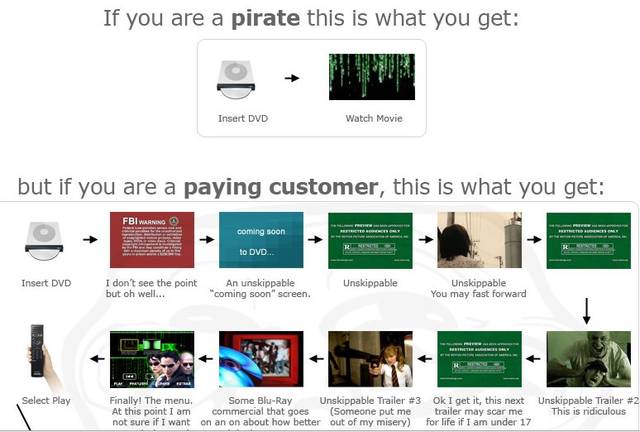
Do people still legitimately wonder why so many people flock to torrents? Hollywood (and by extension, other large content producers) have the most sincere form of Ostrich Syndrome[0] that I know of.
[0] http://www.urbandictionary.com/define.php?term=The%20Ostrich...