Hacker News new | ask | show | jobs
by csandreasen 4216 days ago
... which is a cop-out. He decided which documents to give to the reporters. If they decided to release something that isn't in the public interest or is harmful to national security, nobody can say "well, Snowden wasn't the one who released it." He shouldn't have given them those documents to begin with.
1 comments

> He shouldn't have given them those documents to begin with.

Why do you propose Snowdon should have chosen the suicide mission? It it essential to disconnect the leaker from the documents to bring life threatening action down to a minimum.

I'm not saying he should have released the documents himself, I'm saying he shouldn't have given anything to the reporters which weren't in the public interest.

Whistleblowing is when you see something illegal and you reveal those specific instances of illegal activity. You can debate whether or not what has been revealed has been beneficial or not, but that doesn't change the definition of whistleblowing - it's not taking a job specifically to gain access to classified information you've never seen before with intention to leak it[1], downloading hundreds of thousands of documents, then handing them over to a few reporters and saying "I'm not sure what's appropriate to reveal to the public, so I'll let you decide." If those reporters reveal something that isn't in the public interest or is damaging to national security, it's a cop-out to say that he wasn't the one who revealed it - he gave it to the reporters and he's responsible for anything they choose to report.

I see people saying all of the time that there's a huge difference between what Manning and Snowden did. The way I see it, the difference is that Manning gave thousands of documents to Julian Assange hoping that he'd act responsibly with them, whereas Snowden gave hundreds of thousands of documents to Greenwald, Poitras and Gellman hoping that they'd act responsibly with them.

[1] http://www.cnn.com/2013/06/25/politics/nsa-leak-snowden-job/

> I'm not saying he should have released the documents himself, I'm saying he shouldn't have given anything to the reporters which weren't in the public interest.

That's very much a contradiction in this case. Snowdon found a whole corpus of evidence of illegal action. Since you agree he was capable to evaluate what's illegal or not, the next logic step is to reach out for experts in public interests. Who do you think is more qualified than journalists for this job?

That's the thing - you can call it controversial, but he hasn't shown anything illegal. He'd have a lot more support if he stopped with the cell phone metadata revelation. Section 215 was controversial to begin with (remember the Section 215 library records fiasco from a few years ago? [1]). It's been debated in Congress at length since the revelation.

Everything after that has been showing actual foreign intelligence collection or technical information on the NSA's capabilities, often times shown to the public with a warning that they could be used against ordinary citizens, but no evidence to show that they have. In fact, multiple independent reviews of the NSA's program all mentioned in their reports that they found no evidence of abuse[2][3][4].

If he's going to go up and make the claim that the NSA is spying on all of us, I what to see actual evidence of spying on regular people, not descriptions of how they spy with a warning that it could be used against us. That's like saying "the police have guns - they could use them to kill your children!" Instead of showing small number of revelations limited to actual abuse, he's instead given us this: [5][6].

He doesn't get to say that he has no responsibility for it or try to shift the blame over to the reporters. He dumped a huge trove of documents on them unrelated to abuse.

[1] http://www.ala.org/advocacy/advleg/federallegislation/theusa...

[2] http://www.whitehouse.gov/sites/default/files/docs/2013-12-1... (PDF page 78/labelled p. 76)

[3] http://www.pclob.gov/Library/215-Report_on_the_Telephone_Rec... (p. 16/12)

[4] http://www.pclob.gov/All%20Documents/Report%20on%20the%20Sec... (p. 7/2)

[5] http://www.lawfareblog.com/2014/01/the-extent-of-the-snowden...

[6] http://www.lawfareblog.com/catalog-of-the-snowden-revelation...

> but he hasn't shown anything illegal.

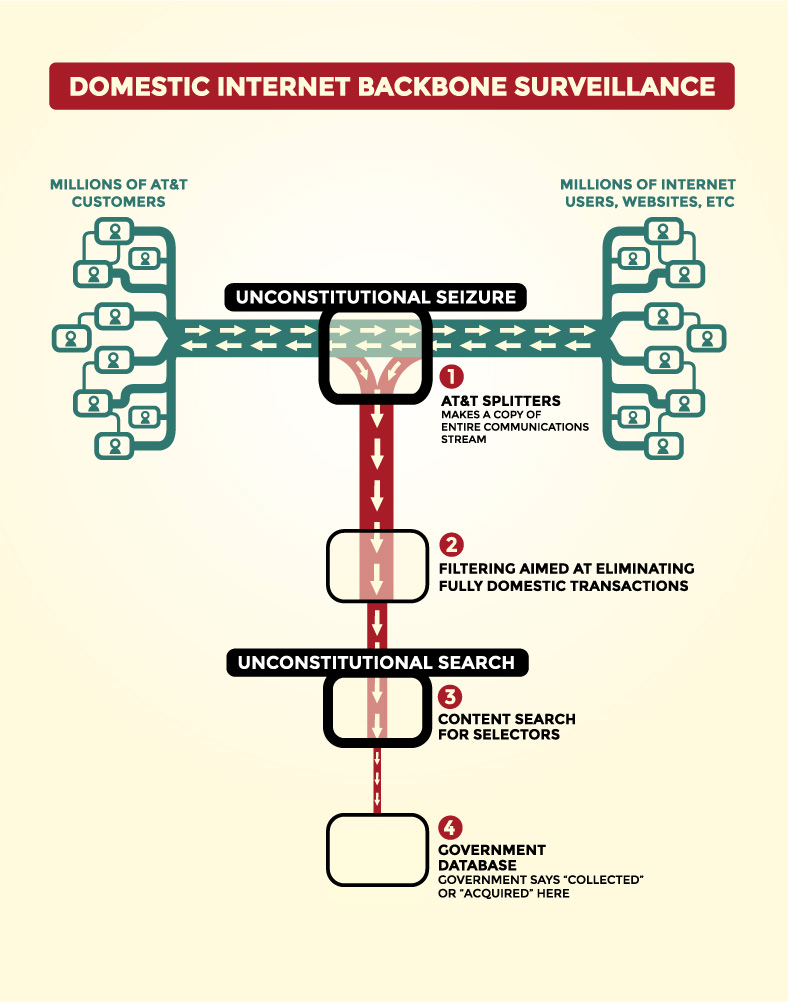
Well, except for all the stuff detailing mass search and seizure[1] of domestic communication. While some people proclaim that the writs of assistance[2] issued by the FISA court make these searches legal, the constitution is still the highest law of the land.

> independent reviews

> [2]...whitehouse.gov

> [3],[4]...pclob.gov

You consider two parts of the executive-branch[3] to be "independent"? Even when one is a "five-member Board is appointed by the President"[4] and the other is "The President’s Review Group"[5]? That's about as far from "independent" as you can get.

[1] https://www.eff.org/files/2014/07/24/backbone-3c-color.jpg ( https://www.eff.org/deeplinks/2014/07/deeper-dive-effs-backb... )

[2] aka the primary reason the 4th Amendment exists. These non-specific, general warrants are the very thing the 4th Amendment forbids.

[3] "The PCLOB is an independent agency within the executive branch" ( http://www.pclob.gov/about-us.html )

[4] ibid

[5] see: your link #2, http://www.whitehouse.gov/sites/default/files/docs/2013-12-1...

With regards to your first link, I think the EFF has a losing argument with their recent addition to the Jewel v. NSA case. Their argument, by analogy: $ seq 1 3 | grep -v 1 | grep 2 > collected.txt The government argues that only "2" is collected, and furthermore there's an extra step to ensure that "1" is never collected. Even though they are never seen by a human/entered into a database/saved to disk/transmitted elsewhere, the EFF argues that 1 and 3 are also collected because they exist in memory for a millisecond before grep discards them. Without coming out and saying it explicitly, they're essentially arguing that it's illegal for the NSA to collect targeted information from any network connection unless they can show that the connection is only used by the target. I don't think the court will ultimately agree with them. If you're interested, you can read the EFF's argument[1] and the corresponding opposition argument[2].

With regards to the independence of the President's Review Group and the PCLOB: all of the members of the PCLOB are confirmed by Congress, so the President can't just staff them with people favorable to his policies; and if you read the PRG report you'll see that it called for quite a few things that directly contradicted the President's statements beforehand (e.g.: moving the phone records to a 3rd party, splitting up NSA and US Cyber Command, limiting NSLs, etc.)

[1] https://s3.amazonaws.com/s3.documentcloud.org/documents/1346...

[2] https://s3.amazonaws.com/s3.documentcloud.org/documents/1346...

> He dumped a huge trove of documents on them unrelated to abuse.

Yes, you already said that. But logic tells me before any conclusion the documents must be analyzed in the first place. To put it simple: Dumping then judging.

There are only two ways around this timeline, a time machine or you already knew the documents before they were published. Since the former can be safely assumed unrealistic, do you see who do you support with your reasoning?