Hacker News new | ask | show | jobs
by bzbarsky 4252 days ago
1) Google never backed Firefox with a billion-dollar-a-year advertising campaign like they have Chrome for several years now.

2) It's not an accident that Google's webservices work best (sometimes only) in Chrome.

They're way past the "disrupt IE" goal. They're into the "tightly couple our web service and Chrome and try to force out other options" goal.

3 comments

I'd like to see a source for the billion-dollar-a-year campaign, that sounds crazy. That's 3 times Mozilla's entire budget, if memory serves me right.
365 days a year for several years Google has had a Chrome banner ad on www.google.com showing to Firefox users. That page is the most lucrative property on the web in terms of eyeballs, so take your most outrageous ad rate you can find and do the math. It's billions per year worth of advertising.
It's also completely free for Google to advertise on their own website.
Yes but that doesn't mean the economic value is non-existent.

Theoretically Google could sell that space. They trade this potential profit to promote their own product, at a loss, of how ever much that space could be sold for. This is like economics 202, opportunity cost.

It's not that simple. It's easy enough to claim that showing a Chrome ad benefits users and helps Google's brand. Showing third party ads hurts Google's brand and overall value.
Only if the 3rd party project is subpar. largely chrome is a 3rd party project from the eyes of search. I'm pretty sure there isn't a massive overlap between search and chrome developers at google.
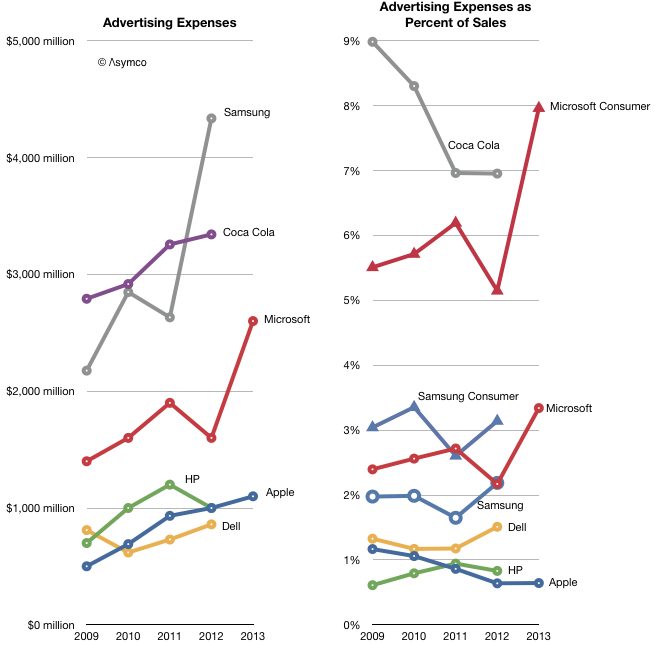
$1 billion is Apple's ad budget as of two years ago and a non-trivial fraction of Coke's overall annual ad budget. I call bs.

(http://www.asymco.com/wp-content/uploads/2013/11/Screen-Shot...)

> I'd like to see a source for the billion-dollar-a-year campaign

I can't find a source for the figure right now, unfortunately. And the whole thing is a guess, since Google doesn't release this information. All it releases is overall sales/marketing spending, which in 2012 was about $6 billion if I understand right (see <http://www.quora.com/How-much-does-Google-spend-on-advertisi...). That includes salaries for the marketing folks, etc, not just direct spending on campaigns.

As I recall, the $1b estimate broke down something like 30% actual spend (primetime TV ads, ads all over the London Tube, etc, etc) and 70% in-kind placement (i.e. "every search you do on Google with another browser shoves an ad for Chrome in your face"). I'll see if I can hunt down where I saw that...

> That's 3 times Mozilla's entire budget

Yep.

I recall seeing a heavy metro ad campaign in Paris. All the slots were used. The campaign cost listed[0] (Q-Massifs) doesn't even have a regular price. Extrapolating from the regular campaigns, it cost Google beyond a million euros a week, and the campaign lasted more than that, if I recall correctly. And that is just one city, one campaign.

As for Google Search ads, let's take the number of search requests[1], an example CPC they give[2], an example CTR they give[3], the StatCounter portion of non-Chrome users[4], we get 1216373500000 * (1-0.3) * $0.10 * 0.005.

That's $425,730,725 for a one-year campaign in 2012. Given the prominence of this ad (and its unintentional scare value), the CTR is probably off, so that's a very conservative figure.

If that is indeed 70% of the whole campaign cost, the total is $608,186,750 per year.

[0]: http://www.mediatransports.com/wp-content/uploads/2013/12/Qu...

[1]: http://www.internetlivestats.com/google-search-statistics/

[2]: https://support.google.com/adwords/answer/2375420?hl=en

[3]: https://support.google.com/adwords/answer/2615875?hl=en

[4]: http://en.wikipedia.org/wiki/Usage_share_of_web_browsers#Sum...

The "billion dollar" number is speculation, since the Google front page ad space that Chrome got isn't for sale to anyone else. "Priceless" would possibly be more accurate.
What do you think it would cost to put an Ad on the google homepage?
You are correct. If you try to go to inbox.google.com, it says "Sorry, this only works in Chrome."
> It's not an accident that Google's webservices work best (sometimes only) in Chrome.

A web service that only works in Chrome? Maybe you mean web application (web service would be really odd to work in just one browser). Do you have a source for this regardless? I hadn't heard of this.

I mean the services Google provides to users in the form of web applications, yes. The terminology is sucky.

As for concrete examples, Hangouts only works in non-Chrome browsers (including ones with WebRTC support) if you install a Google-provided binary blob. Which you may not be able to do.

Gmail only supports offline access in Chrome (see https://support.google.com/mail/answer/6557?hl=en the "two exceptions" bit). Whether not having offline access to your mail counts as mail "not working" is up to you, I guess; for me it counts as "not working".

Various Google properties use UA sniffing to deliver degraded content to non-Chrome browsers. https://bugzilla.mozilla.org/show_bug.cgi?id=921532#c9 is an example.

https://bugzilla.mozilla.org/show_bug.cgi?id=973754 is an example where as far as I can tell they built the feature around non-standard Chrome-only functionality even though Firefox supports the standard version.

Google news menus don't work in standards-compliant browsers because they rely on a Chrome/WebKit bug. See https://bugzilla.mozilla.org/show_bug.cgi?id=1083932

Google patent search uses UA sniffing and locks out various browsers as a result. See https://bugzilla.mozilla.org/show_bug.cgi?id=1013702

Google Translate will fail to work in Firefox unless you have Flash installed (good luck on Mobile).... or spoof the Chrome UA string. See https://bugzilla.mozilla.org/show_bug.cgi?id=976013

They do fix these bugs sometimes (the UA sniffing ones, where they just got the sniffing flat out wrong, tend to get fixed once someone diagnoses them). And sometimes not.

> Hangouts only works in non-Chrome browsers (including ones with WebRTC support) if you install a Google-provided binary blob.

The Google Hangouts website uses some carefully-constructed language to imply that people must download Chrome to use Hangouts, even though a Hangouts NPAPI plugin supposedly exists:

https://www.google.com/hangouts/

  The Hangouts Chrome extension won't work in your current browser. You'll need to
  download Chrome before installing the Hangouts Chrome extension. Do you want to
  download Chrome now?
Google+ photo editing is another Google feature that requires Chrome. I believe it uses NaCL to optimize some photo effects.
The NPAPI plugin is the binary blob bz was referring to.
The NPAPI plugin is one binary blob. The Chrome extension is another. The Google Hangouts home page only offers the Chrome extension. To actually find the NPAPI installer, you have to know it exists and search for it.
Google Inbox is also Chrome-only. It UA sniffs and tells you to download Chrome if you aren't using it.
It's not nefarious on the part of the _developers_. They were given concrete goals. I wasn't privy to those, but it sure looks like those were: Must work in Chrome (Android) and on iOS, working elsewhere is nice to have but optional. They were also given deadlines. Then they proceeded, with no nefariousness, to deliver a product that works on Chrome and iOS and not elsewhere. I'm sure if they had more time or more people they would have made it work elsewhere too.

Then you ask yourself why the goals were set the way they were. Obvious guess at an answer: because they only want to target "mobile" and Android+iOS cover most "mobile" clients. Had iOS had less market share, I will bet the goal would have been Android-only (modulo advice by lawyers based on antitrust worries in that situation, of course).

No malice anywhere along here, but the end result is not so distinguishable from malice, sadly.

Also iOS support is needed for Chrome on iOS. Since the same engine is used for Safari and Chrome in that platform.

That's the other easy explanation as to "why iOS?"

I would like to see similar arguments given when Microsoft developers follow what their management orders them, but alas.

Note, not picking on you, just Internet in general.

btw, the Inbox team clearly didn't bother to contact Mozilla about the Firefox performance problem because Mozilla fixed the bug within a couple hours of it being reported on HN:

https://bugzilla.mozilla.org/show_bug.cgi?id=1087963

This is a huge problem for the overall strength of the open web and Mozilla unfortunately is no less guilty of this. Many of the tools developed for FxOS are targeted for Gecko and wont run on other rendering engines. More and more it seems the only people actually building libs for the open web are independent developers and small shops. :(
I think there's a difference between ChromeBook or FxOS apps, which may need functionality and more importantly permissions that are not available on the web yet and creating web apps that use functionality that's supported in multiple browsers but restricting to only one browser.

That said, I agree that more FxOS bits need to end up on standards tracks. The permissions issue really needs solving to make serious progress there.

http://www.otsukare.info/2014/10/28/google-webcompatibility-... has a more complete rundown of the still-extant issues in case you're interested. The whole post is well worth reading, because it does say something important that needs to be said: there are many individuals at Google who believe in things like interoperability, web sites working in all browsers, etc, and strive for that (sometimes against internal opposition). It just happens that Google as an overall organization cares a lot more about its sites working in Chrome than it cares about them working in other browsers, with predictable results.
An example of this is Google Drive's offline mode, which only runs on Chrome (https://support.google.com/drive/answer/2375012?hl=en)
I can't entirely blame them for this one considering the alternative is either using something standard (localStorage) where they're only going to be able to store a really insignificant amount of information or creating something proprietary for multiple web browsers which is difficult to maintain.

If there was a web standard way of caching 5GB of files locally then I would be annoyed.

IndexedDB is supported on all major browsers by now.
Hmm you have a point though I don't know how well Chrome supported it when they first came out with the offline drive support. May be an issue of legacy needing to be upgraded. I also can't find good performance benchmarks for very large blobs in IndexedDB. But yeah I suppose they could use that now.